
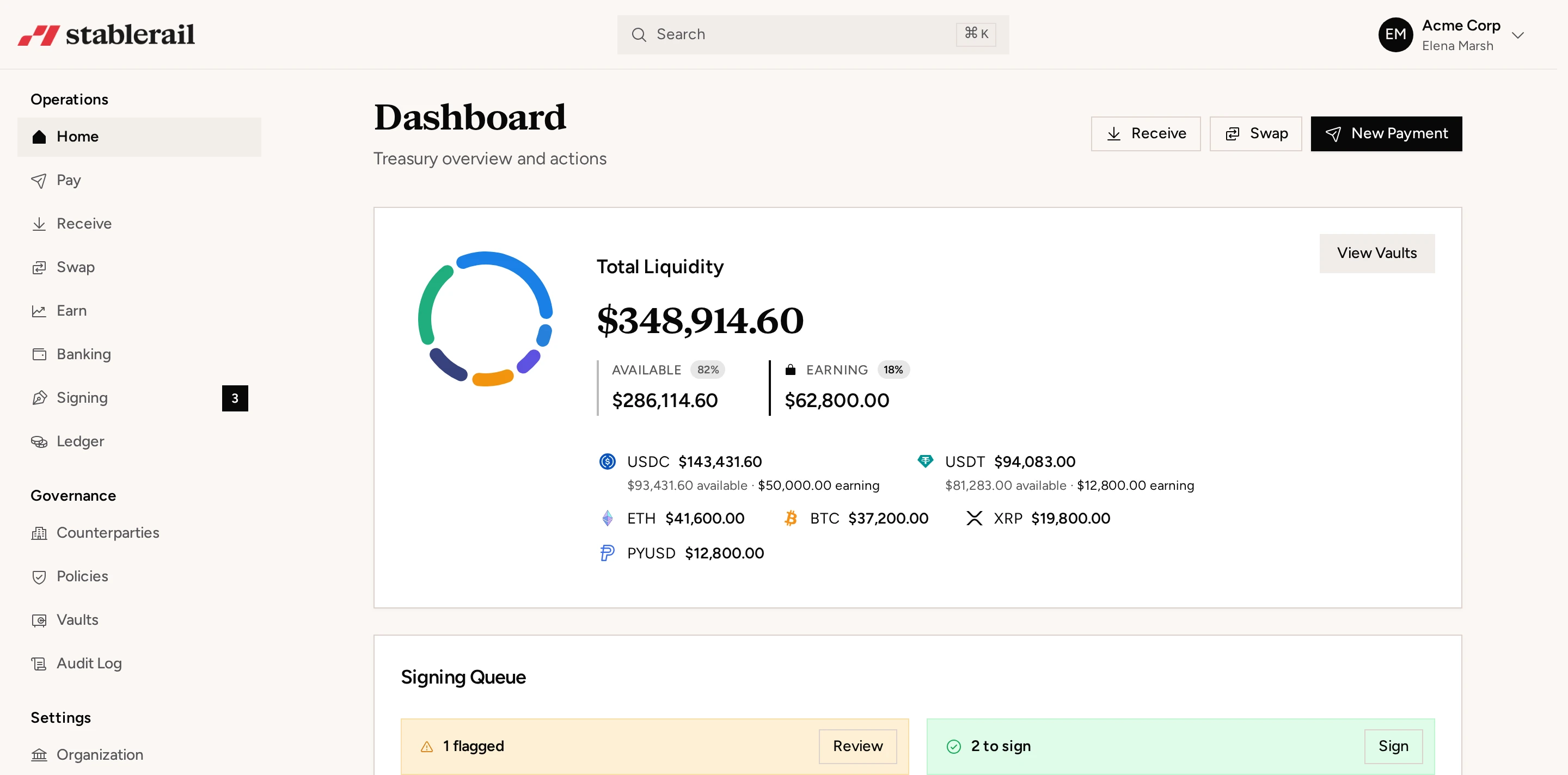
View balances and history
Where to find what you hold, what has moved, and the on-chain record behind each transaction.
Version 1.0 · Last updated
When you would do this
Daily, to see where your money is. At month end, to reconcile. Whenever someone asks what happened to a specific payment.
Where to look
Governance › Vaults shows what you hold. Each vault lists its balance and its positions broken down by chain, and the header totals everything across your vaults.
Operation › Ledger shows what has moved. Every completed transaction, incoming and outgoing, with its amount, counterparty, network and status.
Dashboard gives you the short version of both.
Steps: find a specific transaction
- Go to Operation › Ledger.
- Filter by date, direction, vault, asset or status, or search.
- Open the transaction to see the full detail: timeline, risk result, counterparty, network, and the on-chain transaction reference.
- From the detail view you can download the receipt, the evidence pack, or the invoice if one is attached.
Steps: export your history
- On the Ledger, choose Export.
- Pick PDF, Excel or CSV.
Refreshing balances
Balances update once transactions settle on the network. After a payment or a deposit there is a short delay while the network confirms. Refresh balances on the Vaults page forces a fresh check rather than waiting.
Common problems and what they mean
A deposit has not appeared. Give the network time to confirm, then refresh balances. If it still does not appear and you can see it on a block explorer, use Import transaction on the Ledger: paste the explorer link and Stablerail will fetch it. The dialog tells you whether it will import it, update an existing record, or that the destination is not one of your wallets.
"Not your wallet." The transaction you pasted did not go to an address belonging to your organisation. Check the address on the explorer against your vault addresses.
Your balance looks wrong after a payment. The network fee is deducted from the sending wallet in addition to the amount sent. On some networks that fee comes out of a native coin balance rather than the asset you sent.
Lots of tiny unrecognised balances. These are usually unsolicited dust deposits, sometimes used in address-poisoning attempts. Filter them out with the dust filter, and never copy an address out of your transaction history.
Numbers disagree with your accounting system. Export the ledger and reconcile against the on-chain references, which are the authoritative record of what moved.