
Your corporate treasury
Manage company balances, payments, cards and approvals in one workspace.
Accounts & cards
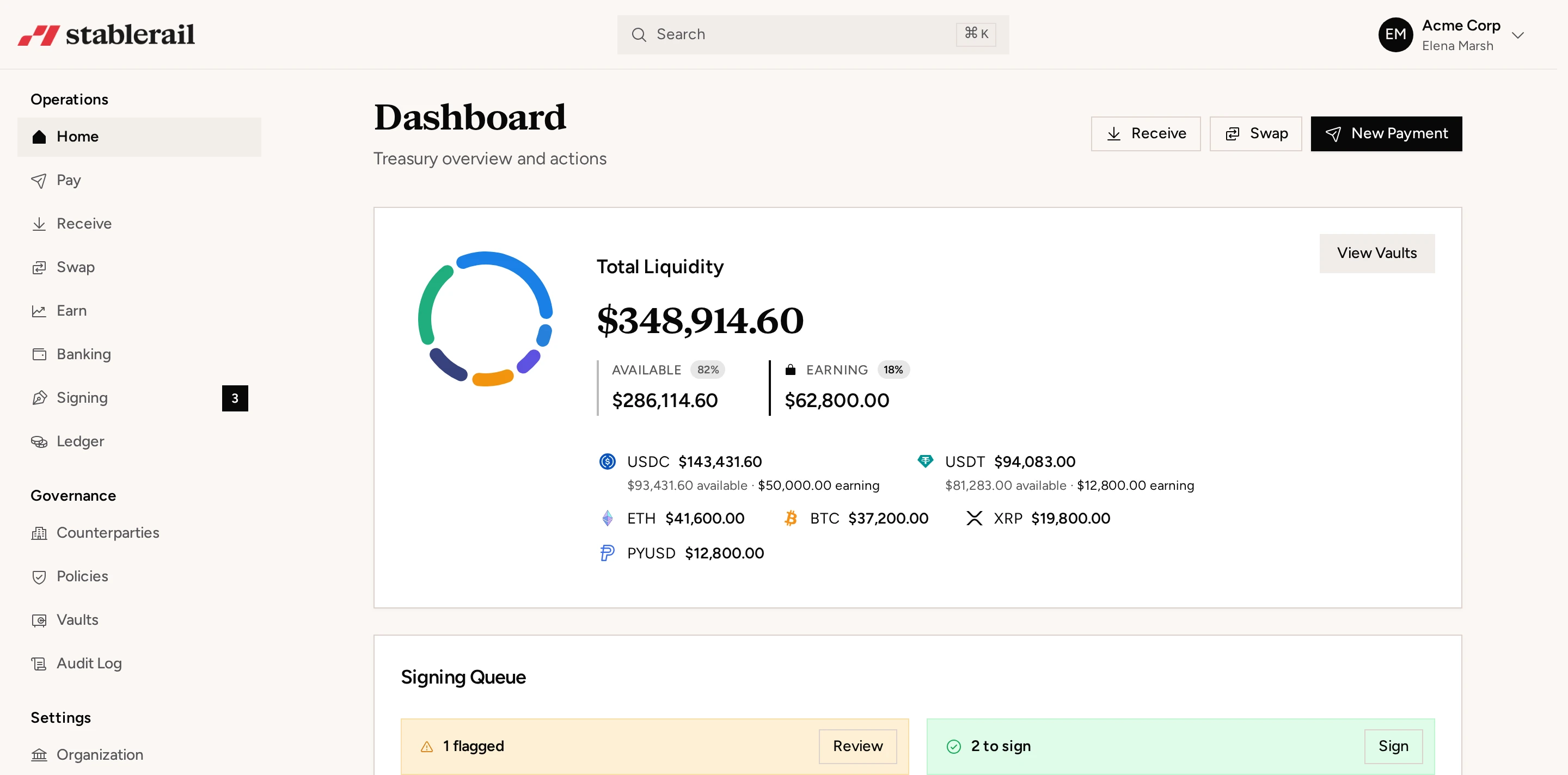
Reference
Stablecoin finance glossary
The vocabulary a finance team needs when its money starts moving in stablecoins — defined without the crypto jargon, in the terms a CFO, controller or auditor would use.
StablecoinUSDTUSDCSelf-custodyMPC (multi-party computation)Quorum signingKey exportOff-rampSanctions screeningTravel ruleTRC-20ERC-20IBANSEPA InstantACHKYB (know your business)Counterparty registerAudit evidenceIdle balance yieldAddress poisoning
- Stablecoin
- A token designed to hold a stable value against a reference currency, usually the US dollar. USDT and USDC are the two dominant dollar stablecoins used for business settlement.
- USDT
- Tether's dollar stablecoin. The deepest liquidity globally, especially in emerging-market corridors and on TRON. Widely used for contractor payouts outside the US and EU.
- USDC
- Circle's dollar stablecoin. Regulated in the US and compliant with the EU's MiCA regime, with monthly attestations. Usually the default when a counterparty or auditor asks about reserve transparency.
- Self-custody
- A model where the company controls the keys to its own funds, rather than a provider holding a balance on its behalf. If the provider disappears, the funds are still reachable.
- MPC (multi-party computation)
- A way of splitting a private key into shares held by different parties so no single party can sign alone. A transaction is signed collaboratively without the full key ever existing in one place.
- Quorum signing
- A rule requiring a minimum number of key shares or approvers to authorise a transaction. It is what makes an approval policy enforceable rather than advisory.
- Key export
- The ability to reconstruct and remove your keys from a provider under a defined quorum. The practical test of whether a product is genuinely self-custodial.
- Off-ramp
- Converting stablecoins into fiat currency and settling to a bank account. The reverse — fiat into stablecoins — is an on-ramp.
- Sanctions screening
- Checking a counterparty address or entity against sanctions and risk lists before money moves. Auditors and banking partners expect evidence that this happened before, not after, the payment.
- Travel rule
- A regulatory requirement that originator and beneficiary information travels with transfers above a threshold between regulated institutions.
- TRC-20
- The token standard on the TRON network. Popular for USDT payouts because fees are low and settlement is fast, especially in Asia, Africa and Latin America.
- ERC-20
- The token standard on Ethereum. The most widely supported network for USDC and USDT, with higher fees than alternatives such as TRON, Base, Polygon or Solana.
- IBAN
- An international bank account number used in Europe and beyond. A dedicated IBAN lets a company receive fiat under its own name and convert into its stablecoin treasury.
- SEPA Instant
- Euro payments that settle in seconds, around the clock, across participating European banks. The euro equivalent of a real-time rail.
- ACH
- The US domestic batch payment network for bank transfers. Cheaper than wires and typically settles in one to two business days.
- KYB (know your business)
- Verification of a company, its ownership and its directors before regulated services such as fiat rails or cards can be enabled.
- Counterparty register
- A maintained list of the vendors, contractors and partners you pay, with their addresses and screening status attached — so payments go to approved destinations rather than pasted strings.
- Audit evidence
- The record proving who approved a payment, what screening was performed, which address it went to and when it settled. Without it, month-end close on stablecoin activity is guesswork.
- Idle balance yield
- Return earned on treasury balances that are not currently deployed. For stablecoin treasuries this typically comes from tokenised money-market style products rather than lending to unknown counterparties.
- Address poisoning
- An attack where a lookalike address is seeded into your transaction history so someone later copies the wrong destination. Counterparty registers and approval checks are the standard defence.
Keep reading
Stablecoin treasury management
Run a USDT/USDC treasury with approvals, limits and clean reporting.
Stablecoin payouts
Batch contractor and vendor payouts with screening and audit evidence.
Stablecoin vendor payments guide
Controls, cost vs wires and accounting treatment for supplier payments.
Internal controls guide
The control matrix and evidence pack auditors ask for.
One account for stablecoin treasury, cards and payouts.
Receive, approve, screen, pay, card-spend and off-ramp — with audit evidence on every transaction.