
Manage company balances, payments, cards and approvals in one workspace.
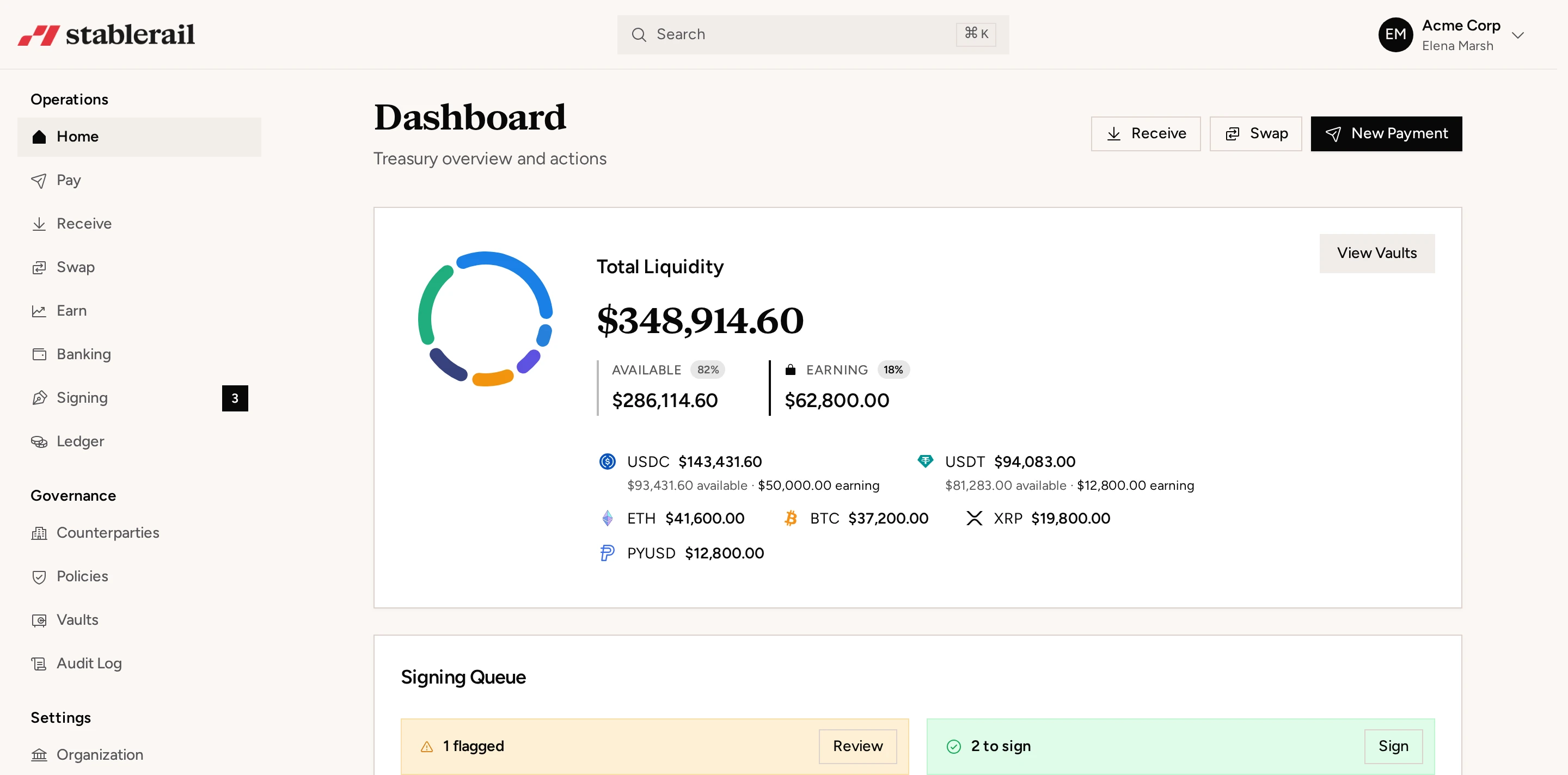
Stablerail as a Safe multisig alternative
A Safe multisig is the default first step for a company holding stablecoins, and it does its job: no single person can move funds. What it does not do is run finance. It only exists on EVM chains, so the Tron USDT your customers actually pay with lives somewhere else. Payouts are pasted addresses, screening is a browser tab, fiat conversion happens on an exchange account, and month-end is a spreadsheet rebuilt from a block explorer.
Side by side
| Dimension | Stablerail | Safe |
|---|---|---|
| What it is | Corporate stablecoin treasury: self-custody, payments, cards, fiat and evidence in one place | A smart-contract multisig wallet you deploy per chain |
| Architecture | MPC key shares held across your team plus Stablerail infrastructure; signing happens off-chain, then one normal transaction is broadcast | An on-chain smart contract. Every signature and every policy change is itself a transaction on that chain |
| Networks | Ethereum, Arbitrum, Base, Optimism, Polygon, BNB Chain, Solana, Tron, Bitcoin, Litecoin, Bitcoin Cash and XRP from one account | EVM chains only. No Tron, no Solana, no Bitcoin, no Litecoin, no Bitcoin Cash, no XRP — those balances need a separate custody solution |
| Tron USDT | Supported natively, and gas is sponsored so you do not have to keep TRX or energy around | Not supported. Safe has no Tron deployment, so the most-used stablecoin rail in emerging markets sits outside your multisig |
| Assets | USDC, USDT, EURC, DAI, PYUSD plus native ETH, BTC, LTC, BCH, XRP, SOL, TRX, BNB and POL | Any token on a supported EVM chain, but nothing outside EVM |
| Custody | Self-custodial MPC with quorum-protected key export; no single party can move funds alone | Self-custodial on-chain multisig; keys are whatever wallet each signer uses (often a browser extension) |
| Deployment per chain | One organisation, one set of wallets, one policy set across all networks | A separate Safe contract deployed, funded and configured on every chain, each with its own address and its own signer set to keep in sync |
| Approvals | Policy engine at organisation level: thresholds by amount, asset, counterparty and role, plus self-approval limits | A single flat N-of-M threshold. Amount-based or counterparty-based rules need third-party modules you install and audit yourself |
| Changing the rules | Admin proposes, signing quorum approves, change is logged with who and when | A contract transaction signed by the current owners, paid in gas, repeated on every chain you run |
| Counterparties | Register with legal name, accepted network, addresses and screening history per record; pay from the record, not from the clipboard | Raw addresses. Naming lives in the browser or a spreadsheet, per signer |
| Sanctions and wallet screening | Sanctions and wallet-risk checks run before release and again on ongoing monitoring; results are stored as evidence against the payment | None. Safe screens nothing. Whatever the owners sign is executed, including a payment to a sanctioned or hacked address |
| Flagged payments | Payment holds, a reviewer resolves it, and the decision plus rationale is recorded; quarantine addresses available | No concept of a hold. There is only signed or not signed |
| Payouts | Batch vendor, contractor and payroll runs from saved counterparties, one approval for the whole run | One multi-send at a time, addresses pasted, and each signer must approve on-chain |
| Cards | Stablecoin-funded corporate cards with per-card limits, freeze and transaction feed | None |
| Fiat rails | SEPA and SEPA Instant, ACH, SWIFT, Faster Payments and virtual IBANs via partners; convert in the same account | None. You need an exchange or a separate PSP in between |
| Invoicing and requests | Payment requests and invoices with reconciliation against incoming payments | None |
| Earn | Idle balances can be put to work from the same account under policy control | None natively; you interact with DeFi protocols yourself |
| Gas | Fees sponsored where supported on Tron, EVM and Solana; treasury does not babysit gas balances | Every signer needs native gas on every chain, and execution costs rise with the number of owners |
| Reporting and close | Audit log of every action, evidence packs and exports built for your auditor | Block explorer plus spreadsheets, reassembled by hand |
| Recovery | Documented account recovery and compromise response with quorum protection | Lose enough owner keys and the funds are unreachable; recovery modules are your responsibility |
| Support | Named account manager and operational support | Community and documentation |
Comparison reflects Stablerail's own assessment of publicly available information about Safe and is not endorsed by Safe.
Choose Stablerail if
- You hold or receive USDT on Tron, or anything on Solana, Bitcoin or XRP, and do not want a second custody stack for it.
- Your multisig has become the bottleneck for payroll and vendor runs.
- You need sanctions and wallet screening evidence attached to payments, not done ad hoc in a browser tab.
- You are moving between stablecoins and fiat and want SEPA, ACH, SWIFT and cards in the same account.
- You are tired of redeploying and re-syncing a Safe on every new chain.
- Month-end close currently means rebuilding history from a block explorer.
Choose Safe if
- You are EVM-only, hold funds long term and rarely make outbound payments.
- Your treasury is DAO or protocol-governed and full on-chain transparency is the point.
- You need to interact directly with DeFi protocols as the signing contract itself.
- You want zero counterparty relationship and are happy to own screening, reporting and recovery yourself.
Frequently asked questions
Is Stablerail a Safe alternative?
For an operating company, yes. Both keep you in self-custody, but a Safe secures funds while Stablerail runs finance on top of them: counterparties, policy-based approvals, screening, batch payouts, cards, fiat rails and audit evidence.
Does Safe support Tron or Solana?
No. Safe is a smart-contract wallet built for EVM chains, so it covers Ethereum and EVM networks like Arbitrum, Base, Optimism, Polygon and BNB Chain. Tron, Solana, Bitcoin, Litecoin, Bitcoin Cash and XRP are outside it. Stablerail supports all twelve of those networks from one account, including Tron USDT with sponsored gas.
Does Safe screen addresses for sanctions or wallet risk?
No. Safe executes whatever the owners sign. Stablerail screens the counterparty and the destination address before release, monitors them afterwards, holds anything that fails and stores the result as evidence you can hand to an auditor.
Is a multisig not already secure enough?
A multisig protects against a single compromised signer. It does not stop a correctly signed payment to a wrong, hacked or sanctioned address, it does not stop a wrong-network send, and it produces no evidence trail an auditor can read. Those are the failures that actually cost money.
Does Stablerail also use multiple signers?
Yes. Keys are split using MPC and a quorum of your team signs. Unlike an on-chain multisig, signing is off-chain, works identically across every supported network, needs no contract deployed per chain, and does not require each signer to hold native gas.
What about approval rules by amount or counterparty?
Safe gives you one N-of-M threshold; anything smarter means installing and auditing third-party modules. Stablerail's policy engine is organisation-level and applies to every vault: thresholds by amount, asset, counterparty and role, with self-approval limits, and any change needs Admin plus the signing quorum.
Can we keep our Safe and use Stablerail as well?
Yes. Many teams keep a cold Safe for long-term EVM reserves and run operating balances — payroll, vendors, cards, Tron and Solana flows, fiat conversion — through Stablerail.
Keep reading
One account for stablecoin treasury, cards and payouts.
Receive, approve, screen, pay, card-spend and off-ramp — with audit evidence on every transaction.