
Manage company balances, payments, cards and approvals in one workspace.
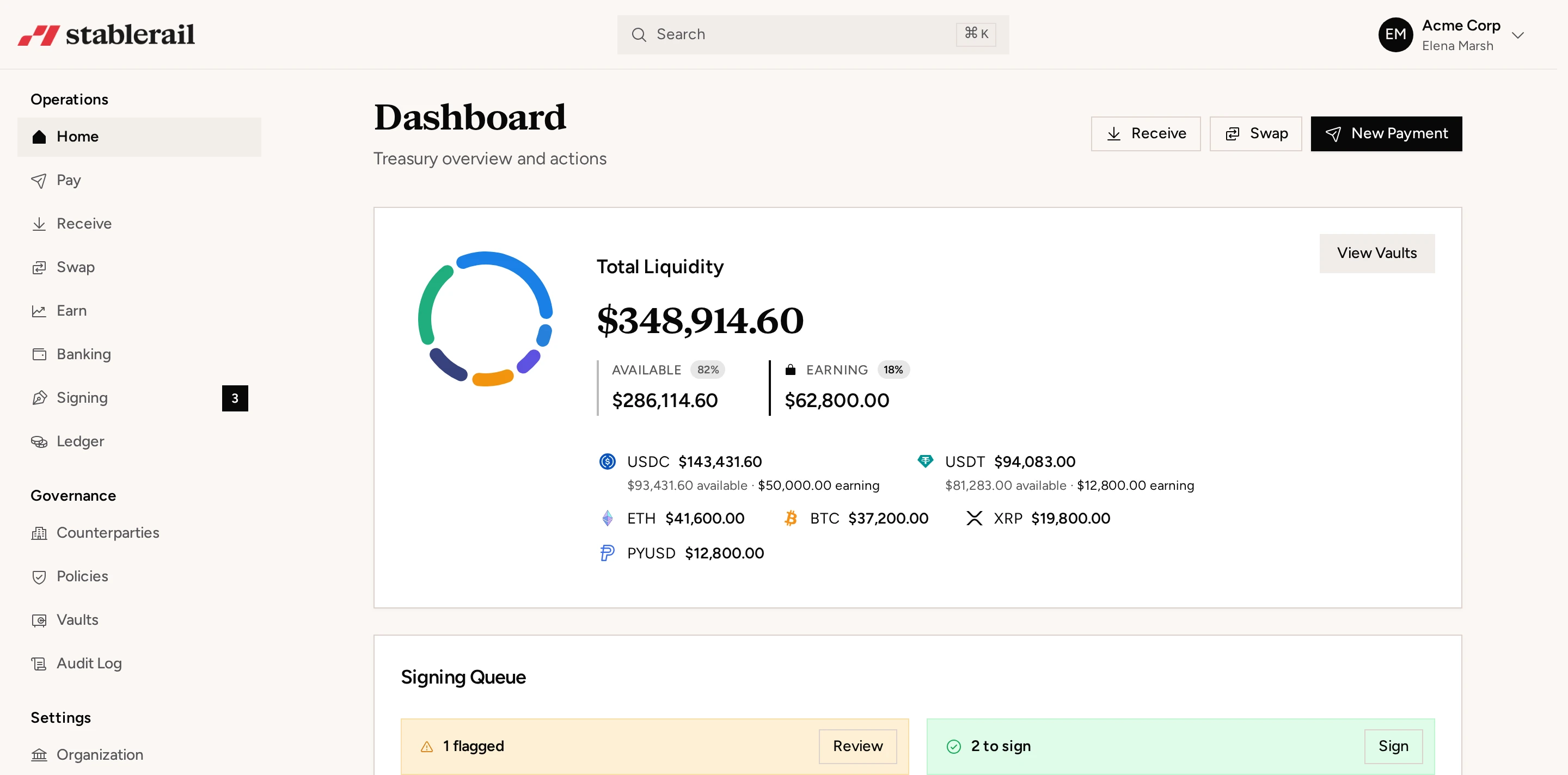
Stablerail as a Utila alternative
Utila gives digital-asset teams institutional MPC wallets and a transaction policy engine, and it does that well. Stablerail starts from a different question: what does a finance team need on top of a stablecoin balance to run payroll, vendor payouts, cards, fiat conversion and month-end close without hiring a crypto-operations function? The two products overlap on custody and diverge on almost everything after the transaction is signed.
Side by side
| Dimension | Stablerail | Utila |
|---|---|---|
| Primary buyer | CFO or finance lead at a 20–500 person operating company | Digital-asset operations, treasury ops and engineering teams |
| Shape of product | A treasury workspace finance teams operate | Wallet infrastructure with a policy engine, console and APIs |
| Custody | Self-custodial MPC with quorum-protected key export; Stablerail cannot sign alone | Self-custodial MPC wallets |
| Networks | Ethereum, Arbitrum, Base, Optimism, Polygon, BNB Chain, Solana, Tron, Bitcoin, Litecoin, Bitcoin Cash and XRP | Broad multi-chain coverage including EVM, Solana and Tron — more chains than Stablerail, aimed at digital-asset operations |
| Assets | USDC, USDT, EURC, DAI, PYUSD plus native ETH, BTC, LTC, BCH, XRP, SOL, TRX, BNB, POL | Wide token coverage across supported chains |
| Approvals | Organisation-level policy engine: thresholds by amount, asset, counterparty and role, plus self-approval limits; policy changes need Admin and the signing quorum | Transaction policies configured per wallet and rule set, aimed at ops administrators |
| Counterparties | Counterparty register with legal name, accepted network, address history and screening stored per record | Address allowlisting and address book |
| Screening | Sanctions and wallet-risk checks before release plus ongoing monitoring, stored as evidence against the payment | Available through third-party analytics integrations you configure |
| Payouts | Batch vendor, contractor and payroll runs from saved counterparties, one approval per run | Bulk transfers via console and API |
| Cards | Stablecoin-funded corporate cards with limits, freeze and transaction feed | Not a card programme |
| Fiat rails | SEPA, SEPA Instant, ACH, SWIFT, Faster Payments and virtual IBANs via regulated partners, in the same account | Off-ramps through connected providers |
| Invoicing | Payment requests, invoices and reconciliation against incoming payments | Not an AR/AP product |
| Earn | Idle balances can be deployed from the same account under policy control | Not the focus |
| Gas | Fees sponsored where supported on Tron, EVM and Solana | Gas managed by your ops team |
| Evidence and close | Audit log of every action, evidence pack per transaction and exports built for auditors | Logs and API data you assemble into reporting |
| Engineering required | None to operate the treasury workspace | Console works out of the box; deeper workflows are an integration project |
| Time to value | Days, self-serve to start after KYB | Onboarding and configuration with the vendor |
Comparison reflects Stablerail's own assessment of publicly available information about Utila and is not endorsed by Utila.
Choose Stablerail if
- Finance owns money movement, not an engineering or crypto-ops team.
- You need fiat rails and corporate cards attached to the same balance, not just wallets.
- You want screening results, approvals and evidence stored against each payment for the auditor.
- You run recurring payroll and vendor batches rather than bespoke on-chain operations.
- You want invoicing and reconciliation in the same place as custody.
Choose Utila if
- You are a digital-asset business — an exchange, fund, market maker or tokenisation platform.
- Your main requirement is programmable wallet infrastructure and a granular policy engine to build on.
- You operate across many chains and asset types well beyond stablecoin treasury.
- You need thousands of wallets or sub-accounts programmatically created.
Frequently asked questions
Is Stablerail a Utila alternative?
For finance teams, yes. Utila is MPC wallet infrastructure aimed at digital-asset operations teams. Stablerail is corporate stablecoin treasury software for companies whose revenue or costs already settle in USDC or USDT and who need approvals, payouts, cards, fiat rails and audit evidence assembled rather than built.
Do both keep the company in self-custody?
Yes. Both use MPC so no single party holds a whole key. Stablerail is self-custodial with quorum-protected key export, meaning the organisation can leave with its keys and Stablerail cannot sign alone.
Which supports more blockchains?
Utila. It targets digital-asset operations and covers a wider chain list. Stablerail deliberately supports the twelve networks a corporate treasury actually uses — Ethereum, Arbitrum, Base, Optimism, Polygon, BNB Chain, Solana, Tron, Bitcoin, Litecoin, Bitcoin Cash and XRP — and puts finance workflow on top of them.
What does Stablerail add that wallet infrastructure does not?
Fiat accounts and rails, corporate cards, batch payroll and vendor runs, invoicing and reconciliation, a counterparty register with screening attached, and an evidence pack per transaction, operated from the same treasury workspace rather than integrated separately.
Who should still choose Utila?
Teams whose core business is digital assets and who want granular programmable wallet infrastructure, very broad chain coverage and an engineering or ops team to build workflows on top of it.
Keep reading
Corporate stablecoin treasury, cards and payouts.
Receive, approve, screen, pay, card-spend and off-ramp — with audit evidence on every transaction.