
Manage company balances, payments, cards and approvals in one workspace.
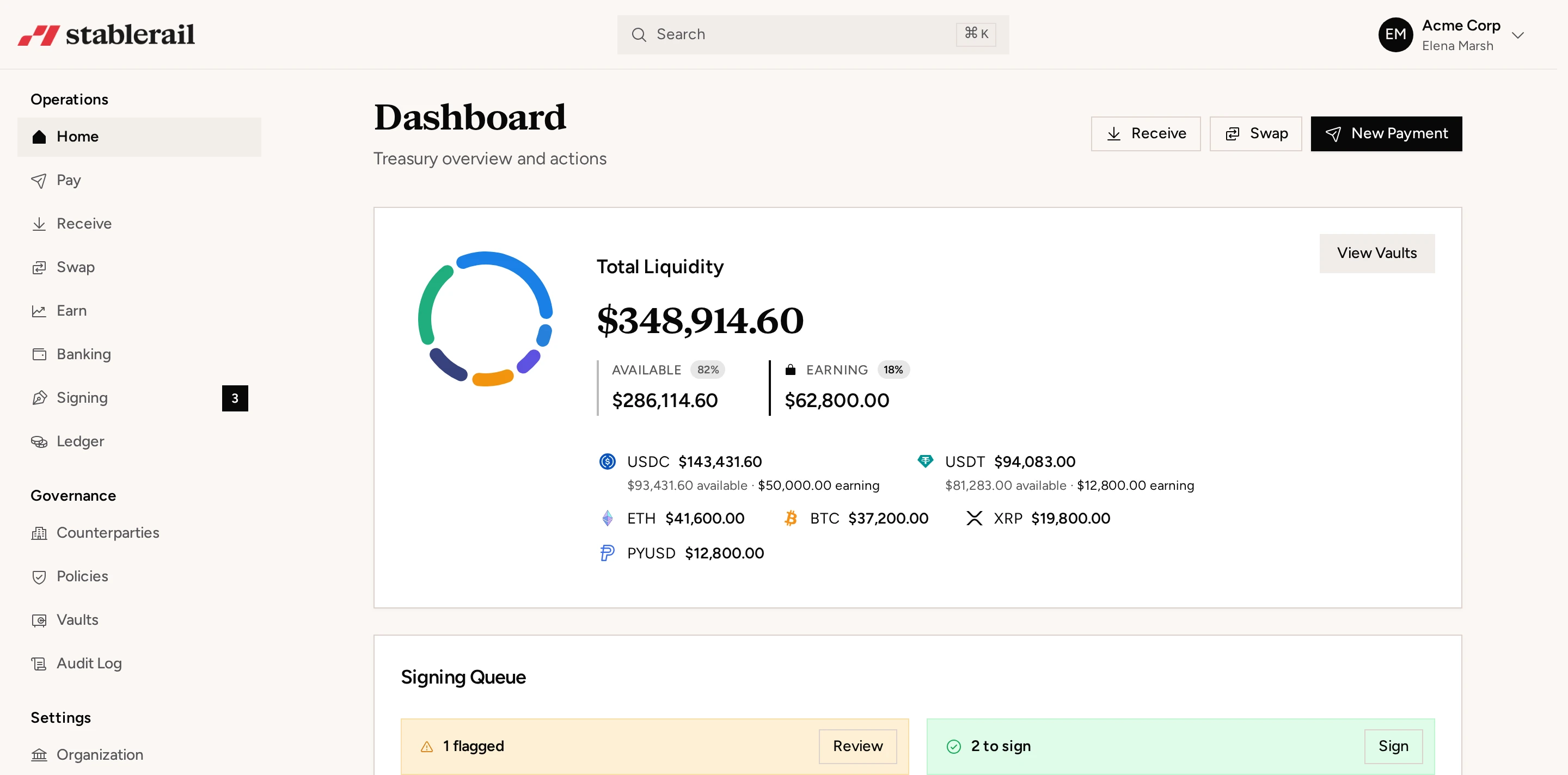
Stablecoin treasury management
Most stablecoin treasuries are run on a hardware wallet, a spreadsheet and a group chat. That works until the first mistaken payment, the first auditor question, or the first hire who needs limited access. Stablerail replaces it with one controlled account.
What stablecoin treasury management means
Treasury management for a stablecoin-native business covers four jobs: knowing what you hold and where, controlling who can move it, moving it safely to counterparties and fiat rails, and being able to prove afterwards what happened and why. Traditional treasury tooling assumes bank accounts; on-chain tooling assumes traders. Neither covers the finance-ops workflow in between.
The control set a CFO needs
- Single balance view across chains and stablecoins — USDC, USDT, EURC, DAI, PYUSD on Ethereum, Arbitrum, Base, Polygon, BNB Chain, Optimism, Solana and Tron.
- Segregation of duties: the person who prepares a payment is not the person who releases it.
- Payment policy: limits by amount, asset, counterparty and destination, enforced before signing.
- Counterparty register with sanctions and wallet-risk screening attached to each payee.
- Fiat off-ramp through regulated partners (IBAN, ACH, SEPA, SEPA Instant, Faster Payments, SWIFT) after KYB.
- Corporate cards funded from the same balance, with per-card and per-team limits.
- Exportable audit evidence for every transaction: requester, approver, policy, screening result, on-chain hash.
How Stablerail runs it
Funds sit in a self-custodial account secured by MPC — the whole private key never exists, and Stablerail cannot sign for you. Each outgoing payment is proposed against policy, screened automatically, reviewed by the approvers you configure, and then signed by humans. AI checks; humans sign.
Month-end stops being an archaeology exercise: balances, counterparties, approvals and screening results are already recorded against each transaction and export in one pass.
Typical setup
- Week 1 — open the account, connect wallets and chains, import counterparties.
- Week 2 — set approval thresholds and payment policy, invite the finance team with role-based access.
- Week 3 — run the first batch payout cycle and reconcile the exported evidence with your ledger.
- Optional — complete KYB to enable IBANs, fiat rails and corporate cards through partners.
Frequently asked questions
What is stablecoin treasury management?
It is running your company's USDT and USDC balance with the same discipline as a fiat treasury: known counterparties, approval thresholds, screening before release, a policy for idle balance, and reporting that reconciles to the ledger at month-end.
Do we keep control of our own funds?
Yes. Stablerail is self-custodial. Keys are split into shares using MPC, Stablerail cannot sign alone, and keys can be exported under a defined quorum.
How do approvals work?
Approval thresholds are enforced at signing time. A payment above the threshold is only signed once the required approvers have signed off, so the policy cannot be bypassed by moving funds directly in a wallet.
Can idle balance earn yield?
Yes. Idle treasury balance can be placed in tokenised money-market style products. Yield is variable, not guaranteed, and comes from third-party protocols rather than from Stablerail.
What evidence do we get for audit?
Every transaction carries the counterparty, screening result, approvers, network, transaction hash and timestamps, exportable as an evidence pack for close and for auditors.
How long does implementation take?
Most teams are live within days and running their first controlled payout cycle within two to three weeks. KYB is required before fiat rails and cards are enabled.
Keep reading
One account for stablecoin treasury, cards and payouts.
Receive, approve, screen, pay, card-spend and off-ramp — with audit evidence on every transaction.