
Manage company balances, payments, cards and approvals in one workspace.
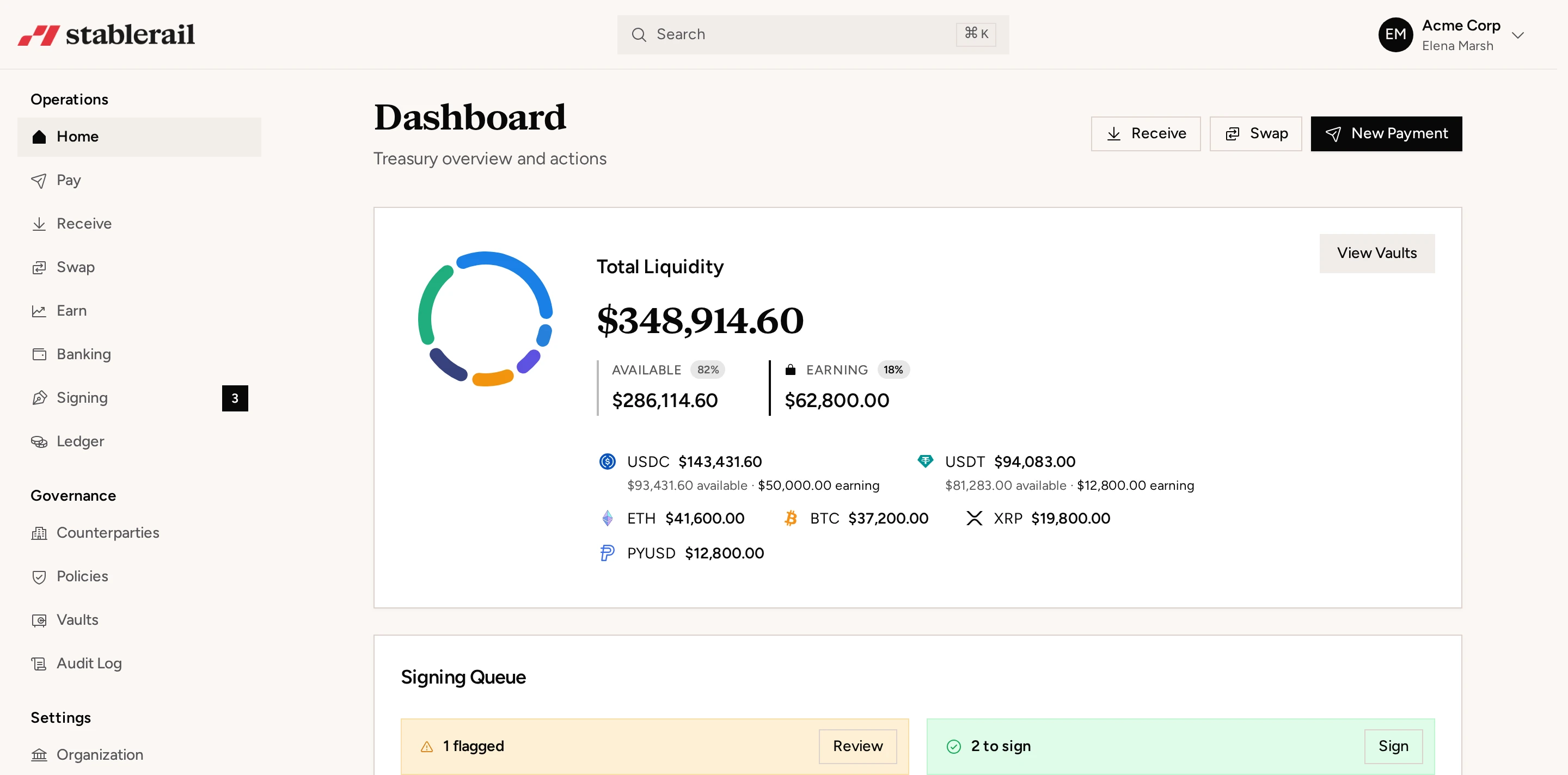

Every way finance teams use Stablerail
Treasury, payroll, supplier payouts, card spend, euro and dollar rails, screening, audit evidence and agent wallets — all on one balance with one approval policy.
Treasury & custody
Holding the balance without a shared exchange login or a personal wallet.
Operating treasury in USDC / USDT
Keep the company float on-chain in self-custody, with named signers, spend limits and a balance the CFO can reconcile daily.
Learn more →Moving off an exchange account
Replace a shared exchange login and 2FA held by one founder with MPC key shares your company controls and can export.
Learn more →Reserve vs operating split
Separate a long-hold reserve from the working float, each with its own approval quorum and withdrawal rules.
Learn more →Idle balance earning yield
Put part of the float to work while keeping withdrawal controls, rate history and reporting for the auditor.
Learn more →Multi-entity groups
One policy across parent and subsidiaries, separate ledgers per entity and consolidated group reporting.
Learn more →Intercompany transfers
Move balance between entities with a documented reason, approver and export line rather than an unlabelled transfer.
Learn more →Getting paid
Revenue arriving in stablecoin or fiat, reconciled the same way.
Invoice customers in stablecoin
Send a payment link or invoice in USDC/USDT that reconciles itself against the invoice when it lands.
Learn more →USD collections by ACH, Fedwire and SWIFT
A dedicated USD account in your company name so US customers pay you the way they already pay everyone else.
Learn more →EUR collections by SEPA
A dedicated euro IBAN in your name for European customers, with SEPA Instant where the receiving bank supports it.
Learn more →Marketplace and platform settlement
Collect from buyers and settle to sellers on a schedule, with screening on every counterparty before funds leave.
Learn more →Converting revenue on receipt
Turn incoming fiat into stablecoin (or the reverse) with the rate, fee and authoriser recorded on the transaction.
Learn more →Paying people and suppliers
Recurring outflows that need review before they leave.
Global contractor payroll
Pay contractors in stablecoin or local currency on a repeatable cycle, batched and approved once.
Learn more →Vendor and supplier payments
Pay suppliers on local rails in 30+ currencies with the corridor fee visible before you approve.
Learn more →Batch payouts to hundreds of recipients
Upload a file, screen the whole batch, approve once and get a per-recipient result you can export.
Learn more →Affiliate, creator and partner payouts
High-volume small payments with counterparty records instead of a spreadsheet of wallet addresses.
Learn more →Refunds and chargebacks
Return funds to the original payer with the link back to the original receipt kept intact.
Learn more →Tax, VAT and statutory costs
Pay obligations that must leave a fiat account without splitting your treasury across institutions.
Learn more →Card spend
Company spend that usually escapes the treasury policy.
Ad spend and SaaS subscriptions
Issue a virtual card per vendor with its own limit, so a renewal cannot quietly triple.
Learn more →Travel and expenses
Physical cards for named cardholders with category restrictions and instant freeze.
Learn more →Per-team budgets
Give each team a card with a monthly cap instead of one shared company card nobody can account for.
Learn more →Contractor spend cards
Fund a contractor's card from treasury and close it the day the engagement ends.
Learn more →Compliance & controls
The part that decides whether your bank, auditor and board stay comfortable.
Sanctions and on-chain screening
Screen every recipient address and counterparty before release, with the verdict stored on the payment.
Learn more →Dual and multi-signer approvals
Require two or more named approvers above a threshold, with self-approval limits enforced by the system.
Learn more →Audit evidence at year end
Export a per-transaction record: who requested, who approved, what document was attached and what the screening said.
Learn more →Banking and licence applications
Show a regulator or partner bank a documented control environment rather than a wallet history.
Learn more →Due diligence and fundraising
Give investors and acquirers clean treasury reporting without reconstructing a year of transfers.
Learn more →Automation & agents
Machine-initiated payments that still need a human boundary.
AI agents with spend limits
Give an agent a scoped wallet, a per-transaction cap and human approval above it.
Learn more →API-initiated payouts
Trigger payouts from your own systems while approvals, screening and limits still apply.
Learn more →Scheduled and recurring transfers
Standing payroll, rent and retainer runs that execute on a schedule under the same policy.
Learn more →Accounting sync
Export transactions in the format your bookkeeping stack expects, fiat and on-chain in one file.
Learn more →Who runs money this way
- Crypto-native companies and protocols
- Trading firms and market makers
- Marketplaces and platforms
- Agencies with global contractors
- iGaming and high-risk merchants (where eligible)
- Fintechs and PSPs
- SaaS with international customers
- Web3 foundations and DAO operating entities
- Import / export and commodities
- AI companies running autonomous spend
Frequently asked questions
Do we have to use every part of the account?
No. Most teams start with one flow — treasury, contractor payroll or payouts — and add cards, fiat rails and agent wallets later. It is the same balance and the same approval policy either way.
Can we keep our existing bank?
Yes. Stablerail sits alongside your bank; the USD and EUR accounts exist so the money that must move on fiat rails can, without a second treasury.
Which use case do companies start with most often?
Paying contractors and suppliers in stablecoin with real approvals, because that is the flow most often running through a personal wallet and a chat message.
Is our industry supported?
Eligibility depends on country, entity type and activity. The eligibility checker gives you an answer in about a minute before you speak to anyone.
Keep reading
Tell us how your company money moves. We will show you the treasury workflow.
Receive, approve, screen, pay, card-spend and off-ramp, with audit evidence on every transaction.