

Account details in your name
After KYB you receive USD account and routing details issued to your entity, so payers see your company as beneficiary.
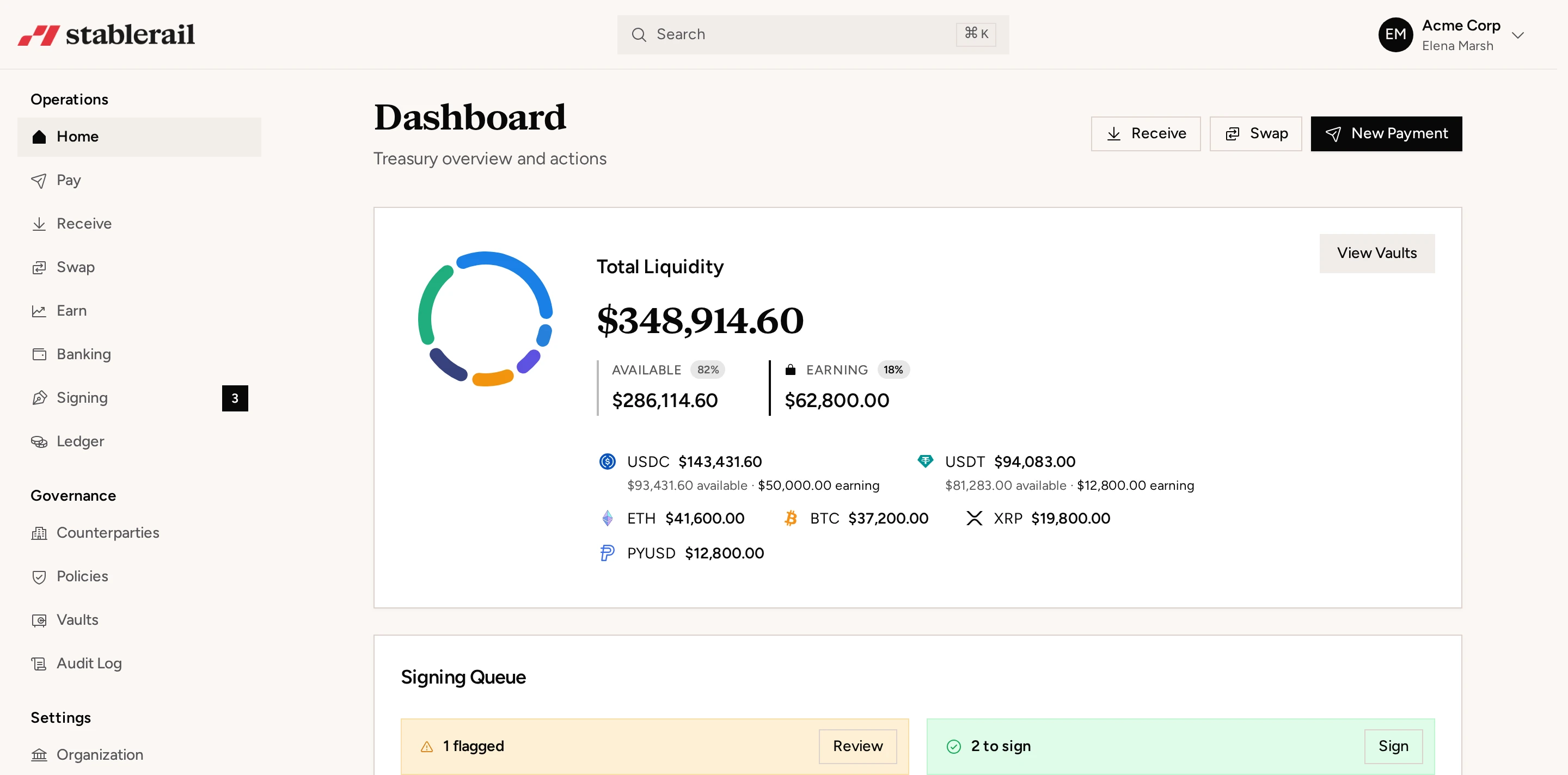
Manage company balances, payments, cards and approvals in one workspace.
Receive ACH and wires from US customers, pay US suppliers, and convert into USDC or USDT without moving money to a second institution.
Your USD account is not a bolt-on. It shares the approvals and audit trail with the rest of your treasury workspace.
After KYB you receive USD account and routing details issued to your entity, so payers see your company as beneficiary.
Domestic ACH for recurring flows, Fedwire for same-day urgency, SWIFT for international dollar payments.
Convert USDC into your USD balance one to one at no cost, with no spread applied to the rate, then pay out over ACH or wire.
Quorum, self-approval limits and document thresholds apply to USD payments exactly as they do on-chain.
ACH in one to two business days, Fedwire same day before cut-off, SWIFT in one to three depending on corridor.
Every inbound and outbound dollar carries a reference, a counterparty record and an exportable evidence line.
KYB on your entity unlocks USD details in your company name.
Invoice US customers and receive by ACH or wire.
Keep dollars as fiat, or convert USDC to USD and back at 0%, one to one.
Send by ACH, Fedwire, SWIFT or on-chain from the same balance.
Most stablecoin businesses lose days moving between a bank and an exchange. Here both legs sit in one account with one set of controls.
Nothing. USDC to USD is 0%, one to one, with no spread and no hidden margin on the rate. Incoming USD is also 0%, and sending dollars to a dollar account over ACH is free. Only cross-currency (FX) payments carry a fee, at your plan rate.
Yes. After KYB you get USD account details issued in your company name, not a shared pooled reference.
ACH for domestic USD, Fedwire for same-day domestic wires, and SWIFT for international USD.
ACH typically settles in one to two business days, Fedwire the same business day when submitted before cut-off, and SWIFT in one to three business days depending on the corridor.
Yes. Incoming USD can be held as fiat or converted into USDC or USDT on receipt, and the conversion rate and fee are recorded on the transaction.
Receive, approve, screen, pay, card-spend and off-ramp — with audit evidence on every transaction.