
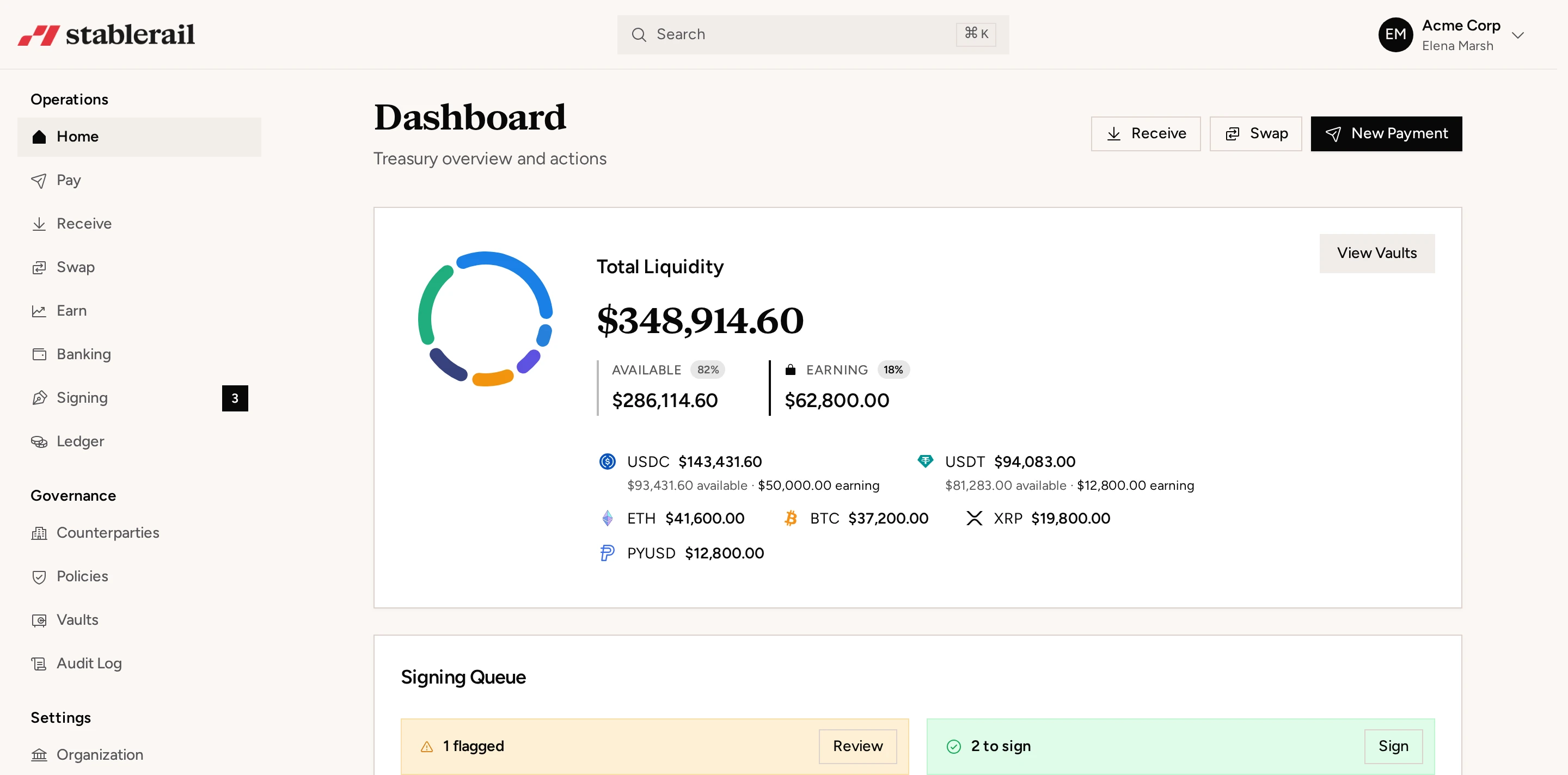
Manage company balances, payments, cards and approvals in one workspace.
Stablerail as a Fireblocks alternative
Fireblocks solved custody and transfer infrastructure for institutions, and for exchanges, funds and custodians it remains the reference implementation. If you are a 20–500 person company whose revenue already settles in USDT or USDC, your problem is not custody plumbing — it is running controlled finance operations on top of it, with an audit trail your accountant can read.
Side by side
| Dimension | Stablerail | Fireblocks |
|---|---|---|
| Primary buyer | CFO or finance lead at a 20–500 person company | Crypto-operations team at an institution |
| Shape of product | A business account you log into and operate | Custody, wallet and transfer infrastructure with a console and APIs |
| Custody | Self-custodial MPC with quorum-protected key export; Stablerail cannot sign alone | MPC custody infrastructure, with self-custody and qualified-custody options depending on contract |
| Networks | Ethereum, Arbitrum, Base, Optimism, Polygon, BNB Chain, Solana, Tron, Bitcoin, Litecoin, Bitcoin Cash and XRP | Very broad chain and token coverage, well beyond stablecoin treasury |
| Approvals | Organisation-level policy engine: thresholds by amount, asset, counterparty and role, self-approval limits and signing quorum, configured by an admin | Transaction Authorisation Policy aimed at ops engineers and administrators |
| Counterparties | Counterparty register with legal name, accepted network, address history and screening per record | Address whitelisting and network connections between institutions |
| Screening | Sanctions and wallet-risk checks before release plus ongoing monitoring, stored as evidence against the payment | Available through integrated analytics and Travel Rule vendors you license and configure |
| Payouts | Batch vendor, contractor and payroll runs from saved counterparties, one approval per run | Transfer APIs and console transactions to build workflows on |
| Cards | Stablecoin-funded corporate cards with limits, freeze and transaction feed | Not a card issuer |
| Fiat rails | SEPA, SEPA Instant, ACH, SWIFT, Faster Payments and virtual IBANs via regulated partners, in the same account | Via separate integrations and banking relationships |
| Invoicing | Payment requests, invoices and reconciliation against incoming payments | Not an AR/AP product |
| Earn | Idle balances can be deployed from the same account under policy control | DeFi and staking access aimed at institutional strategies |
| Gas | Fees sponsored where supported on Tron, EVM and Solana | Managed by your operations team |
| Evidence and close | Audit log of every action, evidence pack per transaction and auditor-ready exports | Rich logs and API data your team assembles into reporting |
| Engineering required | None to operate the account | Console usable directly; real workflows are an integration project |
| Commercials | Subscription by volume tier, sized for mid-market finance teams | Typically an enterprise contract with a substantial annual minimum |
| Time to value | Days after KYB, self-serve to start | Enterprise onboarding and implementation |
Comparison reflects Stablerail's own assessment of publicly available information about Fireblocks and is not endorsed by Fireblocks.
Choose Stablerail if
- Your finance team, not an engineering team, owns money movement.
- You need approvals, screening evidence and clean month-end close more than custody APIs.
- You pay contractors and vendors in stablecoins and need batch payouts with controls.
- You want corporate cards and fiat rails attached to the same balance.
- You do not want an enterprise contract or a crypto-operations hire to get started.
Choose Fireblocks if
- You are an exchange, custodian, fund or institutional trading firm.
- You need deep market, staking, Travel Rule and settlement-network integrations.
- You require very broad chain and token coverage across many desks.
- You have a dedicated crypto-operations team to build workflows on top of infrastructure.
Frequently asked questions
Is Stablerail a Fireblocks alternative?
For mid-market finance teams, yes. Fireblocks is enterprise custody and transfer infrastructure sold to institutions with dedicated crypto-ops teams. Stablerail is an operating account for finance teams that need approvals, counterparty management, screening, payouts, cards, fiat rails and audit evidence out of the box.
What is the difference in custody model?
Both use MPC. Stablerail is self-custodial with quorum-protected key export: the customer can leave with their keys, and Stablerail cannot sign alone. Fireblocks offers several custody arrangements depending on the contract and entity.
Which covers more networks?
Fireblocks, by a wide margin — it is built for institutions trading across many chains and tokens. Stablerail supports the twelve networks a corporate treasury actually uses, including Tron USDT with sponsored gas, and focuses on the finance workflow above them.
Does Fireblocks include cards, invoicing or fiat rails?
No. Corporate cards and invoicing are not part of it, and fiat movement runs through your own banking or partner integrations. Stablerail includes cards, payment requests, and SEPA, SEPA Instant, ACH, SWIFT and Faster Payments through regulated partners.
Who should still choose Fireblocks?
Exchanges, large institutional custodians and firms needing deep trading, staking and market-infrastructure integrations with a dedicated crypto-operations team.
How does pricing compare?
Fireblocks is typically an enterprise contract with a substantial annual minimum. Stablerail is priced for mid-market finance teams with published tiers starting well below enterprise custody pricing.
Keep reading
One account for stablecoin treasury, cards and payouts.
Receive, approve, screen, pay, card-spend and off-ramp — with audit evidence on every transaction.