
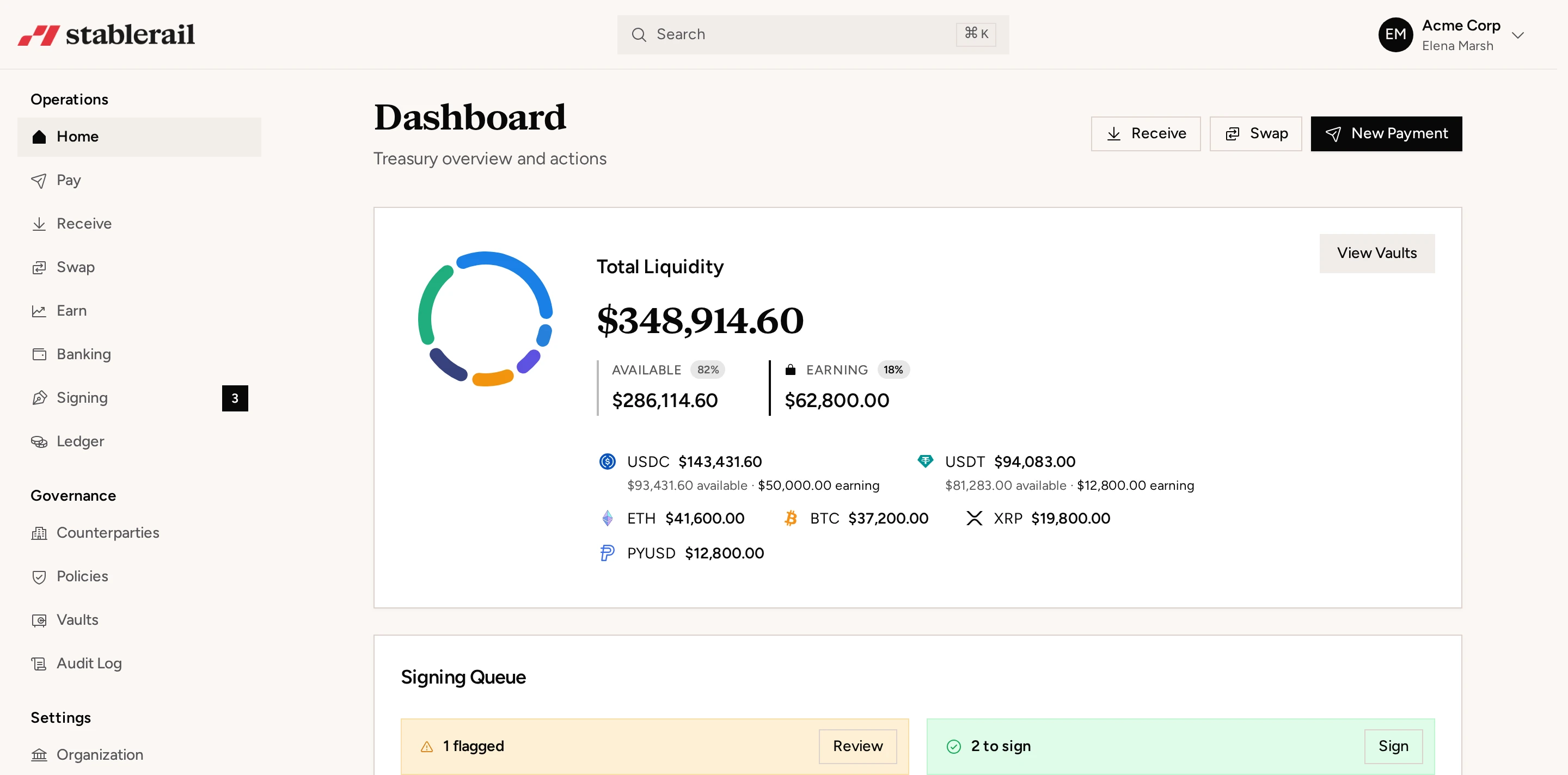
Stablecoin Treasury: Pre-Sign Risk Checks
Pre-sign risk checks stop fraud, sanctions breaches, and liquidity errors in stablecoin treasuries with policy-as-code and MPC.

Stablecoin transactions are fast, irreversible, and operate 24/7. This creates unique risks for corporate treasuries, such as compliance violations, fraud, and liquidity issues. Pre-sign risk checks are the safeguard that ensures every transaction is vetted before execution. These checks enforce policies like spending limits, sanctions compliance, and anomaly detection at the decision-making stage, preventing errors and fraud before they happen.
Key highlights:
Sanctions screening: Blocks payments to blacklisted addresses.
Transaction limits: Ensures spending stays within predefined thresholds.
Anomaly detection: Flags unusual patterns like odd hours or unexpected amounts.
Counterparty risk scoring: Assesses recipient reliability.
Without these checks, treasuries face risks like irreversible fund loss, regulatory penalties, and operational confusion. Tools like Stablerail integrate these controls with automated governance, ensuring secure, compliant, and efficient stablecoin management.
Stablecoin Treasury, Built for Institutions
Risks Without Pre-Sign Checks in Stablecoin Treasuries
Stablecoin treasuries face significant vulnerabilities without pre-sign controls in place. While blockchain technology is celebrated for its speed and transaction finality, these very features can become liabilities in the absence of proper governance. A single unchecked payment has the potential to spiral into financial, legal, and operational chaos - issues that traditional banking systems often mitigate through their inherent safeguards. This makes pre-sign checks indispensable for preventing such cascading problems.
Liquidity Problems and Run Risks
Treasury liquidity is directly at risk when pre-sign controls are absent. Errors like misconfigured batch transfers or unauthorized payments can rapidly deplete funds. Unlike traditional banking systems, where delays and business hours provide some breathing room, stablecoin wallets operate around the clock, with transactions settled instantly. A simple typo - entering $500,000 instead of $5,000 - becomes a catastrophic error that cannot be undone. Similarly, a copy-paste mistake sending funds to the wrong address results in permanent loss.
Blockchain transactions are unforgiving. Once funds leave the treasury, they’re gone. There’s no bank manager to reverse an error or a support team to issue a chargeback. This leaves the treasury exposed to immediate financial strain, while redemption pressures from stakeholders can escalate rapidly.
Fraud and Sanctions Violations
The practice of blind signing is especially hazardous in stablecoin treasury management. Hardware wallets often display technical data that signers might not fully understand, forcing approvals without proper context - akin to signing a blank check in the digital world.
U.S. OFAC standards impose strict liability for sanctions violations, meaning companies are held accountable even for accidental breaches. Post-transaction screening offers no protection - it merely documents the violation after the damage is done. Without real-time sanctions checks before signing, a single payment to a blacklisted address can lead to regulatory fines and significant reputational harm.
Interacting with flagged entities can also result in a complete freeze of the treasury’s assets. This can paralyze operations for weeks or months during investigations, leaving the organization without access to critical operating capital.
Manual Errors and Process Inefficiencies
Relying on informal workflows - like spreadsheets or chat platforms - creates a lack of accountability and transparency. Payment requests managed through Slack, Telegram, or email leave no reliable audit trail, making it impossible to verify who approved what, when, and why. These methods fail to meet regulatory or audit standards.
Manual processes also increase the likelihood of duplicate payments or transfers to outdated vendor addresses. Without automated safeguards, a single signer can execute unauthorized payments without oversight. Behavioral anomalies, such as transfers made on weekends or during odd hours, often go unnoticed because no system is in place to flag unusual activity. This reliance on trust over verification leaves the treasury vulnerable to both unintentional mistakes and deliberate fraud.
Below is a summary of these risks and their potential consequences:
Risk Category
Specific Vulnerability
Potential Outcome
Liquidity
Misconfigured transfers or typos
Treasury depletion, irreversible fund loss
Compliance
Blind signing, no sanctions checks
Regulatory fines, wallet freezes, reputational damage
Operations
Informal approval processes
No audit trail, duplicate payments, insider fraud
Behavioral
Lack of anomaly detection
Unauthorized after-hours or weekend transfers
These risks emphasize the critical need for robust pre-sign controls to safeguard stablecoin treasuries from financial, legal, and operational threats.
What Makes Up Effective Pre-Sign Risk Assessment
Effective pre-sign risk assessment brings together four key elements to shield stablecoin treasuries from financial, legal, and operational risks. Let’s start with the importance of sanctions and taint screening.
Sanctions and Taint Screening
Thorough screening using OFAC lists and blockchain taint analysis helps ensure compliance and uncovers indirect exposures. Under U.S. regulations, violations carry strict liability, making this step essential.
Real-time tools are crucial for spotting attempts to evade controls. For instance, in March 2024, the U.S. OFAC sanctioned Netex24, a Moscow-based fintech accused of facilitating payments to sanctioned entities. Just two months later, the company rebranded as "SafelyChange" to dodge restrictions. However, blockchain intelligence tools identified shared infrastructure, enabling firms to keep sanctions in place.
Taint screening dives deeper than simple address checks. It examines the transaction history of counterparty wallets to detect links to mixers, ransomware payments, or flagged addresses. This proactive approach minimizes the risk of indirect connections to illicit activity, which could result in wallet freezes by issuers like Circle or Tether.
Policy and Transaction Limit Enforcement
Automated policy enforcement replaces manual approval processes with MPC wallets for treasury operations that use machine-readable rules to ensure consistency. These systems automatically block transactions exceeding predefined limits.
For example, policies might specify: "Payments to new addresses over $5,000 require CFO approval" or "Weekend transfers above $10,000 need additional verification." Such rules act as hard limits, preventing unauthorized or accidental transactions.
This automation also addresses the "trust but don’t verify" issue. A single signer can't override controls, and suspicious patterns - like multiple small transfers just below approval thresholds - are flagged for review.
Now, let’s explore how behavioral anomaly detection adds another layer of protection.
Behavioral Anomaly Detection
Anomaly detection identifies irregularities in payment behavior. This includes transactions outside normal business hours, amounts far above historical averages, or abrupt changes in payout frequency.
The system creates a behavioral profile of treasury operations. For instance, if a $50,000 transfer is initiated at 2:00 AM on a Sunday to a first-time recipient, the system flags it for review. This process helps catch both accidental errors and deliberate attempts to exploit moments of reduced oversight.
It also acts as a defense against social engineering attacks. If a vendor suddenly requests payment to a new address, the system halts the transaction, escalates it for review, and recalculates the risk. This prevents phishing schemes that rely on urgency and unexpected changes. Combined with the earlier measures, this layer strengthens the treasury’s overall security.
Counterparty Risk Scoring and Explanations
Risk scoring evaluates every destination address while providing clear, understandable explanations. Traditional hardware wallets often display unreadable hexadecimal strings, leading signers to approve transactions without full clarity.
A risk dossier compiles data from sanctions, taint, and behavioral analyses, delivering a clear PASS, FLAG, or BLOCK decision. Each verdict is backed by evidence - such as timestamps, policy references, and specific risk factors - creating a defensible audit trail.
This layer turns raw technical data into actionable insights. With stablecoin payments expected to handle around $9 trillion globally in 2025 - a massive 87% jump from 2024 - the pressure to get every transaction right is immense. By giving decision-makers clear, evidence-based insights, these measures protect both the treasury and the organization’s reputation, ensuring informed and secure operations.
Policy-as-Code for Transaction Limit Enforcement
Using policy-as-code is a game-changer for pre-sign risk checks in stablecoin treasuries. You can also evaluate stablecoin risks using our specialized calculator. It transforms business rules into machine-executable instructions that kick in before transactions are signed. Instead of relying on manual processes, finance teams can encode their governance requirements directly into the system. Let’s look at some practical examples of how these rules work.
Examples of Enforceable Rules
These rules address common scenarios treasury teams face. For instance, a rule like "New address payments over $5,000 require CFO approval + verification" ensures unauthorized transfers are blocked while routine payments proceed smoothly. Similarly, "Weekend transfers over $10,000 require additional approval" adds an extra layer of security during times when oversight might be limited.
Other rules focus on asset and chain restrictions. For example, "Only allow USDC on Base/Ethereum" ensures that unsupported tokens or networks aren’t mistakenly used. To streamline operations, automated sweeps can also be set up: "Every hour, sweep any amount over $50,000 from location-specific accounts to central treasury" or "Every day at 6:00 PM, rebalance to maintain a minimum $20,000 float." These automated policies run consistently without human input, minimizing errors and enabling operations around the clock, even outside traditional banking hours.
Benefits of Automated Policy Enforcement
These examples highlight how policy-as-code brings structure and efficiency to treasury operations. Automated enforcement offers three major advantages:
Cuts down on manual work: Instead of handling every transaction manually, approvers only step in when a rule is breached. This streamlines workflows and reduces delays.
Ensures consistent compliance: Automated systems apply the same rules every time, eliminating the risk of human error or inconsistent decision-making. Plus, they create a clear audit trail for regulators and auditors.
Blocks control overrides: Policies are non-negotiable once encoded, ensuring that any transaction violating the rules is automatically stopped. Paired with tools like sanctions screening and behavioral detection, this approach delivers a level of security similar to institutional banking controls while maintaining the speed of blockchain settlements.
Human-in-the-Loop Workflow and Audit Trails
Automated checks are a powerful tool, but they can’t replace human judgment. The most effective pre-sign workflows seamlessly combine machine-driven enforcement with human oversight. Machines flag potential risks, while humans make the final call. This approach balances speed with accountability and ensures there’s solid evidence to back decisions when regulators or auditors come knocking.
Intent Creation and Risk Dossier Generation
The process kicks off when someone initiates a transaction intent - whether it’s from an invoice PDF, a payout CSV, or an API call. Once this intent is created, specialized agents immediately compile a Risk Dossier. This dossier evaluates the transaction against sanctions lists and compliance requirements, policy limits, anomaly patterns, and counterparty risks. It provides a clear outcome - PASS, FLAG, or BLOCK - along with plain-English explanations supported by evidence. For example, a flagged transaction might include a note stating it exceeds the $5,000 limit for new addresses, requiring CFO approval.
Approval and Override Processes
After the initial risk assessment, flagged transactions move to human review for a final decision. This step ensures that automated risk detection is validated by human insight before any action is taken. Designated approvers review the flagged details and can choose to approve compliant transactions, override flags with documented reasoning, or reject them entirely. Overrides must include detailed, logged justifications to maintain transparency and avoid improper exceptions. Within Stablerail’s workflow, roles are predefined in the Policy Console. For instance, a rule like "new address payments over $5,000 require CFO approval" automatically routes flagged transactions to the appropriate person. Only after receiving approval can the "Approve & Sign" action be triggered via MPC, ensuring robust governance while preserving self-custody.
Audit Trails for Regulatory Defense
Every step of the process - from intent creation to automated checks, human approvals, and final signing - is meticulously documented in an immutable audit trail. This record demonstrates compliance and shows regulators and auditors that decisions were made thoughtfully and in line with established policies. The audit trail logs everything: policy references, timestamps, human decisions, and override justifications. This level of detail ensures CFO-grade defensibility. For example, under frameworks like the GENIUS Act, stablecoin operators must maintain comprehensive written security and risk control measures. If an auditor questions why a $10,000 weekend transfer was approved, the audit trail provides a complete history: who initiated the request, which checks were performed, what triggered the flag, who approved the override, and when the transaction was signed. This thorough documentation forms the backbone of the pre-sign governance framework.
Stablerail's Implementation of Pre-Sign Controls
Stablerail serves as an advanced control plane, ensuring rigorous pre-sign checks for every transaction. It delivers the precision of bank-level governance while maintaining the speed of on-chain operations. Operating on a "copilot, not autopilot" principle, the platform uses AI-driven agents to verify transaction details, but ultimate authority and control over funds remain firmly in human hands. Here's a closer look at how Stablerail implements these controls.
MPC Wallets and Self-Custody
At the core of Stablerail's system are multi-party computation (MPC) wallets, which distribute signing authority across multiple parties. These wallets operate on major EVM chains, with plans to extend support to Solana. By design, Stablerail never holds unilateral signing authority over funds, ensuring users retain full control. This self-custodial approach aligns with the GENIUS Act's requirements for issuer accountability and control, while enabling instant, around-the-clock settlements via blockchain infrastructure.
The MPC setup is more than just a security feature - it acts as a mandatory checkpoint for pre-sign risk assessments. Transactions cannot proceed without passing these checks, effectively eliminating the possibility of unauthorized fund transfers while maintaining operational efficiency.
Agentic Pre-Sign Verification
Before any transaction is executed, Stablerail deploys specialized agents to conduct thorough pre-sign checks. These agents produce a detailed risk assessment dossier, including a verdict (PASS/FLAG/BLOCK) with clear, evidence-based explanations. The verification process includes:
Sanctions and Taint Screening: Cross-references transactions against global watchlists, such as U.S. OFAC SDN and UK OFSI.
Policy and Limit Enforcement: Ensures compliance with predefined transaction limits and organizational policies.
Behavioral Anomaly Detection: Monitors unusual patterns, such as activity outside normal hours or deviations in transaction amounts.
Counterparty Risk Scoring: Evaluates the risk profile of transaction counterparties.
Each payment is simulated before execution to prevent "blind signing." This simulation flags issues like first-time destinations, unauthorized address changes, and duplicate payments. Importantly, these AI-driven agents operate independently of key management - they can read policies and simulate transactions but cannot hold keys, initiate transfers, or sign transactions. This separation ensures an additional layer of security while setting the stage for automated governance through the Policy Console.
Policy Console for Governance
Building on these risk assessments, Stablerail's Policy Console transforms treasury guidelines into enforceable rules. Finance teams can encode policies such as "New address payments over $5,000 require CFO approval", which are automatically applied to transaction intents. The console enforces separation of duties using configurable t-of-n logic and delivers one of five outcomes for each transaction: Approve, Deny, Hold, Route, or Step-up.
The Policy Console also assigns distinct roles - Requester, Preparer, Approver, Signer, and Reconciler - ensuring a clear division of responsibilities. For stablecoin treasuries operating under the GENIUS Act, which mandates 100% reserve backing, segregated reserves, and monthly disclosures, this policy-as-code system guarantees consistent enforcement of reserve segregation and redemption limits. It also provides the CFO-level audit trail required to meet regulatory standards.
Risk Mitigation Outcomes: With vs. Without Pre-Sign Checks
Stablecoin Treasury Risk Comparison: With vs Without Pre-Sign Checks
Treasuries that use pre-sign risk checks achieve measurable benefits in compliance, operational efficiency, and risk management compared to those that don’t. Without these controls, treasuries face higher risks, including liquidity gaps during market stress and elevated error rates due to manual processes. Additionally, the lack of real-time sanctions screening increases the likelihood of regulatory penalties and exposure to illicit finance activities. These vulnerabilities highlight the importance of automated controls at the transaction level.
On the other hand, pre-sign checks address these issues by embedding compliance directly into the transaction process. Each payment undergoes sanctions screening, taint analysis, and anomaly detection before reaching the blockchain, where transactions become irreversible. This proactive model prevents non-compliant transactions from occurring, shifting away from the traditional reactive approach that identifies violations only after settlement. For stablecoin treasuries operating under the GENIUS Act - which requires full reserve backing and monthly disclosures - automated policies ensure ongoing compliance with reserve segregation and redemption limits.
The operational benefits are equally impressive. Automated enforcement of policies enables instant processing of routine transactions while providing oversight for larger ones, reducing delays and cutting administrative overhead. With settlement available 24/7 instead of being restricted by banking hours, and real-time dashboards offering near-instant visibility into liquidity across networks, these tools significantly enhance payout speed and overall efficiency.
Comparison Table of Checked vs. Unchecked Treasuries
Risk Category
Without Pre-Sign Checks
With Pre-Sign Checks
Reserve Backing Verification
Manual, periodic checks prone to gaps
Continuous, real-time validation against par value
Redemption Risk
High risk during market stress
Mitigated through stress testing and contingency planning
Compliance Violations
Exposed to regulatory penalties and illicit finance risks
Prevented via automated sanctions and taint screening
Operational Errors
Frequent errors in manual approval workflows
Reduced through policy-as-code automation
Audit Readiness
Disjointed records across systems
Centralized audit trail with detailed evidence
Run Risk
Increased due to uncertainty about reserves
Lowered through transparent disclosures and full reserve backing
Counterparty Risk
Passive or nonexistent monitoring
Active scoring and monitoring before transactions
Settlement Speed
Multi-day delays tied to banking hours
Instant settlement, available 24/7
Fraud Detection
Reactive, after funds are lost
Proactive, blocking fraud before execution
Pre-sign systems also create a detailed audit trail by implementing essential controls for stablecoin operations that meet regulatory standards, such as those outlined in the GENIUS Act. Every step - intent creation, checks, flags, overrides, approvals, and signatures - is logged with timestamps and plain-English explanations tied to specific policy clauses. This documentation supports treasuries in defending their decisions to auditors, boards, and regulators. By demonstrating thorough risk management practices, pre-sign systems provide a level of operational transparency and security that manual or unchecked processes simply cannot match.
Conclusion: Securing Stablecoin Treasuries with Pre-Sign Risk Checks
Pre-sign risk checks are the critical safeguard stablecoin treasuries need to function securely within the federal framework established by the GENIUS Act, signed into law on July 18, 2025. Without these measures, treasuries remain exposed to threats like illiquid reserves, fraud, and compliance penalties - risks that are even more pressing due to the lack of public deposit insurance. Ensuring stability hinges on verifying reserve quality before transactions reach blockchain finality.
Unlike traditional post-transaction reviews, which only catch issues after settlement (when funds are often unrecoverable), pre-sign systems take a proactive approach. They enforce full reserve backing, screen for sanctions, and apply policy limits at the decision-making moment - before signing. This ensures compliance with monthly disclosure requirements and prevents operational hiccups like redemption delays. By addressing risks upfront, pre-sign systems not only protect assets but also simplify decision-making for finance teams.
For finance teams handling $1 million to $50 million in annual stablecoin volume, this governance layer fills the gap between custody tools (focused on key management) and business intelligence (focused on vendor history, invoice context, and policy reasoning). Stablerail integrates these controls using MPC-based wallets and agentic verifications, combining custody with business intelligence. Features like sanctions checks, taint analysis, anomaly detection, and counterparty scoring are paired with plain-English explanations tied to specific policy clauses and timestamps, making the system both powerful and user-friendly.
The benefits go beyond regulatory compliance. Automated enforcement speeds up routine transactions and flags larger ones for review, cutting down on manual work while enabling continuous settlement. A comprehensive audit trail - capturing every intent, check, flag, override, approval, and signature - offers CFO-grade evidence to meet the reporting requirements outlined in the GENIUS Act. This robust system supports finance teams in defending their operations to auditors, boards, and regulators with confidence.
FAQs
What’s the difference between pre-sign checks and post-transaction monitoring?
Pre-sign checks take place before a transaction is signed and executed. Their purpose is to evaluate risks in real time, covering areas like sanctions screening, policy enforcement, and anomaly detection. This process helps catch potential errors or compliance issues before they happen.
On the other hand, post-transaction monitoring happens after the transaction is completed. It involves tracing activity, detecting attempts to evade sanctions, and reviewing audit trails to spot any suspicious behavior. While pre-sign checks focus on stopping risks upfront, post-monitoring deals with addressing problems that emerge later.
Which transactions should trigger step-up approvals (like CFO sign-off)?
Transactions that go beyond set risk limits - like payments above $100,000, transfers to unfamiliar accounts, weekend withdrawals, or any atypical activity - should trigger additional approval steps, such as requiring sign-off from the CFO. These safeguards are essential for maintaining compliance and reducing risk in critical situations.
How do you reduce “blind signing” risk while keeping self-custody?
To help minimize the risks of "blind signing" while keeping self-custody intact, you can use pre-signature governance to verify transactions before they are executed. Tools like Stablerail play a key role here by running essential checks such as sanctions screening, enforcing policies, detecting anomalies, and scoring counterparty risks.
Features like policy-as-code governance allow rules - such as approval thresholds - to be automated, streamlining compliance. At the same time, human-in-the-loop approvals and detailed audit trails add a layer of transparency. This combination ensures secure and informed decision-making without giving up control over your assets.
Related Blog Posts
Former CEO of Simple, a self-custodial wallet with $2B+ in transaction volume across 75+ countries.
More about the Stablerail team- Stablecoin treasury managementApprovals, limits, yield and reporting on one balance.
- Stablecoin payoutsBatch contractor and vendor payments with screening.
- USDT vs USDCWhich stablecoin your company should settle in.
- Stablecoin finance glossaryMPC, off-ramp, travel rule and the rest, in plain English.
- Product updatesEverything we ship, month by month.