
Stablecoin Risks: Prevention Before Signing
Stablecoin transfers are difficult to reverse. Learn how finance teams can prevent wrong-address payments, sanctions exposure and unauthorized signing before USDC or USDT moves.
Stablecoin risk is best controlled before a transaction is signed because confirmed blockchain transfers are usually irreversible. Finance teams should verify the asset, network, recipient and amount; screen destination addresses; separate payment creation from approval; require an appropriate signing quorum; and preserve evidence of every decision. These controls reduce wrong-address payments, duplicate transfers, sanctions exposure, compromised-signer risk and insider error.

Stablecoin transactions should be treated as final-payment events, not as ordinary bank transfers that may be recalled. Once a valid transaction is signed, broadcast and confirmed, the sender generally cannot reverse it. The most effective control point is therefore before signing, while the organization can still reject, correct or escalate the payment.
Pre-signature governance means converting a payment request into a verified transaction through defined checks, independent approvals and controlled signing. It protects more than private keys. It protects the business decision represented by the transaction: who is being paid, why, with which stablecoin, on which network and under whose authority.
The main stablecoin risks before funds move
Wrong address, asset or network
A wallet address may be valid yet belong to the wrong recipient. Copy-and-paste errors, address-poisoning attempts, stale beneficiary records and unauthorized changes to vendor instructions can all produce an apparently normal destination. A sender may also choose the wrong token contract or blockchain network, particularly when the same stablecoin symbol appears across several networks.
Finance teams should not approve an address merely because its first and last characters look familiar. The destination should be matched against a controlled beneficiary record, and new or changed instructions should be confirmed through a separate communication channel. The transaction record should identify the token contract and network, not only the ticker symbol.
Duplicate or unsupported payments
Stablecoin payment operations often span invoices, spreadsheets, wallets and accounting systems. Without a common reference, the same obligation can be submitted twice or divided into transfers that evade normal review. Duplicate detection should compare the beneficiary, amount, asset, invoice or payment reference, and relevant time window before signing.
The reviewer should also be able to trace the transfer back to a valid business purpose. An approval message in a chat application is not a substitute for an invoice, contract, redemption request or other source document linked to the transaction.
Sanctions and illicit-finance exposure
Address screening should occur before approval and as close as practical to signing. It may identify direct sanctions matches, exposure to flagged services or other risk indicators requiring investigation. Screening is a point-in-time control: wallet attribution and sanctions data can change, so an old result should not automatically authorize a new payment.
A screening alert is not always proof that a beneficiary is prohibited, and a clear result is not a guarantee that the transaction is safe. The organization needs documented escalation criteria, qualified compliance review and a decision record. Screening should support the risk-based process rather than replace it.
Compromised signers and insider error
A secure hardware device cannot determine whether an invoice is genuine or whether a recipient change was authorized. If one person can create, approve and sign a transfer, a compromised account, fraudulent instruction or simple mistake may become an unrecoverable payment.
Signing authority should be separated from payment preparation, with quorum requirements calibrated to transaction risk. Public incidents involving compromised validator or multisignature environments, including the Ronin and Radiant attacks, also show that multiple signers do not help if their systems, devices or approval processes share the same point of compromise.
Pre-signature controls by risk
| Risk | Control before signing | Evidence to retain | Residual limitation |
|---|---|---|---|
| Wrong beneficiary | Verify the address against an approved beneficiary record; independently confirm new or changed instructions | Beneficiary record, verification result and approver identity | A verified address can later be compromised or reassigned operationally |
| Wrong asset or network | Display and verify the blockchain, token contract, recipient, amount and fee asset | Human-readable transaction summary and raw transaction details | Receiving platforms may support only specific deposit routes |
| Duplicate payment | Match invoice or payment references and check prior transfers to the same beneficiary | Source document, unique payment reference and duplicate-check result | Split or intentionally altered payments may need manual review |
| Sanctions exposure | Screen the destination before send and escalate alerts under a documented process | Timestamped screening result, data source and disposition | Screening data and wallet attribution can change |
| Unauthorized transfer | Separate preparation, approval and signing; require a suitable signing quorum | Requester, approvers, signers and timestamps | Collusion or a shared compromise can defeat weakly designed quorums |
| Malicious contract interaction | Decode or simulate contract calls; inspect token approvals and expected balance changes | Decoded call, simulation output and approval rationale | Simulation cannot eliminate smart-contract or data-quality risk |
How a controlled signing workflow should operate
1. Capture a complete payment intent
The request should state the legal beneficiary, business purpose, amount, stablecoin, blockchain network, destination address, requested execution date and supporting reference. Recording only “send USDC” is insufficient because USDC exists on multiple networks and token representations may differ.
Beneficiary changes should be versioned. A change to an address, entity name or settlement network should trigger re-verification rather than silently replacing the prior record.
2. Validate the transaction details
Before approval, confirm that the destination format is valid for the selected network, the token contract is the intended asset, the sending wallet has sufficient stablecoin and fee-token balances, and the amount matches the obligation. Where funds are going to an exchange or payment provider, confirm its supported network and any required account-routing information.
For smart-contract interactions, signers need more than a hexadecimal payload. The workflow should decode the method, identify the contract, show expected asset movements and highlight permissions such as unlimited token allowances. A simple token transfer and a contract approval create different risks even if both use the same wallet.
3. Screen and investigate
Run sanctions and address screening before funds move. A hit should pause the transaction until it is cleared or rejected under the company’s compliance procedure. For material or unusual payments, teams may also review the beneficiary’s relationship to the business, transaction history and source documentation.
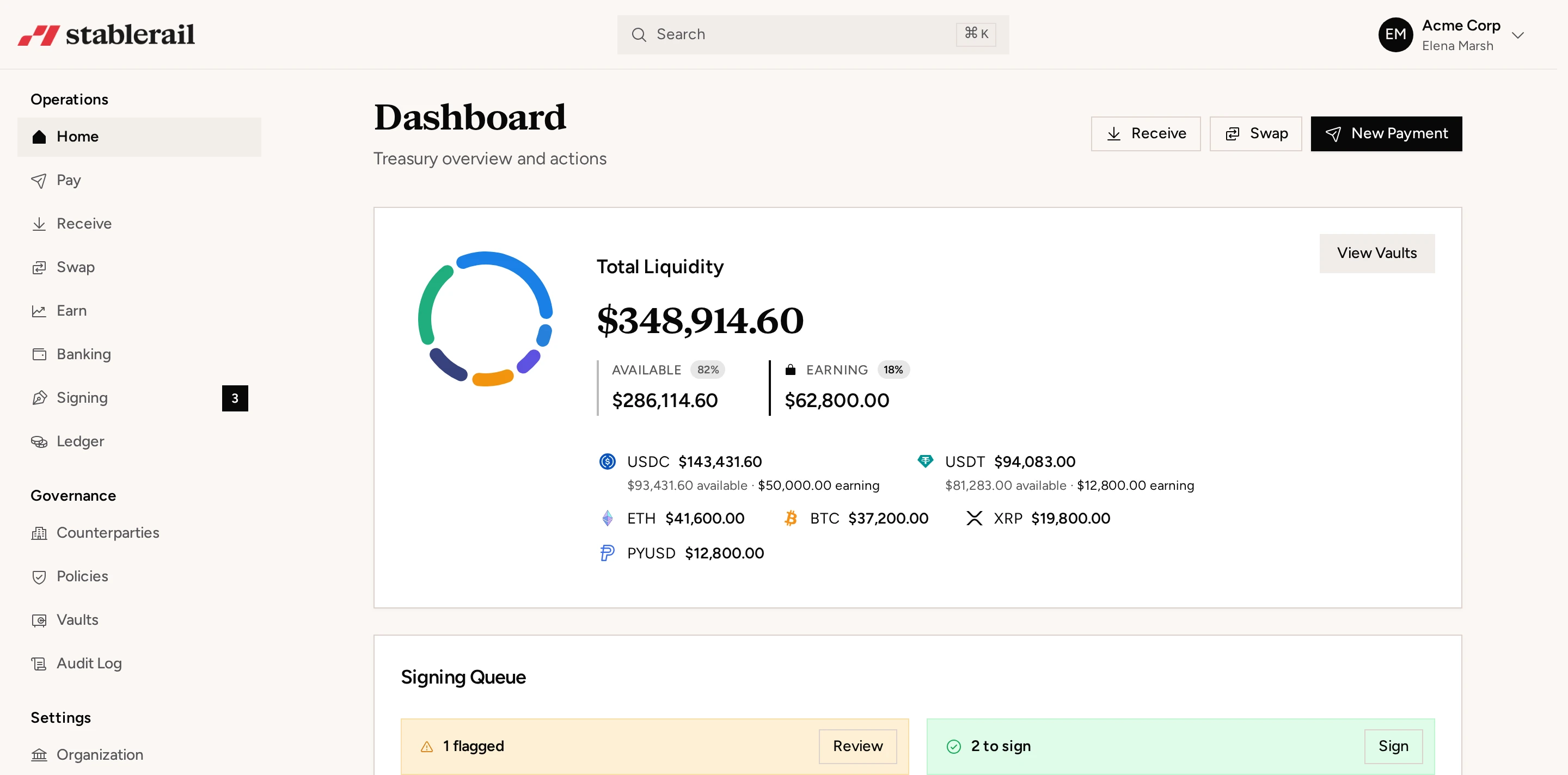
Stablerail can perform sanctions and address screening before send while keeping the result with the approval record. Whatever system is used, the finance team should be able to demonstrate what was checked, when it was checked and who resolved any alert.
4. Apply independent approval and signing
The person entering a payment should not be its only approver. Approval thresholds can vary by amount, beneficiary status, transaction type and urgency. A new destination or exceptional payment should receive more scrutiny than a recurring transfer to a previously verified address.
A signing quorum reduces dependence on one key holder, but quorum design matters. Signers should use independently secured devices and accounts, understand the transaction they are approving and have a defined replacement process. Multisignature wallets enforce approvals on-chain through several keys; MPC-based arrangements distribute signing operations differently. Neither model compensates for poor beneficiary controls or inattentive signers.
5. Broadcast, monitor and reconcile
After final approval, broadcast the exact transaction that was reviewed. Material changes to the amount, destination, asset, network or call data should invalidate prior approvals. Record the transaction hash and confirmation status, then reconcile the transfer to the source obligation and general ledger.
Post-transaction monitoring remains necessary even though prevention is the priority. Teams should detect failed or replaced transactions, unexpected balance changes and payments that remain unreconciled. Stablecoin issuers may sometimes freeze assets in specific circumstances, but finance teams should never treat issuer intervention as a reliable recovery mechanism.
Finance team checklist before signing
- Confirm purpose: Link the payment to an invoice, contract, redemption or approved treasury action.
- Verify the beneficiary: Match the legal recipient and address to a controlled record; independently confirm changes.
- Check the route: Verify the stablecoin, token contract, blockchain network and receiving platform support.
- Screen the address: Review sanctions and risk results, documenting any escalation and disposition.
- Check for duplicates: Compare the amount, beneficiary and payment reference with pending and completed transfers.
- Review transaction effects: Inspect the destination, amount, fees and any contract permissions in readable form.
- Enforce separation: Require independent approval and the designated signing quorum.
- Preserve evidence: Store the request, supporting documents, checks, approvals, signers, timestamps and transaction hash.
What an audit-ready record should contain
A blockchain transaction proves that a wallet moved funds; it does not prove that the company authorized the payment correctly. Audit evidence should connect the on-chain event to the off-chain decision. At minimum, retain the payment request, beneficiary version, source document, screening result, exception handling, approver and signer identities, transaction details, timestamps, transaction hash and reconciliation status.
For teams moving USDC or USDT, a unified workflow can reduce gaps between wallets, approvals and accounting evidence. Stablerail combines approval and signing quorum, pre-send sanctions and address screening, global payouts and fiat off-ramp capabilities, and exportable audit evidence in one business account. The important control outcome is that no transaction reaches signing without a reviewable chain of authorization.
Prevention is stronger than attempted recovery
Stablecoin speed is valuable only when governance can operate at the same pace. Manual chat approvals, shared spreadsheets and isolated signing devices leave critical facts disconnected at the moment of decision. A disciplined pre-signature process creates a pause where errors, suspicious destinations and unauthorized instructions can still be stopped.
The objective is not to eliminate every blockchain, issuer or counterparty risk. It is to ensure that each transfer is intentional, compliant with the organization’s process, independently authorized and supported by evidence before it becomes difficult or impossible to reverse.
Frequently asked questions
What are the biggest risks of using stablecoins for business payments?
The main operational risks are sending to the wrong address or network, duplicate payments, sanctions exposure, compromised signers and unauthorized contract interactions. Businesses must also assess issuer, depegging, liquidity, blockchain and counterparty risks that pre-signature controls cannot fully eliminate.
Can a USDC or USDT transaction be reversed?
A confirmed blockchain transfer generally cannot be reversed by the sender. A stablecoin issuer may be able to freeze certain addresses under its own procedures, but that is not a normal payment-recall process and should not be treated as a recovery guarantee.
What should be checked before signing a stablecoin transaction?
Verify the beneficiary, destination address, stablecoin, token contract, blockchain network, amount and business purpose. Also screen the address, check for duplicates, review contract permissions, obtain independent approval and confirm that the required signing quorum is met.
Does a multisig wallet prevent stablecoin theft?
Multisig reduces reliance on one private key by requiring multiple signatures, but it does not prevent every loss. Signers may approve a fraudulent transaction, several devices may share a compromise, or weak beneficiary verification may direct an otherwise valid transaction to an attacker.
How should stablecoin transactions be documented for an audit?
Retain the payment request, source document, beneficiary record, screening result, approvals, signer identities, timestamps and full transaction details. Add the transaction hash, confirmation status and reconciliation record so auditors can connect the business authorization to the on-chain movement.
Former CEO of Simple, a self-custodial wallet with $2B+ in transaction volume across 75+ countries.
More about the Stablerail team- Stablecoin treasury managementApprovals, limits, yield and reporting on one balance.
- Stablecoin payoutsBatch contractor and vendor payments with screening.
- USDT vs USDCWhich stablecoin your company should settle in.
- Stablecoin finance glossaryMPC, off-ramp, travel rule and the rest, in plain English.
- Product updatesEverything we ship, month by month.