
Cross-Chain Sanctions Screening: Best Practices
Real-time, risk-based cross-chain sanctions screening: automated list updates, fuzzy matching, taint analysis, and pre-sign controls.

Cross-chain sanctions screening is a critical process for treasury teams using stablecoins across multiple blockchains. Unlike traditional financial systems with intermediaries, blockchain transactions are self-executing and irreversible, making real-time compliance checks essential. Here's what you need to know:
Why It Matters: A single payment to a sanctioned entity can result in penalties, reputational damage, and strained banking relationships.
Key Practices:
Conduct real-time screening before signing transactions to avoid compliance gaps.
Use risk-based approaches to prioritize high-risk transactions, such as those involving mixers or sanctioned entities.
Automate sanctions list updates across all chains to prevent outdated data from causing errors.
Implement fail-closed logic to block transactions if compliance systems are unavailable.
Regularly re-screen wallets and trace transaction histories to identify indirect exposure to risks.
Effective sanctions screening combines automated tools, human oversight, and clear policy enforcement. By embedding compliance into pre-signature checks and maintaining robust audit trails, organizations can manage risks while leveraging the benefits of stablecoins.
Cross-Chain Sanctions Screening Framework: 7-Step Compliance Process
$48.9M in Sanctions Evasion - We Traced the Wallets
Use a Risk-Based Approach for Cross-Chain Transactions
Cross-chain transactions carry varying levels of risk. For instance, a small payment to a regulated exchange is far less concerning than a large transfer to an unknown wallet linked to a mixer. By using risk-based screening, treasury teams can focus their compliance resources on the most critical threats, while minimizing unnecessary delays for low-risk payments. This approach is essential for identifying and managing high-risk transactions effectively.
In 2023 alone, illicit cryptocurrency transactions totaled $24.2 billion, with $11.5 billion sent to sanctioned entities. These numbers highlight the importance of automated, tailored risk assessments. A generic approach can either overwhelm systems by flagging too many legitimate transactions or leave gaps that allow real threats to slip through.
Identify High-Risk Transactions
High-risk transactions are flagged based on factors like counterparty exposure, transaction hops, and patterns. Direct exposure to high-risk entities results in an immediate block, while indirect exposure - such as transactions passing through legitimate exchanges - requires further scrutiny.
Exposure categories are key to prioritizing responses. For example:
Critical risk: Transactions involving sanctioned entities (e.g., those on the OFAC SDN list).
High risk: Payments linked to mixers, tumblers, darknet markets, or ransomware wallets.
Medium risk: Transactions through unregulated peer-to-peer exchanges.
Low risk: Transfers involving regulated exchanges.
Interestingly, about 72% of illicit cryptocurrency flows through centralized services, making them critical points for enforcing anti-money laundering (AML) measures.
To manage these risks, create a risk-response matrix that outlines specific actions for each category. For example:
Direct interactions with sanctioned entities trigger an automatic block and require filing a Suspicious Activity Report (SAR).
Indirect exposure, such as through peer-to-peer platforms, may call for additional documentation like proof of funds.
These measures should be implemented before a transaction is signed, ensuring compliance is baked into the decision-making process.
Set Custom Risk Tolerance Levels
Once risks are identified, the next step is to customize your response by setting clear thresholds. For instance, a payment to a mixer might be automatically blocked if it exceeds a certain amount, while a transaction through an unregulated exchange might only require extra due diligence.
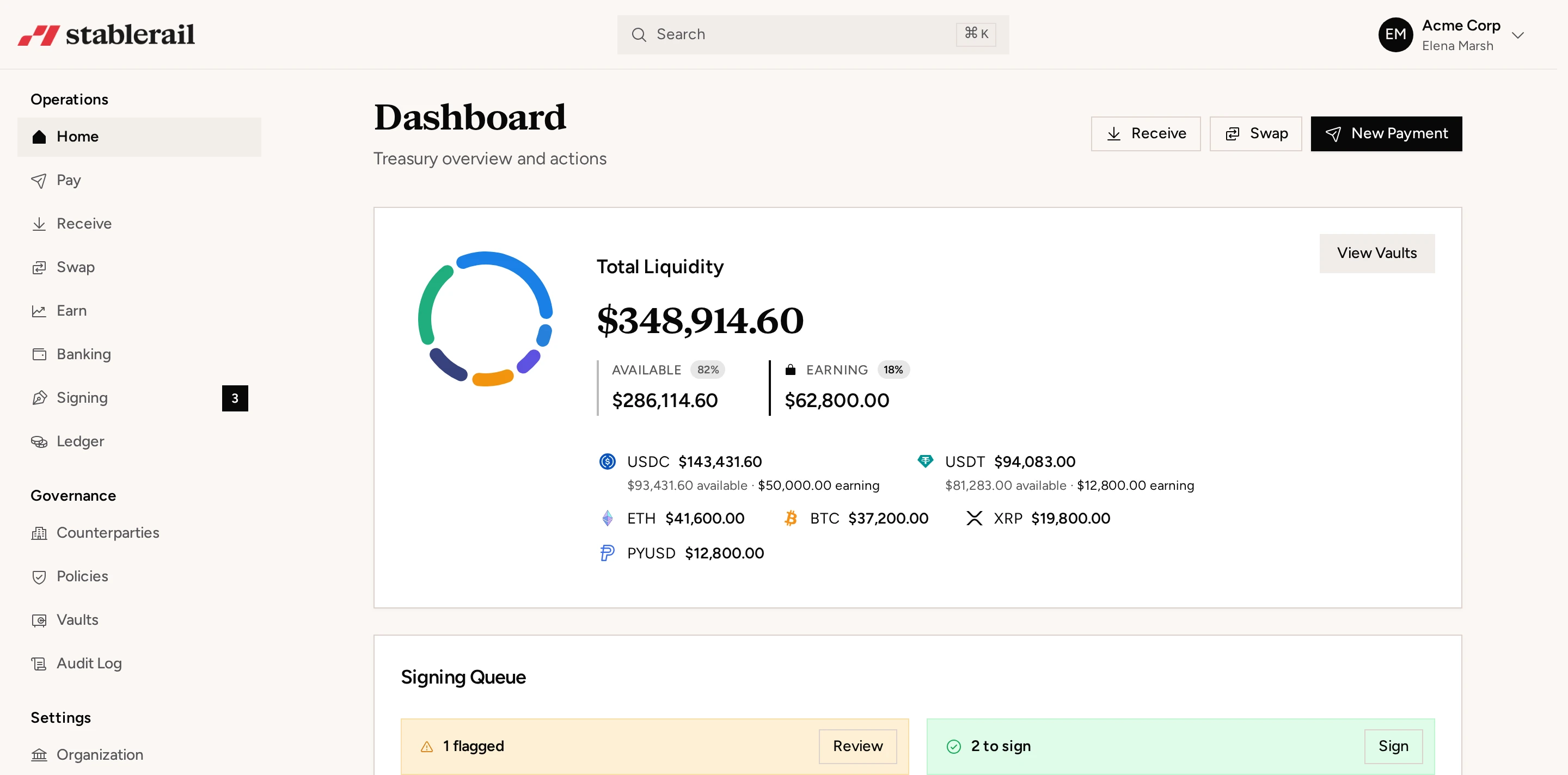
Tools like Stablerail allow treasury teams to enforce these thresholds through automated rules. Examples of configurable policies include:
"Block transactions with direct sanctions exposure."
"Require CFO approval for payments over $10,000 with medium risk."
These rules are applied automatically, ensuring consistent compliance across all transactions.
To stay ahead of evolving risks, schedule quarterly re-screenings of counterparty wallets. This proactive step helps identify newly flagged threats without the need for manual reviews of past transactions. It’s a practical way to keep your compliance efforts aligned with emerging challenges.
Keep Sanctions Lists Current Across All Chains
Sanctions lists are constantly evolving. For example, the OFAC SDN list is updated several times a week, while the EU Consolidated List refreshes daily. If you're screening transactions across Ethereum, Base, and other blockchains, relying on outdated lists can lead to serious consequences. You might miss flagged wallets or mistakenly block legitimate payments.
The challenge goes beyond the frequency of updates. Each authority publishes its lists in different formats: OFAC uses XML, the UN provides JSON, and the EU offers CSV files. Without a unified process, treasury teams often set up MPC wallets to manage assets but juggle multiple data formats with varying update schedules. This creates vulnerabilities, allowing sanctioned entities to move funds between chains while your compliance system struggles to keep up.
In 2023, $11.5 billion was sent to sanctioned entities. Many of these transactions slipped through because compliance systems were relying on outdated or incomplete data. The solution? Automate list updates and standardize how that data is applied across all blockchains your organization operates on.
Use Automated List Updates
Manually downloading and importing spreadsheets can't keep up with the pace of cross-chain transactions. Instead, set up a data ingestion layer that pulls sanctions lists automatically from OFAC, the EU, and the UN via their APIs. This ensures your database reflects the latest updates within seconds rather than days.
Store this data in an optimized local database like PostgreSQL or Redis, and keep it updated with scheduled cron jobs or webhook listeners. By querying a synchronized local database, you avoid delays caused by external API latency.
For regulatory compliance, track each update's list_version and publish_date to maintain a clear audit trail.
Implement fail-closed logic: if your automated screening system or oracle encounters an issue, the system should default to blocking the transaction. This approach ensures there are no compliance gaps during technical outages.
Once your updates are automated, focus on standardizing how the data is applied across all blockchain ecosystems.
Standardize List Integration Across Chains
Different blockchains handle addresses in their own ways - Ethereum uses checksummed formats, while others may rely on lowercase. To ensure consistency, sanctions data needs to be normalized into a unified schema that accounts for variations in names, identifiers, and wallet addresses across all chains.
Use fuzzy matching algorithms like Levenshtein distance to catch errors, name variations, and formatting differences. This reduces the risk of false negatives when a sanctioned wallet appears with slight discrepancies in its format across chains. A standardized approach ensures your screening remains thorough and reliable across all platforms.
For decentralized applications, on-chain enforcement requires a tailored strategy. Oracles like Chainlink can provide verified sanctions data feeds directly to smart contracts. However, many organizations find it more practical to handle screening off-chain via a backend service before the user signs the transaction. This avoids the high gas costs associated with on-chain screening.
Feature / List
OFAC SDN List
EU Consolidated List
Issuing Authority
U.S. Dept. of the Treasury
United Nations
European Union
Update Frequency
Multiple times per week
As needed
Daily
API Access
Free (OFAC API)
Free (UN API)
Free (EU Open Data Portal)
Typical Latency
< 1 sec (via API)
1-2 sec (via API)
< 1 sec (via API)
Source:
Given the rapid rate of updates, use a short cache TTL. For high-risk transactions, bypass the cache entirely and query the live database to ensure the most accurate results.
Use Fuzzy Matching to Reduce False Positives
Relying solely on exact string matching often fails when screening cross-chain transactions because names can appear in various formats across blockchains and sanctions lists. For instance, a sanctioned entity might be listed as "Mohammed Ali" in one source, "Muhammad Aliy" in another, or even "Mohamed Aly" elsewhere. Without fuzzy matching techniques - like the Levenshtein distance algorithm - these variations could go unnoticed, leaving compliance gaps.
However, fuzzy matching isn’t without its own issues. If the algorithm is too sensitive, it may flag legitimate transactions that happen to share similar names or formatting quirks. On the other hand, if it’s too lenient, it risks letting sanctioned entities slip through. Blockchain analytics operate on probabilities rather than certainties. For example, heuristic clustering methods like "common input ownership" can incorrectly link unrelated wallets - such as shared exchange hot wallets or CoinJoin users - with sanctioned addresses.
"Risk scores must be treated as inputs to decisions, not as conclusions. Every high-risk screening result should receive human analyst review before adverse action." - Wallet Screening Guide
Calibration is the solution. Regularly track your false positive rate, ideally on a quarterly basis, and fine-tune the sensitivity of your fuzzy matching algorithm as needed. Striking the right balance between sensitivity and specificity is crucial for effective compliance.
Balance Sensitivity and Specificity
Before setting thresholds for any tool, start with a category-response matrix. This helps prioritize and weight different risk factors. Not all matches are equal in risk. For instance, a direct match to an OFAC SDN (Specially Designated Nationals) entry might require immediate blocking and filing a Suspicious Activity Report (SAR). Meanwhile, a fuzzy match to a common name with indirect exposure - such as being two or more transaction hops away from a sanctioned wallet - might only call for enhanced due diligence.
Assign higher weights to direct exposure (e.g., one transaction hop) since it often demands immediate action. In contrast, indirect exposure through regulated channels, even with a high risk score, may pose a lower threat. Instead of acting on a single risk score, analyze the specific exposure type - whether it’s linked to sanctions, mixers, darknet markets, or P2P exchanges - to decide on the appropriate response.
Keep an eye on your false positive rate. If your team is spending too much time manually clearing flagged transactions, the algorithm might be overly sensitive. On the other hand, if sanctioned transactions are being missed, the algorithm might need tightening. Running backtests on historical transaction data can help fine-tune this balance.
Tune Algorithms for Cross-Chain Screening
Screening transactions across multiple blockchains introduces additional challenges, as each blockchain formats addresses differently. For example, Ethereum uses checksummed addresses, while others may rely on lowercase formatting. To handle this, your fuzzy matching algorithm should normalize all data into a consistent internal structure before screening. This includes parsing names, aliases, and wallet addresses from sources like OFAC, EU, and UN lists, which are often distributed in various formats like XML, JSON, or CSV.
Develop a multi-factor scoring system that weighs matches based on confidence levels, geographic context, and the specific risk type of the list entry. For example, a high-confidence match to an SDN entry should be weighted more heavily than a low-confidence phonetic match to a Politically Exposed Person (PEP) list.
To reduce unnecessary costs and avoid broadcasting non-compliant transactions to the blockchain, run off-chain pre-sign simulations for fuzzy matching and risk scoring. This approach lowers gas fees while ensuring compliance. Additionally, since analytics providers frequently update their databases, re-screen existing wallets at least every quarter to account for newly identified risks.
Lastly, establish a clear dispute resolution process. Since heuristic clustering is probabilistic, legitimate users might occasionally be flagged due to shared infrastructure or privacy tools. A documented review workflow ensures false positives are resolved quickly without undermining compliance efforts. These steps are critical for maintaining effective pre-transaction compliance in multi-chain treasury systems.
Add Cross-Chain Taint and Exposure Screening
Expanding on earlier risk-based screening techniques, cross-chain taint analysis digs deeper into transaction histories to uncover hidden risks. While direct screening targets explicitly flagged wallets, it often misses indirect connections. For example, a counterparty might have received funds from a sanctioned entity several transactions back. This is where taint and exposure analysis becomes essential. In 2023 alone, $11.5 billion was sent to sanctioned entities, marking it as the largest category of illicit crypto transactions by volume. Without thoroughly tracing transaction histories, treasuries risk unknowingly accepting tainted funds, which can lead to asset freezes.
Trace Transaction Histories Across Chains
Blockchain analytics tools employ heuristic clustering to group wallet addresses into identifiable entity clusters, such as a "Binance hot wallet" or a mixer service. This clustering helps compliance teams identify whether a wallet has indirectly interacted with high-risk entities. A critical factor in this process is the number of transaction hops.
1-hop exposure: Direct interaction with a sanctioned entity or mixer, which typically requires an immediate block and, for U.S.-linked entities, the filing of a Suspicious Activity Report (SAR).
2+ hop exposure: Indirect interaction, which usually calls for enhanced due diligence rather than an outright block.
Interestingly, about 72% of illicit cryptocurrency eventually flows through centralized services, making continuous monitoring a must. A wallet that seems "clean" during onboarding can later engage with a mixer or a sanctioned entity. To address this, regular re-screening - ideally conducted quarterly - can help identify emerging risks. Tools that generate visual transaction graphs can translate numerical risk scores into actionable insights, illustrating the transaction paths that trigger high-risk flags.
Incorporating these taint findings into compliance policies ensures a more focused and effective response to potential risks.
Include Exposure Risk in Compliance Policies
Using taint analysis data allows organizations to craft targeted, policy-driven responses. Instead of relying solely on numerical risk scores, it’s crucial to review detailed exposure breakdowns. Categories like Sanctions, Mixer, Darknet, Ransomware, and Unregulated P2P Exchange should be evaluated along with their hop distances. A category-response matrix can help define clear actions for various risk scenarios:
Exposure Category
Severity
Compliance Response
Sanctioned Entity (OFAC SDN)
Critical
Immediate block; SAR filing mandatory for U.S.-linked entities
Mixer / Tumbler
High
Block if volume exceeds thresholds; request source-of-funds documentation
Darknet Market
High
Block; SAR filing strongly recommended
Ransomware
High
Block; SAR; investigate source of funds
Unregulated P2P Exchange
Medium
Enhanced due diligence; request source-of-funds documentation
Regulated Exchange
Low
Proceed with standard monitoring
These rules can be programmed into a policy-as-code framework, ensuring compliance checks are automated before any transaction is executed. For example, one rule might state: "Block any payment to a wallet with 1-hop exposure to an OFAC SDN entity." Another might require enhanced due diligence for wallets with 2+ hop exposure to mixers. By automating these checks through APIs, organizations can achieve consistent coverage and maintain a comprehensive audit trail.
Additionally, implementing fail-closed logic - where transactions are blocked if the screening service is unavailable - ensures compliance is upheld under all circumstances.
Enforce Policy-as-Code with Pre-Sign Agent Checks
Enforcing policy-as-code through pre-sign checks strengthens compliance across cross-chain transactions. Traditional workflows often rely on informal approvals, which can lead to compliance gaps and unorganized audit trails. Policy-as-code eliminates these issues by embedding governance into every step of the transaction process. This ensures payments meet both regulatory and internal standards before they are executed.
Automate Pre-Sign Compliance Checks
Pre-sign checks act as a critical compliance checkpoint, analyzing each payment before it’s signed. These checks evaluate transactions for sanctions, exposure data, policy thresholds, unusual behaviors, and counterparty risks. The process is fully automated, providing clear, plain-English explanations for each decision, complete with policy references and timestamps for a transparent audit trail.
For instance, if a payment is directed to a wallet linked to an OFAC SDN entity, the system will automatically block the transaction. It will also trigger a Suspicious Activity Report (SAR) requirement - entirely without manual intervention. This automation bridges the gap between identifying risks and preventing non-compliant transaction execution.
Customize Rules for Your Organization
Organizations have the flexibility to create tailored rules that align with their specific needs. For example, a company might require CFO approval for transactions involving new addresses exceeding $5,000 or impose additional scrutiny for transfers over $10,000 during weekends. These custom rules ensure that every transaction complies with both internal policies and external regulations.
The GENIUS Act, effective July 18, 2025, mandates that stablecoin issuers must be able to freeze or block illicit transactions. This regulatory shift makes automated, real-time controls a necessity. Custom rules can incorporate earlier risk-response frameworks, such as automatically blocking payments to wallets with sanctions exposure or flagging transactions with multi-hop exposures for enhanced due diligence.
Stablerail’s policy console allows organizations to turn business rules into machine-enforceable policies. These policies are applied automatically to every transaction attempt, creating a complete audit trail of checks, approvals, overrides, and signatures. This ensures organizations have the evidence needed to justify decisions to auditors, boards, and regulators.
Enable Human-in-the-Loop Approvals and Audit Trails
Automation alone can't cover all the bases when it comes to sanctions screening for stablecoin payments. That's because heuristic clustering - used to flag risky transactions - is probabilistic, meaning it’s not foolproof. High-risk findings need human review to ensure accuracy. Analysts step in to validate flagged transactions before any adverse action, like freezing an account, is taken. This layer of human oversight works hand-in-hand with automated pre-sign controls, ensuring flagged transactions get the extra scrutiny they need.
Implement Role-Based Approval Workflows
Role-based approval workflows are key for dividing responsibilities, especially when it comes to payments. These systems ensure that tasks like requesting, approving, and signing payments are handled by different people. For instance, a finance team might require a CFO’s approval for payments exceeding $5,000 to new addresses, while routine transfers between subsidiaries can follow a simpler process. Importantly, every step leaves behind a detailed audit trail.
Risk dossiers make this process even more efficient. By combining screening, taint analysis, and anomaly detection into a single view, these dossiers provide clear outcomes like PASS, FLAG, or BLOCK, along with explanations. This setup allows organizations to create consistent, role-based approval rules for better decision-making. Adding temporal controls - like a four-hour cooling-off period for high-value transfers - provides an extra layer of protection, giving teams time to catch potential fraud before funds are sent.
Maintain a Complete Audit Trail
Once automated risk checks and role-based approvals are in place, keeping a detailed audit trail becomes critical. Every action - whether it’s creating an intent, running risk assessments, flagging transactions, overriding decisions, or finalizing approvals - should be recorded in a tamper-proof log. These logs link on-chain transaction IDs with off-chain identities, ensuring full traceability. Alongside this, human-readable risk dossiers provide policy evidence, making it easier for organizations to back up their compliance decisions during audits, board meetings, or regulatory reviews.
Stablerail simplifies this process by automatically generating a complete audit trail for every transaction. It even creates real-time "Proof-of-Control" receipts, reducing the delays and risks that come with manual reconciliation. This ensures compliance decisions are not only transparent but also defensible when it matters most.
Test, Validate, and Monitor Screening Effectiveness
Setting up cross-chain sanctions screening is just the beginning. To keep up with evolving risks and regulatory demands, it’s essential to regularly test and monitor your system. Think of screening as an ongoing process, not a one-and-done task.
Conduct Regular Compliance Audits
Audits are your safety net - they help you spot issues before regulators do. These audits should compare results across different blockchain analytics providers to identify any gaps in chain coverage. Using a risk-response matrix is key here. This matrix assigns specific actions based on risk levels and hop distances, such as:
Proceed: Low-risk transactions.
Enhanced Due Diligence: Medium-risk scenarios.
Block: High-risk connections.
SAR Filing: Situations requiring a Suspicious Activity Report.
Hop distance plays a big role in assessing risk. A direct link (1 hop) is a glaring red flag, while connections further out, like 3 hops away, demand a more nuanced approach.
Track and Address Performance Gaps
Audits aren’t enough on their own - continuous monitoring is just as important. For example, keeping an eye on false positive rates can reveal whether your screening thresholds need adjustment. If more than 10–15% of blocked accounts are cleared during manual reviews, it’s time to recalibrate. Aim to track this metric quarterly and fine-tune your algorithm’s sensitivity as needed.
Another critical metric is your review service level agreement (SLA). A documented review period of five business days shows good-faith compliance and safeguards both your organization and its users. Tools like transaction graph visualizations can simplify this process, turning complex risk scores into clear, actionable insights. These visualizations also make it easier to explain your decisions during audits.
Stablerail streamlines much of this work by automating performance tracking and generating real-time data. It logs every decision - complete with details like the address checked, the tool used, the risk score, and the rationale - into a tamper-proof audit trail. This ensures you have the evidence needed to defend your compliance efforts when it matters most.
Conclusion
Cross-chain sanctions screening requires ongoing vigilance and thoughtful strategies. In 2023 alone, authorities identified $24.2 billion in illicit crypto transactions, with $11.5 billion linked to sanctioned entities. Notably, about 72% of these transactions flowed through centralized services, highlighting the growing regulatory focus on compliance efforts.
To establish audit-ready stablecoin operations, start with a risk-based approach. Instead of relying solely on numerical risk scores, categorize threats by exposure type - such as sanctions, mixers, or darknet markets. Keep sanctions lists updated across all chains using automated tools and schedule quarterly re-screenings. This ensures that wallets initially flagged as clean are revisited as blockchain analytics evolve. Incorporating cross-chain taint and exposure checks is equally important to trace transaction histories effectively, ensuring your screening process remains both accurate and efficient.
Implementing policy-as-code enforcement strengthens compliance by automating pre-sign controls. This eliminates the risks associated with manual processes like spreadsheet tracking or informal approvals via Slack. For high-risk decisions, human-in-the-loop workflows provide essential oversight, while detailed audit trails meet the stringent evidence requirements of regulatory bodies. These practices not only protect treasury operations but also position your organization for proactive compliance.
Regular monitoring and testing are critical. Before configuring tools, document a risk-response matrix that outlines specific actions for different risk categories and hop distances - whether to proceed, review, or block a transaction. Evaluate false positive rates quarterly. If manual reviews frequently clear blocked accounts, it may be time to adjust your thresholds.
Stablerail serves as a compelling example of how integrated controls can secure cross-chain transactions. Its agentic control plane enforces pre-sign compliance at the pace of on-chain settlements. By deploying specialized agents for sanctions screening, policy enforcement, and anomaly detection before each transaction, Stablerail delivers the transparency and auditability needed to defend compliance decisions. This approach ensures swift operations while maintaining regulatory accountability.
FAQs
What’s the difference between direct sanctions exposure and multi-hop exposure?
Direct sanctions exposure happens when transactions involve a wallet or entity that is explicitly named on sanctions lists, such as the OFAC SDN list. Engaging in these transactions carries a high level of risk and is often illegal.
Multi-hop exposure, on the other hand, occurs when funds move through several intermediaries or chains before eventually connecting to a sanctioned entity. Tracking these transactions can be challenging, as they often use complex pathways to hide ties to sanctioned entities, requiring sophisticated monitoring tools to uncover.
How often should we re-screen counterparties and past wallet activity?
Counterparties and past wallet activity need regular re-screening, especially when considering factors like transaction frequency, shifts in activity patterns, or updates to sanctions lists. It's a good idea to conduct these reviews periodically - quarterly, for instance - or whenever there are major changes in activity. This helps ensure compliance and reduces potential risks.
What happens if the sanctions screening service fails during a payment?
If the sanctions screening service goes down during a payment, the payment process should be paused and sent for manual review to ensure compliance before moving forward. Automated screening plays a critical role in avoiding sanctions violations and associated penalties, making manual checks essential when automation isn't functioning.
Related Blog Posts
Former CEO of Simple, a self-custodial wallet with $2B+ in transaction volume across 75+ countries.
More about the Stablerail team- Stablecoin treasury managementApprovals, limits, yield and reporting on one balance.
- Stablecoin payoutsBatch contractor and vendor payments with screening.
- USDT vs USDCWhich stablecoin your company should settle in.
- Stablecoin finance glossaryMPC, off-ramp, travel rule and the rest, in plain English.
- Product updatesEverything we ship, month by month.