
Manage company balances, payments, cards and approvals in one workspace.
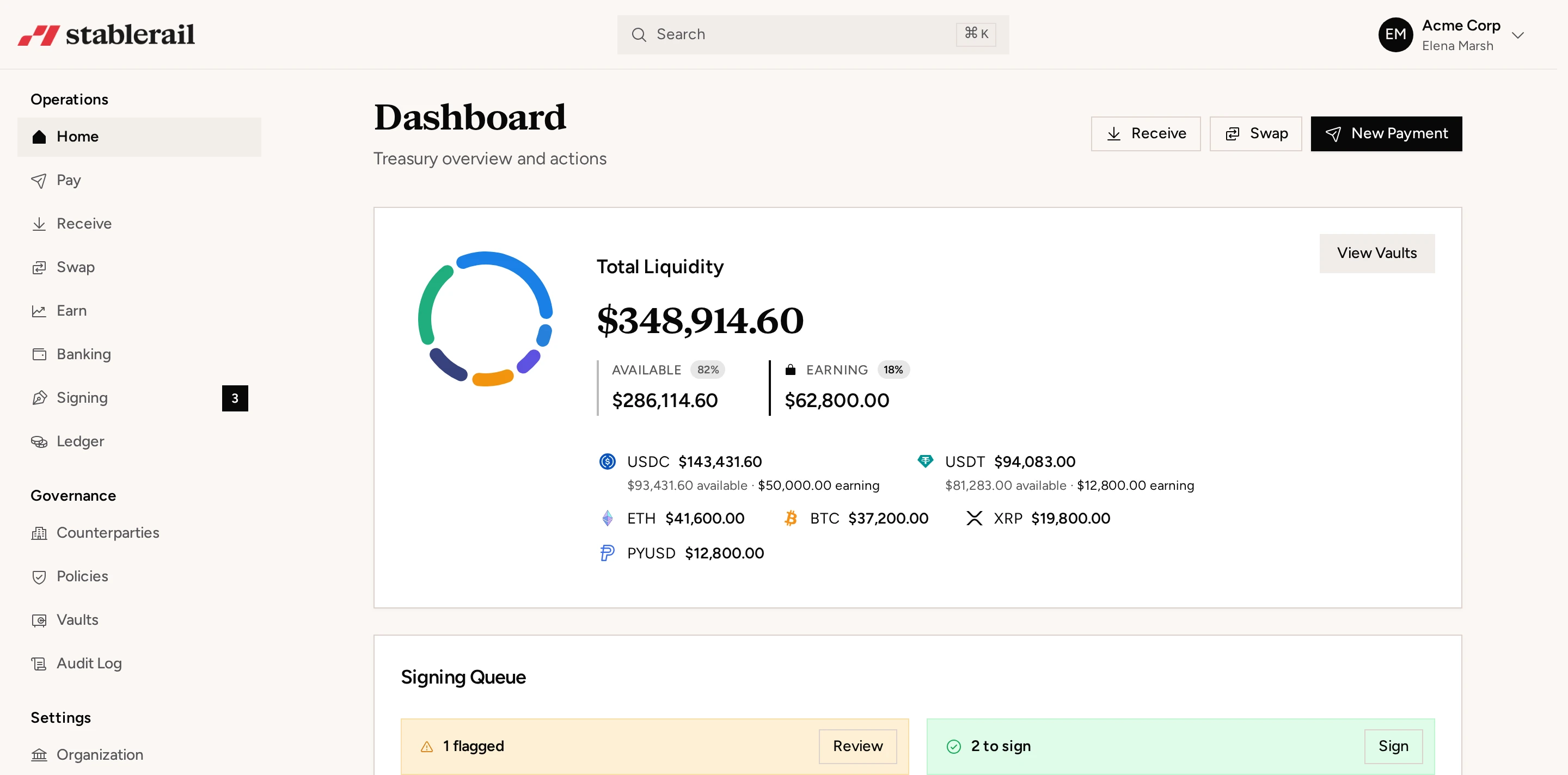
Real-time stablecoin treasury monitoring
How to tell prevention from reporting when you are shortlisting tools — and what a treasury actually needs to watch.
Real-time monitoring for a stablecoin treasury should do more than alert you after a transfer confirms. Because on-chain settlement is irreversible, the useful controls run before the signature: address whitelisting, spend limits, approval quorums and sanctions screening at intent. Post-execution analytics still matters for reporting and investigation — it just cannot save a payment that has already landed.
Detection vs. prevention
| Post-execution analytics | Pre-execution controls | |
|---|---|---|
| When it runs | After the transaction confirms | Before the transaction is signed |
| What it produces | An alert and a risk score | A block, or an approved release |
| Prevents loss | No — funds have moved | Yes |
| Primary user | Compliance, investigations | Treasury, finance operations |
| Audit value | Evidence of review | Evidence the control existed before the payment |
| Failure mode | Alert fatigue | Over-tight policy blocking legitimate payments |
Both belong in a mature setup. The mistake is buying only the first and assuming it is a control — an auditor will read it as detective, not preventive, and will keep the finding open.
What to monitor
- Balances by asset, chain and vault, converted into your reporting currency at a consistent rate source.
- Every outbound payment attempt, including the ones policy blocked — blocked attempts are the signal.
- Counterparty screening status, re-checked on a schedule rather than only at onboarding.
- Changes to signers, quorum, limits and whitelists, with who requested and who approved them.
- Inflows that do not match an expected invoice or funding event.
- Gas and network fee drift, which quietly reprices high-frequency corridors.
Shortlisting a platform
| Question to ask | Weak answer | Strong answer |
|---|---|---|
| Can it block a payment? | It raises an alert | Policy is enforced at signing; a breach cannot be released |
| Who holds the keys? | We custody them for you | Self-custodial MPC with quorum signing and documented key export |
| Is screening pre-execution? | We screen daily | Screening runs at intent and the result is stored before the hash exists |
| How is evidence exported? | CSV of transactions | Per-payment record: requester, approver, policy, screening result, hash |
| Multi-chain consistency? | Separate dashboard per chain | One normalised schema across every supported network |
| What happens if the vendor disappears? | Support ticket | Keys and funds remain recoverable by the customer without the vendor |
A 30-day evaluation plan
- 01Write your policy on paper first: limits, approvers, whitelisted destinations, escalation.
- 02Ask each vendor to configure that exact policy in a sandbox — not a demo script.
- 03Attempt a payment that breaches each rule and confirm it is blocked, not merely flagged.
- 04Export the evidence pack for one blocked and one approved payment and hand it to your auditor.
- 05Test a signer change and confirm it requires quorum and leaves a record.
- 06Run the same payment on two chains and compare the exported records field by field.
- 07Price the whole year including screening volume, off-ramp fees and per-seat charges.
Where Stablerail fits
Stablerail is the account itself, not a dashboard bolted to one. Policy is enforced at signing, screening runs before release, funds stay self-custodial under MPC with quorum signing, and every payment exports with the evidence an auditor asks for. Monitoring across Ethereum, Base, Arbitrum, Polygon, Solana and Tron uses one normalised record, so reconciliation does not change shape per chain.
Frequently asked questions
What does real-time stablecoin treasury monitoring actually mean?
Two different things are sold under that name. Detection tools watch confirmed transactions and alert you afterwards. Pre-execution controls evaluate a payment before it is signed and block it if it breaches policy. Only the second one prevents a loss, because on-chain settlement is irreversible.
Is blockchain analytics enough for a corporate treasury?
No. Analytics tells you a wallet is risky after the money has moved. For a corporate treasury you also need address whitelisting, approval quorums, spend limits and screening that runs before release. Analytics is an input to those controls, not a substitute for them.
What should a monitoring dashboard show a CFO?
Total balance by asset and chain, exposure by counterparty, payments pending approval and who is blocking them, policy breaches attempted in the period, and any change to signers or limits. Anything else is an operator view, not a treasury view.
How do you monitor across multiple chains consistently?
Normalise every event into the same schema — counterparty, asset, amount in reporting currency, policy applied, approver, hash — so a Base transfer and a Tron transfer produce identical evidence. Chain-specific dashboards are where reconciliation gaps start.
How much does treasury monitoring cost?
Standalone analytics subscriptions typically start in the low thousands per year and price by screening volume. Where monitoring is bundled with the account that holds and moves the funds, it is usually part of the platform fee, which avoids paying twice for the same transaction data.
What alerts are worth having and which are noise?
Worth it: an attempted payment to an unlisted address, a signer or policy change, a balance moving outside its expected band, a counterparty's screening status changing. Noise: every inbound transfer, every price tick, and any alert nobody is accountable for closing.
Keep reading
One account for stablecoin treasury, cards and payouts.
Receive, approve, screen, pay, card-spend and off-ramp — with audit evidence on every transaction.