
Manage company balances, payments, cards and approvals in one workspace.
Stablecoin vendor payments
Everything a finance team needs to move supplier payments onto USDC or USDT without losing control, evidence or the auditor's confidence.
Stablecoin vendor payments let a company settle supplier invoices in USDC or USDT in seconds instead of days. The controls that make them safe are the same ones a bank gives you for free: a verified counterparty record, segregation of duties, an approval quorum, sanctions screening before release, and an evidence trail per payment. Get those four in place and the rail is boring — which is the point.
Why finance teams move vendor payments on-chain
- Settlement in seconds, including weekends, quarter-end and public holidays.
- One rail for every corridor, instead of a different bank relationship per country.
- Cost that does not scale with distance — a payment to Lagos costs the same as one to Lisbon.
- No intermediary bank haircuts, so the vendor receives the invoiced amount.
- An independently verifiable receipt: the transaction hash proves settlement without a bank statement.
Stablecoin payment vs. bank wire, side by side
| Stablecoin (USDC/USDT) | International wire | Card / AP platform | |
|---|---|---|---|
| Settlement time | Seconds to minutes, 24/7 | 1–3 business days | 1–5 business days |
| Typical cost | Cents in network fees + platform fee | $25–$60 plus 1–3% FX spread | 1.5–3% of invoice |
| Weekend / holiday | Works | Does not move | Does not move |
| Amount received | Exactly as sent | Reduced by intermediary fees | As sent |
| Reversibility | None — controls must be pre-execution | Recall possible, rarely successful | Chargeback window |
| Proof of payment | On-chain hash, instantly verifiable | MT103, requested from the bank | Platform statement |
The trade the table hides is irreversibility. A wire gives you a slim chance of recall; a stablecoin payment gives you none. That is why the control model has to move before the signature rather than after it.
The four controls that make it audit-safe
| Control | What it prevents | How it is evidenced |
|---|---|---|
| Counterparty register | Address substitution and wrong-chain sends | Record showing who added the destination, when, and who approved the change |
| Segregation of duties | One person creating and releasing a payment | Requester and approver captured as different identities on the payment |
| Approval quorum | A single compromised device draining treasury | Signature set stored with the transaction |
| Pre-execution screening | Paying a sanctioned or high-risk wallet | Screening result timestamped before the hash exists |
Rolling it out without breaking month-end
- 01Pick two or three vendors who already ask to be paid in stablecoins — usually contractors and offshore suppliers.
- 02Get written agreement on the asset, the network and the invoicing currency. Never let the network be chosen at payment time.
- 03Add each vendor to a counterparty register with a verified destination address and a small test payment.
- 04Define the approval policy: value thresholds, who can approve, and the quorum required for release.
- 05Run screening on every destination before the first live payment, and store the result.
- 06Book the payment in your functional currency at the invoice date and attach the transaction hash to the ledger line.
- 07Reconcile the first month manually against bank-equivalent evidence, then automate the export to your accounting system.
Accounting and tax treatment
For most operating companies, a payment-stablecoin balance held only to settle invoices is a short-term asset, and the vendor payment is booked in your functional currency at the invoice date. Because USDC and USDT track the dollar, FX movement is normally immaterial, but the balance is not cash under most frameworks — so keep it disclosed separately. Where you convert fiat to stablecoin, keep the conversion rate and the payment hash on the same voucher so the two legs reconcile. Confirm the final treatment with your auditor; the pattern above is what they usually ask to see.
What Stablerail does here
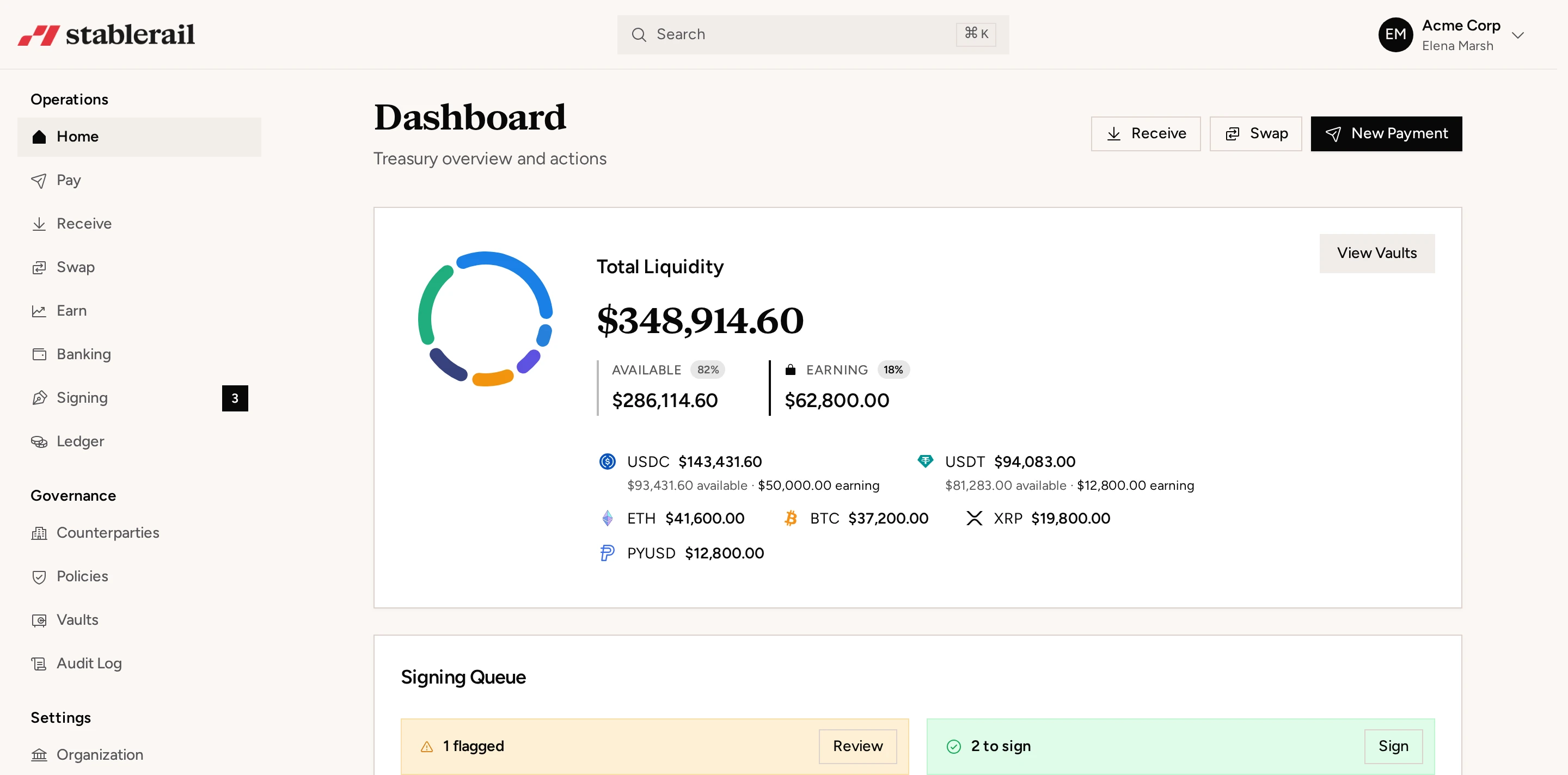
Stablerail gives finance teams one account for stablecoin treasury, corporate cards and vendor payouts. Counterparties are registered once with their asset and network, approvals are enforced by policy, sanctions screening runs before release, and every payment carries requester, approver, screening result and hash into an export your auditor accepts. Funds stay self-custodial under MPC with quorum signing.
Frequently asked questions
Can a company legally pay vendors in stablecoins?
In most jurisdictions yes, provided the vendor agrees in writing, the payment is invoiced and booked in your functional currency, and you run sanctions screening on the counterparty. The stablecoin is treated as a settlement instrument, not as a barter transaction — but tax treatment varies, so confirm with your auditor before switching a corridor.
What is the cheapest way to pay a vendor in stablecoins?
Settling USDC or USDT on a low-fee network such as Base, Arbitrum, Polygon or Tron costs cents in network fees. The larger cost is usually the platform fee and any fiat off-ramp on the vendor's side, so compare all-in landed cost rather than gas alone.
How do you stop paying the wrong wallet address?
Keep the destination address, asset and network on a counterparty record rather than on the individual payment. Payments inherit the verified destination, address changes require re-approval, and screening runs before release. This removes the two most common losses: address substitution and wrong-chain sends.
How fast do stablecoin vendor payments settle?
Typically seconds to a couple of minutes once released, including weekends and holidays. The variable is your internal approval time, not the network. A wire is 1–3 business days and only moves during banking hours in both jurisdictions.
How do stablecoin vendor payments get reconciled?
Each payment should carry the invoice reference, the vendor record, the approver, the screening result and the transaction hash. Export that as a ledger line so the on-chain hash is the supporting document your auditor can independently verify.
What controls do auditors expect?
Segregation of duties between the person who prepares a payment and the people who approve it, an approval quorum for release, sanctions screening evidence dated before execution, a whitelist of destinations, and an immutable record of every policy change.
Keep reading
One account for stablecoin treasury, cards and payouts.
Receive, approve, screen, pay, card-spend and off-ramp — with audit evidence on every transaction.