
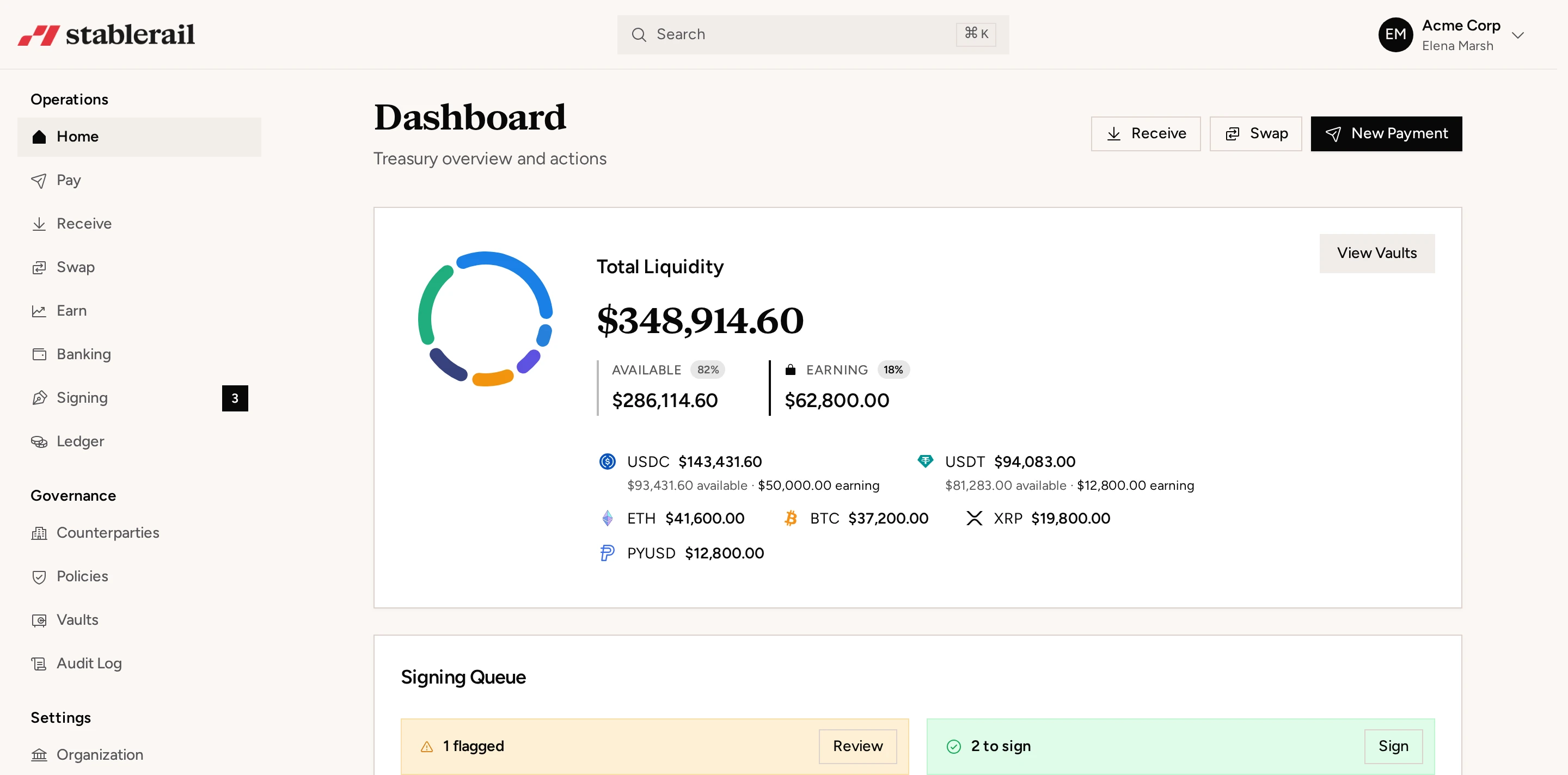
Top 7 Audit Trail Techniques for Stablecoin Governance
Seven governance controls create an unbroken audit trail for stablecoin treasuries, aligning on-chain transparency with off-chain oversight.

Switching to stablecoin treasury operations demands precise oversight to meet compliance standards and ensure accountability. This article outlines seven key techniques to create reliable audit trails for stablecoin governance:
Complete Transaction Logging: Tracks every step of a transaction, from initiation to on-chain settlement, including identities, policies, and risk checks.
Policy Version Control: Maintains machine-readable, versioned policies to document which rules governed each transaction.
Multi-Step Approval Documentation: Separates responsibilities with maker/approver/releaser roles and logs every decision for transparency.
Risk Assessment Dossiers: Compiles pre-transaction checks like sanctions screening and anomaly detection into defensible records.
Blockchain Reconciliation: Matches off-chain governance logs with on-chain transaction data for consistency.
Audit Evidence Package Exports: Provides detailed, exportable records of compliance, including policy traces and risk assessments.
Anomaly Detection and Change Logs: Flags irregularities and records responses to ensure traceability and accountability.
These techniques bridge the gap between blockchain transparency and off-chain oversight, helping finance teams meet regulatory demands and maintain control over stablecoin operations.
7 Essential Audit Trail Techniques for Stablecoin Governance
1. Complete Transaction Logging
End-to-end traceability
When it comes to stablecoin transactions, every step needs to be documented - from the moment a payment intent is created to the final on-chain settlement. This includes tracking who initiated the transfer, the policies that were triggered, who approved it, the risk checks performed, and the blockchain transaction ID. Without this level of detail, evidence can get scattered across emails, Slack messages, and wallet tools, which is far from acceptable for auditors or regulators.
Basic wallet logs won't cut it. While a blockchain explorer can give you details like the transaction hash, amount, and timestamp, it won't explain why the payment was made, which invoice it was tied to, or whether it complied with internal compliance policies.
Proof-of-Control Component
Data Captured
Purpose for Audit
Identity Logs
Requester ID, Approver ID, Signer ID
Ensures accountability and separation of duties
Policy Trace
Policy version, rules triggered, reason codes
Verifies adherence to compliance rules
Risk Dossier
Sanctions status, anomaly flags, risk score
Documents pre-transaction compliance checks
Business Context
Invoices, vendor history, override rationale
Connects on-chain transactions to their business purpose
Execution Data
Blockchain TX ID, timestamp, asset, chain
Links approvals to on-chain finality
In addition to automated records, capturing moments of human intervention is just as vital.
Human-in-the-loop governance
While automated systems are great at flagging risks, human oversight is still essential. Every point of human involvement - approvals, overrides, and justifications - needs to be logged. For instance, if a CFO approves a flagged payment, the system should record their identity, the timestamp, and their written justification. This ensures that every decision is traceable, demonstrating that risks were reviewed by humans at critical stages.
Stablerail offers a clear example of this governance model: "Agents verify the context. Humans sign the transaction. The system protects the treasury - it never touches the money." This approach ensures that AI can assist by identifying risks and suggesting actions, but final signing authority stays with your team. These logs serve as proof that your organization maintained control at every step, satisfying both regulators and auditors.
2. Policy Version Control and Application Records
Policy enforcement and versioning
An effective audit trail does more than just track transactions - it also documents the exact policies that governed them at the time. To achieve this, governance rules must be machine-readable and version-controlled. By implementing version-controlled, machine-enforceable policies for stablecoin governance, you create a reliable record of which rules were active during each transaction. This approach ensures that every payment limit, approval threshold, and whitelist entry is tied to a specific policy version, which must be reviewed and approved before activation.
The goal is to generate a permanent policy record for every transaction. This record should detail the specific version of the policy in effect, the rules that were triggered, and the reasons behind the decision. Without this level of precision, auditors can't accurately determine why a transaction was approved or denied. For instance, if your policy required CFO approval for vendor payments exceeding $5,000 on March 15, 2026, but this threshold changed to $10,000 on March 20, 2026, your audit trail must show which rule applied to each payment during that period.
Component
Trace Data
Purpose
Policy Version ID
Unique identifier, activation timestamp, approver
Links transactions to the specific ruleset in effect
Triggered Rules
Rule name, threshold values, reason codes
Identifies the exact conditions evaluated
Business Context
Invoice ID, vendor name, payment purpose
Connects policy decisions to actual business activities
Change Control Log
Who modified the policy, when, and why
Makes policy updates auditable events themselves
Equally important is managing and documenting policy changes, which is explored further in the next section.
Human-in-the-loop governance
While automated controls are vital, human oversight plays a critical role in managing policy updates. Before any new policy version becomes active, it should require independent authorization. A "t-of-n" approval process - where multiple stakeholders must approve - provides an extra layer of accountability. Each policy update should be treated as an auditable event, with detailed records of who proposed the change, who approved it, and when it took effect.
To minimize errors, conduct shadow audits on recent transactions before deploying new policies. For example, if you're updating weekend transfer limits, test the new rules against the last 90 days of weekend transactions to ensure routine activities, like payroll, won't be mistakenly flagged. This proactive approach helps identify potential issues and ensures smoother implementation of updated policies.
Stablecoins to Scale A Compliance Playbook After GENIUS
3. Multi-Step Approval Documentation
Multi-step approval documentation is a cornerstone of a robust audit framework. It creates a detailed, timestamped audit trail that tracks every phase of a payment request - from its initiation to its settlement on-chain. Each step - intent, risk check, approval, override, and signing - must be recorded with precise timestamps, identities, and reasons. This ensures auditors can reconstruct the decision-making process, even years later.
End-to-End Traceability
The maker/approver/releaser model is key to maintaining proper oversight and audit readiness. This model separates responsibilities among three distinct roles:
The maker initiates the payment instruction.
The approver independently reviews the stablecoin risk assessment.
The releaser executes the transaction.
Each role generates its own timestamped record, ensuring no single individual can handle a payment from start to finish without oversight. This layered approach provides a clear and thorough record, which is essential for addressing exceptions and ensuring accountability.
Human-in-the-Loop Governance
While automated systems are excellent at flagging policy violations and screening errors, human oversight remains critical for managing exceptions. For example, if an approver decides to authorize a flagged payment after verifying the vendor manually, the reason for the override and the approver's identity must be documented and preserved.
Before human intervention, automated processes should run checks for sanctions compliance, policy adherence, transaction limits, and behavioral anomalies. The results are compiled into a Risk Dossier, which includes a clear verdict (e.g., PASS, FLAG, or BLOCK) and plain-English explanations tied to specific evidence, such as policy clauses and timestamps. This system empowers approvers to make well-informed decisions while maintaining records that meet the expectations of auditors, boards, and regulators. Retaining these records for 5–7 years is standard, though for large or unusual transactions, keeping them indefinitely may be prudent based on jurisdictional requirements and statutes of limitations.
Blockchain Reconciliation and Evidence Generation
To complete the audit trail, approval logs must be reconciled with blockchain data. This involves matching off-chain records - such as intent logs, approval timestamps, and risk assessments - with on-chain data like transaction hashes, confirmation times, and wallet balances. This reconciliation process is especially crucial under the GENIUS Act, which requires monthly independent audits by registered public accounting firms, making thorough documentation a legal necessity.
Modern stablecoin governance platforms simplify this process by generating exportable evidence packages. These include:
Timestamped logs for every approval step
Comprehensive risk dossiers
Records of policy applications
Blockchain transaction receipts
Such packages allow finance teams to produce reconciliation reports on demand, demonstrating that every payment adhered to the required approval workflow. Regular monthly drills to export and verify these records - covering identity verification logs, sanctions screening results, wallet checks, and on-chain data - ensure compliance and readiness for audits.
4. Risk Assessment and Dossier Creation
Risk assessment and dossier creation play a key role in closing the loop between policy enforcement and blockchain reconciliation. Instead of juggling scattered records, a risk dossier transforms raw transaction data into a timestamped, defensible package. This ensures that every payment is backed by a clear audit trail from the moment it’s initiated.
Policy Enforcement and Versioning
Risk dossiers begin with policy-as-code governance, which automates the enforcement of business rules. For example, a finance team might set policies like:
Payments to new addresses over $5,000 require CFO approval and verification.
Weekend transfers exceeding $10,000 need additional approval.
These rules are applied to every payment intent before it’s signed, and the system logs which policy version was active at the time of the transaction. Automated checks handle routine enforcement, while human oversight focuses on exceptions that require judgment.
Human-in-the-Loop Governance
Before final approval, specialized agents run pre-sign checks, such as sanctions screening, taint exposure analysis, anomaly detection, and counterparty risk scoring. The findings are compiled into a risk dossier, which includes a verdict - PASS, FLAG, or BLOCK - along with clear, evidence-backed explanations.
"Agents verify the context. Humans sign the transaction. The system protects the treasury - it never touches the money."
To further safeguard against rushed decisions or social engineering attacks, cool-off periods can be implemented. For instance, high-value transfers to new beneficiaries might be delayed by four hours.
Blockchain Reconciliation and Evidence Generation
Once a transaction is signed and settled on-chain, the risk dossier is reconciled with blockchain data to complete the audit trail. This process aligns off-chain logs with on-chain records, such as transaction hashes, timestamps, and wallet balances.
"Every payout generates a defensible receipt: what was paid, why, who approved, and the risk verdict."
These practices ensure that governance processes remain transparent and defensible, meeting the expectations of auditors and regulators as outlined earlier in the article.
5. Blockchain Transaction Reconciliation
Blockchain transaction reconciliation bridges the gap between off-chain governance and on-chain execution. Once a payment is signed and settled, the system checks that the blockchain record aligns with the approved intent, policy requirements, and the related approval records stored in the audit trail. This process guarantees that every off-chain approval is backed by a corresponding on-chain record.
End-to-End Traceability
This process ensures that all on-chain details - like the transaction hash, timestamp, wallet addresses, and transfer amount - are consistent with the pre-approved payment data. By doing so, it creates a comprehensive audit trail, laying the groundwork for solid compliance documentation.
Blockchain Reconciliation and Evidence Generation
After settlement, the system goes a step further by automating compliance evidence generation. It captures critical on-chain data, such as the transaction hash, block number, gas fees, confirmation timestamp, and wallet balances, and compares it with the off-chain audit trail. This comparison confirms that no unauthorized changes have occurred.
The result is a CFO-grade receipt that details what was paid, why it was paid, who approved it, and the associated risk assessment. This level of documentation ensures that every treasury movement is supported by a clear, audit-ready record - particularly vital for enterprises managing $1M–$50M in stablecoins. On the Stablerail platform, this automated reconciliation is seamlessly integrated into the workflow, enabling finance teams to maintain strict, real-time oversight of stablecoin payments.
6. Audit Evidence Package Exports
With automated blockchain reconciliation as the foundation, these evidence packages provide a complete, exportable proof of your entire audit trail. After every stablecoin transaction, you can compile a detailed audit package that captures all decisions and actions. These packages consolidate transaction data into a single, audit-ready record.
Policy Enforcement and Versioning
Each export includes a snapshot of the active Policy Trace, preserving a historical record of governance rules as they were applied at the time of the transaction. Version-controlled policies allow auditors to verify the specific rules in effect - such as spending limits, whitelists, or approval thresholds - at the moment of execution.
Additionally, Risk Dossiers provide plain-English explanations tied to specific policy clauses. For instance, if a $15,000 vendor payment was flagged for exceeding a weekend transfer limit, the package documents the policy version, the reason code, and the approver's override rationale. This transforms raw transaction logs into a fully audit-ready format.
Human-in-the-Loop Governance
While automated systems handle many checks, human oversight plays a critical role in validating the integrity of these records. The evidence package tracks every human interaction, including who initiated the payment intent, which approvers reviewed the Risk Dossier, and who ultimately signed the transaction using MPC wallets. Any overrides are logged with documented justifications, reinforcing accountability at every step.
As Stablerail emphasizes:
"Agents verify the context. Humans sign the transaction. The system protects the treasury - it never touches the money".
This method ensures that each evidence package reflects both automated processes and essential human oversight. These exportable records establish a secure chain of custody from transaction intent to execution, supporting regulatory compliance and transparent governance.
Component of Evidence Package
Data Captured
Purpose for Audit
Policy Trace
Policy version, rules triggered, reason codes
Demonstrates compliance with specific governance rules at execution
Identity Logs
Requester ID, Approver ID, Signer ID
Ensures accountability and segregation of duties (SoD)
Risk Dossier
Sanctions status, anomaly flags, risk score
Documents pre-transaction compliance and risk evaluations
Business Context
Invoices, vendor history, override rationale
Connects on-chain transactions to their business purpose
Execution Data
Blockchain TX ID, timestamp, asset, chain
Links internal approvals to immutable on-chain records
7. Anomaly Detection and Change Logs
When it comes to maintaining thorough audit trails, detecting anomalies and logging configuration changes is a critical step. Think of anomaly detection as an early warning system - it spots irregularities that might go unnoticed during manual reviews. By keeping an eye on patterns like transaction sizes, unexpected counterparties, or transfers happening at odd hours, these systems flag unusual activity. Each flagged anomaly automatically generates a change log entry, creating a detailed, timestamped record of the event and your team’s response.
End-to-End Traceability
To achieve full traceability, it’s essential to log every stage of a transaction - from the creation of a payment intent to its final settlement on the blockchain. While every transaction is logged and reconciled, anomaly detection adds another layer of oversight. It compares real-time activity against historical patterns using AI and machine learning. These tools establish behavioral baselines, analyzing factors like transaction frequency, average amounts, and time-of-day trends. For instance, if a $15,000 USDC transfer happens on a Saturday evening, the system flags it as unusual based on past data. The entire verification process - from the initial alert and risk assessment to approval and authorization - is then documented for reference.
Whenever an anomaly is flagged, the system logs the deviation, its response, and any manual overrides, complete with justifications. This creates an unbroken chain of accountability that ties business decisions directly to their blockchain outcomes.
Policy Enforcement and Versioning
Machine-enforced policies work hand-in-hand with anomaly detection to uphold governance standards. For example, if your policy states, “Weekend transfers over $10,000 require extra approval,” the system ensures the rule is applied to every relevant transaction. If an anomaly arises - like a payment bypassing the usual approval process - the change log captures the policy breach, the system’s reaction, and any human intervention, including explanations for overrides.
Version control adds another layer of transparency. It preserves historical records of the rules in effect at the time of each transaction, allowing auditors to verify which policies governed specific actions.
Human-in-the-Loop Governance
Automation plays a key role in identifying potential issues, but human judgment remains crucial for validating responses. When a transaction is flagged, the system generates a Risk Dossier with a PASS, FLAG, or BLOCK verdict. This dossier includes plain-English explanations and highlights the evidence behind the decision. Approvers then review the dossier, document their decisions, and provide reasons for any overrides. Every step - from initial review to the final Multi-Party Computation (MPC) signature - is logged for transparency.
Conclusion
Creating a reliable audit trail requires weaving together seven critical techniques into a seamless system. It starts with complete transaction logging to capture raw data, followed by policy version control to clarify which rules applied at the time of each transaction. Multi-step approval documentation ensures every authorization is recorded, while risk assessment dossiers explain the reasoning behind decisions. Add to this blockchain reconciliation to link business intent with on-chain activity, audit evidence packages to satisfy regulatory requirements, and anomaly detection to flag irregularities before they become major issues. Together, these practices form an unbroken chain of accountability, tracking every step from the creation of a payment intent to its final settlement on the blockchain.
These methods address key gaps in traditional custody tools. Stablecoin treasuries need to maintain audit records that meet CFO-level standards while still operating at blockchain speed. Traditional custody tools handle key management well but fail to capture the business context - like why a payment was made, what policy governed it, or who approved exceptions. This is where Stablerail steps in. Acting as a control layer between custody and transaction signing, Stablerail integrates all seven audit trail techniques into a streamlined workflow. From its Treasury Hub, which tracks balances across multiple blockchains, to its Policy Console, which enforces machine-readable rules, every action is backed by clear, defensible evidence.
Stablerail’s design prioritizes human oversight, supported by AI-powered tools. These agents handle tasks like sanctions screening, taint checks, and behavioral analysis, presenting their findings in plain-English Risk Dossiers. Approvers then review this evidence, make decisions, and document their reasoning. Every step - whether it’s intent creation or MPC signing - is meticulously logged with timestamps, policy references, and justifications. The result? A comprehensive audit trail that satisfies auditors, boards, and regulators, all while maintaining the speed and efficiency of blockchain operations. Stablerail works with companies managing $1 million to $50 million in annual stablecoin volume, offering a scalable subscription model to replace outdated processes. Each transaction generates a concise, defensible receipt detailing the amount, purpose, approvals, and risk assessment.
FAQs
What should a stablecoin audit trail include beyond the on-chain transaction hash?
A stablecoin audit trail needs to document more than just the transaction hash. It should include all critical actions such as intent creation, pre-sign checks, policy enforcement, human approvals, overrides, and signing events. Additionally, it must offer detailed evidence like behavioral anomaly logs and proof-of-control receipts to promote transparency and maintain accountability.
How do you prove which policy rules were in effect when a stablecoin payment was approved?
Maintaining a complete audit trail is essential to prove which policy rules were active during a stablecoin payment approval. This means documenting every step of the process, including intent creation, checks, flags, overrides, approvals, and signing. Alongside these actions, it's crucial to record timestamps, policy references, and any supporting evidence. This level of detail ensures clarity and accountability, meeting the expectations of auditors and regulators.
What’s the best way to reconcile off-chain approvals with on-chain settlement for audits?
A solid way to manage this process is by using a pre-signature governance system. This approach ensures that all necessary approvals, checks, and overrides are documented before any on-chain transaction takes place. The result? A clear audit trail that boosts both transparency and accountability.
Tools like Stablerail make this process easier by automating pre-signature checks. These include tasks like sanctions screening and policy compliance. Additionally, they record human approvals alongside automated results, creating a seamless connection between off-chain decisions and on-chain actions. This integration ensures audits are not only thorough but also reliable.
Related Blog Posts
Former CEO of Simple, a self-custodial wallet with $2B+ in transaction volume across 75+ countries.
More about the Stablerail team- Stablecoin treasury managementApprovals, limits, yield and reporting on one balance.
- Stablecoin payoutsBatch contractor and vendor payments with screening.
- USDT vs USDCWhich stablecoin your company should settle in.
- Stablecoin finance glossaryMPC, off-ramp, travel rule and the rest, in plain English.
- Product updatesEverything we ship, month by month.