
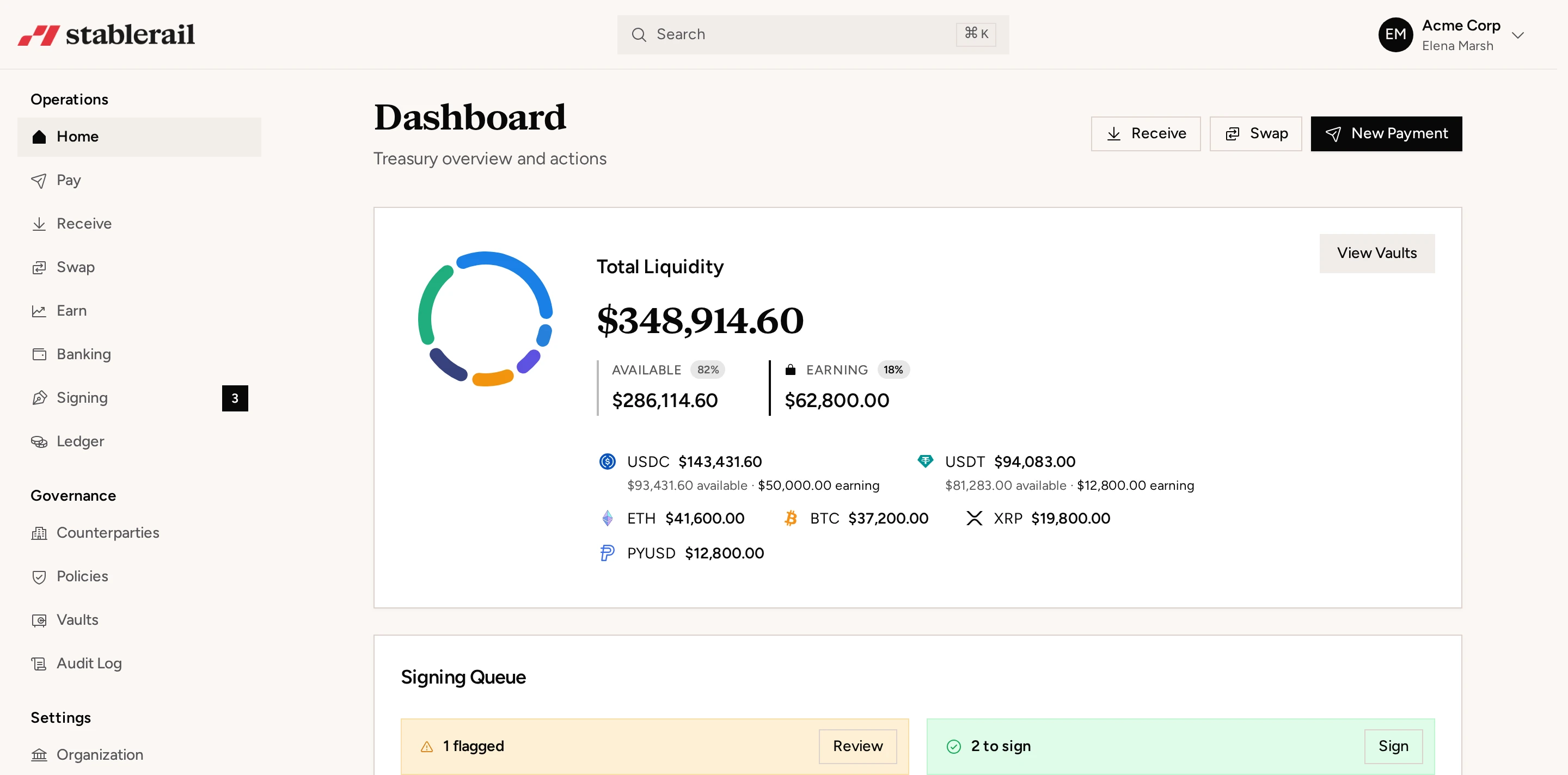
Stablecoin Treasury Management: 7 Best Practices for CFOs
Seven controls for CFOs to secure stablecoin treasuries: governance, tiered custody, dual approvals, issuer due diligence, real-time monitoring, audits.

Dec 30, 2025
Stablecoins are reshaping treasury operations, offering faster settlements and operational efficiency. By 2024, stablecoins facilitated $14 trillion in transactions, surpassing Visa's payment volume. With regulatory clarity from the GENIUS Act (July 2025), CFOs must adopt secure practices to mitigate risks like custody errors or de-pegging events. Here are the seven best practices for stablecoin treasury management:
Board-Approved Policies: Define approved stablecoins, blockchains, and operational limits.
Tiered Custody: Use hot, warm, and cold wallets for varying security and liquidity needs.
Dual Control: Require multi-step approvals and segregate transaction roles.
Issuer Due Diligence: Evaluate reserve audits, regulatory compliance, and redemption pathways.
Real-Time Monitoring: Detect anomalies, enforce limits, and ensure compliance before transactions settle.
Allocation Models: Limit exposure to 5% of liquid assets and maintain liquidity for 12–18 months of expenses.
Audit Trails: Maintain immutable records for compliance and tax reporting.
Stablecoins are no longer experimental - they're a critical tool for modern treasury operations. Implementing these controls ensures security, compliance, and efficient management.
7 Best Practices for Stablecoin Treasury Management
TRM Talks: Building the Infrastructure for the Stablecoin Moment with Paxos' Lesley Chavkin
1. Create a Board-Approved Digital Asset Policy
Having a formal, board-approved digital asset policy is the cornerstone of managing stablecoin treasuries securely. This policy empowers CFOs to enforce strict controls and establish clear operational boundaries. It should outline which stablecoins are permitted (e.g., USDC, USDT), identify approved blockchain networks, and specify prohibited activities. Additionally, it must include a change management process that details who has the authority to modify spending limits, update signer rosters, or adjust wallet routing protocols.
Governance and Policy Alignment
Think of blockchain networks as separate regulatory territories. Your policy should allowlist specific chains - such as Ethereum, Polygon, or Solana - and mandate an annual review to assess their operational performance and compliance with regulations. Clearly define approved use cases, such as vendor payments, payroll, or cross-border settlements. To strengthen internal controls, implement segregation of duties by assigning different roles for payment requesters, approvers, and signers. This ensures no single individual can initiate and complete a transaction alone.
"A strong policy is the foundation of crypto treasury management. It aligns executive intent with practical controls and creates a shared language for risk." – BitGo
Once governance is in place, the next step is to focus on risk management and operational security.
Risk Management and Operational Security
To minimize risks, set concentration limits for each issuer, blockchain network, and counterparty wallet, reducing the likelihood of single points of failure. For example, avoid overexposure to any one stablecoin issuer. Implement a tiered wallet structure - hot, warm, and cold wallets - with specific approval thresholds and require additional approvals for high-risk transactions. Use velocity limits (spending caps within defined timeframes) to detect unusual activity. Be prepared for emergencies by creating incident response playbooks for scenarios like lost keys, breaches, or misdirected funds, complete with escalation protocols.
Operational controls should also stay in step with changing regulatory requirements.
Regulatory Compliance and Defensibility
Under the GENIUS Act, your policy must include KYB/KYC protocols, sanctions screening, and "Travel Rule" compliance for all virtual asset transfers. Maintain immutable audit trails that link every on-chain action to a specific individual and internal approval process. Ensure your operations are audit-ready by defining recordkeeping requirements for tax reporting, including cost-basis tracking and realized/unrealized gains. This approach ensures compliance with both federal and state regulations.
Capital Preservation and Yield Optimization
Your policy should specify redemption paths with at least two tested methods, such as direct redemption with the issuer and a secondary regulated liquidity provider. Avoid reliance on a single pathway to convert stablecoins into fiat currency. If engaging in yield-generating activities like staking or lending, set risk thresholds that align with your organization’s financial goals and runway. Additionally, establish minimum on-chain confirmation requirements to ensure transactions are fully settled before they are operationally recognized.
2. Use a Tiered Custody Architecture
A tiered custody architecture organizes your stablecoin holdings into hot, warm, and cold wallets, depending on how often transactions occur, their value, and your appetite for risk. Think of it as a system that mimics traditional banking practices, where funds are separated by purpose and level of risk - this all ties back to your board-approved digital asset policy. The result? A more secure and efficient treasury operation.
Risk Management and Operational Security
Cold wallets are your long-term vaults. They’re stored offline, adhering to strict FIPS 140-3 standards, and withdrawals require multiple people to authorize them. While they offer the highest level of security, they’re not very liquid - retrieving funds can take hours or even days.
Warm wallets handle your regular operational needs, like vendor payments and payroll. These wallets are connected to the network but are protected by safeguards like pre-approved recipient lists, time locks, and quorum-based approvals. This setup strikes a balance between accessibility and security.
Hot wallets are designed for quick, low-value transactions that need to settle almost instantly. To keep things secure, apply velocity limits, set up real-time alerts, and enforce the principle of least privilege - only granting temporary elevated access when absolutely necessary. Keeping immutable logs of all transactions adds another layer of operational security.
Wallet Tier
Usage
Security Controls
Liquidity Level
Cold
Strategic reserves, long-term holding
Offline storage, multi-person authorization, FIPS 140-3 compliance
Low (Hours to Days)
Warm
Regular vendor payments, payroll
Quorum approvals, allowlists, time locks
Medium (Minutes to Hours)
Hot
Automated flows, small disbursements
Velocity limits, real-time monitoring
High (Near-Instant)
Regulatory Compliance and Defensibility
Staying compliant with regulations is just as important as securing your assets. As of July 2025, the GENIUS Act categorizes stablecoin issuers as financial institutions, bringing them under the Bank Secrecy Act’s umbrella. This means you’ll need to adopt an "authorization-before-settlement" model, which ensures sanctions checks and Travel Rule compliance are completed before blockchain transactions are processed.
If you’re working with third-party custodians for your vault-tier assets, make sure they provide SOC 2 reports to confirm their controls are audit-ready. It’s also smart to run regular recovery drills - like tabletop exercises that test your ability to restore encrypted backups. These practices not only enhance your security but also make your operations more defensible in an ever-evolving regulatory landscape.
3. Require Dual Control and Multi-Step Approvals
Governance and Policy Alignment
A well-defined, board-approved digital asset policy is essential for managing stablecoin transactions. This policy should clearly outline who has the authority to request, approve, and execute these transactions, ensuring that each role is assigned to a different individual. Approval requirements should align with wallet tiers: for example, warm wallets might need quorum approvals (e.g., 3 out of 5 signers), while cold storage vaults should involve multi-person signing ceremonies and offline protocols.
Establish detailed spending limits based on wallet type, user roles, asset categories, counterparties, and timeframes. For high-risk or high-value transactions, implement “step-up” approvals that require additional scrutiny. These measures, rooted in your governance framework, create a strong operational foundation for transaction security.
Risk Management and Operational Security
To eliminate single points of failure, use multisig and MPC (multi-party computation) methods to distribute key control among multiple stakeholders. This ensures that even if a signing device is compromised or lost, your treasury remains secure.
"Treasury teams need rigorous safeguards for wallet management, transaction approvals, and identity verification. Best practice is to use infrastructure with built-in governance controls, multi-layer authentication, and real-time monitoring to prevent unauthorized transfers." - Fireblocks
Strengthen signing devices by removing unnecessary software and disabling radios, reducing potential vulnerabilities. Add extra layers of security with allowlists and time-locks. Every signing and approval action should be logged immutably, linking actions to specific individuals. These records, paired with your policy and custody framework, not only protect your assets but also enhance regulatory audit readiness.
Regulatory Compliance and Defensibility
Regulators demand institutional-grade governance, and multi-step approval workflows provide the defensibility required during audits or reviews. Incorporate sanctions screening and Travel Rule data checks directly into your approval processes to block transactions involving restricted jurisdictions.
Since stablecoin transactions are irreversible - there’s no way to reverse a transfer once it’s sent - multi-step approvals act as a critical safety measure. Regularly reconcile on-chain data, custodian statements, and internal sub-ledgers to resolve any discrepancies. This three-way reconciliation process ensures you’re audit-ready and compliant with evolving regulations, such as the GENIUS Act, which classifies stablecoin issuers as financial institutions under the Bank Secrecy Act.
4. Perform Due Diligence on Stablecoin Issuers
Governance and Policy Alignment
When evaluating stablecoin issuers, it's crucial to understand the difference between attestations and audits. An attestation offers a snapshot of reserve levels on a specific date, while an audit digs deeper, assessing the company's ongoing governance and internal controls.
"An attestation tells you there's $40 billion in the vault on March 31. An audit tells you whether the company has proper processes to keep that $40 billion safe." - Torsion.ai
Focus on issuers that provide monthly attestations from reputable firms like Deloitte, PwC, EY, or KPMG. Additionally, look for those offering weekly or daily updates on reserve composition. Delays in reporting - especially beyond 30 days - can leave you vulnerable during market fluctuations. For example, Circle stands out by publishing weekly updates and daily net asset value (NAV) reports for about 45% of USDC reserves, which are held in the Circle Reserve Fund (USDXX), an SEC-registered government money market fund managed by BlackRock.
Once governance practices are clear, shift your attention to the issuer's risk management and operational resilience.
Risk Management and Operational Security
The composition of an issuer's reserves is a critical factor. Under the GENIUS Act, U.S. payment stablecoins must maintain 1:1 backing with high-quality liquid assets like U.S. Treasuries (with maturities of 93 days or less), cash, and overnight repo agreements. If more than 10% of reserves fall into ambiguous categories like "other investments" - which might include secured loans, corporate bonds, or even precious metals - it signals a lack of transparency and potential risk exposure.
"100% reserves mean nothing if you can't access them"
Another key consideration is the issuer's daily redemption capacity. For instance, Tether processes roughly $2 billion in daily redemptions, which amounts to less than 2% of its $157 billion market cap. To ensure liquidity, verify that the issuer has at least two tested redemption pathways: direct redemptions through the issuer and secondary options via regulated liquidity providers. Keep in mind that many issuers impose high minimum redemption thresholds - often $100,000 - forcing smaller players to rely on secondary markets during times of stress.
Regulatory Compliance and Defensibility
Regulatory credentials are non-negotiable. Confirm that the issuer holds proper U.S. licenses, such as a New York BitLicense, Limited Purpose Trust Company charter, or federal banking charter. The GENIUS Act classifies stablecoin issuers as financial institutions under the Bank Secrecy Act, requiring them to meet the same anti-money laundering (AML) and countering the financing of terrorism (CFT) standards as banks.
Reserves must also be held in segregated, bankruptcy-remote accounts, ensuring that holder claims are prioritized. Under the GENIUS Act, compliant issuers must distribute reserves to holders within 14 days in the event of failure. This protection does not extend to stablecoins issued outside permitted U.S. frameworks, which means such assets cannot be treated as "cash or cash equivalents" for corporate accounting purposes.
Feature
USDC (Circle)
USDT (Tether)
Attestation Frequency
Monthly (Deloitte)
Quarterly (BDO Italia)
Public Disclosure
Weekly updates; Daily NAV for USDXX
Quarterly (30-45 day lag)
Regulatory Status
NYDFS BitLicense; GENIUS Act compliant
BVI structure; Limited U.S. oversight
Reserve Transparency
~88% Treasuries/Repos; 12% Cash
84.1% Cash/Treasuries; 15.9% Other
Request SOC 1 or SOC 2 Type II reports to validate the issuer's operational standards and ensure their regulatory credentials align with effective treasury governance. Additionally, confirm they have robust risk-based programs for sanctions screening (OFAC compliance) and adhere to the Travel Rule (Title 31 CFR), which mandates the collection and transmission of originator and beneficiary details for qualifying transactions.
5. Monitor Transactions in Real-Time and Detect Anomalies
Governance and Policy Alignment
Real-time transaction monitoring shifts treasury controls from reactive to proactive by intercepting non-compliant stablecoin transactions before they can settle irreversibly. Set up your systems to automatically flag specific policy breaches, such as transactions exceeding wallet or role-based spending limits, attempts to bypass dual control workflows, transfers to unapproved addresses, or activity outside authorized business hours. These safeguards integrate your board-approved policies directly into the transaction process, ensuring every payment aligns with your governance standards before it’s executed. This approach strengthens risk management by preventing issues in real time.
Risk Management and Operational Security
To manage risk effectively, implement velocity limits that cap transaction volumes over specific time frames. If these limits are exceeded, the system can trigger additional approvals or halt transactions entirely. Alerts for concentration risk are also key - these notify you when a single wallet, blockchain, or settlement partner holds a disproportionately large share of your treasury assets. Additionally, liquidity alerts can warn you when balances dip below the minimum reserves needed for operations, ensuring funds remain accessible and properly distributed.
Modern platforms leverage API-driven verification to perform near-instant checks, including sanctions screening, counterparty verification, and balance confirmations. This capability is crucial given the speed of blockchain settlements. By verifying OFAC databases and beneficiary details before revealing settlement addresses, these systems enable pre-transaction authorization. This not only enhances compliance but also keeps pace with evolving regulatory demands.
Regulatory Compliance and Defensibility
Your monitoring system should automatically flag transactions that meet mandatory reporting thresholds. For example, any crypto receipt over $10,000 requires 6050I reporting to the IRS, treating it like a cash transaction.
"The Travel Rule's core purpose extends beyond information transmission. Institutions must use this information to 'take freezing actions and prohibit transactions with designated persons and entities.'" - FATF
Automate sanctions screening and enforce geographic restrictions to block transfers to prohibited regions. Use three-way reconciliation systems to match on-chain data, custodian statements, and internal sub-ledgers, identifying discrepancies and anomalies as they happen. This daily reconciliation process ensures your internal records stay aligned with blockchain transactions, catching errors or inconsistencies before they escalate into larger issues.
6. Build a Tiered Allocation Model for Yield and Capital Preservation
Governance and Policy Alignment
Combine traditional treasury practices with blockchain-specific safeguards. Start by setting up a three-tier wallet system that segments funds based on their purpose and how often they need to be accessed:
Settlement/Hot Wallets: Designed for daily transactions. Keep balances low and enforce strict velocity limits.
Treasury Reserve/Warm Wallets: Serve as operational buffers. Require quorum-based approvals for medium-frequency transactions.
Cold/Vault Storage: Used for long-term reserves. These funds are secured through offline protocols and rigorous security measures.
For additional wallet security details, refer to earlier sections.
To mitigate risk, establish strict concentration limits for issuers, blockchains, and counterparties, reducing the likelihood of single points of failure. Clearly outline which stablecoins are approved, prioritizing those backed by high-quality reserves such as U.S. Treasury bills, overnight repos, and cash held at regulated banks. This structure supports a robust risk management framework.
Risk Management and Operational Security
Limit stablecoin exposure to 5% of total liquid assets to guard against systemic risks like de-pegging. For example, in March 2023, $3.3 billion of Circle's $40 billion reserves were frozen at Silicon Valley Bank, causing USDC to drop to $0.87. This event triggered over 3,400 automatic DeFi liquidations, and the peg only recovered after the Federal Reserve stepped in to guarantee deposits on March 13, 2023.
Set up alerts for price movements exceeding 2% from the peg, and maintain at least two tested redemption pathways - one directly with the issuer and another through a secondary regulated liquidity provider. This ensures you’re not overly dependent on a single exit route. Additionally, automate systems to sweep excess balances from hot wallets to fiat or cold storage once they surpass predefined thresholds. This keeps hot wallets lean and minimizes operational risks.
Capital Preservation and Yield Optimization
Divide your holdings based on time horizons:
Operating: Funds needed within 0–12 months, requiring maximum liquidity.
Strategic: Funds with a 12–24 month horizon, allocated for low-risk yield opportunities.
Long-term: Investments beyond 24 months, aimed at higher yield potential.
Before pursuing yield, ensure you have 12–18 months of operating expenses in liquid assets. By October 2025, Circle revamped its USDC reserves, placing about 45% in the Circle Reserve Fund (USDXX), a government money market fund managed by BlackRock. This move introduced daily transparency for net asset values and portfolio holdings, aligning stablecoin management with institutional-grade standards.
When exploring yield opportunities, require full financial audits of issuers instead of relying on point-in-time attestations, which may overlook intra-month fluctuations. Finally, align stablecoin denominations with the currency of the liabilities they cover - such as using USD-pegged stablecoins for USD-denominated expenses - to eliminate foreign exchange risks entirely.
7. Maintain Audit Trails and Compliance Reporting Systems
Governance and Policy Alignment
Keep a detailed record of every stablecoin transaction using board-approved request logs, along with a dedicated crypto sub-ledger. This sub-ledger should track wallet addresses, TXIDs, cost basis, and profit and loss (P&L) data for tax purposes. Your audit trail system must create immutable logs that tie every approval and signature to a specific individual. This ensures that records not only document on-chain activity but also clearly indicate who initiated, approved, and executed each transaction. Such transparency is essential for meeting U.S. tax and audit standards while supporting a seamless reconciliation process.
Risk Management and Operational Security
To identify discrepancies, reconcile data across on-chain records, custodian statements, and internal ledgers. This step ensures data accuracy and helps quickly flag any irregularities. At the end of each reporting period, capture verifiable snapshots of wallet balances and price references to support fair-value measurement. Additionally, categorize your wallets into tiers - hot, warm, and cold - and link each tier to specific approval thresholds and transaction types. Keep a thorough change management log detailing updates to signer rosters, spending limits, or wallet routing. These reconciliations are crucial for feeding accurate data into compliance reporting systems, ensuring your audit process is smooth and reliable.
Regulatory Compliance and Defensibility
Your compliance system should align with existing treasury governance frameworks, retaining evidence of key processes like sanctions screening, KYC/KYB verifications, and Travel Rule data exchanges for every transaction. In July 2025, the GENIUS Act introduced a federal framework requiring stablecoin reserves to be held in segregated accounts with super-priority status. This ensures that, in the event of an issuer's bankruptcy, funds are distributed to holders within 14 days. CFOs now use this 14-day liquidity metric as a benchmark in audit reports.
Automate the classification of on-chain activity into a standardized chart of accounts to reduce manual reconciliation errors. Leverage independent node verifications and work with qualified custodians to produce third-party audit reports, such as SOC reports and bridge letters, for external auditors. By implementing a comprehensive request-to-settle workflow - covering everything from pre-trade sanctions screening to post-trade reconciliation - you can provide auditors and regulators with a clear, traceable record of each transaction from start to finish.
Conclusion
The seven controls discussed earlier lay the groundwork for secure and compliant treasury management of stablecoins. By adopting practices such as board-approved policies, tiered custody, dual controls, issuer due diligence, real-time transaction monitoring, allocation models, and audit trails, CFOs can move stablecoins beyond experimental tools and turn them into a reliable part of their payment infrastructure.
In 2024 alone, stablecoins facilitated $14 trillion in transactions. Looking ahead, 39% of CFOs at companies earning $10 million or more annually are planning to integrate stablecoin payments by 2027. As PwC highlights, "The cost of inaction may outweigh the risks of engagement".
With the GENIUS Act now enforcing federal standards for reserves, disclosures, and bankruptcy protections, CFOs must embed these controls into transaction workflows proactively, rather than address issues during month-end reconciliations. This regulatory clarity underscores the importance of having robust operational controls in place.
Automating treasury operations brings significant benefits, including faster month-end closes, reduced reconciliation errors, and improved working capital management. The move toward 24/7 liquidity and nearly instant cross-border settlements is reshaping how treasury teams handle global operations. By implementing structured practices - from advanced custody solutions to dual control systems - CFOs can not only mitigate risks but also position their organizations for growth. Transitioning from manual, spreadsheet-based processes to automated, policy-driven systems doesn’t just reduce risk; it builds a treasury infrastructure designed to drive progress and support long-term success.
FAQs
What is the GENIUS Act, and how does it affect stablecoin treasury management?
The GENIUS Act establishes the first federal regulatory framework for payment stablecoins, requiring these digital currencies to be fully backed by high-quality liquid assets like cash and U.S. Treasury securities. This ensures that reserves are entirely collateralized and subject to continuous audits, promoting greater transparency and accountability.
Under the Act, issuers must secure a federal license and adhere to strict rules covering marketing practices, custodial services, and third-party facilitators. For CFOs, this introduces several critical responsibilities:
Regularly document and audit reserves, ensuring they match U.S. Treasury holdings.
Implement pre-settlement authorization and governance controls to meet compliance standards.
Verify that third-party platforms used for transactions comply with the Act’s custodial and disclosure rules.
These measures push stablecoin treasuries toward more rigorous risk management, improved transparency, and closer alignment with U.S. regulations.
What’s the difference between hot, warm, and cold wallets for stablecoin storage?
Hot, warm, and cold wallets serve as distinct cryptocurrency storage options, each striking a different balance between security and accessibility. Hot wallets are connected to the internet at all times, making them perfect for frequent transactions. However, this constant connectivity also makes them more susceptible to online threats. In contrast, cold wallets are offline storage solutions, such as hardware devices, that prioritize security. These are ideal for safeguarding large amounts of stablecoins over the long term. Sitting between the two are warm wallets, which offer quicker access than cold wallets while providing better security than hot wallets. This makes them a practical choice for short-term or medium-frequency transactions.
The right wallet for you depends on how you manage your cryptocurrency. If you need something for daily transactions, hot wallets are the most convenient. For securely storing large reserves, cold wallets are the safest bet. Warm wallets, meanwhile, offer a balanced option, combining ease of access with added security.
Why is it important to evaluate a stablecoin issuer before use?
When choosing a stablecoin issuer, it’s essential to confirm they maintain clear and fully-backed reserves and provide dependable redemption options. This can protect your treasury from potential risks such as de-pegging, regulatory challenges, or financial losses.
Taking the time to perform thorough due diligence allows you to assess the issuer’s reliability and operational stability, helping to keep your organization’s funds secure and in line with compliance requirements.
Related Blog Posts
Former CEO of Simple, a self-custodial wallet with $2B+ in transaction volume across 75+ countries.
More about the Stablerail team- Stablecoin treasury managementApprovals, limits, yield and reporting on one balance.
- Stablecoin payoutsBatch contractor and vendor payments with screening.
- USDT vs USDCWhich stablecoin your company should settle in.
- Stablecoin finance glossaryMPC, off-ramp, travel rule and the rest, in plain English.
- Product updatesEverything we ship, month by month.