
Tracking Cross-Chain Policy Adherence in Real Time
Real-time policy enforcement for cross-chain treasuries: pre-sign sanctions screening, tracing, anomaly detection, and audit trails.

Cross-chain compliance is all about ensuring that treasury transactions across multiple blockchains follow strict governance rules - like sanctions screening, transaction limits, and anomaly detection - before they’re executed. This approach prevents errors, fraud, and regulatory violations while maintaining the speed of blockchain settlements.
Here’s what you need to know:
Why it matters: Without real-time enforcement, funds moving across 720+ blockchain bridges can escape compliance checks, creating risks like fraud or regulatory breaches.
Key challenges: Sanctions screening, policy enforcement, and anomaly detection are harder when transactions span multiple chains and pseudonymous participants.
Metrics to track: Treasury teams use four main indicators - policy enforcement rates, cross-chain tracing coverage, anomaly detection accuracy, and audit trail completeness - to monitor compliance effectively.
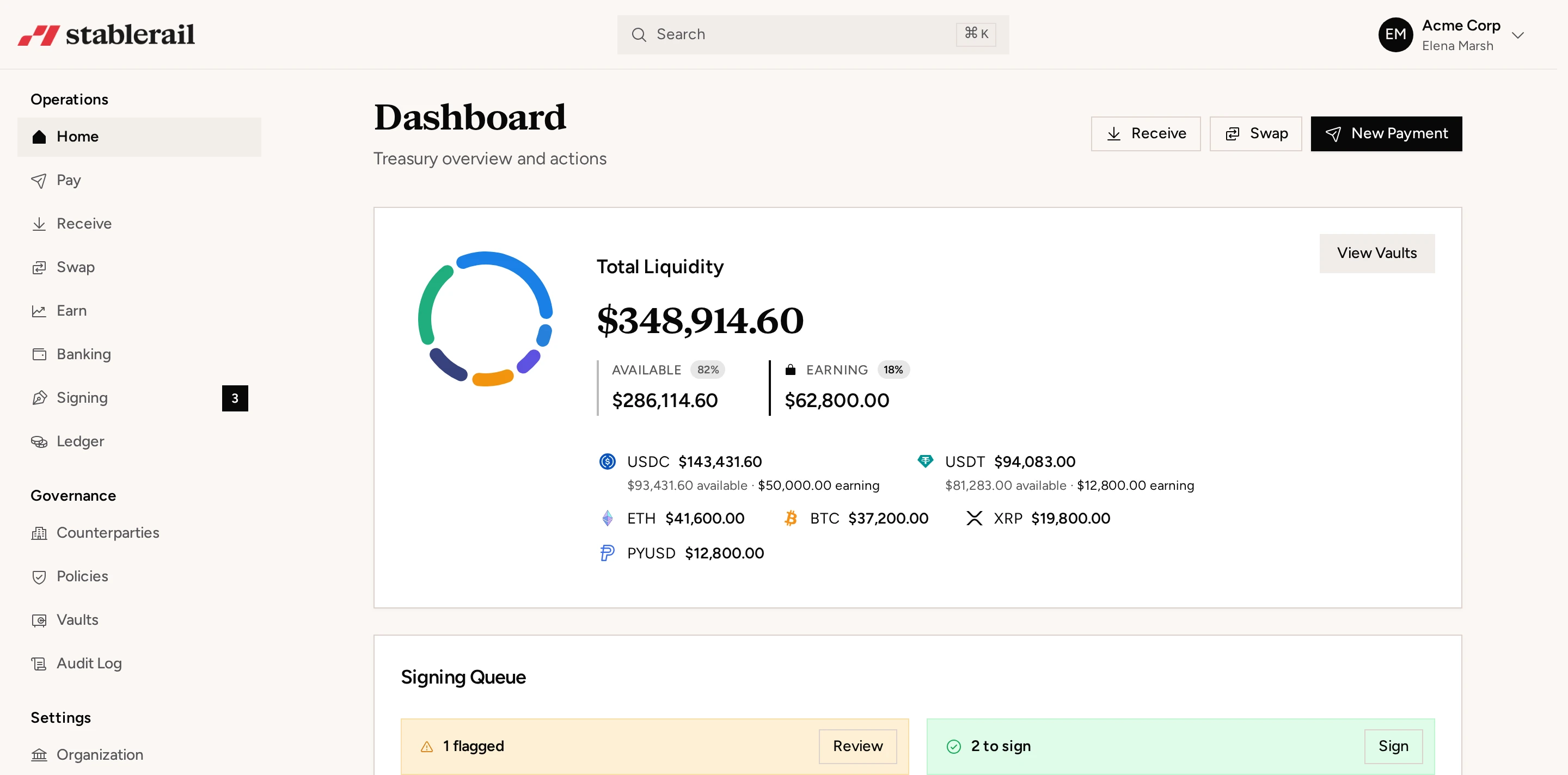
Modern solutions: Systems like Stablerail integrate policy-as-code governance, risk dossiers, and tiered approvals to enforce rules in milliseconds, ensuring every transaction is documented and compliant.
Bottom line: Real-time controls are transforming how stablecoin treasuries operate in 2026, helping finance teams follow a stablecoin compliance checklist to meet tough regulatory demands while preventing compliance gaps.
Compliant Cross-Chain Lending With ZK Pre-Checks | Kacper Koziol - Amish Protocol
Core Metrics for Real-Time Policy Adherence
Treasury teams rely on four primary indicators to evaluate cross-chain governance: policy enforcement rates, cross-chain tracing coverage, anomaly detection accuracy, and audit trail completeness. These metrics are designed to address specific compliance risks, providing measurable insights into whether governance controls are functioning effectively before transactions are executed. Let’s break down each metric and its role in ensuring proactive compliance.
Policy Enforcement Rates
This metric measures the percentage of transactions that successfully pass automated pre-sign checks, which include policy limits, mandatory approvals, and governance rules. It categorizes transactions into three groups: those that pass all checks on the first attempt, those flagged but later approved with proper justification, and those blocked due to policy violations. For well-functioning operations, legitimate transactions should consistently exceed a 95–98% success rate, while blocked transactions should account for less than 2% of the total volume.
Real-time enforcement ensures compliance by applying machine-enforceable rules, such as “Payments over $5,000 to new addresses require CFO approval” or “Only allow USDC transactions on Base or Ethereum.” These constraints are applied before a transaction is signed, preventing violations from occurring.
Cross-Chain Tracing Coverage
Cross-chain tracing coverage evaluates the ability to monitor asset movements across multiple blockchains and bridges, ensuring complete visibility of fund flows. Current tools can trace assets across more than 50 blockchains and over 720 attributed bridges and swap services. Given that blockchain bridges have facilitated over $680 billion in crypto swaps, comprehensive tracing is critical for compliance.
This metric tracks the percentage of cross-chain transactions with full attribution, identifying not only the assets involved but also the initiators and destinations. For example, Homeland Security Investigations (HSI) used blockchain intelligence to trace proceeds from an opioid and fentanyl vendor across multiple chains, leading to the seizure of over $1.5 million and the takedown of the operation.
Anomaly Detection Accuracy
Anomaly detection accuracy focuses on identifying unusual transaction behaviors while minimizing false positives that can disrupt operations. This involves monitoring deviations in transaction amounts, timing anomalies (e.g., transfers during weekends when policies mandate weekday activity), and unexpected wallet reuse.
Effective systems analyze patterns by clustering activity into behavioral profiles, linking wallets based on timing, transaction patterns, and reuse. The goal is to enhance sensitivity - accurately identifying genuine anomalies - and specificity, reducing false alarms. For example, tools like TRM have attributed over 180 million cross-chain swaps to detect high-risk activities and obfuscation tactics.
Audit Trail Completeness
Audit trail completeness measures how thoroughly transactions are documented, covering every step from the initial intent to final execution. Each record should include timestamps, specific policy clauses triggered, evidence supporting decisions, and the identities of approvers.
Regulatory compliance demands detailed audit trails. For instance, under EU MiCA regulations, crypto asset service providers must maintain real-time transaction monitoring with auditable systems. Non-compliance can result in fines of up to €20 million or 5% of global annual revenue, whichever is higher. To meet these standards, 100% of transactions should have documentation that satisfies CFO-level scrutiny and is suitable for board reviews, audits, and regulatory inquiries.
Stablerail's Approach to Real-Time Policy Adherence
Stablerail functions as an agentic control plane that operates above custody infrastructure and before transaction signing. This setup allows for real-time governance without slowing down transaction speeds. Unlike traditional custody platforms that focus only on key management, Stablerail integrates business context - like vendor history, invoice details, and policy rationale - into every transaction decision. Below, we break down the key technical components that make this possible.
Self-Custodial MPC Wallets
Stablerail uses MPC-based wallets to hold funds across major chains, including EVM networks like Ethereum and Base, as well as stablecoins such as USDC and USDT. This setup ensures users retain full control of their keys, while Stablerail itself cannot independently sign or execute transactions. By incorporating pre-sign intelligence agents, the system analyzes transaction intents, applies policy checks, and flags risks before funds are moved. This embeds compliance checks directly into the payment process without creating a custodial relationship.
Policy-as-Code Governance
Stablerail digitizes approval processes by enabling finance teams to define machine-enforceable rules that are automatically applied to every transaction intent. These rules ensure consistent governance and traceability. Examples of such policies include:
Payments over $5,000 to new addresses require CFO approval and verification.
Weekend transfers exceeding $10,000 demand additional approval steps.
Transactions are restricted to USDC on Base or Ethereum networks.
The system operates in three steps: transaction intents are created via invoice, CSV batch, or API; automated screening checks for policy limits, compliance concerns, and anomalies; and human approvers make final decisions, documenting their rationale. This ensures every transaction follows established rules while maintaining a clear audit trail.
Risk Dossiers and Human-in-the-Loop Approvals
To ensure thorough documentation and anomaly detection, Stablerail generates a Risk Dossier for every transaction before signing. These dossiers include a verdict (PASS/FLAG/BLOCK) and a plain-English explanation, citing specific evidence like policy clauses and timestamps. They cover:
Sanctions and taint screening.
Behavioral anomaly detection, such as unusual transaction times or amounts that deviate from norms.
Counterparty risk scoring.
Approvers review these dossiers to either approve or override decisions, with all actions and reasons immutably recorded. For example, a $15,000 USDC payment to a new vendor on Base would trigger a flag for exceeding the $5,000 threshold for new addresses. This would require CFO review and approval, with all context provided before execution. Every step is documented to produce evidence suitable for auditors, boards, and regulators. This approach is similar to the screening methods that have enabled platforms to manage over 180 million cross-chain swaps for compliance purposes.
Benefits of Real-Time Cross-Chain Governance
Real-Time vs Batch Monitoring for Cross-Chain Treasury Governance
Real-time governance systems revolutionize treasury operations by using metrics like policy enforcement rates and anomaly detection accuracy. Unlike traditional methods, which identify issues only after transactions are completed, real-time systems intervene before transactions are signed or broadcast. This proactive approach blocks or flags risky payments during the decision-making process, offering treasury teams a more effective way to manage risks and justify their actions to auditors.
Real-Time vs. Batch Monitoring Comparison
Here’s a quick look at how real-time governance stacks up against traditional batch monitoring:
Factor
Traditional Batch/Manual Monitoring
Real-Time Cross-Chain Governance
Timing
Reactive (post-transaction)
Proactive (pre-signature)
Detection Speed
Minutes to days (manual reconciliation)
Milliseconds (automated screening)
Audit Quality
Manual spreadsheets/chat logs
Cryptographic "Proof-of-Control" receipts
Fraud Prevention
Low (vulnerable to "blind signing")
High (simulations and anomaly detection)
Regulatory Defense
Difficult to prove intent/authorization
Full "Policy Trace" for every decision
Real-time governance systems use layered guardrails to prevent 94% of policy violations, adding just 12% more latency to processes. They’re also 13.8x more cost-effective than relying on LLM-based "constitutional" self-checks for each action. These efficiency gains make them a practical choice for high-volume treasury operations.
Efficiency and Compliance Benefits
Real-time systems offer operational advantages that go beyond just speed. By using policy-as-code governance, spending limits, whitelists, and approval workflows become machine-enforceable. This ensures 100% compliance and eliminates the risk of unauthorized manual overrides. These systems can also detect tainted counterparties or unusual behavioral patterns - like odd timing or velocity spikes - helping to prevent issues like stablecoin freezes or regulatory breaches. Auditors benefit from having a complete context for every decision.
For treasury teams handling internal fund transfers between subsidiaries, real-time systems simplify the process. They automatically verify "Own-Account" relationships, removing the need for complex manual checks while maintaining a full audit trail. This built-in compliance ensures every transaction meets regulatory standards seamlessly.
Stablecoin Compliance in 2026
Treasury teams managing stablecoins in 2026 are navigating a landscape of heightened regulatory scrutiny, building on the controls and metrics already in place.
Regulatory Pressures on Stablecoin Treasuries
Stablecoin treasuries are under increasing pressure from global regulators. The FATF Travel Rule now mandates that Virtual Asset Service Providers (VASPs) and financial institutions identify and share information about both the originators and beneficiaries of digital asset transactions. In parallel, the EU's Anti-Money Laundering Authority (AMLA) is addressing what it sees as a blind spot in decentralized cross-chain infrastructures. This includes enforcing stricter oversight across multi-asset operations and tightening anti-money laundering (AML) requirements for DeFi protocols and non-custodial bridges.
The urgency is clear. By 2024, more than $7 billion in illicit cryptocurrency was laundered through cross-chain methods, leading law enforcement to adopt advanced tracing tools. A notable case was the Nomad Bridge exploit in 2022, where the U.S. Department of Justice tracked $190 million in stolen funds through intricate laundering schemes involving privacy coin swaps and mixers.
To stay compliant and avoid asset freezes, treasury teams need to move from reactive to proactive measures. This involves integrating real-time sanctions and AML screening into payment workflows, setting smart cool-off periods for high-value transactions (e.g., over $100,000) or for new payees, and maintaining a verified "golden source" list of approved counterparties. These evolving regulatory demands have led to the development of innovative tools aimed at streamlining compliance for treasury teams.
Stablerail's Regulatory Preparedness
Stablerail has positioned itself as a solution for meeting these regulatory challenges. Its Treasury Hub and Policy Console modules are equipped with robust safeguards to ensure compliance. The system includes pre-sign checks like sanctions screening and counterparty analysis, and each transaction produces a Risk Dossier. These dossiers provide plain-English explanations, policy references, and timestamps - offering the detailed audit trail regulators require.
The platform also employs policy-as-code governance, allowing compliance rules to be automatically enforced. For example, Stablerail enables tiered approval workflows:
Tier 1 transactions (e.g., routine payroll to verified vendors) are processed automatically through programmatic checks.
Tier 2 transactions (e.g., payments exceeding auto-release limits or involving new vendors) require approval from one finance officer.
Tier 3 transactions (e.g., those over $100,000 or flagged as high-risk) demand dual approval from senior executives, such as the CFO.
Additionally, every payment is accompanied by cryptographic "Proof-of-Control" receipts, ensuring a comprehensive audit trail that aligns with the requirements of both the GENIUS Act and MiCA regulations. This structured and transparent approach helps treasury teams navigate the increasingly complex regulatory environment with confidence.
Conclusion
The move from reactive to proactive treasury management is becoming critical for organizations dealing with stablecoins across multiple blockchains. With tighter regulatory frameworks and increasing cross-chain transaction volumes, ensuring real-time compliance has become the backbone of stablecoin treasury management best practices. Enforcing authorization before settlement not only creates a transparent audit trail but also helps avoid unnecessary regulatory complications. This proactive approach ties directly into the real-time metrics highlighted earlier.
Stablerail addresses this need by acting as an advanced control layer that operates beyond custody and prior to transaction signing. By combining real-time metrics with its cutting-edge controls, the platform allows finance teams to retain full authority over their MPC-based wallets while adding a governance layer that custody platforms alone cannot provide. As Stablerail explains:
Agents verify the context. Humans sign the transaction. The system protects the treasury - it never touches the money.
Through features like its policy-as-code engine, Risk Dossiers, and tiered approval workflows, Stablerail transforms regulatory requirements into enforceable rules. This creates a detailed audit trail that meets the strict expectations of regulators and auditors in 2026. For companies managing stablecoin transactions ranging from $1 million to $50 million annually, this represents a major step forward in how corporate funds are managed and moved.
FAQs
What counts as “real-time” compliance in cross-chain treasury?
Real-time compliance in cross-chain treasury involves actively monitoring and enforcing policies as transactions occur, even before they’re signed. This process includes tasks like sanctions screening, detecting anomalies, and conducting risk assessments to instantly flag or block transactions deemed high-risk. And it all happens without compromising the fast settlement speeds that blockchain technology offers.
How is cross-chain tracing coverage measured in practice?
Cross-chain tracing coverage evaluates how well asset movements across different blockchains are monitored and analyzed. This involves tracking asset flows, spotting unusual activities, and linking transactions to specific bridges or protocols. By using real-time tracking, it becomes possible to capture the full transaction lifecycle, confirm bridge connections, and apply behavioral insights to piece together multi-chain activities. This approach helps reduce risks, ensures compliance, and aligns with governance requirements.
What evidence should an audit trail include for each transaction?
An audit trail needs to capture every step of the process - from the creation of intent to final actions like signing. It should document details such as checks performed, any flags raised, overrides made, approvals granted, and the reasons behind each action. Including precise timestamps for every step is crucial to maintain accountability and transparency throughout the process.
Related Blog Posts
Former CEO of Simple, a self-custodial wallet with $2B+ in transaction volume across 75+ countries.
More about the Stablerail team- Stablecoin treasury managementApprovals, limits, yield and reporting on one balance.
- Stablecoin payoutsBatch contractor and vendor payments with screening.
- USDT vs USDCWhich stablecoin your company should settle in.
- Stablecoin finance glossaryMPC, off-ramp, travel rule and the rest, in plain English.
- Product updatesEverything we ship, month by month.