
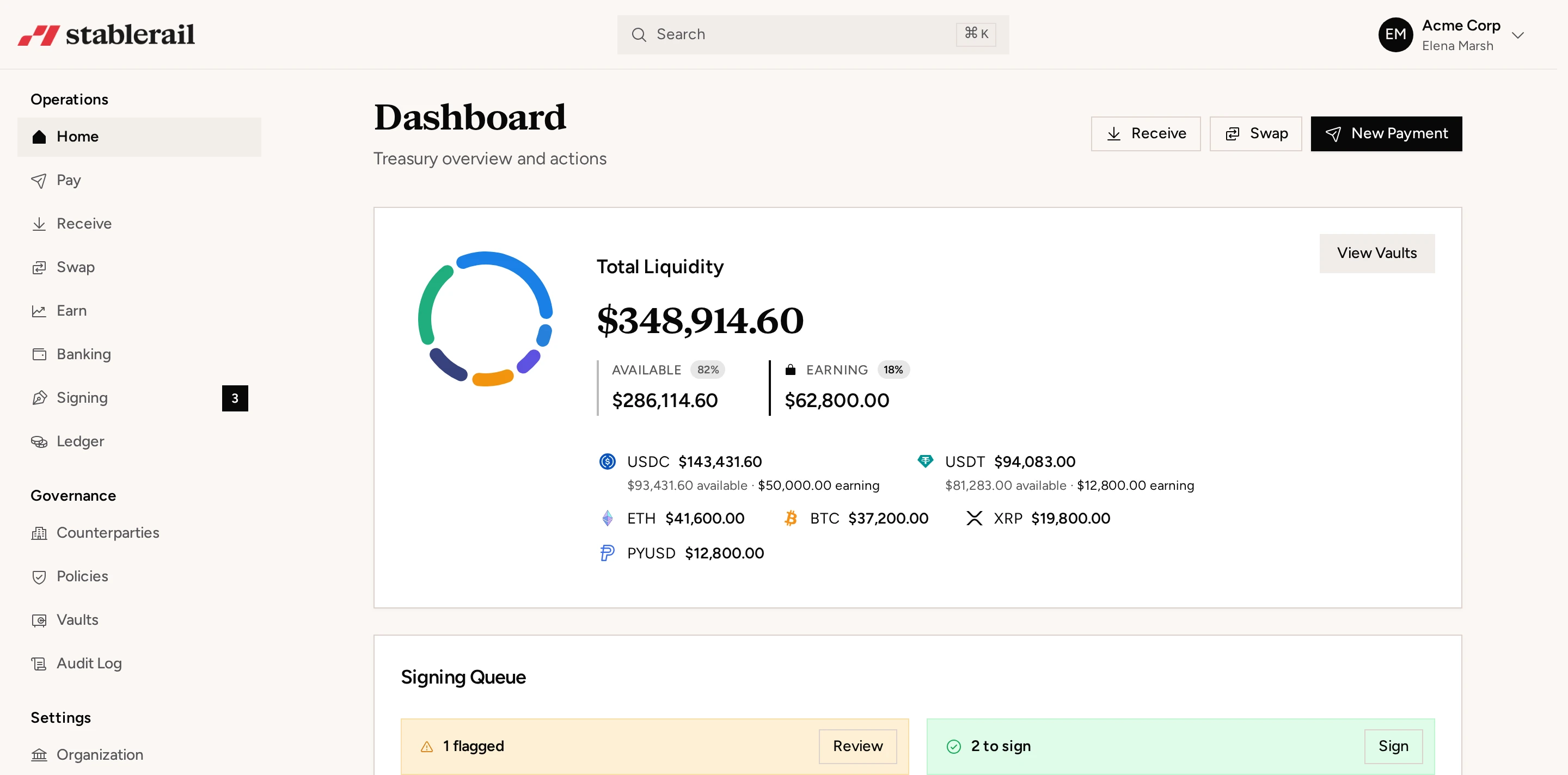
Stablecoin Custody for Enterprises: Guide 2026
2026 enterprise guide to secure and compliant stablecoin custody: governance, MPC wallets, policy-as-code, and pre-sign risk checks.

Stablecoin custody in 2026 is no longer about simply holding digital assets. It’s now an advanced system combining governance, compliance, and security for managing corporate treasuries. With stablecoins surpassing $308 billion in market size and $27.6 trillion in transaction volume, businesses need custody solutions that integrate business logic, risk checks, and regulatory compliance.
Key insights:
Why it matters: Stablecoins offer faster, cheaper transactions compared to traditional payment systems.
Regulations: The GENIUS Act (2025) mandates 100% reserves and compliance for issuers. The upcoming CLARITY Act (2026) strengthens self-custody rights.
Custody options: Enterprises can choose self-custody for full control or institutional custodianship for convenience, with trade-offs in security and speed.
Security: Advanced tools like Multi-Party Computation (MPC) wallets, cold storage, and programmable wallets ensure asset protection.
Governance: Policy-as-code enforces transaction rules, while audit trails and risk checks ensure compliance. Implementing essential controls for stablecoin operations is critical for maintaining audit readiness.
Stablecoin custody today is about combining technical security with structured governance to meet operational and regulatory demands.
Regulatory Framework for Stablecoin Custody in 2026
U.S. Regulations Affecting Stablecoin Custody
The regulatory environment for stablecoin custody saw a major shift in July 2025 with the introduction of the GENIUS Act (Guiding and Establishing National Innovation for U.S. Stablecoins). This federal regulation requires all payment stablecoins to maintain 100% reserves in assets like U.S. dollars, Treasury bills, or repurchase agreements.
"The GENIUS Act establishes a comprehensive framework for payment stablecoins in the United States, addressing a critical gap in financial regulation." - Richmond Fed
Under the Act, only specific entities can issue stablecoins: subsidiaries of insured depository institutions, federally licensed nonbank issuers regulated by the Office of the Comptroller of the Currency (OCC), or certain state-approved issuers. This ensures that businesses interact solely with regulated and compliant issuers.
Looking ahead, the CLARITY Act (Digital Asset Market Clarity Act), expected to pass in 2026, reinforces protections for self-custody. Key provisions, such as Section 15H and the BRCA safe harbor, shield "non-controlling" developers and non-custodial wallet providers from being classified as money transmitters, provided they cannot unilaterally initiate transactions. Section 605 further guarantees the right of individuals and enterprises to self-custody digital assets using self-hosted wallets for lawful purposes.
Stablecoin custody operations must also comply with strict Anti-Money Laundering (AML) and Bank Secrecy Act (BSA) requirements, which include sanctions screening and transaction monitoring. Section 404 of the CLARITY Act bans service providers from offering passive "interest" on stablecoins; any rewards must be tied to activities like staking, liquidity provision, or loyalty programs.
How to Stay Compliant
To navigate these regulations, businesses must carefully align their practices with the new requirements. Start by checking your compliance status and prioritizing stablecoins issued by entities that meet the GENIUS Act's standards. Diversifying holdings across compliant issuers - such as USDC, USDT, or PYUSD - can help mitigate concentration risk.
For enterprises relying on self-custody, it’s critical to structure custody systems to document "non-controlling" status. This ensures compliance with BRCA safe harbor protections under the CLARITY Act by demonstrating that no single party has unilateral control over funds.
Additionally, reward programs must be activity-based, offering incentives like platform usage or liquidity provision rather than passive interest. This adjustment ensures alignment with Section 404. Using segregated on-chain wallets for each entity can simplify audits and reduce risk exposure.
To strengthen governance, implement comprehensive AML/BSA programs that include Know Your Customer (KYC) protocols, OFAC sanctions screening, and transaction monitoring. Establishing clear audit trails for custody decisions will further enhance compliance. The Treasury retains authority to impose "special measures" against offshore platforms that pose money laundering risks, even if the protocol itself is non-custodial.
Finally, the GENIUS Act adds an extra layer of protection by prioritizing stablecoin holders’ claims over other creditors in the event of an issuer's insolvency. This provision provides critical safeguards for enterprise treasuries.
From SWIFT to Stablecoins, Treasury in 2026
Self-Custody vs Institutional Custodians
Self-Custody vs Institutional Custodianship for Stablecoin Management
Self-Custody: Benefits and Challenges
Self-custody gives enterprises direct control over their private keys and assets. By using Multi-Party Computation (MPC), keys are divided among multiple parties, reducing the risk of a single point of failure. Additionally, this setup is protected from bankruptcy risks since stablecoins remain in wallets controlled by the enterprise, not on a third party's balance sheet.
This model offers round-the-clock access and instant transaction execution while eliminating counterparty risk. However, it comes with significant responsibilities. Enterprises must develop and maintain their own security infrastructure, including governance policies, approval workflows, and audit trails. While self-custody ensures fast transactions, it demands strong internal security measures.
Non-custodial approaches often bypass the need for custody licenses since they do not hold assets on behalf of others. Even so, companies must maintain thorough AML/BSA programs and controls to meet compliance standards. This approach aligns with regulatory expectations and compliance checklists but requires a high level of internal oversight.
Institutional Custodianship: What It Offers
Institutional custodianship shifts the burden of key management and compliance to a third party. These custodians take on responsibilities like securing keys, maintaining infrastructure, and providing compliance-grade documentation that satisfies both auditors and regulators. This setup reduces the need for an in-house security team and policy framework.
However, there are trade-offs. Institutional custody introduces counterparty risk - if the custodian becomes insolvent, assets may be frozen or entangled in bankruptcy proceedings. Additionally, enterprises are limited by the custodian's operating hours and approval processes, which can slow down time-sensitive transactions. To balance these risks, some businesses adopt a hybrid model, using institutional custody for long-term reserves while relying on self-custody for day-to-day operations.
Comparison: Self-Custody vs Institutional Custodians
Feature
Self-Custody (MPC/Non-Custodial)
Institutional Custodianship
Asset Control
Full; enterprise holds the keys
Delegated; custodian holds the keys
Bankruptcy Risk
Immune; funds not on a provider's balance sheet
Exposed to custodian's solvency
Operational Speed
24/7 instant execution
Subject to custodian's business hours
Security Burden
High; requires internal governance
Low; handled by the provider
Regulatory Licensing
Often lower requirements
Higher; requires regulated custodian status
Selecting the right custody method is a critical decision for any stablecoin strategy. It boils down to the enterprise's risk tolerance and operational priorities. To quantify these factors, teams can use a stablecoin risk calculator to assess specific asset exposures. Self-custody provides unmatched control but demands significant expertise and resources. On the other hand, institutional custodianship simplifies operations but introduces reliance on a third party. Many enterprises mitigate risks by using segregated on-chain wallets for each entity, ensuring clear accounting and reducing exposure.
Security Requirements for Stablecoin Wallets
Managing stablecoins securely requires a combination of strong on-chain protocols and reliable wallet storage solutions.
MPC Wallets and Multi-Signature Technology
Multi-Party Computation (MPC) spreads signing authority across multiple parties, reducing the risk of a single point of failure. In this setup, private keys are divided into encrypted shares. Each share is useless on its own, and only when a predefined number of shares are combined can a transaction be approved.
This method is especially useful for enterprises handling substantial stablecoin balances. Even if one share is compromised, attackers can’t access the funds. By early 2026, the stablecoin market had already exceeded $310 billion in total market capitalization.
Smart contract wallets are becoming popular due to their ability to include programmable features like automated "cool-off" periods for high-value transactions. For instance, a rule could delay any transfer over $100,000 by four hours, giving finance teams enough time to spot and stop potential fraud or social engineering attempts. Enterprises should also implement transaction requirements, such as attaching a business reference (e.g., an Invoice ID), to maintain a clear and auditable trail.
These on-chain security measures should be paired with strong off-chain protections and hardware-based safeguards.
Cold Storage and Hardware Security Modules
Enterprises need additional layers of security by incorporating offline and hardware-based solutions.
Cold storage offers protection by keeping most funds offline and out of reach from internet-based attacks. A tiered wallet strategy can help: reserve funds in cold wallets, handle regular operations with warm wallets, and limit hot wallets to small, automated transactions.
Hardware Security Modules (HSMs) provide another critical defense by storing private keys within tamper-resistant devices. For institutional-grade security, enterprises should use HSMs certified to FIPS 140-3 standards, which are widely recognized by auditors. Some organizations go a step further with air-gapped environments, where systems are completely disconnected from external networks, ensuring maximum isolation. Regularly testing key-share backups on tamper-evident media is also essential for ensuring recovery during emergencies.
Insurance and Third-Party Audits
Insurance and external audits add an extra layer of protection. Independent audits confirm that security measures are effective and meet industry standards. These audits also generate documentation, such as proof-of-control records, that can be used for compliance.
The GENIUS Act, set to take effect by late 2026, prohibits custodians from mixing customer assets with stablecoin reserves. This makes secure, segregated cold storage an absolute necessity for compliance. Additionally, enterprises should maintain a detailed inventory of their cryptographic tools and begin experimenting with NIST-standardized Post-Quantum Cryptography (PQC) algorithms in controlled environments to prepare for emerging threats.
How to Build Stablecoin Custody Policies
Creating custody policies for stablecoins is a critical step in ensuring secure and compliant management for enterprises. Beyond securing wallets, it's essential to establish clear roles and conditions for every transaction. As Stablecoin Insider explains:
"A stablecoin treasury cannot be 'a wallet that holds funds.' It must be an operating system with documented rules, enforceable permissions, and an auditable reconciliation process."
This highlights the importance of a strong governance framework to manage stablecoin operations effectively.
Setting Up Governance and Approval Rules
A key principle here is Separation of Duties (SoD). No single individual should have control over the entire payment process. Instead, responsibilities should be divided among distinct roles:
Requester: Initiates the payment and provides supporting documentation.
Preparer: Compiles the transaction batch.
Approver: Ensures compliance with policies.
Signer: Handles the cryptographic signing of transactions.
Reconciler: Matches blockchain transactions with ledger entries.
To enhance governance, policy-as-code can transform these rules into machine-enforceable logic. For example, you could automate conditions like "Payments over $5,000 to new addresses require CFO approval" or "Weekend transfers exceeding $10,000 need additional verification." Unlike basic multisig setups, smart contract wallets allow these permissions to be programmed directly into the contract, making it possible to update governance without needing to move assets.
Once governance rules are in place, the next step is implementing robust risk checks before transactions are executed.
Risk Management and Pre-Transaction Checks
Before approving any stablecoin transactions, it's crucial to perform pre-sign checks. These checks should cover:
Sanctions screening: Ensuring compliance with regulatory requirements.
Taint and exposure analysis: Identifying any links to illicit activities.
Behavioral anomaly detection: Flagging unusual transaction patterns, such as odd amounts or unexpected timings.
Counterparty risk scoring: Evaluating the reliability of transaction partners.
Assets should also be segmented into different wallet types based on their purpose:
Cold wallets: For reserves.
Warm wallets: For operational needs.
Hot wallets: For automated transactions.
Fee wallets: For transaction costs.
Each wallet type should have its own thresholds and controls. For example, Siemens demonstrated how programmable payments using JPM Coin in 2025/2026 automated internal treasury transfers based on predefined rules, embedding compliance directly into the payment process.
Maintaining Audit Trails and Documentation
For every transaction, it’s critical to link it to a clear business reference, such as an Invoice ID or Payroll Batch ID. This ensures that all on-chain movements can be traced back to legitimate business activities. The full lifecycle of each transaction should be documented, including:
Who initiated the request.
What checks were performed.
Any red flags that were raised.
Who approved or overrode decisions.
When the transaction was signed.
Conduct periodic shadow audits to verify that controls are functioning as intended. As regulatory scrutiny on stablecoin operations grows, maintaining a detailed and accurate audit trail not only ensures compliance but also provides evidence that every action was deliberate and well-documented. These records are invaluable for meeting both immediate regulatory demands and long-term audit requirements.
Stablerail: Governance Layer Above Custody
Traditional custody solutions manage key storage and transaction signing but often lack insight into the business reasons behind transactions - like who initiated them, why they were requested, and whether they align with company policies. Stablerail fills this gap by adding a governance layer above your custody setup, enforcing transaction policies before any signing occurs. This approach combines technical security with structured governance to elevate stablecoin custody.
How Stablerail Works
Stablerail uses a self-custodial model with MPC-based wallets across major EVM networks, ensuring it never has unilateral signing authority over your funds. This design keeps your assets under your control and separate from Stablerail’s balance sheet, offering protection even in the event of bankruptcy.
Before any transaction is signed, Stablerail performs a series of mandatory pre-sign checks using specialized agents:
Sanctions screening: Ensures compliance with global regulations.
Taint and exposure analysis: Flags transactions linked to questionable sources.
Behavioral anomaly detection: Identifies unusual patterns, like unexpected amounts or timing.
Counterparty risk scoring: Evaluates the reliability of the recipient.
Transaction simulation: Prevents errors from "blind signing."
Each check provides detailed explanations, policy references, and timestamps, ensuring transparency for your team when a transaction is flagged.
Governance rules are defined using policy-as-code, which turns business requirements into enforceable logic. For example, you could create a rule like: "Payments over $5,000 to new addresses require CFO approval." Additional safeguards include smart cool-off periods for large transfers and escalation triggers when vendor payment details change.
What Enterprises Gain from Stablerail
Stablerail transforms stablecoin payment management by replacing scattered workflows - like juggling wallets, spreadsheets, and Slack approvals - with a centralized, structured policy engine. Finance teams gain role-based access controls and formal approval workflows that mirror the governance of traditional banking systems.
The platform also maintains detailed audit trails, documenting every step from payment intent to final execution. These records provide CFO-grade evidence for auditors, boards, or regulators. Additionally, Stablerail identifies freeze-risk patterns that could lead to stablecoin issuers blacklisting addresses, helping protect your operational liquidity.
Stablerail primarily serves companies managing $1 million to $50 million in stablecoins annually. It operates on a subscription model that scales based on the number of entities, active users, and transaction volume.
Transaction Workflow: Intent to Execution
Stablerail’s workflow integrates governance and risk management into every stage of the transaction process, bridging the gap between custody infrastructure and business decision-making.
Here’s how the end-to-end process works:
Create intent: Upload an invoice, submit a payout file, or use the API to initiate a payment.
Generate Risk Dossier: The system runs pre-sign checks and provides a verdict (PASS, FLAG, or BLOCK) with detailed reasoning.
Review and approve: Designated approvers review the dossier and either approve or override, with documented explanations.
Sign transaction: Authorized signers complete the process using MPC wallets in a single "Approve & Sign" step.
Record and receipt: Every action is logged, producing a complete compliance record.
This process ensures that every stablecoin payment meets the same rigorous standards of scrutiny and documentation as traditional bank wires, while still benefiting from the speed of blockchain settlements.
Implementation Roadmap for Self-Custody
Creating a self-custody framework for stablecoins involves a step-by-step process that ensures both security and operational efficiency. Most enterprises move through four main stages: exploration, pilot testing, integration with existing systems, and full automation. This roadmap builds on earlier discussions around risk management and technical safeguards, offering a guide toward fully autonomous stablecoin operations.
Setting Up Wallet Infrastructure
A tiered wallet architecture is essential to separate funds based on their purpose and associated risk. Here's how it typically breaks down:
Cold or reserve wallets: These are used for long-term asset storage and require strict approval processes, often employing a 3-of-5 MPC (Multi-Party Computation) setup.
Warm or operational wallets: These handle day-to-day payouts and settlements, with daily reconciliation and standard approvals (e.g., 2-of-3 MPC).
Hot or automation wallets: Designed for programmatic workflows, these wallets have strict balance caps to minimize exposure.
Fee or gas wallets: These wallets manage network transaction costs and are refilled under controlled conditions.
To secure private keys, split them into "shards" using MPC and Threshold Signature Schemes (TSS). For example, a 3-of-5 setup requires collaboration among multiple participants to complete a transaction, ensuring redundancy and eliminating risky 2-of-2 setups. To further enhance security, require hardware security modules (HSMs) or physical hardware keys for all authorized signers. This step helps protect against threats like SIM swaps or remote hacking.
Adding Governance and Policy Tools
Once the wallet infrastructure is in place, the next step is integrating governance controls to enforce business policies at the transaction level. Policy-as-code governance ensures that unauthorized actions are blocked, even if a transaction meets the signing quorum. For instance, tools like Stablerail's Policy Console allow you to define automated rules such as:
"Payments over $5,000 to new addresses require CFO approval."
"Weekend transfers exceeding $10,000 demand additional verification."
These rules are automatically applied to every transaction before signing occurs.
To further strengthen governance, implement role separation across different functions like requester, preparer, approver, signer, and reconciler. Introduce temporal controls, such as a mandatory 4-hour delay for high-value transfers (over $100,000) or payments to new recipients. This approach minimizes risks from social engineering. No single person should have the ability to control multiple roles in this process.
Monitoring and Maintenance
Maintaining security and compliance in a self-custody setup requires ongoing monitoring and regular upkeep. A 30-60-90 day roadmap can help you establish a structured maintenance plan:
Days 0–30: Define the scope, draft wallet policies, set up wallet tiers, and implement daily reconciliation processes.
Days 31–60: Onboard counterparties, run controlled pilots, and formalize access review procedures.
Days 61–90: Integrate reconciliation into your finance systems and conduct incident response drills to test team readiness.
Monitoring should focus on three key metric categories:
Security metrics: Track changes to signer sets, new destination addresses, and policy overrides.
Operational metrics: Measure settlement speed, costs per transfer, service level agreements for approvals, and exception rates.
Financial metrics: Monitor wallet balances by tier, spikes in fees, and unusual network activity.
Set automated alerts for critical events, such as hot wallets exceeding balance caps or unauthorized withdrawals from reserve wallets. Maintain a "golden source" whitelist of approved vendor addresses, locking accounts automatically if payment details change. Any such changes should trigger mandatory escalation and manual review.
Every transaction should produce a Proof-of-Control receipt, linking the transaction hash to its business purpose and evidence of approval. This documentation plays a vital role in audits, board reviews, and regulatory inquiries.
"A stablecoin treasury cannot be 'a wallet that holds funds.' It must be an operating system with documented rules, enforceable permissions, and an auditable reconciliation process." – Stablecoin Insider
Conclusion
Key Takeaways
By 2026, stablecoin custody has evolved far beyond just securing private keys. It's now about creating a full-fledged system for managing digital treasuries, complete with role-based governance that separates tasks like requests, approvals, and signing functions.
Today's effective custody relies on three core principles:
Policy-as-code governance: Automatically enforces spending limits and whitelists.
MPC-based wallet infrastructure: Removes single points of failure.
Pre-signature verification: Offers Risk Dossiers before transactions occur.
These aren't just nice-to-have features - they're essential for meeting regulatory requirements like the GENIUS Act and protecting against the irreversible nature of on-chain transactions.
The shift from blind signing to informed, contextual decision-making is a game-changer. Systems like Stablerail illustrate this approach perfectly:
"Agents verify the intent. Humans sign the transaction. The system protects the treasury - it never touches the money".
This approach, described as "copilot, not autopilot", keeps human oversight in the loop while automating tasks like sanctions checks, anomaly detection, and policy enforcement during transaction decisions.
Equally important is the security architecture. A tiered wallet setup - cold wallets for reserves, warm wallets for operations, and hot wallets for automation - combined with user-specific on-chain addresses, minimizes risk and simplifies audits. Moreover, every transaction should generate a Proof-of-Control receipt, linking the on-chain hash to business purpose, approval evidence, and compliance with policies.
With these strategies in place, enterprises can confidently move toward practical implementation.
Next Steps
To get started, follow a structured 30-60-90 day roadmap:
First 30 days: Define the scope of your treasury, draft a Wallet Policy v1 with an approval matrix, and establish a tiered wallet infrastructure.
Days 31-60: Onboard counterparties using standardized procedures and conduct controlled pilots with strict transaction limits.
By day 90: Integrate automated reconciliation into your financial systems and run incident response drills for scenarios like key compromises or network disruptions.
For companies managing $1 million to $50 million annually in stablecoin transactions, it's crucial to evaluate governance systems that operate above custody and before signing. These systems should enforce controls similar to those used for traditional bank wires - dual approvals, velocity limits, and sanctions screening - while maintaining the speed of blockchain settlements. Start with high-friction use cases, such as cross-border contractor payments or intercompany transfers, before scaling to broader treasury operations.
The June 2025 survey showing that 54% of non-users plan to adopt stablecoins within 6 to 12 months highlights the urgency of this transition. Success will come to enterprises that approach stablecoin custody not just as a wallet for storing funds, but as a comprehensive operating system with clear rules, enforceable permissions, and a transparent reconciliation process.
FAQs
Should my company choose self-custody or an institutional custodian?
Deciding between self-custody and using an institutional custodian comes down to your company’s specific needs, risk tolerance, and compliance obligations.
Self-custody gives you complete control over your funds. With tools like MPC-based wallets, automated checks, and audit trails, you can strengthen both security and governance. This approach ensures that your business remains in charge of its assets at all times.
On the other hand, institutional custodians take the burden of key management off your shoulders. They simplify operations by holding the keys for you. However, they often lack the detailed business context and level of control that self-custody provides.
Ultimately, the decision boils down to what matters most to your organization: Do you prioritize control and compliance? Or are you looking for simplicity and delegation? Choose the approach that aligns best with your goals.
What do the GENIUS Act and the CLARITY Act change for enterprise stablecoin custody?
The GENIUS Act and the CLARITY Act aim to simplify regulations around enterprise stablecoin custody. They introduce safe harbors for developers, clearly define the roles of federal and state authorities, safeguard self-custody rights, and set guidelines for stablecoin backing and yield generation. These updates help businesses by improving compliance, boosting security, and providing operational consistency.
What controls should be enforced before signing a stablecoin transfer?
Before finalizing a stablecoin transfer, it's crucial to have these safeguards in place:
Sanctions screening: Ensure restricted addresses are blocked to avoid compliance violations.
Policy enforcement: Set up rules like transaction limits or additional approvals for high-value transfers or new addresses.
Pre-sign risk checks: Look for irregularities, assess counterparty risks, and confirm the intent behind the transaction.
Automated compliance: Implement systems that apply your policies consistently across all transactions.
Human-in-the-loop approvals: Incorporate manual review processes with a detailed audit trail to maintain accountability.
Related Blog Posts
Former CEO of Simple, a self-custodial wallet with $2B+ in transaction volume across 75+ countries.
More about the Stablerail team- Stablecoin treasury managementApprovals, limits, yield and reporting on one balance.
- Stablecoin payoutsBatch contractor and vendor payments with screening.
- USDT vs USDCWhich stablecoin your company should settle in.
- Stablecoin finance glossaryMPC, off-ramp, travel rule and the rest, in plain English.
- Product updatesEverything we ship, month by month.