
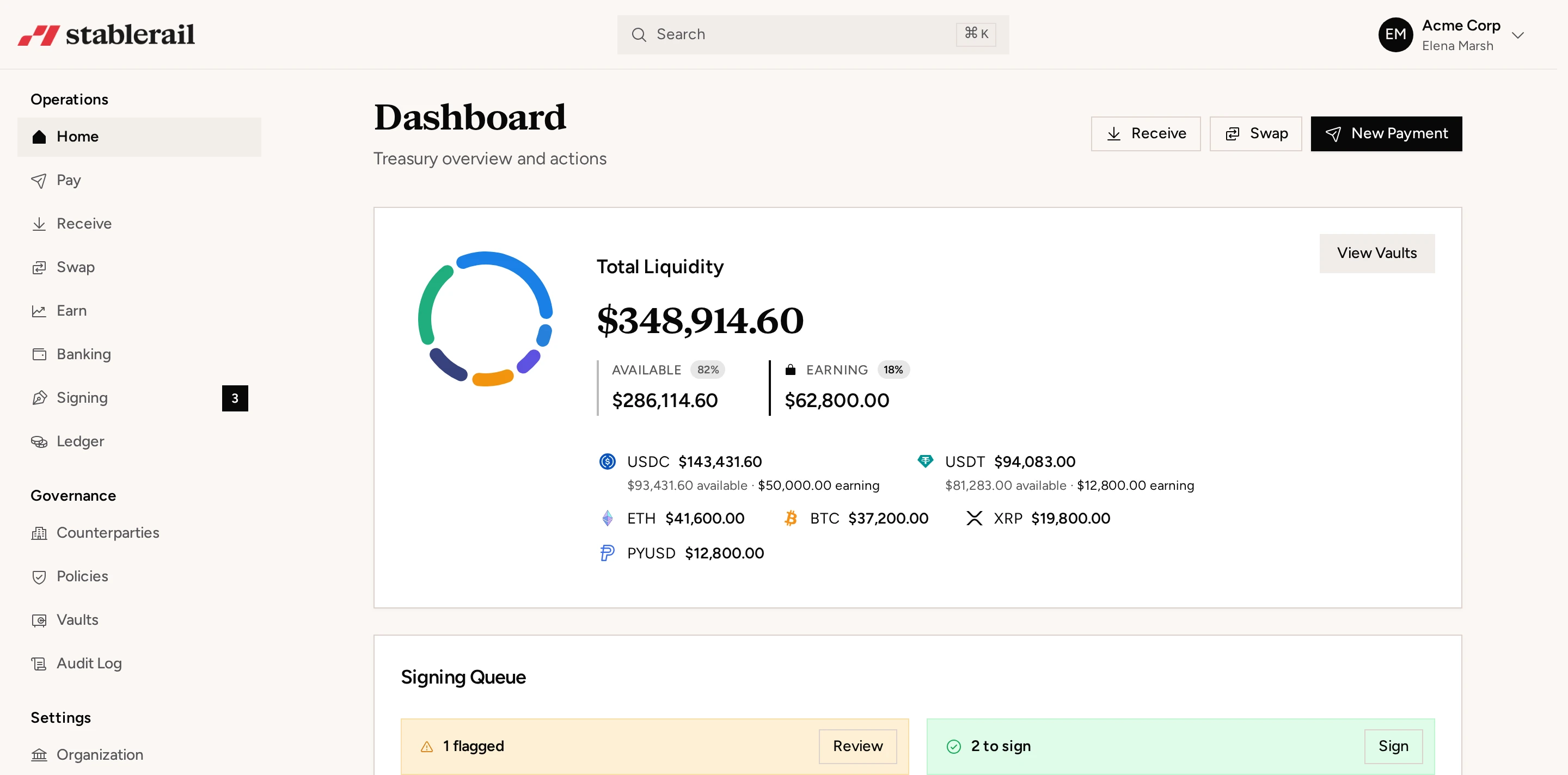
Pre-Signing Controls: Audit Evidence in Real Time
Enforce policy and sanctions screening before stablecoin transfers to create real-time, tamper‑proof audit evidence and cut reconciliation time.

Want faster, more reliable audit evidence? Pre-signing controls simplify compliance and treasury management by generating audit-ready records before transactions occur.
Here’s the deal:
Traditional methods take 8–12 weeks to gather evidence for blockchain audits.
Pre-signing controls automate this process in hours, ensuring every transaction is verified and documented upfront.
Tools like Stablerail perform instant checks (e.g., sanctions screening, risk assessment) and log every action in tamper-proof records.
Why it matters: Stablecoin transactions settle in seconds, leaving no room for errors or delays. Pre-signing controls prevent issues before they happen, unlike post-transaction reconciliation, which only detects problems after funds move.
Quick Overview:
Timing: Pre-signing controls act before transactions; reconciliation happens after.
Efficiency: Automated logs replace manual effort.
Risk Management: Prevents high-risk transactions upfront.
Cost: Higher initial setup costs but saves time and reduces errors.
If your organization handles $1M–$50M in stablecoin transactions yearly, this approach is a game-changer. Pre-signing controls deliver instant, reliable oversight for high-speed blockchain payments.
How will AI and blockchain shape audit? - Conversations with Auditors, Season 2, Episode 3
1. Stablerail Pre-Signing Controls
Stablerail takes a proactive approach to audit evidence by addressing governance at the moment a transaction is initiated. Instead of relying on after-the-fact reconstruction, the platform creates a detailed record of governance decisions in real-time. This ensures that every payment intent is backed by a defensible chain of decisions, setting a new standard for audit-ready governance that traditional systems struggle to achieve.
Audit Evidence Timeliness
Traditional reconciliation typically involves piecing together evidence long after funds have been moved. Stablerail flips this process on its head by generating audit-ready records in real time. As soon as a payment intent is initiated - whether through an invoice PDF, a payout CSV, or an API call - the platform springs into action. It performs sanctions screening, enforces policies, detects anomalies, and scores counterparty risks instantly. Each of these checks is meticulously logged with timestamps and clear, plain-language explanations. These logs reference specific policy clauses and the data that triggered the verdict (PASS, FLAG, or BLOCK).
This means auditors can review the exact controls applied, the risks identified, and the approvals granted within seconds of the transaction request. This kind of immediate, detailed logging creates a rock-solid foundation for audit trails.
Audit Evidence Completeness
Stablerail doesn’t just stop at real-time validation; it captures every single step of the decision-making process in one centralized, tamper-proof log. Informal approval methods like Slack messages, Telegram chats, or email threads are often fragmented and lack the necessary context to stand up to scrutiny. Stablerail addresses this gap by consolidating every action - intent creation, risk assessments, flags, approver decisions (complete with explanations), and the final MPC signature - into one comprehensive record.
As Stablerail explains:
"Every payout generates a defensible receipt: what was paid, why, who approved, and the risk verdict."
This centralized approach ensures that every transaction is fully documented, searchable, and ready for review.
Risk Mitigation
Stablerail goes beyond documentation by actively preventing high-risk transactions. Its policy-as-code engine enforces strict, predefined rules before any funds are moved. For example, policies like "New address payments over $5,000 require CFO approval and verification" or "Weekend transfers over $10,000 require additional approval" are implemented automatically. The system also flags questionable counterparties or suspicious patterns that could lead to stablecoin issuer freezes, helping safeguard the organization’s financial stability.
Cost Efficiency
Manual reconciliation can bog down finance teams with repetitive tasks, leaving little room for strategic work. Stablerail’s automated evidence generation dramatically reduces this burden, turning weeks of manual effort into just a few hours of review. The platform offers scalable pricing based on entity size, user count, and transaction volume. It’s particularly well-suited for organizations managing between $1 million and $50 million in stablecoin transactions annually. This efficiency highlights the practical benefits of adopting proactive governance measures.
2. Post-Transaction Reconciliation
Post-transaction reconciliation operates differently from pre-signing controls. Instead of preventing issues before they occur, it focuses on verifying what actually happened after funds have been moved. While traditional methods relied on batch exports, which delayed anomaly detection, modern real-time reconciliation has made strides in addressing these delays. However, it remains a detective control, meaning it identifies issues after the fact rather than preventing them.
Audit Evidence Timeliness
The shift to real-time reconciliation has significantly improved the speed of detection. Industry research shows that organizations take an average of 18 months to uncover fraud using older retrospective methods. Real-time streaming technologies have changed this by providing immediate visibility into system events as they happen.
Confluent highlights the risks of delayed detection:
"Waiting hours, or even days, for batch exports of your audit data leaves your organization vulnerable."
Real-time pipelines allow compliance teams to spot anomalies continuously, rather than months later. However, this approach is still reactive - the transaction has already been executed, and now the organization must verify its legitimacy.
Audit Evidence Completeness
One strength of post-transaction reconciliation is its ability to capture the ground truth of events. It records every detail - application logs, infrastructure changes, database updates - creating a thorough and tamper-proof record stored in immutable (WORM) storage for at least seven years.
The challenge, however, lies in reconstructing the context. While these systems can answer "who", "what", and "when", they often struggle with the "why." They may not capture the business rationale, the approval process, or the policies that should have guided the decision.
Risk Mitigation
Risk management is another key focus. Real-time reconciliation can trigger automated responses - like blocking an IP address or disabling an account - within milliseconds of detecting an anomaly. This is a major improvement over batch processing, which might allow fraudulent activity to go unnoticed for days or weeks. Considering that companies lose an average of 5% of their revenue to fraud annually, and manual audits only catch fraud 40% of the time, this speed is critical.
Still, post-transaction controls remain reactive. By the time an issue is flagged, the funds have already moved, payments have been made, and finance teams are left dealing with the fallout. As Paul Dixon of VOQUZ Labs points out:
"The risk of missing critical issues drastically increases when internal controls professionals only see periodic updates and reports (e.g., quarterly)."
Cost Efficiency
Automation has eased some of the burdens of post-transaction reconciliation. Real-time monitoring spreads the workload across daily or weekly tasks, avoiding the year-end rush that often leads to errors or oversights. Automated internal controls have been shown to reduce audit fees by 27%, while also cutting down on false positives that inflate labor costs.
Despite these efficiencies, the process still demands significant manual effort. Teams must investigate flagged transactions, piece together approval chains, and compile evidence for auditors. The backward-looking nature of post-transaction reconciliation means finance teams are focused on validating past decisions rather than ensuring sound decision-making upfront. This contrasts sharply with the proactive approach of pre-signing controls.
Advantages and Disadvantages
Pre-Signing Controls vs Post-Transaction Reconciliation Comparison
This section takes a closer look at the pros and cons of pre-signing controls versus post-transaction reconciliation, building on earlier operational differences. Each method offers distinct strengths, with pre-signing controls addressing issues upfront and post-transaction reconciliation focusing on retrospective verification.
Pre-signing controls significantly cut down the time needed to assemble evidence compared to traditional methods. A common audit challenge is verifying the reliability of blockchain explorer tools used for evidence. By embedding governance directly into the transaction approval process, pre-signing controls act as "processing integrity controls", ensuring that transactions adhere to set policies as they happen. This proactive approach not only detects errors but also works to prevent them in the first place.
However, implementing pre-signing controls comes with higher upfront costs. These include investments in layered access systems, segregation of duties matrices, and key management ceremonies supported by HSM audit logs. This setup can be particularly challenging for businesses managing multiple blockchain addresses, exchange accounts, and custodial relationships, as each requires clear documentation of custody roles and responsibilities.
On the other hand, post-transaction reconciliation excels in ensuring completeness. It captures a comprehensive record of every event - application logs, infrastructure changes, and database updates - stored securely in immutable storage for at least seven years. While this method is inherently retrospective, advancements in automation have significantly reduced the time it takes to identify issues. Older methods could take up to 18 months to uncover fraud, but modern tools have sped up this process. Additionally, automated internal controls have been shown to reduce audit fees by 27%.
Here’s a side-by-side comparison of the two approaches:
Aspect
Pre-Signing Controls
Post-Transaction Reconciliation
Timing
Proactive (before signing)
Retrospective (after period-end)
Evidence Generation
Automated logs and risk alerts
Manual assembly of records, reconciliations
Auditor Focus
High-risk transactions, control effectiveness
Full transaction assertions (completeness, accuracy)
Preparation Time
Hours via ingestion pipelines
8–12 weeks
Risk Mitigation
Near real-time fraud/anomaly detection
Cutoff verification, exception logs
Implementation Cost
High (policy engines, access systems, segregation matrices)
Lower (reconciliation tools, monitoring systems)
Business Context
Captures the "why" (approval rationale, policy enforcement)
Captures the "what" (transaction details, amounts, timestamps)
The core distinction between these methods lies in their focus: prevention versus detection. Pre-signing controls aim to stop issues before they occur, while post-transaction reconciliation identifies problems after the fact. For organizations handling substantial stablecoin volumes - ranging from $1M to $50M annually - there’s a growing preference for pre-signing controls. These controls shift the emphasis from reactive investigations to proactive governance, aligning with the evolving demands of stablecoin management.
Conclusion
The move from post-transaction reconciliation to pre-signing controls marks a major change in how finance teams handle audit evidence for stablecoin payments. Instead of spending weeks manually gathering records from exchanges and custodians, pre-signing controls collect audit evidence as transactions are initiated. This proactive approach not only simplifies stablecoin compliance but also creates a stronger framework for real-time governance.
Given that stablecoin transactions are irreversible and settle in seconds, generating evidence in real-time is critical in a 24/7 settlement environment. Post-transaction reconciliation only highlights losses or compliance violations after the fact. With regulators like the U.S. OFAC enforcing strict liability standards - where penalties apply even for unintentional sanctions violations - real-time screening becomes a necessity. Blockchain’s immutable ledgers make whole-population auditing possible, eliminating the need for sampling. Public chains provide direct, real-time access to transaction histories validated by miners.
For finance teams managing stablecoin volumes ranging from $1 million to $50 million annually, adopting policy-as-code governance is the next step. This approach enforces machine-readable rules before funds are moved. A solution like Stablerail demonstrates how this works: it generates Risk Dossiers with PASS/FLAG/BLOCK decisions, incorporates human approvals for high-risk transactions, and creates detailed audit trails that link on-chain transaction hashes to off-chain business details like invoices and approval justifications. By embedding this business context into the audit trail, pre-signing controls enable real-time and reliable financial oversight.
The benefits go beyond compliance. Automated pre-sign checks replace disjointed processes that rely on Slack messages or spreadsheets, which auditors often find difficult to verify. Instead, every transaction is documented with tamper-proof records, timestamps, and policy references. This creates continuous evidence for key audit areas such as transaction records, reconciliation, and control testing, including access management and segregation of duties.
As blockchain continues to reshape audits by enabling real-time transaction validation through smart contracts, the focus shifts from proving what happened to demonstrating that improper actions were prevented. Pre-signing controls address this shift by providing evidence at the decision point, where governance is most critical.
FAQs
What is a pre-signing control?
A pre-signing control is a governance tool designed to verify and enforce policies before a stablecoin transaction is signed. Unlike methods that rely on post-transaction reconciliation, these controls operate in real time. They handle tasks like sanctions screening, policy enforcement, and risk scoring to ensure compliance and reduce the chances of errors or fraud. Additionally, pre-signing controls offer detailed audit trails, helping organizations manage risks tied to the fast and irreversible nature of blockchain transactions.
What evidence do auditors get from pre-sign checks?
Auditors are provided with detailed audit trails from pre-sign checks, featuring plain-English explanations, precise timestamps, and references to relevant policies. These trails capture verifications for sanctions, exposure levels, policy adherence, unusual behaviors, and counterparty risks. This ensures a clear and accountable process before any transaction is finalized.
How hard is it to implement pre-signing controls?
Implementing pre-signing controls might seem challenging at first, but modern tools make it much more approachable. The process typically includes creating governance policies, setting up verification agents, and defining approval workflows. Automation plays a big role here, offering features like real-time checks, policy enforcement, and audit trails. While the initial setup takes some effort, these controls are built to minimize manual tasks and improve both security and compliance for stablecoin transactions.
Related Blog Posts
Former CEO of Simple, a self-custodial wallet with $2B+ in transaction volume across 75+ countries.
More about the Stablerail team- Stablecoin treasury managementApprovals, limits, yield and reporting on one balance.
- Stablecoin payoutsBatch contractor and vendor payments with screening.
- USDT vs USDCWhich stablecoin your company should settle in.
- Stablecoin finance glossaryMPC, off-ramp, travel rule and the rest, in plain English.
- Product updatesEverything we ship, month by month.