
How Pre-Sign Checks Prevent Sanctions Violations
Pre-sign checks screen destination wallets, exposure paths and transaction details before a stablecoin payment is signed, preventing risky transfers from becoming on-chain incidents.
Pre-sign checks prevent sanctions violations by screening a proposed stablecoin transaction before an authorized signer can approve and broadcast it. They compare the destination and relevant counterparties against sanctions data, assess direct and indirect on-chain exposure, and route exceptions for review. The strongest workflow binds the screening result to the exact transaction, enforces approval quorum, and preserves evidence showing why the payment was allowed or blocked.

Pre-sign checks place sanctions controls directly in the stablecoin payment workflow. Before a USDC or USDT transfer receives the required signatures, the system evaluates the destination, transaction details and available blockchain intelligence. A clear result then determines whether the payment can proceed, requires investigation or must be blocked.
This timing matters because an on-chain payment is generally difficult for the sender to reverse after broadcast. A stablecoin issuer may have freezing capabilities under its terms and applicable law, but a treasury team should not treat that as a recovery mechanism. Screening after settlement may identify a problem, yet it cannot prevent the original transfer.
Why stablecoin sanctions screening requires more than address matching
Blockchain addresses are pseudonymous identifiers, not verified legal names. A sanctioned person can control addresses that do not appear in a public designation, while an address can also interact with illicit funds without being controlled by a sanctioned party. Effective screening therefore requires both list matching and a reasoned assessment of blockchain exposure.
The U.S. Treasury's Office of Foreign Assets Control states that its digital currency address listings are not exhaustive. Businesses may need to act when they identify other addresses owned by or associated with a sanctioned person. OFAC also encourages a risk-based compliance program for companies involved with virtual currency. Relevant guidance is available through OFAC's compliance guidance.
Common risk patterns include:
- Direct designation: The destination address appears in sanctions data or is attributed to a designated person or entity.
- Indirect exposure: The address recently received assets from, or sent assets to, an identified sanctioned service or wallet.
- Intermediary wallets: Funds move through a series of addresses intended to make their source or destination harder to recognize.
- Cross-chain movement: Assets pass through bridges, decentralized exchanges or multiple networks, complicating attribution.
- Service rebranding: A counterparty changes its name or website while continuing to use related on-chain infrastructure.
Indirect exposure is not automatically equivalent to sanctions ownership or control. A low-value, distant connection can have a different risk meaning from a recent direct transfer involving a substantial share of funds. Compliance teams should evaluate proximity, value, direction, recency, attribution confidence and the type of intermediary rather than applying an unexplained rule to every transaction.
How a pre-sign control works
A reliable workflow begins when the payment instruction is created, not when someone opens a block explorer. The request should include the network, asset, token contract where applicable, amount, destination address, beneficiary identity, business purpose and supporting records such as an invoice or withdrawal request.
- Validate the instruction. Confirm the chain, asset and address format. A valid address on the wrong network is still an operational failure.
- Screen the destination. Check current sanctions data, attributed entities and relevant blockchain exposure. For contract interactions, assess the contract, spender or routing service where appropriate.
- Apply the company's decision criteria. Produce an allow, review or block result based on documented thresholds and the applicable sanctions regimes.
- Route exceptions. A reviewer examines the evidence, beneficiary information and transaction purpose. Any override should require a reason and appropriately senior approval.
- Bind approval to the transaction. The screened network, asset, amount and destination must match the transaction presented to signers. A material change should invalidate the prior result.
- Sign and broadcast. Only an approved transaction should reach the required signing quorum. The transaction hash and receipt are then added to the record.
Screening should also have a defined freshness period. Sanctions data and address attribution can change between payment creation and execution. A queued transaction should be screened again if its details change, its approval expires or new risk information becomes available before signing.
Comparison of sanctions control points
| Control approach | When it operates | What it can prevent | Main limitation | Best use |
|---|---|---|---|---|
| Public-list address match | During manual review | Transfer to an exactly listed address if the reviewer catches it | Misses unlisted associated wallets and may be inconsistently applied | Basic check within a broader process |
| Post-transaction monitoring | After broadcast or settlement | Cannot prevent the completed transfer | Creates an alert only after funds have moved | Ongoing monitoring, investigation and reporting |
| Pre-sign screening without enforced approvals | Before signing | Identifies risk before execution | A user may bypass the result or change transaction details | Advisory control for low-risk workflows |
| Pre-sign screening tied to signing quorum | Before authorized signatures | Stops blocked transactions from entering the approved signing path | Depends on current data, sound thresholds and controlled exception handling | Business stablecoin treasury and payout operations |
| Pre-sign plus post-transaction monitoring | Before and after execution | Prevents known risks and identifies later attribution changes | Requires case ownership and continuing review | Higher-volume or higher-risk payment programs |
What evidence should be retained
A screening result is useful only if the company can reconstruct the decision. Finance, compliance and internal audit should be able to determine who requested the payment, what was screened, which data was available, who approved it and what was ultimately sent.
For each transaction, retain:
- The legal entity, requester, beneficiary and stated business purpose.
- The network, asset, token contract, amount and complete destination address.
- The screening timestamp, data source or provider version, result and relevant risk indicators.
- The reasoning behind any review outcome, release or rejection.
- The identities and timestamps of reviewers and signers.
- The exact approved transaction details, signing quorum and any transaction payload identifier used to detect changes.
- The broadcast transaction hash, confirmation record and links to supporting documents.
Records should be exportable in a form auditors can use without relying exclusively on screenshots. Access to edit case notes or change dispositions should be restricted, and corrections should preserve the original entry and show who made the change. Retention periods should follow the legal requirements that apply to the entity and sanctions program.
How to set review and blocking rules
There is no universal number of blockchain hops that makes a wallet safe or prohibited. A defensible process distinguishes a confirmed sanctions match from indirect exposure and documents how each factor affects the decision.
A direct match to a designated address or a high-confidence attribution to a sanctioned party generally requires an immediate stop and escalation under the company's legal procedures. Indirect exposure may require analysis of the path, asset value, percentage of funds, timing, intervening services and whether the connection represents ownership, facilitation or incidental activity.
Behavioral indicators such as rapid movement, asset swaps or use of a bridge can inform a broader investigation, but they do not establish a sanctions violation by themselves. Similarly, geolocation and VPN indicators may be useful for customer or user access controls, but they do not prove who controls an external wallet. Teams should avoid presenting probabilistic analytics as verified identity.
A pre-sign check is a preventive control, not a legal conclusion. Screening data narrows the decision; documented investigation, applicable law and authorized review determine the response.
Finance-team implementation checklist
- Map which sanctions regimes apply based on the entity, counterparties, personnel, banks and jurisdictions involved.
- Require beneficiary identity, payment purpose, chain, asset and destination before screening begins.
- Define separate outcomes for allow, review and block, with named owners and escalation paths.
- Set approval quorum and prevent a blocked transaction from reaching authorized signers.
- Invalidate approval when the destination, network, asset, amount or transaction payload changes.
- Set a screening expiry period and rerun checks before signing delayed payments.
- Document override authority; never permit the requester to approve their own exception.
- Test the process with listed addresses, indirect-exposure scenarios, stale approvals and altered transaction details.
- Export screening, approval and on-chain evidence for periodic control testing.
Where pre-sign checks fit in treasury operations
Pre-sign screening works best as part of a layered sanctions program that includes counterparty due diligence, transaction monitoring, access controls, employee training, case escalation and legally required blocking or reporting. It reduces execution risk, but it cannot compensate for missing beneficiary information, weak vendor data or uncontrolled private keys.
The control should cover every route by which company funds can leave, including treasury transfers, vendor payments, customer withdrawals, global payouts and card-related settlement where relevant. Parallel wallets or emergency processes can undermine the control if they permit unscreened sends.
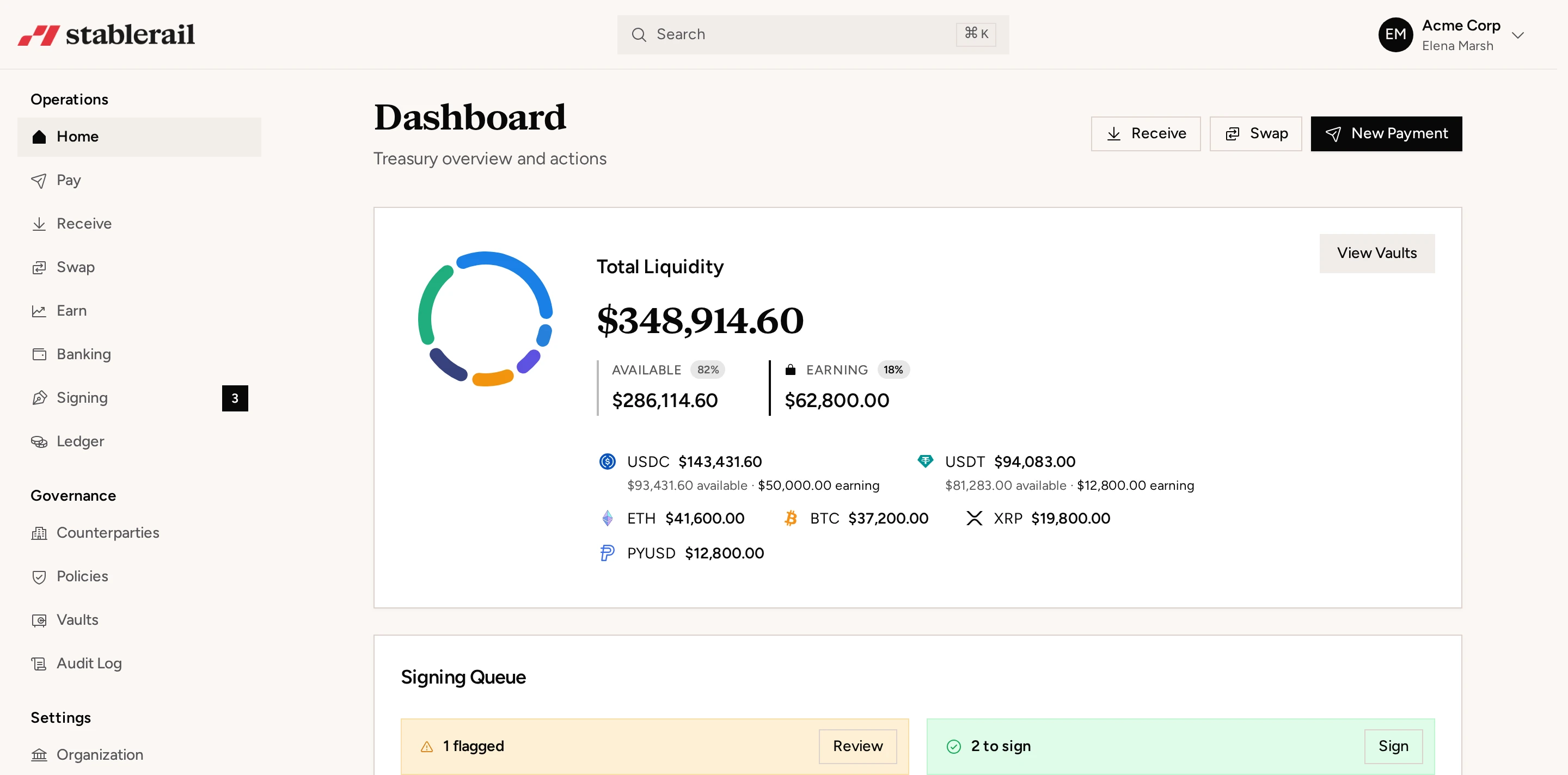
Stablerail brings USDC and USDT treasury activity into one business account with sanctions and address screening before send, approvals and signing quorum, global payouts, fiat off-ramp, corporate cards and exportable audit evidence. Regardless of the platform used, the critical design principle is the same: a transaction that fails required screening must not be able to obtain the signatures needed for execution.
The practical outcome
Post-transaction alerts tell a company what already happened. Pre-sign checks give it a decision point while funds are still under its control. By screening the exact transaction, routing uncertain cases to qualified reviewers, enforcing signing authority and preserving evidence, a finance team can materially reduce the chance that a stablecoin payment reaches a sanctioned counterparty.
The strongest process remains cautious about what blockchain analytics can prove. It combines current screening data with counterparty information, applies documented criteria consistently and escalates potential matches rather than relying on automation alone.
Frequently asked questions
What is a pre-sign sanctions check for a crypto transaction?
It is a compliance review performed before a blockchain transaction receives the signatures needed for broadcast. The check evaluates the destination, applicable sanctions data, on-chain exposure and transaction details, then returns an allow, review or block decision.
Does OFAC require cryptocurrency businesses to screen wallet addresses?
OFAC does not prescribe one universal screening tool or workflow, but U.S. persons must comply with applicable sanctions obligations. OFAC's virtual currency guidance encourages a risk-based compliance program and warns that its published digital currency addresses are not exhaustive.
How many wallet hops should sanctions screening examine?
There is no universally safe or prohibited number of hops. Teams should assess proximity alongside direction, value, recency, attribution confidence, asset flow and the role of intervening services rather than relying only on a fixed hop threshold.
Can a company rely only on post-transaction blockchain monitoring?
No. Post-transaction monitoring can detect later attribution changes and support investigations, but it cannot stop a payment that has already been broadcast. It should complement pre-sign screening rather than replace it.
What should happen when a wallet screening result is inconclusive?
The transaction should pause and move to a documented review queue. A qualified reviewer should examine the exposure path, beneficiary information, payment purpose and applicable sanctions rules, escalating to legal or sanctions specialists when necessary.
What records should be kept for stablecoin sanctions screening?
Keep the transaction details, beneficiary and purpose, screening timestamp and result, relevant risk evidence, reviewer reasoning, approvals, signer records and final transaction hash. The record should also show any overrides or changes made after the initial screening.
Former CEO of Simple, a self-custodial wallet with $2B+ in transaction volume across 75+ countries.
More about the Stablerail team- Stablecoin treasury managementApprovals, limits, yield and reporting on one balance.
- Stablecoin payoutsBatch contractor and vendor payments with screening.
- USDT vs USDCWhich stablecoin your company should settle in.
- Stablecoin finance glossaryMPC, off-ramp, travel rule and the rest, in plain English.
- Product updatesEverything we ship, month by month.