
How Pre-Transaction Checks Reduce Sanctions Risk
How real-time pre-transaction checks stop sanctioned or tainted stablecoin transfers and create audit-ready risk dossiers.

Pre-transaction checks are a critical step for stablecoin payments. They help prevent irreversible mistakes like sending funds to sanctioned wallets, which can lead to severe penalties, frozen assets, and reputational damage. These checks screen wallet addresses, assess risks, and enforce compliance before any funds are moved, ensuring you stay on the right side of regulations.
Key takeaways:
Why it matters: Blockchain transactions are permanent. Mistakes can't be undone.
How it helps: Tools like sanctions screening and taint analysis flag risky transactions in real-time.
Compliance made easier: Proof of pre-transaction checks protects you during audits and regulatory reviews.
Real-world example: A crypto exchange faced $3.4M in fines in 2022 for failing to block transactions linked to sanctioned addresses.
Presentation: Beyond the Hype: Sanctions Compliance in Crypto
Why Screening Before Transactions Prevents Sanctions Violations
The key difference between reactive and preventive compliance lies in timing. Reactive compliance examines transactions after they’ve been executed, identifying and reporting issues only after the fact. Preventive compliance, on the other hand, conducts real-time checks before transactions are finalized, automatically flagging or blocking high-risk transfers. This proactive approach is especially critical in stablecoin operations, where stopping a violation before it happens is the only way to avoid irreversible blockchain transactions. In this context, the distinction isn’t just theoretical - it’s the difference between preventing a violation and merely documenting one after the damage is done.
For example, in 2022, a major crypto exchange faced $3.4 million in fines from OFAC for processing transactions linked to sanctioned Tornado Cash addresses. If the exchange had implemented pre-transaction screening tools like Chainalysis or Elliptic, those transfers would have been flagged and blocked before they could be completed, avoiding the violation entirely. Instead, the issue was discovered too late, resulting in financial penalties, legal challenges, and a hit to the exchange’s reputation.
The financial risks tied to OFAC violations are steep. Civil penalties can reach up to $1 million per transaction, while criminal fines can also hit $1 million, accompanied by potential prison sentences of up to 20 years. Beyond these direct costs, reputational damage can lead to revenue losses that are 10–20 times greater than the fine itself. The table below highlights the stark contrast between reactive and preventive approaches:
Aspect
Reactive Compliance
Pre-Transaction Prevention
Timing
After payment execution
Before payment execution
Detection
Post-transaction monitoring
Real-time screening
Risk Window
Days
Seconds (immediate)
Regulatory Defense
Limited proof of prevention
Full evidence chain available
Remediation
Expensive and challenging
Violations avoided entirely
Pre-transaction screening systems cross-check recipient addresses against sanctions lists and perform taint analysis before a transaction is approved. This approach shifts compliance from merely detecting violations to actively intercepting them, aligning with SEC frameworks for stablecoins. Auditors also require proof that sanctions screenings are conducted and documented within the required policy windows - something only preventive systems can reliably provide. These advantages underscore the importance of following a stablecoin compliance checklist for pre-transaction controls, as detailed in the next guide.
How to Implement Pre-Transaction Checks: A Step-by-Step Guide
5-Step Pre-Transaction Compliance Check Implementation Process
Building a robust pre-transaction screening system involves five key steps that address control gaps - like securing custody, enforcing policies, and maintaining audit trails. Skipping or rushing these steps can lead to compliance headaches during audits, especially if the evidence chain breaks down at the transaction approval stage. The goal? A control framework that ensures identity verification, wallet binding, sanctions screening, segregation-of-duties approvals, and full reconciliation before payments are executed. Here's a structured, audit-ready approach to implementing these controls.
The table below breaks down the control elements finance teams need to implement across three phases: pre-launch, per-transaction, and quarterly testing.
Control Element
Pre-Launch Requirement
Per-Transaction Requirement
Quarterly Testing Requirement
Policy Documentation
Stablecoin policy approved and versioned
Funding source verified and within policy
Policy changes and version logs reviewed
Identity Verification
KYB completed for entity; KYC requirements defined by cohort
Payee verification statuses current
RBAC and access reviews validated
Wallet Management
Wallet policy documented with verification and change controls
New wallets reviewed under step-up controls
Wallet change workflow tested
Sanctions Screening
Sanctions screening rules and escalation workflow tested
Screening completed within the required window
Sanctions hit workflow tested
Approvals
Maker-checker workflow enforced
Batch approvals captured (maker/approver/releaser)
Segregation-of-duties validated
Most compliance failures stem from weak wallet controls, poorly designed payout approvals, or missing audit logs - not the stablecoins themselves. The following steps tackle these vulnerabilities.
Step 1: Set Up Self-Custodial MPC Wallets
Self-custodial MPC wallets distribute private key control across multiple parties or devices, reducing the risk of unilateral fund movement - even by third-party providers. This model keeps your treasury assets under your control and is considered bankruptcy-immune because the platform lacks signing power.
To implement MPC wallets:
Choose providers supporting EVM-based chains and stablecoins like USDC and USDT.
Generate wallets with threshold signatures (e.g., 2-of-3 approvals).
Integrate wallets with your treasury systems for balance visibility across entities and chains.
Document your custody model and test key recovery processes to ensure you can regain access if a key share is lost.
This documentation is essential for audits, as examiners will check whether your custody controls align with your policies.
Step 2: Define Policy Rules in the Policy Console
Policy rules automate compliance by enforcing transaction limits, approval requirements, and asset restrictions before a transaction is signed. These rules ensure consistency and minimize manual errors.
To set up policy rules:
Access the Policy Console and input rules via a user interface or API.
Define roles and limits for different organizational tiers. For example, treasury officers might approve moderate-risk transactions, while high-risk ones require dual approval from senior signers.
Test the rules with sample transactions to confirm they work as intended.
Version your policies to maintain a clear audit trail of updates over time.
The table below illustrates a three-tier approval structure that balances automation with oversight:
Tier
Category
Criteria
Required Approvals
Tier 1
Auto-Release
Routine payroll, verified vendors
Programmatic checks only
Tier 2
Single Approval
Above auto-limit, new vendors
One finance/treasury officer
Tier 3
Dual Approval
>$100,000, high-risk scenarios
Two senior signers (e.g., CFO)
Step 3: Configure Sanctions and Taint Screening
Sanctions and taint screening tools check recipient addresses against sanctions lists (e.g., OFAC, EU) and databases tracking illicit activity. These checks occur pre-transaction and return PASS/FLAG/BLOCK results with evidence. FinCEN mandates these checks for money transmitters handling stablecoins, emphasizing prevention.
To configure sanctions and taint screening:
Integrate API feeds from providers that maintain updated sanctions and taint databases.
Set thresholds for screening and define escalation workflows for flagged transactions. For instance, a match to the OFAC SDN list blocks a transaction, while addresses with 20% taint exposure may require manual review.
Test the setup with historical data to confirm sanctioned addresses are flagged and false positives are manageable.
Automated checks are just the first layer - behavioral analysis adds another level of scrutiny.
Step 4: Enable Behavioral Anomaly Detection and Counterparty Scoring
Behavioral anomaly detection tools analyze transaction patterns - like time-of-day, transaction size, payout frequency, and on-chain history - to flag unusual activity before a transaction is signed. For example, a $50,000 transaction to a new vendor at 2:00 AM might trigger an alert for further review. Counterparty scoring evaluates risk factors like links to mixers or sanctioned entities.
To implement this:
Use historical data to set baseline metrics for anomaly detection.
Configure alert thresholds to balance sensitivity and efficiency. For example, flag transactions exceeding twice the average amount or occurring outside business hours.
Review counterparty scores alongside sanctions screening results, and consider continuous on-chain monitoring for added security.
This layered approach helps identify risks that static rules might miss.
Step 5: Set Up Manual Approval Workflows for Flagged Transactions
Manual approval workflows enforce maker-checker controls with role-based access, ensuring that flagged transactions are reviewed and approved with documented reasons. Typically, this involves three roles: an initiator, an approver, and a signer who authorizes the transaction via MPC.
To configure these workflows:
Define approval requirements in the Policy Console based on transaction tier and risk.
Set up notifications (e.g., via Slack or email) to alert approvers when transactions need review.
Enforce strict segregation of duties, ensuring initiators cannot approve their own requests.
Archive all approvals with timestamps and documented reasons for overrides.
This system not only strengthens compliance but also ensures transparency and accountability in your processes.
Creating Risk Dossiers and Audit Trails for Every Transaction
When processing stablecoin payments, it's essential to create a detailed documentation package - known as a risk dossier - that ties every on-chain transaction to its business purpose, approval process, and risk evaluation. This dossier consolidates all screening results, policy checks, and approval decisions into one record. Why is this important? Without this documentation, there’s no way to prove that necessary controls were in place before the funds were transferred - even if no fraud occurred. This approach ensures that pre-transaction checks are not isolated but are part of a broader compliance strategy, reinforcing proactive risk management across operations.
The dossier itself includes seven critical components:
Pre-verified identity
Timestamped sanctions screening
Policy compliance checks
Behavioral anomaly alerts
Counterparty risk scores
A complete approval chain with override notes
Wallet verification status
By embedding these elements directly into the transaction layer before any signing occurs, compliance efforts shift from merely detecting issues after the fact to actively preventing them in real time. This aligns with earlier policy enforcement steps, ensuring every transaction is backed by a documented chain of evidence.
"Every payout generates a defensible receipt: what was paid, why, who approved, and the risk verdict."
In addition to the risk dossier, robust audit trails are a cornerstone of a secure compliance framework. These trails must clearly demonstrate segregation of duties at every stage. This means recording who created the payment intent, the results of automated checks, the details of reviews and approvals, any override notes, and the final on-chain signing.
Real-time reconciliation is another key element. It ensures that internal approvals align seamlessly with on-chain records. For every transaction, the amount, recipient, and timestamp on the blockchain must match the approved intent. Every on-chain transaction should trace back to its corresponding policy-checked approval, eliminating the reliance on informal methods like Slack messages, email threads, or spreadsheet notes. Instead, timestamped records provide the necessary business context and evidence of control to meet regulatory standards.
To streamline this process, organizations should establish their evidence pack schema before operations begin and archive it after each payment cycle. This evidence pack includes:
Versioned policy documents
Completed identity verifications
Wallet policy records
Timestamped screening results
Maker-checker workflow logs
Blockchain transaction hashes
Exception review documentation
This structured approach ensures that auditors can reconstruct the full evidence chain for any transaction in just minutes. By transforming compliance into a strategic asset, these records not only simplify regulatory reviews but also integrate seamlessly with Treasury Hub monitoring to maintain ongoing compliance.
Using Stablerail to Run Pre-Transaction Checks
Stablerail acts as an agentic control plane, seamlessly connecting your payment intent with transaction execution. Unlike traditional custody platforms that focus on key management, Stablerail integrates sanctions screening, policy enforcement, and approval workflows into a single layer. This all happens before any cryptographic signing, ensuring a higher level of oversight and governance by combining technical controls with human decision-making.
The platform operates through a streamlined three-step process that replaces outdated approval methods:
Create: Initiate a payment intent using invoice PDFs, payout CSVs, or API submissions.
Verify: The system automatically runs pre-sign checks using specialized agents. These include sanctions screening against global watchlists (like U.S. OFAC SDN and UK OFSI), taint analysis, behavioral anomaly detection, and counterparty risk scoring.
Approve & Sign: Human approvers review flagged results and provide cryptographic signatures via Multi-Party Computation (MPC) to finalize the transfer.
This approach follows a "copilot, not autopilot" philosophy. The AI's role is strictly limited to flagging or blocking transactions - it cannot execute transfers independently. For every transaction, Stablerail generates a Risk Dossier with one of three outcomes: PASS, FLAG, or BLOCK. Flagged transactions are immediately locked and sent to a manual approval process, where human approvers assess plain-English explanations supported by evidence like policy clauses, timestamps, and risk scores.
"Agents verify the context. Humans sign the transaction. The system secures your treasury without ever handling funds."
Stablerail
As non-custodial software, Stablerail ensures your funds remain in MPC-based wallets under your control, currently supporting major EVM networks with plans to expand to Solana. The platform never has unilateral signing authority. Stablerail is designed for companies handling $1M–$50M in annual stablecoin volume, offering an annual subscription model tailored to entities, active users, and transaction volume. This integrated system not only simplifies pre-sign checks but also strengthens risk management across your treasury operations.
Tracking Risk Reduction with Treasury Hub Monitoring
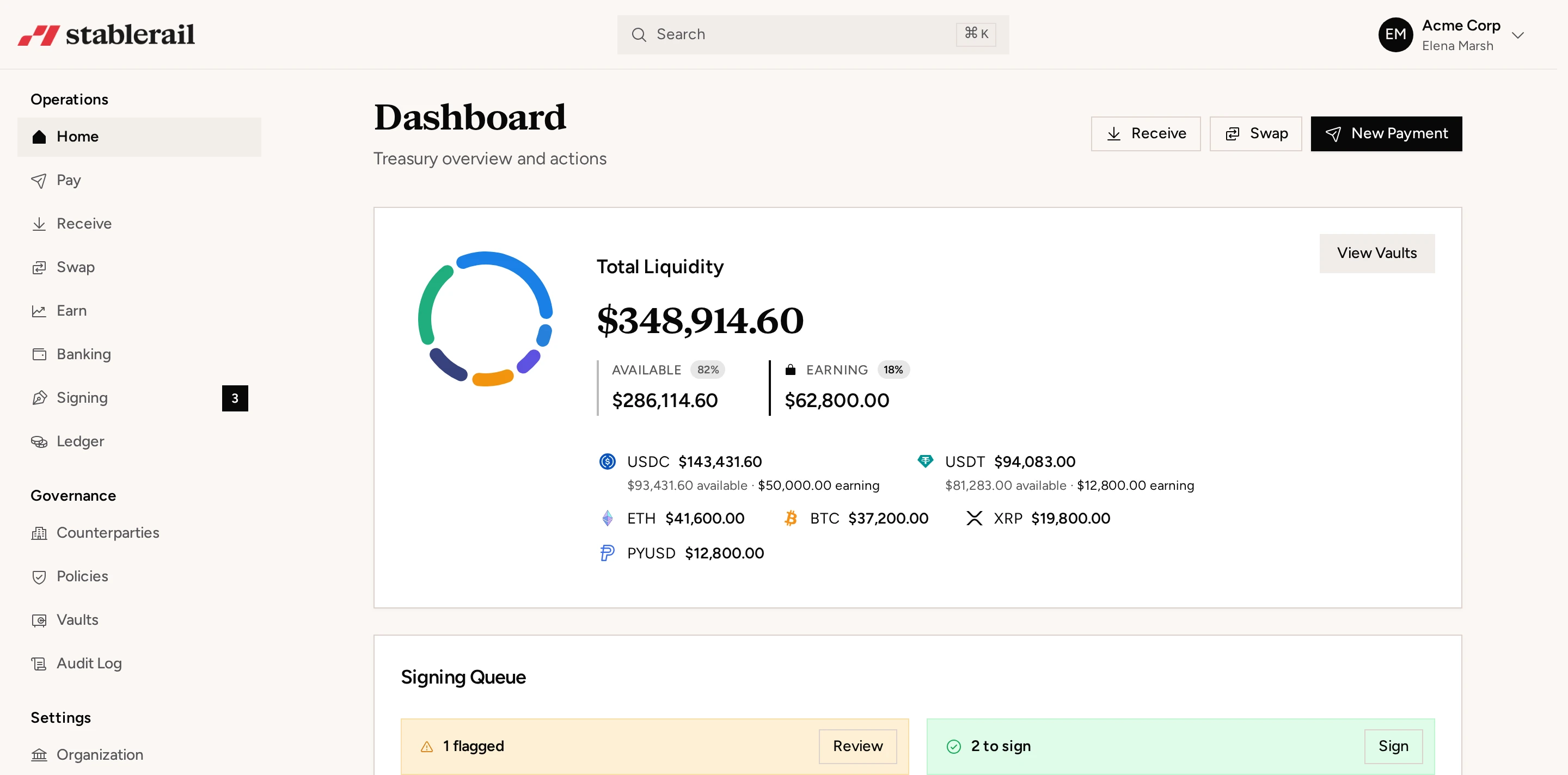
The Treasury Hub offers a real-time dashboard that replaces scattered spreadsheets and manual processes with a single, unified view. It provides visibility into wallet holdings, transaction activity, and compliance outcomes, making it easier to measure the impact of pre-transaction checks on sanctions exposure.
The dashboard focuses on four main components: Identity Logs, Policy Trace, Risk Dossier, and Execution Data:
Identity Logs: These logs track who requested, approved, and signed off on each transaction, ensuring proper accountability and separation of duties.
Policy Trace: This feature shows which rules were triggered and why, offering a clear record of adherence to internal compliance policies.
Risk Dossier: It links sanctions status and risk scores to individual transactions, providing a detailed risk profile.
Execution Data: By connecting internal approvals to the final blockchain transaction ID and timestamp, this component bridges your governance processes with on-chain settlements.
Together, these metrics ensure every transaction aligns with pre-sign control objectives, helping to avoid costly sanctions risks. Beyond compliance, this unified approach simplifies audits and supports real-time evaluations.
To gauge compliance effectiveness, focus on metrics like Risk Verdict Distribution, Override Frequency, and Exception Rates:
Risk Verdict Distribution: A high percentage of "BLOCK" verdicts indicates that risky transactions are being caught before reaching the blockchain.
Override Frequency: Tracks how often senior leaders bypass policy flags. High override rates might suggest overly restrictive thresholds or potential circumvention of controls.
Exception Rates: Measures the percentage of transactions that trigger compliance alerts or require manual intervention, providing insight into overall system performance.
Move beyond traditional metrics like Suspicious Activity Report (SAR) counts. Instead, prioritize prevention-focused measures such as pre-transaction authorization rates, response times, Travel Rule compliance, and freeze actions taken. This approach shifts the focus to how quickly risky transactions are identified and stopped, rather than simply counting reports filed after the fact.
Conclusion
In stablecoin treasury operations, pre-transaction checks are a game changer. They shift compliance from simply reacting to issues after the fact to actively preventing them. By screening every payment for sanctions exposure, taint risks, and policy violations before execution, finance teams can stop non-compliant transactions in their tracks. This approach avoids the expensive mistake of sending funds to sanctioned entities or tainted wallets and only catching the problem after settlement.
A robust five-step process - MPC wallets, policy rules, sanctions screening, anomaly detection, and manual approvals - creates a multi-layered defense system. Each transaction produces a detailed risk dossier with clear PASS/FLAG/BLOCK outcomes, complete with supporting evidence. This ensures every decision is well-documented and can withstand scrutiny from auditors and regulators.
This method not only strengthens compliance but also fits seamlessly into existing treasury workflows. Stablerail applies these controls by operating above custody and before signing transactions. Its control plane enforces mandatory pre-sign checks for sanctions, policy adherence, and behavioral anomalies, while providing plain-English explanations for clarity. Finance teams retain full custody using self-custodial MPC wallets, gaining the governance tools they need to stay compliant while operating at the speed of blockchain settlement.
FAQs
What’s the minimum “pre-transaction checks” setup a treasury team needs?
The basic setup for pre-transaction checks relies on automated, policy-driven controls to confirm the intent behind a transaction before it’s signed. Here are the key elements involved:
Sanctions screening: This includes checking against lists such as the OFAC SDN list to ensure compliance.
Policy enforcement: Establishing limits and approval processes to adhere to organizational policies.
Risk assessments: Using tools like counterparty scoring and anomaly detection to evaluate potential risks.
It’s also critical to maintain a comprehensive audit trail that documents all checks, overrides, and approvals. This ensures both compliance and accountability throughout the process.
How do you set taint thresholds without creating too many false positives?
To cut down on false positives, use automated policy-as-code rules to classify transactions based on risk factors like dollar amounts and counterparty profiles. By setting clear thresholds for routine, mid-range, and high-value payments, you can ensure that only higher-risk transactions trigger additional scrutiny.
Incorporating automated anomaly detection and behavioral checks adds another layer of precision. This approach helps filter out harmless activity, allowing teams to focus their efforts on transactions that genuinely pose a risk - all while staying compliant and running efficiently.
What evidence should a risk dossier include to satisfy U.S. audits?
A well-prepared risk dossier should cover several key components, including sanctions screening results, transaction monitoring data, and counterparty risk assessments. Additionally, it must include timestamps and policy compliance documentation to ensure thorough record-keeping.
To meet U.S. audit standards, the dossier should also provide plain-English explanations of findings. These explanations should be supported by relevant policy clauses and precise timestamps, ensuring clarity and alignment with regulatory expectations.
Related Blog Posts
Former CEO of Simple, a self-custodial wallet with $2B+ in transaction volume across 75+ countries.
More about the Stablerail team- Stablecoin treasury managementApprovals, limits, yield and reporting on one balance.
- Stablecoin payoutsBatch contractor and vendor payments with screening.
- USDT vs USDCWhich stablecoin your company should settle in.
- Stablecoin finance glossaryMPC, off-ramp, travel rule and the rest, in plain English.
- Product updatesEverything we ship, month by month.