
Stablecoin Governance: Address Risk Monitoring Explained
Learn how stablecoin address risk monitoring combines sanctions screening, exposure analysis, payment controls and audit evidence to reduce treasury risk before USDC or USDT is sent.
Stablecoin address risk monitoring checks a wallet, its attributed owner and relevant transaction history before USDC or USDT is sent. It can identify sanctions matches, links to illicit services, unusual payment behavior and address changes. Effective monitoring does not treat a vendor’s risk score as an automatic verdict: it combines screening evidence with independent address verification, approval controls, documented escalation and periodic re-screening.

What stablecoin address risk monitoring does
Address risk monitoring evaluates blockchain addresses involved in a stablecoin payment. For outbound payments, the main objective is to identify risk before the transaction is signed and broadcast. For inbound transfers, monitoring helps a business assess the source of received funds and determine whether an investigation, restriction or report may be required.
This matters because an on-chain transfer generally cannot be recalled by the sender. Some centrally issued stablecoins include issuer-controlled freezing capabilities, but a freeze is not the same as recovering an incorrect or fraudulent payment. A business may also face delayed funds, counterparty disputes, compliance investigations and difficult audit questions if it transacts with a sanctioned or illicit address.
Address monitoring supports sanctions and anti-money laundering controls, but it does not guarantee compliance. Legal obligations depend on the company’s activities, counterparties and jurisdictions. Screening must sit inside a broader program that covers customer or vendor due diligence, beneficial ownership, escalation, recordkeeping and any applicable reporting requirements.
The four layers of address risk monitoring
1. Sanctions and attribution screening
The first layer checks whether an address has been identified by a sanctions authority or attributed to a sanctioned person or entity. The U.S. Office of Foreign Assets Control publishes some digital currency addresses in its sanctions data, while screening providers also map blockchain addresses to named services and entities. UK and EU sanctions lists generally identify people and organizations; blockchain analytics may be needed to associate those subjects with addresses.
An exact address match is a strong signal, but the absence of a match does not establish that an address is safe. A blocked entity may use addresses that have not been publicly identified. Ownership and control rules can also apply even when a specific wallet is not listed. Compliance teams should define when a potential match is blocked, rejected or escalated for legal review rather than relying on a generic software verdict.
2. Transaction history and exposure analysis
Exposure analysis examines an address’s direct and indirect connections to categories such as sanctioned entities, stolen funds, scams, darknet markets, mixers or unlicensed services. Multi-hop tracing can reveal relationships that are not visible from the destination address alone.
These results require interpretation. A direct receipt from a sanctioned address is different from a remote connection several transfers away. Teams should consider the amount and proportion of exposed funds, direction of flow, number of hops, attribution confidence, recency and whether an intermediary is a high-volume service that pools customer funds.
There is no universal definition of “taint” and no standardized risk-score scale. A score of 80 from one provider is not necessarily equivalent to 80 from another. Finance and compliance teams should document the underlying signals and thresholds instead of recording only a color or number.
3. Behavioral and payment-context monitoring
Blockchain data should be evaluated alongside internal payment context. A transfer may deserve review because the beneficiary is new, a saved address has changed, the amount is outside the counterparty’s normal pattern or the request arrived through an unusual channel. These facts may indicate fraud even when the destination has no adverse on-chain history.
Address poisoning and business email compromise are especially relevant to treasury teams. An attacker may present a visually similar wallet address or impersonate a vendor and request new payment details. Screening alone may not detect either attack because the attacker’s wallet can be new and have a clean history. Independent address verification and approval separation are therefore essential.
4. Decision controls before signing
The final layer converts risk signals into a controlled decision. A payment workflow should distinguish between signals that stop a transfer, signals that require compliance review and operational changes that require additional approval. Signing quorum prevents one user from creating and releasing a transaction alone.
Policies should reflect the company’s actual risk assessment rather than arbitrary public examples. Relevant factors include payment value, beneficiary status, jurisdiction, stablecoin, blockchain network, screening result and whether payment details have changed.
| Signal or control | What it establishes | Typical finance-team response | Evidence to retain |
|---|---|---|---|
| Exact sanctions address match | The submitted address appears in applicable sanctions data | Stop signing and escalate to compliance or legal counsel | Address, network, list source, query time and match details |
| Attributed sanctioned owner | Analytics links the wallet to a listed person or entity | Hold the payment and validate attribution and applicable rules | Entity name, attribution confidence, source and reviewer decision |
| Direct illicit exposure | Funds moved directly between the wallet and a flagged address | Review category, direction, value, timing and counterparty explanation | Transaction hashes, exposure amount and investigation notes |
| Indirect or multi-hop exposure | A connection exists through intermediary addresses | Apply documented thresholds; do not block solely because of an unexplained score | Hop count, flow path, proportional exposure and provider methodology |
| New or changed beneficiary address | Payment instructions differ from the approved vendor record | Verify through an independent channel and require additional approval | Verification method, approvers and updated vendor record |
| Wrong network or token contract | The instructions may route funds incorrectly or reference an imitation asset | Stop and validate the network, token contract and recipient capability | Validated asset, network, contract and source of instructions |
A defensible pre-payment workflow
The most effective control point is before signing. Screening after broadcast may support investigation and reporting, but it cannot prevent the original transfer. A practical workflow is:
- Capture the payment intent. Record the legal counterparty, business purpose, amount, stablecoin, network and destination address.
- Validate payment instructions. Compare the address with the approved vendor master. Confirm changes through a trusted contact method that does not rely on the original change request.
- Confirm technical details. Check the blockchain network and official token contract. The same-looking address may be usable across several compatible networks, but the recipient may not support all of them.
- Run address screening. Screen for applicable sanctions matches, attributed entities and relevant direct or indirect exposure. For inbound funds, screen the sending address and investigate the source where appropriate.
- Apply the decision standard. Allow, escalate or stop the transaction according to documented criteria. Preserve the reasons behind the result rather than only the final label.
- Obtain approvals and signing quorum. Separate payment creation, review and signing where practical. Higher-risk exceptions should require an appropriately authorized reviewer.
- Record execution evidence. Save approvals, screening output and the final transaction hash so the intended payment can be reconciled with the on-chain transfer.
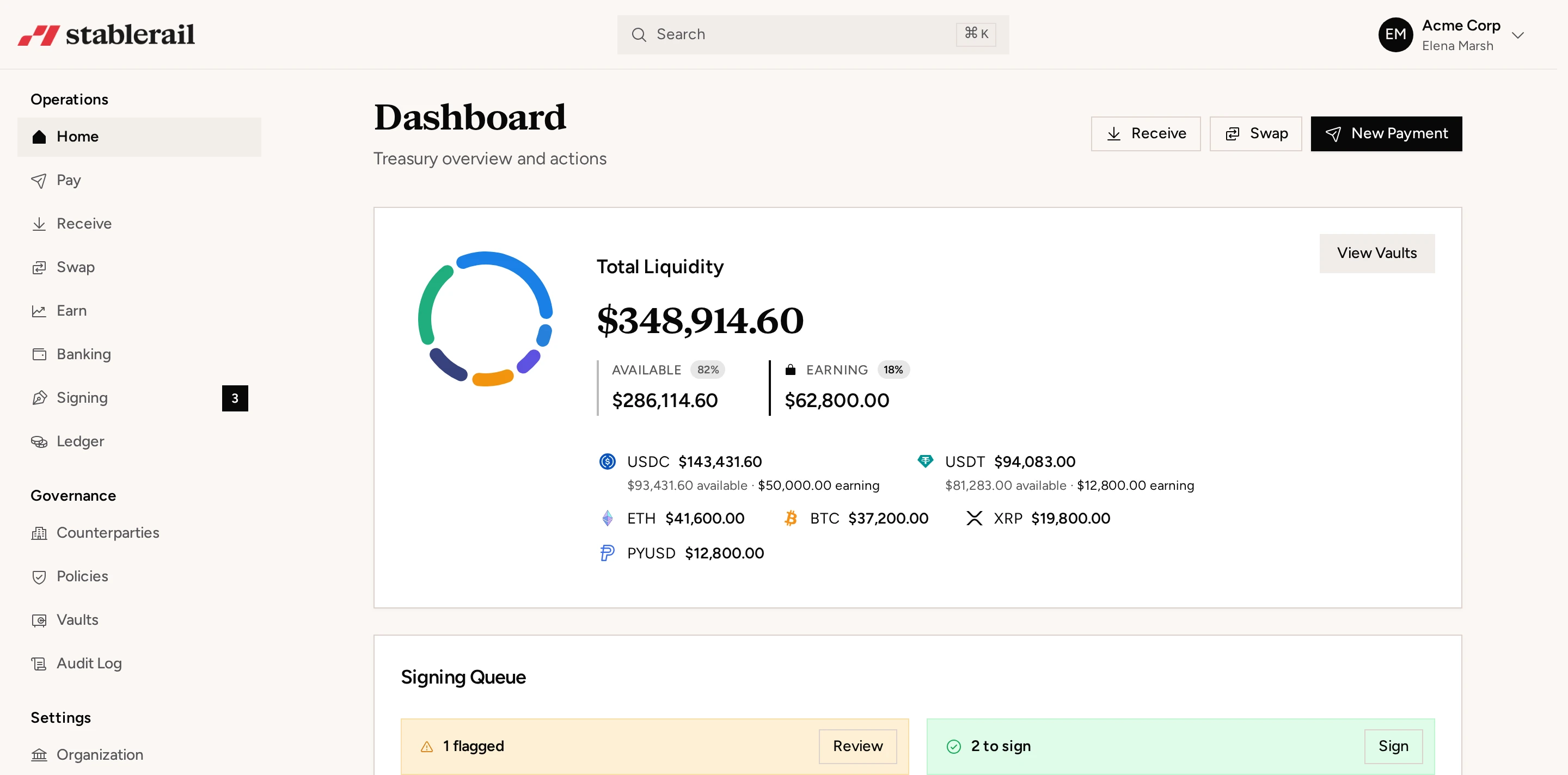
Stablerail supports this operating model through sanctions and address screening before send, approvals and signing quorum, and exportable audit evidence within a business account for USDC and USDT treasury operations.
What the audit trail should contain
A defensible record explains what the company knew and decided at the time of payment. At minimum, retain the recipient’s legal name, address, network, token, token contract, amount, payment purpose, screening timestamp, data source, detected risk signals, reviewer notes, approval identities and final transaction hash.
Overrides require particular care. The record should show which result was overridden, why the reviewer concluded the payment could proceed and who had authority to accept the risk. Free-text explanations such as “known vendor” are weak unless they are supported by due diligence and independent address verification.
Saved beneficiaries also need re-screening. Sanctions lists and blockchain attributions change, while an address considered low risk at onboarding may later receive funds from a flagged source. A sensible control is to screen immediately before each material payment and periodically review active beneficiaries based on risk. The exact frequency should be approved by compliance and aligned with transaction volume and exposure.
Common implementation mistakes
- Treating a risk score as a legal conclusion. Scores summarize a provider’s model; they do not replace sanctions analysis or documented judgment.
- Screening an address without its network. Chain context is necessary to interpret activity and confirm that the intended asset can be received.
- Checking only outbound destinations. Incoming stablecoins can create source-of-funds and sanctions exposure that also requires review.
- Whitelisting addresses permanently. An approved beneficiary can change ownership, become compromised or develop new risk exposure.
- Ignoring attribution confidence. Labels can be incomplete or change over time. Reviewers need access to the evidence behind material classifications.
- Combining request, approval and signing. A single-user workflow leaves the business more exposed to account compromise, insider fraud and simple mistakes.
How to choose an address monitoring approach
A finance team should test more than list coverage. Ask which networks and stablecoins are supported, how quickly sanctions updates become available, whether results distinguish direct from indirect exposure, and whether reviewers can inspect transaction paths and attribution confidence. The workflow should also export evidence in a form that compliance teams, auditors and investigators can use without reconstructing decisions from chat messages.
Finally, test the full payment process with controlled scenarios: a new address, a changed beneficiary, an exact list match, indirect exposure, a duplicate payment and an unsupported network. The objective is not to generate more alerts. It is to produce consistent decisions before irreversible transfers while preserving enough evidence to explain those decisions later.
Frequently asked questions
What is stablecoin address risk monitoring?
Stablecoin address risk monitoring screens blockchain wallets and their transaction histories for sanctions, illicit activity and other risk indicators. Businesses use it before sending USDC or USDT and when assessing the source of incoming funds.
Does a clean wallet risk score mean an address is safe?
No. A new address may have little history, attribution data may be incomplete and risk-score methods differ between providers. A clean result should be combined with counterparty due diligence, independent address verification and payment approvals.
Should stablecoin addresses be screened before every payment?
Material payments should generally be screened close to signing because sanctions data, address attribution and transaction history can change. The precise frequency should follow the company’s risk assessment, legal obligations and payment volume.
What should happen when a wallet has indirect sanctions exposure?
The team should review the number of hops, direction of funds, value and proportion of exposure, attribution confidence and any pooled intermediary service. Indirect exposure is not automatically equivalent to an exact sanctions match, so the decision should follow documented escalation criteria.
What evidence should be kept for a stablecoin payment?
Keep the beneficiary identity, wallet address, network, token contract, amount, purpose, screening timestamp, results, reviewer notes, approvals and transaction hash. If a warning was overridden, document the reason and the person authorized to accept the risk.
Former CEO of Simple, a self-custodial wallet with $2B+ in transaction volume across 75+ countries.
More about the Stablerail team- Stablecoin treasury managementApprovals, limits, yield and reporting on one balance.
- Stablecoin payoutsBatch contractor and vendor payments with screening.
- USDT vs USDCWhich stablecoin your company should settle in.
- Stablecoin finance glossaryMPC, off-ramp, travel rule and the rest, in plain English.
- Product updatesEverything we ship, month by month.