
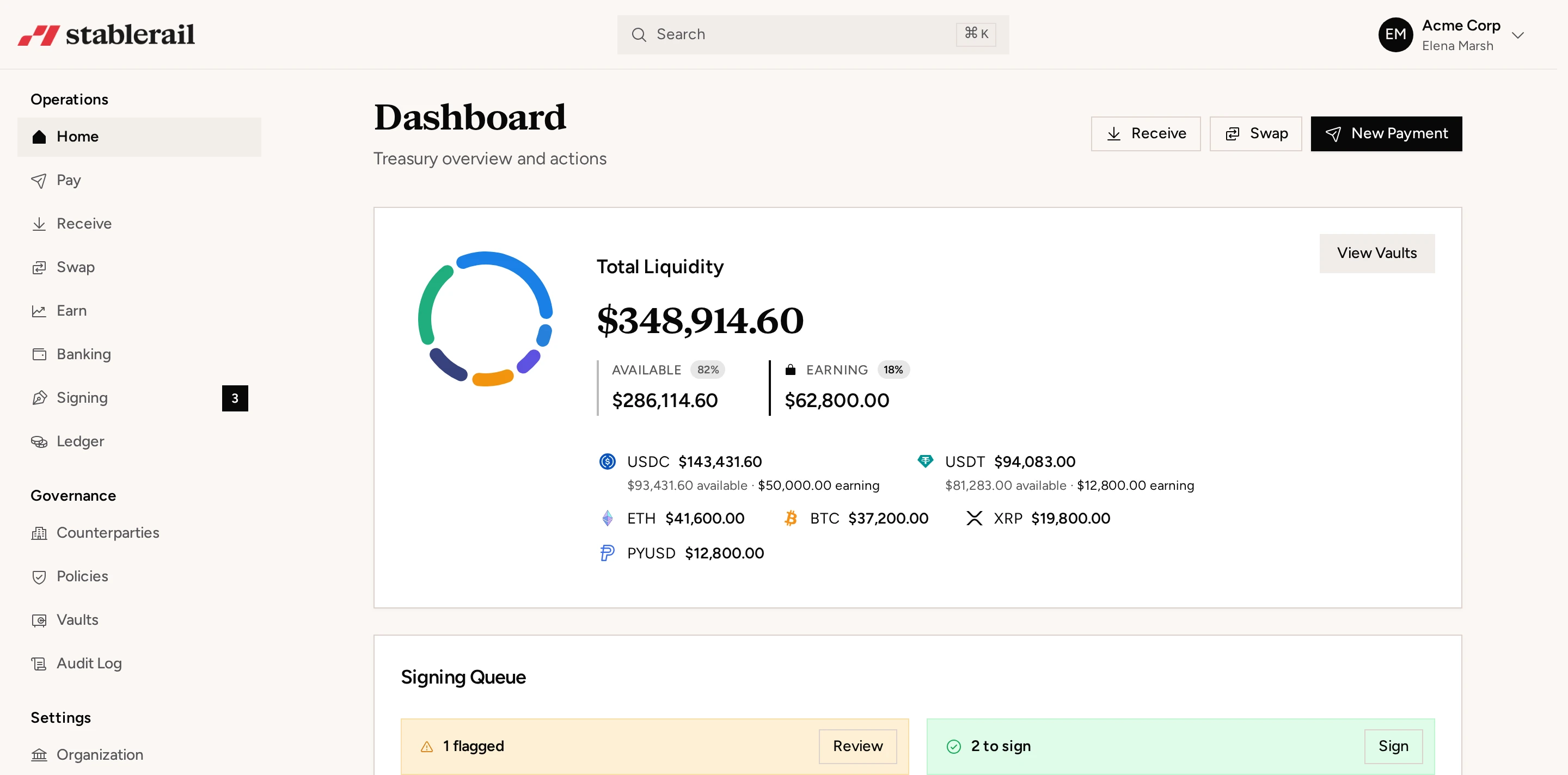
Why CFOs Need Pre-Transaction Controls for Stablecoins
Pre-transaction controls are essential to protect CFOs from irreversible stablecoin risks and regulatory liability.

Following stablecoin treasury management best practices is essential as stablecoins transform corporate finance, offering fast, 24/7 payments and reduced cross-border costs. But they come with risks - irreversible transactions, compliance demands, and personal accountability for CFOs. Mistakes like sending funds to a sanctioned address can lead to fines or criminal charges.
The solution? Pre-transaction controls. These automated checks ensure payments meet compliance and policy standards before execution. They:
Screen transactions against sanctions lists (e.g., OFAC).
Detect anomalies like unusual amounts or timing.
Enforce rules (e.g., approvals for large payments).
Provide detailed audit trails, protecting CFOs from liability.
Platforms like Stablerail integrate these safeguards, combining speed with governance to keep corporate treasuries secure.
Stablecoins to Scale A Compliance Playbook After GENIUS
CFO Risks in Stablecoin Transactions
Stablecoin transactions are fast and irreversible, leaving no room for mistakes. CFOs face the challenge of meeting regulatory demands, handling operational risks, and managing personal accountability. These risks call for stablecoin compliance checklist and robust operational controls.
Regulatory and Compliance Requirements
Regulatory oversight has tightened, raising the bar for compliance in stablecoin transactions. CFOs must ensure that every transaction adheres to anti-money laundering (AML) standards and sanctions screening protocols. The Office of Foreign Assets Control (OFAC) frequently updates its list of sanctioned addresses, and even an accidental transaction to one of these addresses can lead to investigations, fines, or even criminal charges.
Regulators now require detailed audit trails for every transaction. This includes information on who authorized the payment, what checks were performed, and the reasoning behind approvals. Relying on manual record-keeping - spread across spreadsheets, emails, and messaging apps - can fall short under scrutiny. It's not just about maintaining reserves but proving they were managed responsibly at every stage.
Operational Failures Without Transaction Controls
Manual workflows introduce significant risks in stablecoin operations. Payments are often prepared using details from various sources and submitted for approval without systematic verification. Without automation to detect errors or enforce policies, human mistakes can quickly lead to irreversible consequences.
"A stablecoin treasury cannot be 'a wallet that holds funds.' It must be an operating system with documented rules, enforceable permissions, and an auditable reconciliation process." - Stablecoin Insider
When pre-transaction checks are absent, payments might bypass critical controls, exposing the company to financial and reputational risks. These issues often surface during audits or board reviews, making automation essential for balancing transaction speed with rigorous oversight.
CFO Personal Liability
CFOs are directly accountable for managing reserves and overseeing transactions under current regulations. If stablecoin payments violate sanctions, facilitate fraud, or fail audit requirements, the CFO is often the first to face scrutiny. This accountability can extend beyond corporate penalties to include criminal charges and potentially career-ending consequences.
Traditional treasury tools often lack the transparency CFOs need to defend their decisions. Without detailed records showing what checks were performed, who approved payments, and why exceptions were made, CFOs may struggle to demonstrate due diligence. Implementing systems that document every aspect of a transaction is critical to protecting both the company and the individuals responsible for its financial integrity.
What Pre-Transaction Controls Do
How Pre-Transaction Controls Protect CFOs in Stablecoin Payments
Pre-transaction controls serve as a safeguard, providing a verification layer between initiating and completing payments. Instead of relying on manual reviews, these systems evaluate payments before they are executed. This proactive approach helps address the regulatory and operational challenges CFOs encounter when dealing with stablecoin transactions.
Sanctions Screening and Anomaly Detection
These controls automatically compare recipient addresses against sanctions lists maintained by organizations like OFAC and other regulatory agencies. This process happens in real time, flagging any address linked to restricted activities or appearing on watchlists. Additionally, the system monitors transaction patterns to identify unusual activity. For example, it can flag payments made at odd hours, amounts that significantly differ from typical transactions, or transfers to unverified addresses. Imagine a $50,000 payment initiated at 2 a.m. to a new vendor - this would trigger an alert, catching risks that manual checks might overlook.
Policy Enforcement and Approval Workflows
Pre-transaction controls go beyond detection by actively enforcing corporate policies. They convert company rules into automated, enforceable actions for every transaction. For instance, you can set conditions such as "payments over $5,000 to new addresses require CFO approval and vendor verification" or "transfers exceeding $10,000 on weekends need additional authorization." Payments that fail to meet these criteria are automatically blocked, reducing the chance of unauthorized transactions.
These systems also implement a Separation of Duties framework, ensuring no single person has full control over a transaction. Multiple parties must review and approve payments based on factors like amount or recipient type. Additionally, reconciliation processes are streamlined by requiring mandatory business references for every transaction, linking on-chain activity directly to the general ledger.
Complete Audit Trails for Every Transaction
Every step in the payment process - from initiation to execution - is recorded in detail. These records include who initiated the payment, what checks were performed, which policies were applied, and who approved or overrode decisions. The system logs timestamps, triggered policy clauses, assigned risk scores, and clear explanations in plain language. If a regulator questions why a flagged payment was approved, you can provide a comprehensive record showing all actions taken, the individuals involved, and the business justification provided at the time. This detailed documentation not only satisfies regulatory requirements but also strengthens CFO accountability.
How Stablerail Delivers Pre-Transaction Controls for CFOs
Stablerail acts as an agentic control plane that operates above custody and before signing, giving finance teams the governance they need without sacrificing on-chain settlement speed. Designed for companies managing between $1 million and $50 million annually in stablecoin volume, the platform offers an annual subscription model that adjusts based on the number of entities, active users, and on-chain volume.
Self-Custodial MPC Wallets for Fund Control
To address potential risks, Stablerail employs advanced wallet architecture for secure fund management. Funds are stored in MPC-based wallets across major chains (currently EVM-compatible, with plans to include Solana) and stablecoins like USDC and USDT. Importantly, the platform never has unilateral signing authority, meaning it cannot initiate transfers independently, ensuring your funds remain safe even if provider issues arise.
CFOs can manage funds through a tiered wallet structure, splitting them into Cold (reserve), Warm (operations), and Hot (automation) wallets. This setup minimizes exposure by simulating every payment before execution. The system identifies potential issues like address changes, duplicates, or first-time payment destinations, preventing "blind signing" errors.
Risk Dossier and Human Approval Before Execution
Before any transaction is executed, Stablerail generates a Risk Dossier that provides a clear verdict - PASS, FLAG, or BLOCK - along with plain-English evidence. Automated checks, such as sanctions screening, taint exposure analysis, behavioral anomaly detection, and counterparty risk scoring, are conducted before the transaction proceeds.
If flagged, approvers can review the dossier to either approve the payment or override it with a documented reason. Every action, from transaction intent to final signing, is logged in a tamper-evident audit trail. Each payout also generates a Proof-of-Control receipt, detailing the payment specifics, who approved it, and the final risk assessment. Finance teams can further evaluate their exposure using a stablecoin risk calculator to quantify potential threats. This makes it easier to meet auditor and board-level requirements. Additionally, the system identifies tainted counterparties or risk patterns that could prompt issuers like Circle or Tether to freeze wallets, protecting your company's operational stability.
Policy-as-Code for Automated Governance
Stablerail's Policy Console transforms corporate rules into automated controls that are enforced before signing. For instance, rules like requiring approvals for payments over $5,000 to new addresses or weekend transfers exceeding $10,000 are applied programmatically. This ensures that no single individual, not even the CEO, can bypass these safeguards.
The platform enforces a clear separation of duties, ensuring that no one person can control a transaction from start to finish. Additionally, every payment must include a business reference, which links on-chain activity directly to the general ledger. This replaces the disjointed process of combining wallets, spreadsheets, and Slack approvals with a structured, multi-step policy engine. By delivering real-time, AI-driven pre-sign checks, Stablerail eliminates reliance on manual or post-transaction reviews, reducing CFO liability and ensuring all transactions comply with regulatory standards before they are signed.
Conclusion
Pre-transaction controls are what separate strong governance from personal liability for CFOs handling stablecoin reserves. Without these checks in place, every payment becomes a potential risk for compliance issues, fraud, or audit complications. The rapid pace of blockchain settlement means these controls need to work just as quickly, identifying problems before funds are moved - not after.
This is where Stablerail steps in. Positioned above custody and before transaction signing, it translates corporate rules into automated, enforceable policies. Every transaction is subjected to risk checks, producing a detailed Risk Dossier and a tamper-evident audit trail from the moment intent is established until the transaction is signed.
The platform’s design effectively combines technological safeguards with the practical needs of CFOs. As one of Stablerail's principles puts it: "Agents verify the context. Humans sign the transaction. The system protects the treasury - it never touches the money". This approach ensures CFOs retain full control while meeting the governance expectations of boards, auditors, and regulators.
For companies managing $1M–$50M in annual stablecoin volume, the platform’s scalable subscription model is tailored to fit both organizational and user-specific requirements. By implementing a tiered wallet structure - utilizing Cold/Reserve wallets for long-term holdings and Warm/Operations wallets for day-to-day transactions - finance teams can minimize risk exposure while keeping operations flexible.
FAQs
What are pre-transaction controls for stablecoin payments?
Pre-transaction controls for stablecoin payments are designed to prioritize security, compliance, and effective risk management before a transaction takes place. These measures include automated checks such as sanctions screening, risk scoring, and anomaly detection. They also involve enforcing policies to ensure adherence to company guidelines.
CFOs can establish specific rules for transaction approvals and set limits to maintain control over financial operations. Additionally, every action is recorded in detailed audit trails, which boosts accountability and helps minimize both operational and compliance risks.
How do pre-transaction controls reduce CFO personal liability?
Pre-transaction controls play a crucial role in shielding CFOs from personal liability by ensuring all transactions are thoroughly reviewed and aligned with company policies before they’re executed. These controls rely on automated checks, such as:
Sanctions screening: Ensures transactions comply with legal restrictions.
Policy enforcement: Confirms adherence to internal guidelines.
Anomaly detection: Flags unusual activity for further investigation.
By implementing these measures, companies create an auditable process that significantly reduces the risk of errors, fraud, and compliance breaches.
Additionally, role-based approvals and detailed decision records provide a clear trail of accountability. This documentation becomes invaluable during audits or regulatory inquiries, allowing CFOs to justify actions and decisions. Ultimately, these safeguards help minimize legal and financial risks while ensuring compliance with regulatory standards.
What should a stablecoin payment audit trail include?
A stablecoin payment audit trail needs to capture every step of the transaction process to maintain transparency, accountability, and compliance. This includes documenting:
Intent creation: Such as invoices or payout instructions.
Pre-sign checks: Results from processes like sanctions screening, risk assessments, and policy enforcement.
Human approvals: Including reasons for any overrides and authorized signatures.
Additionally, the audit trail should feature detailed logs with timestamps, references to policy clauses, and plain-English explanations. These elements are crucial for supporting audits, ensuring compliance, and resolving disputes effectively.
Related Blog Posts
Former CEO of Simple, a self-custodial wallet with $2B+ in transaction volume across 75+ countries.
More about the Stablerail team- Stablecoin treasury managementApprovals, limits, yield and reporting on one balance.
- Stablecoin payoutsBatch contractor and vendor payments with screening.
- USDT vs USDCWhich stablecoin your company should settle in.
- Stablecoin finance glossaryMPC, off-ramp, travel rule and the rest, in plain English.
- Product updatesEverything we ship, month by month.