
Why Cross-Chain Payments Need Pre-Sign Governance
Irreversible cross-chain payments demand pre-sign governance to prevent fraud, enforce compliance, and create tamper-proof audit trails.

Mar 31, 2026
Cross-chain payments are growing fast, fueled by stablecoins like USDC and USDT. But they come with risks: irreversible transactions, compliance issues, and operational complexity. Once funds are sent, mistakes like sending to the wrong wallet or falling for scams can't be undone. Traditional post-sign reviews fail to address these challenges.
Pre-sign governance solves this. It ensures every transaction is screened for risks, compliance, and policy adherence before being signed. This process prevents errors, fraud, and compliance breaches while maintaining control over funds. Key features include:
Sanctions screening: Blocks payments to flagged addresses.
Policy enforcement: Automates rules like approval thresholds.
Risk detection: Flags unusual activity or anomalies.
Audit trails: Centralized, tamper-proof records of every decision.
With tools like Stablerail, businesses can manage high volumes of cross-chain payments securely and efficiently, ensuring compliance and reducing risks. Pre-sign governance isn't just a safeguard - it's a must-have for modern finance teams handling blockchain payments.
Compliant Cross-Chain Lending With ZK Pre-Checks | Kacper Koziol - Amish Protocol
Risks and Challenges of Cross-Chain Payments
Cross-chain payments introduce a range of operational and financial hurdles that aren't present in traditional banking. Imagine a finance team sending $50,000 in USDC from Ethereum to a vendor’s wallet on Base. They’re navigating multiple blockchains, each with its own speed, fees, and security protocols. These layers of complexity create opportunities for errors and failures. Let’s break down the specific risks and why standard post-transaction controls often fall short.
Settlement Failures and Irreversible Transactions
One of the biggest risks with cross-chain payments is irreversibility. Once a transaction is confirmed on the blockchain, it’s final - there’s no option for chargebacks or recovery. Even small mistakes, like entering the wrong wallet address, can result in permanent loss of funds.
Handling payments across different chains also brings orchestration challenges. Finance teams must juggle liquidity across chains, manage risks tied to asset transfers, and deal with timing delays that can disrupt settlements. Most stablecoin systems rely on "push" mechanics, where every transaction requires a manual signature. This dependency creates gaps in execution - if a signer is unavailable due to travel or technical issues, recurring payments like vendor subscriptions can fail unexpectedly.
Counterparty and Compliance Risks
Cross-chain payments also come with counterparty and compliance risks. Unlike traditional bank accounts, blockchain wallet addresses lack the same level of verification. When you wire funds to a bank account, it’s been vetted by a regulated institution. In contrast, sending USDC to a wallet address often leaves you in the dark about who controls it or whether it’s flagged for illegal activity.
The rise of agentic payments - where AI systems autonomously initiate transactions - compounds this issue. Protocols like ACP (developed by OpenAI and Stripe) and x402 (from Coinbase) enable software agents to make payments without human approval. This makes machine-enforceable governance essential. Without strict pre-sign controls, an AI agent could unknowingly send funds to a sanctioned wallet or one linked to illicit activities, leading to immediate compliance violations.
Operational Complexity and Fragmented Tools
Managing cross-chain payments is often a fragmented process. Finance teams rely on a patchwork of tools like hardware wallets, spreadsheets, and messaging apps. These disconnected systems not only create inefficiencies but also introduce risks of human error and security breaches.
The lack of integration means organizations lose a real-time view of their treasury. They can’t monitor balances across chains like Ethereum, Base, and Polygon from a single dashboard. This makes it harder to spot anomalies, such as unusual transaction patterns or sudden liquidity drains. Month-end accounting becomes a tedious, manual process of reconciling on-chain transactions with internal records. For businesses handling $1 million to $50 million in stablecoin payments annually, this level of manual effort becomes unsustainable. The coordination required between product teams, wallet signers, and finance approvers grows overwhelming.
Additionally, without a unified system, signers are left vulnerable to incomplete transaction details, increasing the risk of falling victim to social engineering attacks. These challenges highlight the importance of implementing pre-sign governance with MPC wallets to catch errors before they happen.
Why Post-Sign Controls Fail for Cross-Chain Payments
When it comes to blockchain payments, traditional post-sign governance falls short. Once a transaction is broadcast, it’s irreversible, leaving no room for corrective action. This creates a significant challenge for managing risks and complicates audit processes, as there’s no way to reverse or adjust the transaction after the fact.
Irreversibility Eliminates Corrective Action
Blockchain’s irreversibility means that once a cross-chain payment is signed and sent, it’s final. If a fraudulent or non-compliant transaction is flagged during a post-sign review, it’s already too late - the funds are gone. This is a growing concern, especially considering that 79% of organizations experienced payment fraud in 2024, with 63% identifying business email compromise (BEC) as the top fraud method.
Here’s an example: imagine a finance team member unwittingly falls for a BEC scam and authorizes a $100,000 USDC payment to what seems like a legitimate vendor. By the time post-sign controls detect the fraud, the funds have already been transferred. Unlike traditional banking systems, where you might freeze a wire transfer or dispute the transaction, blockchain offers no such options.
"Approval logic designed for next-day ACH batches will fail on irrevocable real-time transfers."
– Peyman Khosravani, Industry Expert
Incomplete Audit Trails Across Chains
Another issue with post-sign systems is their inability to provide a complete and defensible audit trail. These systems often fail to capture the full context of a transaction’s approval. Many organizations rely on fragmented tools like spreadsheets, Slack messages, and email threads to document approvals. When auditors or regulators request proof of authorization for a $50,000 payment, finance teams are left scrambling to piece together disjointed records.
While blockchain confirms that a payment occurred, it doesn’t reveal the story behind it - such as who approved the transfer, which invoice it was tied to, or whether proper risk checks were completed. This gap is compounded by the fact that 98% of companies still handle some payment operations manually, and 49% use five or more separate systems. These inefficiencies make it nearly impossible to reconstruct a reliable audit trail, and delayed governance only increases the risk of policy breaches.
No Enforcement of Business Policies Before Execution
Post-sign controls also fail to prevent policy violations - they only detect them after the damage is done. For instance, if a company requires CFO approval for payments over $10,000 to new vendors, a post-sign system might flag a $25,000 payment to an unvetted wallet the next day. By then, the funds are already gone, and the finance team is left explaining the oversight.
The rise of real-time settlement systems like FedNow, RTP, and cross-border stablecoin payments further reduces the window for governance. With business-to-business stablecoin payments now exceeding $6 billion per month, relying on after-the-fact reviews is no longer practical. These limitations underscore the need for pre-sign governance to catch and prevent violations before transactions are executed.
Pre-Sign Governance: Preventing Disputes Before Transactions Execute
Pre-sign governance ensures every payment is validated before signing, minimizing risks while funds remain under your control. This involves conducting stablecoin compliance checks, risk assessments, and enforcing policies upfront - before any transaction is finalized.
With the sheer volume of cross-chain payments today, this proactive approach is more important than ever. From October 2024 to October 2025, stablecoins facilitated $9 trillion in adjusted payment activity, marking an 87% increase compared to the previous year. Managing fraud or policy violations after transactions have been executed is simply not feasible at this scale. Pre-sign governance addresses this by applying strict checks to ensure every transaction adheres to established standards.
Core Components of Pre-Sign Governance
Pre-sign governance performs several critical checks to safeguard transactions:
Sanctions Screening: Ensures funds aren’t sent to prohibited addresses.
Policy Validation: Confirms payments comply with your organization's specific rules.
Anomaly Detection: Flags unusual activities, such as transfers at odd hours or amounts that significantly deviate from normal patterns.
Counterparty Risk Assessment: Reviews the recipient's wallet history to identify potential risks.
Each transaction undergoes these checks and receives a verdict - PASS, FLAG, or BLOCK - with clear explanations. For instance, if a $15,000 payment to a new vendor wallet is flagged for exceeding a $5,000 threshold for unvetted addresses, the system will specify which policy was triggered and provide supporting details. By addressing risks at this stage, pre-sign governance ensures transactions meet rigorous standards before they proceed.
Self-Custodial Security with MPC Wallets
To complement these governance measures, multi-party computation (MPC) wallets provide robust security by distributing cryptographic signing authority across multiple parties. Unlike traditional wallets where a single person holds the keys, MPC ensures no individual - including the governance platform - can move funds unilaterally.
This approach is especially critical as payment systems evolve. With the rise of autonomous AI agents and delegated payment systems, "Owner-Operator" key architectures have become essential. These setups grant limited signing power to agents while enforcing strict, programmable guardrails. MPC wallets form the backbone of this system, ensuring that even automated processes operate within your governance framework.
Human Approval Workflows and Complete Audit Trails
When a transaction is flagged, it enters a human-in-the-loop workflow for review. Designated approvers, such as a CFO or finance manager, assess the flagged transaction, record their decision, and document the process with a timestamp, identity, and reasoning.
This workflow eliminates the need to piece together approvals from scattered communications like emails or Slack messages. Instead, it provides a centralized record showing who initiated the payment, which checks were conducted, what issues were flagged, who approved it, and when it was signed. Such detailed documentation becomes invaluable when auditors or regulators request justification for a transaction - like a $50,000 payment - months after it was completed.
How Stablerail Implements Pre-Sign Governance
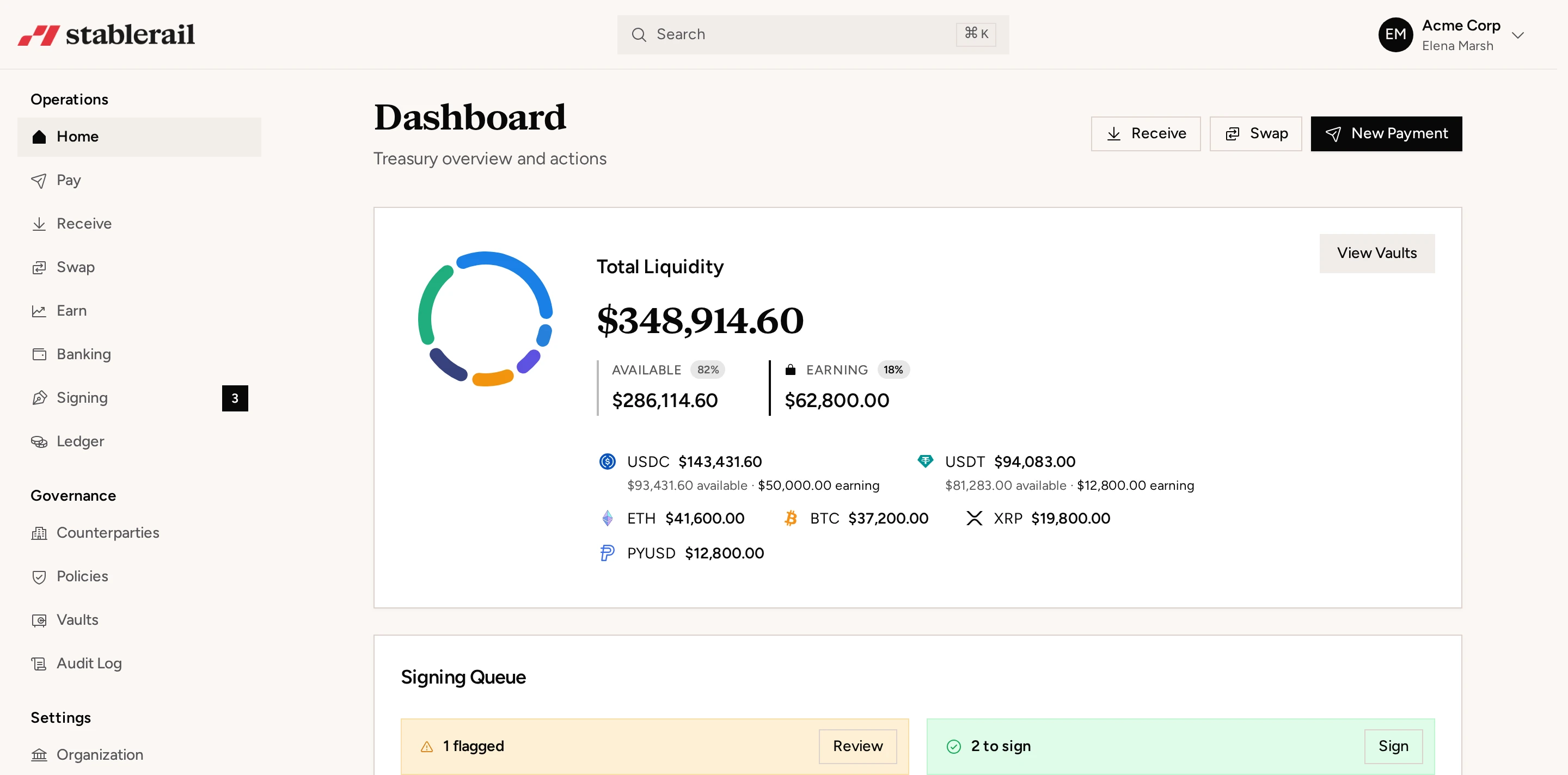
Pre-Sign Governance Workflow for Cross-Chain Payments
To address the challenges of irreversible and fragmented cross-chain payments, Stablerail has created a pre-sign governance framework. Acting as a control layer between custody and signing, it automates governance rules before any blockchain transaction takes place. This replaces manual, scattered approvals with a centralized, audit-ready workflow.
Policy-as-Code Rules for Automated Enforcement
Finance teams can define machine-readable rules that are automatically enforced for every payment intent. Once these policies are set, they cannot be modified, ensuring consistency without requiring manual oversight. For example:
Payments over $5,000 to new addresses require CFO approval.
Transfers exceeding $10,000 on weekends need additional approval.
Only USDC transactions on Base or Ethereum are allowed.
The system enforces least-privilege access and separation of duties, ensuring that different individuals handle requests, approvals, and signatures. For batch payouts, a single signature can process up to 500 transfers from a validated CSV file while still applying individual policy checks to each transaction.
To prevent discrepancies between approval and execution, Stablerail uses intent fingerprinting, which creates a SHA-256 hash to ensure the transaction remains exactly as authorized.
Risk Dossiers with Clear Verdicts and Explanations
Before any transaction is signed, Stablerail generates a Risk Dossier, eliminating the risk of "blind signing" technical data. Each dossier provides one of three verdicts:
PASS: Meets all policy requirements.
FLAG: Needs manual review or override.
BLOCK: Violates critical policy rules.
These dossiers include detailed explanations, referencing specific policy clauses, timestamps, and relevant business logic. The system simulates transaction outcomes to identify potential issues, such as first-time payees, address changes, or duplicate payments. It also flags risks like stablecoin issuer blacklisting, which could lead to frozen funds.
Feature
Current Manual Process
Stablerail Risk Dossier Process
Risk Assessment
Manual, ad-hoc, or after-the-fact
AI-driven pre-signature checks
Clarity
"Blind signing" of technical data
Human-readable, contextual explanations
Evidence
Scattered in emails/chat logs
Unified report with policy clauses and timestamps
Verdict
Subjective human judgment
Standardized PASS/FLAG/BLOCK verdicts
This approach replaces fragmented manual processes with a seamless risk evaluation workflow.
End-to-End Workflow from Intent to Execution
Stablerail’s system integrates these automated checks into a streamlined, end-to-end process:
Create an intent: Submit an invoice PDF, payout CSV, or API request.
Generate a Risk Dossier: The system runs policy checks and provides a verdict with supporting evidence.
Approvers review: Designated individuals evaluate flagged transactions, documenting their decisions with timestamps, identities, and reasoning.
Sign via MPC: Approved transactions are signed using multi-party computation (MPC).
Record and receipt: The system logs the entire transaction history and generates CFO-grade evidence.
Every step, from intent creation to final signature, is recorded in a tamper-evident audit trail. This ensures transparency by detailing who initiated the payment, what checks were conducted, any flagged issues, who approved it, and when it was signed.
Benefits of Pre-Sign Governance for Cross-Chain Payments
Better Security and Risk Prevention
Pre-sign governance adds an essential layer of security to cross-chain payments by addressing risks before transactions are finalized. This approach stops unauthorized transactions and ensures compliance, reducing the chance of frozen funds, regulatory fines, or capital loss. Since cross-chain payments are irreversible, identifying and resolving issues during the approval phase is critical. Stablerail strengthens this process with automated checks for sanctions screening, taint detection, and counterparty risk scoring, ensuring every transaction aligns with compliance requirements before being signed. Additionally, the system enforces separation of duties and limits access, preventing any single employee from having unchecked control over initiating, approving, and executing payments.
Faster Operations and Support for High Volume
Manual approvals can slow down operations, but automating policy enforcement speeds things up significantly. Stablerail enables businesses to handle high transaction volumes efficiently by allowing batch processing through CSV uploads, applying rigorous policy checks to each payment. For perspective, between October 2024 and October 2025, stablecoins facilitated $9 trillion in adjusted payment activity - an 87% increase compared to the previous year. This capability allows companies to scale their operations without compromising on security or control, making it easier to manage growing transaction demands.
Compliance Documentation and Audit Readiness
Stablerail simplifies compliance and audit processes by maintaining a tamper-evident audit trail for every workflow step. Each transaction is linked to specific policy clauses and approval workflows, providing a detailed, timestamped record. This eliminates the need for finance teams to sift through scattered emails or spreadsheets. Instead, they can present clear, auditor-ready documentation to regulators, auditors, or board members, showcasing compliance and the rationale behind business decisions with ease.
Conclusion
Cross-chain payments come with a unique challenge: they’re irreversible. That means if something goes wrong, there’s no way to fix it after the fact. This is where pre-sign governance changes the game. By identifying risks, enforcing policies, and documenting decisions before transactions are finalized on the blockchain, finance teams can avoid disputes altogether.
Stablerail acts as the critical bridge between business logic and blockchain execution. It lets finance teams implement policy-as-code, where they can set spending limits, approval workflows, and restrictions to stop unauthorized payments before they’re signed. Every transaction is subjected to AI-driven risk checks - covering sanctions, tainted funds, and unusual behaviors - resulting in a clear verdict: PASS, FLAG, or BLOCK. And the best part? These verdicts come with plain-English explanations, ensuring teams stay informed and in control. This "copilot, not autopilot" approach avoids the dangers of blindly signing off on transactions. Plus, it creates a tamper-proof audit trail, linking every payment to its policies, approvals, and risk checks, with timestamps to back it all up. So when auditors, regulators, or board members come knocking, finance teams can provide detailed, CFO-level documentation without scrambling through Slack threads or spreadsheets.
With this approach, companies can grow their cross-chain payment operations without compromising on security or compliance. Finance teams retain full control through MPC-secured wallets while automating the checks and approvals that help them avoid costly errors. The platform ensures blockchain speed is preserved, all while embedding the critical business context and risk controls needed for peace of mind.
Pre-sign governance doesn’t just stop disputes before they happen - it gives finance teams the confidence to manage cross-chain payments, knowing every transaction aligns with their standards before it becomes permanent.
FAQs
What is pre-sign governance?
Pre-sign governance is all about making sure everything checks out before a cross-chain payment gets signed and finalized. This process includes automated steps like sanctions screening, enforcing policies, and spotting anomalies. By catching potential problems early, it helps prevent mistakes, fraud, or compliance breaches. This ensures that transactions are secure, follow regulations, and stick to an organization's policies before they're permanently recorded on the blockchain.
How does pre-sign governance work across multiple chains?
Pre-sign governance secures cross-chain transactions by applying strict policies and running automated checks before any signatures are made. These checks cover sanctions screening, policy enforcement, anomaly detection, and counterparty risk scoring. Funds are stored in MPC-based wallets across supported blockchains, ensuring the same governance rules are applied consistently. Additionally, a complete audit trail records every step, offering transparency and reducing the risk of unauthorized or high-risk transactions across multiple chains.
What does Stablerail check before a transaction is signed?
Before finalizing a transaction, Stablerail runs a series of thorough checks, including sanctions screening, policy enforcement, behavioral anomaly detection, and counterparty risk scoring. To make the process transparent, it offers clear, plain-English explanations backed by evidence like policy clauses and timestamps.
Related Blog Posts
Former CEO of Simple, a self-custodial wallet with $2B+ in transaction volume across 75+ countries.
More about the Stablerail team- Stablecoin treasury managementApprovals, limits, yield and reporting on one balance.
- Stablecoin payoutsBatch contractor and vendor payments with screening.
- USDT vs USDCWhich stablecoin your company should settle in.
- Stablecoin finance glossaryMPC, off-ramp, travel rule and the rest, in plain English.
- Product updatesEverything we ship, month by month.