
Stablecoin Blacklisting vs. Sanctions Screening
Explains why issuer blacklists fall short and why pre-transaction sanctions screening is essential for stablecoin payments.

Stablecoins are reshaping corporate finance, with predictions of $500 billion moving from traditional banks to stablecoins by 2028. This shift offers businesses benefits like 24/7 accessibility and higher yields but also introduces compliance challenges. Two key tools - blacklisting and sanctions screening - address these risks differently:
Blacklisting: Issuers freeze funds after incidents (e.g., thefts, hacks). By 2025, over $1 billion in stablecoin assets were frozen, but only 36.4% of OFAC-sanctioned addresses were blacklisted, highlighting its limitations.
Sanctions Screening: Prevents flagged transactions before they occur by checking addresses against regulatory lists like OFAC. This proactive approach ensures compliance before funds move.
While blacklisting reacts to issues, sanctions screening prevents them, making it essential for corporate teams to manage regulatory risks effectively. Tools like Stablerail enhance compliance by verifying transactions pre-signing, offering audit trails, and ensuring adherence to global regulations.
Stablecoins to Scale A Compliance Playbook After GENIUS
What Is Stablecoin Blacklisting?
Stablecoin blacklisting involves freezing specific wallet addresses on the blockchain by adding them to a deny-list embedded in the smart contract. Once an address is blacklisted, it becomes incapable of sending or receiving tokens because any transaction involving it is automatically blocked. Importantly, this authority lies with stablecoin issuers like Circle (USDC) or Tether (USDT) - not with governments or individual users.
By late 2025, more than $1 billion in stablecoin assets had been frozen across platforms such as Ethereum, Solana, and Tron. In 2025 alone, 4,320 addresses were added to deny-lists, which is more than double the count from 2023.
How Stablecoin Blacklisting Works
Stablecoin issuers program deny-lists directly into their smart contracts. This ensures that any transaction involving a blacklisted address is automatically canceled on networks like Ethereum and Tron.
Timing, however, plays a crucial role. Delays caused by multisignature (multisig) authorizations can sometimes allow funds to be moved before a freeze is enforced. This explains why over 6,000 blacklisted addresses showed zero balances at the time of enforcement.
This technical process forms the backbone of the enforcement actions described below.
When Blacklisting Is Applied
Blacklisting isn’t limited to government-sanctioned addresses. In fact, only 0.04% of frozen assets - about $419,320 - are linked to OFAC sanctions. Most blacklisting actions stem from internal risk assessments, feedback from security teams, or requests from law enforcement during active investigations.
"Blacklisting is not driven by regulatory lists alone. Instead, issuers appear to rely on internal risk detection, incident reports, or ecosystem feedback, resulting in a much broader, more discretionary enforcement scope." - Andres M, Range
Issuers typically use blacklisting to address issues like exploits, thefts, phishing schemes, or other high-risk wallet behaviors. For instance, in mid-2025, Tether took action against over 800 Tron addresses tied to phishing and spam operations. Compared to Circle, Tether has been far more aggressive, blacklisting 7,021 addresses on Ethereum and Tron, while Circle blocked only 548 addresses on the same networks. By the end of 2025, 760 unblacklisting events had occurred, though the reasons for these reversals were rarely made public.
What Is Sanctions Screening?
Sanctions screening is a pre-transaction compliance measure designed to prevent violations of regulatory rules. It works by checking wallet addresses and counterparties against official lists, such as those maintained by the U.S. Office of Foreign Assets Control (OFAC), before any payment is processed. Unlike blacklisting, which reacts after transactions occur, sanctions screening stops prohibited transactions in their tracks.
By late 2025, only 36.4% (32 out of 88) of stablecoin addresses sanctioned by OFAC had been effectively blacklisted on-chain by issuers. This highlights a major gap in enforcement. Sanctions screening shifts the responsibility to the transacting party, empowering finance teams to verify counterparties themselves before funds are sent.
How Sanctions Screening Works
Sanctions screening tools pull data from various regulatory databases before a transaction is finalized. They analyze wallet addresses, entity names, and related metadata, cross-referencing them with OFAC lists, EU sanctions registries, and other global watchlists. If a match - or even indirect exposure - is identified, the transaction is either blocked automatically or flagged for further review.
Some systems go a step further by using fuzzy matching and blockchain-level analysis to catch minor discrepancies or indirect links. These advanced capabilities ensure thorough pre-transaction checks, forming a critical layer of risk management.
Where Sanctions Screening Is Used
Sanctions screening is commonly applied in stablecoin treasury management for B2B payments, where companies must confirm the legitimacy of vendors, suppliers, and service providers before transferring stablecoins. It's particularly crucial during vendor due diligence, especially when onboarding new partners or handling large invoices. Industries like finance, healthcare, and defense - where compliance with U.S. and international regulations is non-negotiable - rely on these tools to avoid dealings with restricted entities.
This proactive approach ensures that every payment decision is backed by real-time compliance data, minimizing the chances of regulatory fines, reputational harm, or interruptions to business operations.
Key Differences Between Blacklisting and Sanctions Screening
Stablecoin Blacklisting vs Sanctions Screening: Key Differences
Blacklisting and sanctions screening both aim to ensure compliance, but they function in distinct ways when it comes to timing, control, and enforcement. Let’s dive into these differences by examining how each approach operates.
Control Levels and Mechanisms
Blacklisting is managed directly by the stablecoin issuer and is embedded within the stablecoin's smart contract. For example, if Tether or Circle adds a wallet address to their deny-list, that address is immediately restricted from sending or receiving the associated tokens on that blockchain. This process is entirely controlled by the issuer - users and intermediaries have no ability to override these restrictions.
On the other hand, sanctions screening works off-chain and takes place before a transaction is even signed. This pre-sign layer acts as a compliance checkpoint, ensuring that prohibited transactions are blocked before they can be executed on the blockchain. The user retains control over their keys and funds, but the screening adds an extra layer of security. As highlighted by Range Security, "Relying solely on issuer-level blacklisting from Circle or Tether is not sufficient for meeting regulatory obligations".
Pre-Transaction vs. Post-Incident Enforcement
The timing of enforcement is a major distinction. Sanctions screening is proactive, preventing flagged transactions before they leave a wallet. In contrast, blacklisting is reactive - it freezes funds only after an incident has occurred, such as a hack or a request from law enforcement.
This delay in blacklisting can create vulnerabilities. For instance, Tether’s multisignature process can slow down the execution of a freeze, giving bad actors time to move funds before the restriction takes effect. In many cases, by the time the blacklisting is enforced, the targeted wallet may already have a zero balance. This difference in timing has a direct impact on how compliance strategies should be designed, particularly for corporate finance teams.
Comparison Table: Blacklisting vs. Sanctions Screening
Feature
Stablecoin Blacklisting
Sanctions Screening
Mechanism
Smart contract "deny-list" function
Off-chain API or pre-sign governance layer
Primary Actor
Asset Issuer (e.g., Tether, Circle)
Intermediary (e.g., Exchange, DApp, Treasury)
Timing
Post-incident (Reactive)
Pre-transaction (Proactive)
Trigger
Hacks, exploits, or law enforcement requests
Regulatory lists (OFAC, UN, EU)
Enforcement Speed
Slow (due to multisignature delays)
Instant (blocks transaction intent)
Effectiveness
Low efficiency on active funds
High (prevents fund movement)
It’s worth noting that only 36.4% of OFAC-sanctioned stablecoin addresses have been blacklisted on-chain by issuers. This highlights the importance of pre-transaction controls to ensure robust compliance measures.
Choosing the Right Mechanism for Your Organization
Deciding between blacklisting and sanctions screening comes down to timing and the level of control your organization needs. Let’s break down when each method works best to ensure strong compliance practices.
When to Use Blacklisting
Blacklisting is a reactive measure used by stablecoin issuers to freeze assets after incidents like hacks or exploits. While it serves as a security tool, it falls short when it comes to regulatory compliance. Here’s why:
Only 36.4% of stablecoin addresses sanctioned by OFAC have been blacklisted on-chain.
A mere 0.04% of frozen stablecoin value (around $419,320) is linked to OFAC-sanctioned addresses.
Over 6,000 blacklisted addresses had zero balances at the time of enforcement, showing its inability to address all sanctioned entities effectively.
Due to these gaps, organizations aiming for proactive compliance might need a different solution.
When to Use Sanctions Screening
Sanctions screening is ideal for corporate finance teams needing to meet compliance requirements before transactions occur. This approach allows you to block flagged transactions in advance, giving your organization full control over compliance. Here’s how it works:
Conduct real-time checks against global sanctions lists, such as OFAC SDN, EU Consolidated, and UN lists, ensuring payments align with the latest regulations.
Implement custom policies and approval workflows, offering flexibility tailored to your operations.
Maintain detailed audit trails, which are critical for transparency and accountability.
Since issuers miss about 64% of sanctioned addresses, sanctions screening fills this gap by preventing non-compliant payments before they happen. It’s a proactive approach that helps keep your organization ahead of potential risks.
Stablerail's Pre-Transaction Sanctions Screening
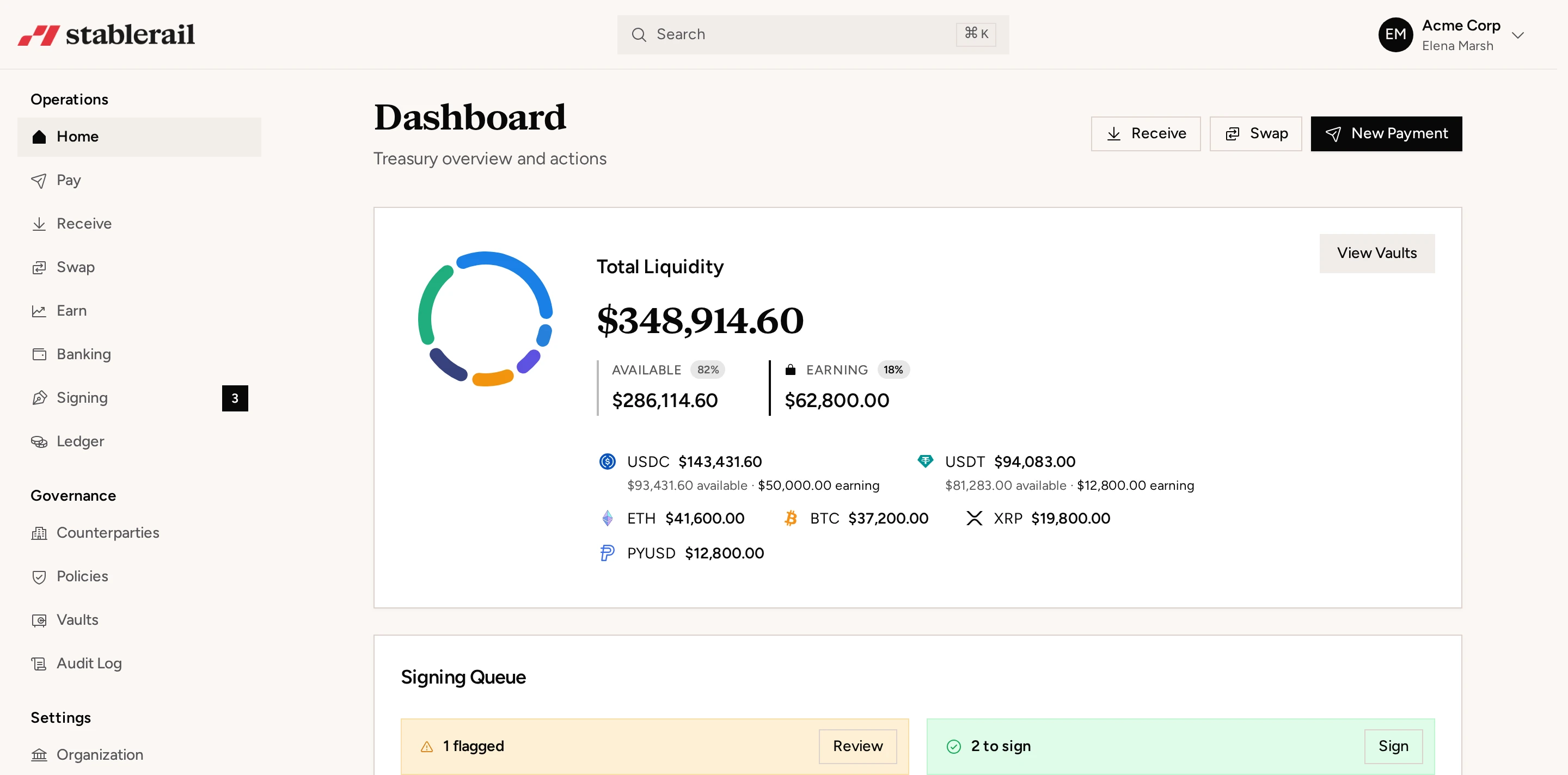
Stablerail steps in to stop risky payments before they happen. With over 6,000 zero-balance addresses monitored, it acts as an agentic control plane, sitting above custody and ahead of signing. Your finance team retains full control of keys through MPC wallets for corporate treasury, while Stablerail ensures every transaction passes rigorous compliance checks before execution.
This proactive approach combines compliance with operational control, ensuring every step is thoroughly verified.
Verification Before Signing
Stablerail operates on a "copilot, not autopilot" principle, enforcing mandatory pre-sign checks on every transaction. Before your team approves a payment, specialized agents perform a series of automatic screenings. These include:
Cross-checking global sanctions lists (OFAC SDN, EU Consolidated, UN)
Conducting taint and exposure analysis
Enforcing policy limits
Detecting anomalies like unusual payment amounts or times
Scoring counterparty risk
Each flagged transaction is accompanied by plain-English explanations, citing relevant policy clauses and timestamps, so your team knows exactly why a payment was flagged.
Policy-as-Code Governance
Stablerail’s rule-based framework allows finance teams to define and enforce machine-readable policies for every transaction. Examples include:
Requiring CFO approval for payments over $5,000 to new addresses
Adding extra approval for weekend transfers exceeding $10,000
Restricting transactions to USDC on Base/Ethereum networks
These policies eliminate informal, unrecorded approvals, ensuring every transaction follows the same consistent rules. The built-in policy engine minimizes human error and closes compliance gaps.
Risk Dossier and Audit Trail
For every transaction, Stablerail generates a detailed Risk Dossier, which includes:
A clear verdict: PASS, FLAG, or BLOCK
Identity checks and risk scoring for high-risk regions and politically exposed persons (PEPs)
Taint analysis and anomaly detection
The system logs every action, from intent creation to risk checks, approvals, overrides, and final signing, all timestamped for accuracy. These control receipts document what was paid, why, who approved it, and the associated risk verdict. By linking pseudonymous on-chain activity to real-world business identifiers, Stablerail replaces hidden chat logs and spreadsheets with a tamper-proof audit trail that meets regulatory standards. This ensures your compliance efforts are both transparent and well-documented for auditors and regulators alike.
Conclusion
Blacklisting and sanctions screening play distinct roles in stablecoin compliance. Blacklisting, managed by issuers like Tether and Circle, is a reactive measure often used after incidents like hacks or exploits. On the other hand, sanctions screening is proactive and legally required, ensuring transactions comply with regulatory lists from organizations like OFAC and the EU before funds are transferred. Interestingly, data reveals that over 6,000 blacklisted addresses had zero balances at the time of freezing because funds were moved beforehand. Additionally, only 36.4% of OFAC-sanctioned addresses have been blacklisted on-chain. This reliance on issuers highlights notable compliance gaps.
For corporate finance teams, pre-transaction screening is crucial to stop non-compliant payments from entering the blockchain. Real-world examples underline this need: In 2025, TraderTraitor managed to move nearly $30 million in stolen Ether through over 350 new addresses, effectively bypassing static blacklists. Such tactics demonstrate the limitations of blacklisting and emphasize the importance of real-time transaction verification.
Stablerail addresses these challenges by implementing pre-transaction checks, including sanctions screening, taint analysis, and policy enforcement. The platform generates a Risk Dossier for every transaction, providing a clear PASS/FLAG/BLOCK decision along with straightforward explanations. All transactions are logged with a verified audit trail, and finance teams maintain control through self-custodial MPC wallets while ensuring compliance by following a stablecoin compliance checklist for regulatory standards and internal policies.
This shift from reactive blacklisting to proactive screening mirrors a growing trend among stablecoin issuers to establish systematic enforcement pipelines. Corporate users must adopt tools that align with this approach. Pre-transaction screening not only prevents compliance failures and reputational risks but also ensures funds remain accessible and transactions are auditable. Adopting this proactive strategy strengthens your organization's ability to thrive in the evolving world of digital finance.
FAQs
Can a stablecoin issuer freeze my funds without warning?
Stablecoin issuers have the ability to freeze funds using on-chain tools like blacklisting. However, this process usually involves compliance checks and enforcement actions - it’s not something that happens instantly or without notice. Blacklisting works by restricting specific wallet addresses, often due to reasons like sanctions or policy violations. Once blacklisted, the funds in those addresses can no longer be spent. This underscores how crucial it is to ensure compliance before making transactions, as reversing transactions that have already been signed and executed is incredibly challenging.
Do I still need sanctions screening if issuers blacklist wallets?
Sanctions screening remains a critical practice. While wallet blacklisting can freeze known sanctioned addresses, it’s a reactive approach that doesn’t stop efforts to bypass detection, such as using mixers or generating new wallets. Sanctions screening, on the other hand, provides a proactive solution by continuously monitoring transactions and wallets in real time against updated sanction lists. This helps identify and block interactions with restricted parties before they can take place.
What should finance teams screen before signing a stablecoin payment?
Finance teams must carefully screen stablecoin payments to ensure compliance with sanctions, particularly under strict U.S. regulations like those outlined by the Office of Foreign Assets Control (OFAC). This involves several critical steps:
Checking wallet addresses: Compare wallet addresses against official sanctions lists to identify any restricted entities.
Monitoring transactions: Watch for signs of evasion tactics, such as the use of mixers or cross-chain swaps, which can obscure transaction origins.
Enforcing policies: Implement clear policies to block or restrict flagged wallets to prevent unauthorized transactions.
Taking these proactive measures can help organizations avoid penalties, protect their reputation, and maintain smooth relationships with banking partners.
Related Blog Posts
Former CEO of Simple, a self-custodial wallet with $2B+ in transaction volume across 75+ countries.
More about the Stablerail team- Stablecoin treasury managementApprovals, limits, yield and reporting on one balance.
- Stablecoin payoutsBatch contractor and vendor payments with screening.
- USDT vs USDCWhich stablecoin your company should settle in.
- Stablecoin finance glossaryMPC, off-ramp, travel rule and the rest, in plain English.
- Product updatesEverything we ship, month by month.