
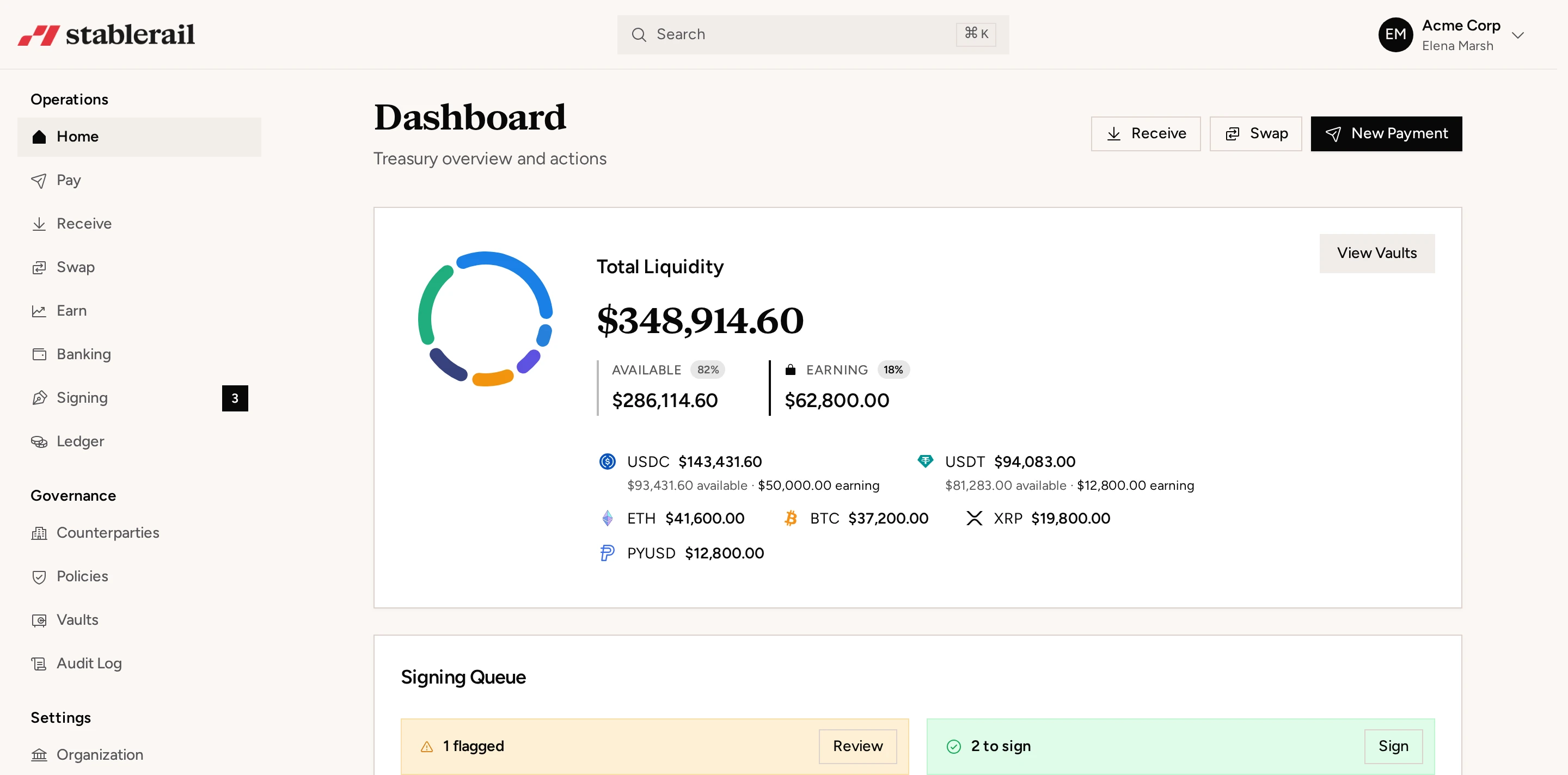
OFAC Screening for Stablecoin Payments
Pre-sign OFAC screening is essential for stablecoin payments: automate wallet checks, enforce policy-as-code, and log immutable audits.

Mar 31, 2026
When sending stablecoin payments, you must comply with OFAC sanctions to avoid severe legal consequences. This means screening wallet addresses against the Specially Designated Nationals (SDN) List, which identifies individuals, entities, and wallets U.S. persons cannot transact with. Unlike traditional banking, stablecoin transactions lack built-in compliance checks, making it your responsibility to ensure every transaction is screened before funds are sent.
Key points to know:
OFAC Compliance: U.S. persons must perform sanctions screening for stablecoin payments against OFAC's lists. Payments to sanctioned addresses are illegal and can result in fines or penalties.
Challenges with Stablecoins: Blockchain payments are instant and irreversible, with no intermediary to flag issues. This makes pre-transaction compliance critical.
Automation is Key: Manual screening is error-prone and slow. Automated tools can perform real-time checks, flag risks, and maintain audit trails. You can also use a crypto compliance checker to verify regional requirements.
To protect your treasury, use tools like self-custodial wallets, automated screening systems, and policy-based approval workflows. These ensure compliance, reduce errors, and provide the required accountability for regulatory audits.
Decoding the FATF Report: Stablecoins, Unhosted Wallets, and the Future of Compliance
OFAC Regulations for Stablecoin Transactions
Navigating compliance in stablecoin payments requires strict adherence to OFAC regulations. These rules, which enforce U.S. economic sanctions, apply to all financial transactions, including those involving stablecoins. U.S. persons are obligated to screen their transaction counterparties against OFAC's sanctions lists. To meet these requirements, modern stablecoin platforms rely on automated, thorough screening processes.
The SDN List and Stablecoin Payments
The Specially Designated Nationals (SDN) List is one of OFAC’s main tools for enforcement. It names individuals, entities, and even blockchain wallet addresses that U.S. persons are forbidden from engaging with. If a wallet address is added to the SDN list, any payments to that address become illegal, carrying serious penalties.
OFAC sanctions fall into several categories:
Sanction Type
Scope
Key Restriction
Comprehensive
Geographic (e.g., Iran, North Korea)
Prohibits nearly all trade and transactions with the region
List-Based (SDN)
Specific Individuals/Entities
Requires blocking all property and related interests
Sectoral (SSI)
Specific Economic Sectors
Restricts certain activities, such as dealing in debt or equity
Secondary
Non-U.S. Persons
Threatens U.S. market access for those dealing with sanctioned entities
The SDN list is updated frequently - sometimes multiple times a day. This means a wallet address that was permissible yesterday could suddenly become restricted today. To stay compliant, continuous re-screening of wallet addresses is essential.
While these screening requirements are clear, stablecoin transactions come with their own set of challenges that complicate compliance efforts.
Compliance Challenges in Stablecoin Payments
Stablecoin transactions present unique compliance difficulties that go beyond traditional banking systems. Blockchain addresses, such as Ethereum’s 42-character alphanumeric strings, provide little to no information about ownership or jurisdiction. Unlike traditional financial systems, stablecoin payments lack built-in Know Your Customer (KYC) and OFAC compliance checks, leaving the sender fully responsible for ensuring compliance.
Another challenge lies in the nature of cross-border on-chain payments. These transactions settle almost instantly, bypassing intermediary banks that might otherwise flag suspicious activity. Once a transfer is completed, it is both immediate and irreversible. There’s no compliance team at a correspondent bank to pause or review the transaction, nor is there a way to recover funds sent to a wallet on the SDN list. While the speed of on-chain payments is a clear operational benefit, it also removes many of the safeguards present in traditional financial systems.
How to Add OFAC Screening to Stablecoin Payment Workflows
5-Step OFAC Screening Workflow for Stablecoin Payments
Incorporating OFAC compliance into stablecoin payment workflows requires a methodical process. The idea is to screen every transaction against sanctions lists and internal policies before funds are moved, while maintaining a detailed audit trail for regulatory purposes. Below is a step-by-step guide to building this workflow effectively.
Step 1: Set Up Self-Custodial MPC Wallets
Multi-Party Computation (MPC) wallets are a key starting point. They allow your finance team to maintain full control over private keys while enabling role-based signing. By splitting cryptographic key shares across multiple parties, MPC wallets ensure that no single individual can move funds without approval. This setup adds a layer of governance and security to your system.
For example, Stablerail’s self-custodial MPC wallets support USDC and USDT across major EVM chains. Importantly, Stablerail itself cannot initiate or complete transfers - it only enforces policy checks.
As Stablerail explains: "Agents verify the context. Humans sign the transaction. The system protects the treasury - it never touches the money."
This separation ensures compliance by keeping the control of funds with your team while enforcing strict policy checks.
Step 2: Define Policy-as-Code Rules
Policy-as-code lets you automate your organization’s approval requirements. By translating these rules into machine-enforceable instructions, you can ensure consistent application across all payment intents, eliminating the need for informal, manual processes.
For instance, you might set rules that require CFO approval for vendor payments over $5,000, block weekend transfers above $10,000 without dual sign-off, or restrict payments to specific stablecoins or chains. Stablerail’s Policy Console allows you to define these rules based on variables like transaction size, recipient status, time of day, or flagged risks. Many companies adopt a tiered structure, such as:
Routine payments: Automated approval.
New vendors: Single approval.
High-risk or high-value transactions: Dual approval.
Once these policies are in place, automation ensures they’re executed consistently and reliably.
Step 3: Use Automated Sanctions Screening
Manual sanctions screening is often too slow and prone to errors, especially with high volumes of transactions. Automated systems, however, can screen wallets in real time against OFAC’s SDN and other sanctions lists, significantly reducing false positives and compliance burdens.
Because OFAC updates its lists multiple times a day, continuous screening is crucial. Instead of screening just at onboarding, automated systems re-check addresses at the moment of each transaction. Stablerail’s pre-sign checks go further, incorporating sanctions screening, taint and exposure analysis, behavioral anomaly detection, and counterparty risk scoring - all before any payment is approved.
Step 4: Review Risk Dossiers Before Payment
After automated checks, the system compiles a Risk Dossier for each transaction. This dossier provides a verdict - PASS, FLAG, or BLOCK - along with plain-English explanations citing relevant policy rules, timestamps, and risk factors.
PASS: All checks are cleared, and the payment can proceed with standard approval.
FLAG: Potential concerns (e.g., a new vendor or unusual timing) require additional review.
BLOCK: Serious violations, like confirmed sanctions matches, stop the payment entirely.
Approvers can document any overrides or justifications directly within the system, adding transparency and accountability to the process.
Step 5: Keep Full Audit Trails
Regulatory bodies, such as OFAC, expect comprehensive records for every payment, including screening results, list versions, and timestamps. These records must be stored for at least five years to meet compliance requirements under the Bank Secrecy Act .
Stablerail automatically logs every action - from the creation of payment intent to final signature - into an immutable audit trail. This creates a detailed, tamper-proof record that provides CFO-grade evidence of compliance, which is critical for regulatory audits and internal reviews.
Common Mistakes in OFAC Screening for Stablecoin Payments
Companies often stumble when implementing OFAC screening for stablecoin transactions, mainly because they approach blockchain payments as if they were traditional ones. This oversight ignores the irreversible nature and rapid execution of blockchain transactions, leading to avoidable errors. Here's a breakdown of the most common pitfalls and how to steer clear of them.
Why Manual Screening Falls Short
Manual processes simply don’t cut it for stablecoin workflows. Teams relying on spreadsheets, copy-paste methods, and informal approval systems face serious risks. Typos in wallet addresses can send funds to the wrong recipient with no way to recover them. Double payments are a frequent issue when multiple team members work from separate spreadsheets. And approvals made through Slack, Telegram, or email lack the audit trails regulators demand.
A recurring mistake is static screening - where companies screen a counterparty at the start of a relationship but fail to re-screen them after new sanctions are issued. This oversight has led to hefty penalties in past enforcement cases.
Since blockchain transactions are irreversible, screening after the payment has been made is ineffective. Checks must occur before signing the transaction. Another common oversight is ignoring OFAC's "50 Percent Rule", which mandates screening entities owned 50% or more by sanctioned individuals, even if those entities aren’t listed on the SDN list. Pre-transaction screening that adheres to these rules is crucial for staying compliant and safeguarding treasury operations.
Manual vs. Automated Screening: A Comparison
Feature
Manual (Wallet/Spreadsheet)
Automated (Policy-Enforced)
Timing
Manual or post-transaction
Real-time, pre-signature checks
Approvals
Informal (Slack, Telegram, Email)
Formal, structured policy engine
Scalability
Low; manual reconciliation required
High; handles batch payouts (e.g., 500 transfers)
Audit Trail
Hidden in chat logs or manual files
Automated, tamper-proof logs
Risk Detection
Basic list matching only
Includes behavioral analysis and taint detection
Rules-based sanctions screening often produces false positives - sometimes as high as 99.99% - creating an overwhelming manual workload. This can lead to shortcuts and missed warning signs. The stakes are high: global AML-related fines surged by 522% to $3.65 billion in 2024, showing the steep cost of inadequate controls.
While automation streamlines compliance, it must also address nuanced risks, such as behavioral anomalies, to deliver effective protection.
Overlooking Transaction Anomalies and Behavioral Risks
Beyond manual errors, ignoring behavioral risks can leave stablecoin transactions vulnerable to sanctions violations. Screening wallet addresses against the SDN list is essential but not enough. Many companies fail to detect behavioral warning signs that suggest illicit activity or connections to sanctioned entities. For example:
Velocity spikes: Rapid transfers to new or unverified wallets can signal laundering schemes like "peel chains".
Odd timing: Payments made at unusual hours or sudden changes in vendor wallet addresses can raise red flags.
First-time beneficiaries: Transfers to unfamiliar wallets may indicate risk.
A notable case occurred in January 2025, when OFAC sanctioned Iran-based digital asset exchanges Zedcex and Zedxion for facilitating illicit financial activities tied to the Islamic Revolutionary Guard Corps (IRGC). These exchanges were used for fund transfers and procurement networks, marking the first time OFAC targeted exchanges for aiding the IRGC. This underscores the importance of Know Your Transaction (KYT) practices, which monitor ongoing patterns and sanctions exposure, rather than just verifying identities during onboarding.
Between October 2024 and October 2025, stablecoins facilitated $9 trillion in adjusted payments - a staggering 87% year-over-year increase. With this volume, manual monitoring is simply unfeasible. Automated systems that establish behavioral baselines can flag deviations in real-time. Features like automatic 4-hour cool-off periods for high-value transfers allow for additional risk review and can prevent social engineering attacks. These capabilities are essential for building a robust stablecoin compliance checklist for your workflow.
Conclusion
OFAC screening for stablecoin payments requires a pre-signature verification process. Unlike traditional banking, blockchain transactions are irreversible, making it critical to identify sanctions violations, unusual behaviors, or tainted funds before the transaction leaves your wallet. This proactive approach is key to addressing the unique complexities of stablecoin transactions.
The proposed framework - combining MPC wallets, policy-as-code, automated screening, risk dossier reviews, and immutable audit trails - provides a scalable and compliant solution. By automating these processes, the framework avoids the errors and inefficiencies of manual workflows.
To bring this framework to life, a unified solution is necessary. Stablerail offers such a solution, acting as a control layer above custody and before transaction signing. Its AI-driven agents create risk dossiers with PASS, FLAG, or BLOCK decisions for every transaction by performing sanctions checks against the OFAC SDN List, running taint analyses, and identifying behavioral anomalies. Additionally, its policy-as-code engine converts rules - like requiring CFO approval for payments over $5,000 to new addresses - into automated controls that prevent unauthorized transactions. With a self-custodial MPC setup, Stablerail maintains user control over private keys while automating governance, ensuring compliance, and generating tamper-proof audit trails, all without sacrificing speed.
These tools go beyond just meeting regulatory requirements - they safeguard your treasury from costly mistakes. Transitioning from manual processes to automated, policy-driven workflows not only ensures compliance but also strengthens the security and efficiency of your treasury operations.
FAQs
Do I need to screen every stablecoin payment before sending it?
Yes, it's crucial to screen every stablecoin payment before sending it. This ensures compliance with sanctions regulations and helps you avoid potential penalties. With strict liability standards in place, real-time screening of wallet addresses and ongoing transaction monitoring are essential steps to meet these requirements.
How often should I re-screen a vendor wallet address against the SDN list?
The Office of Foreign Assets Control (OFAC) recommends reporting any blocked virtual currency transactions within 10 business days. Additionally, they suggest conducting annual re-screening of the blocked currency as long as it remains restricted. This process helps ensure adherence to sanctions regulations over time.
What records should I keep to prove OFAC screening compliance?
Keeping detailed records is critical for meeting OFAC compliance requirements. This includes maintaining documentation of sanctions screening results, pre-sign risk assessments, policy enforcement actions, and any approvals or overrides. Additionally, ensure you have detailed audit trails that capture all transaction checks and decisions. These records serve as clear evidence of your compliance efforts and provide transparency in case of audits or reviews.
Related Blog Posts
Former CEO of Simple, a self-custodial wallet with $2B+ in transaction volume across 75+ countries.
More about the Stablerail team- Stablecoin treasury managementApprovals, limits, yield and reporting on one balance.
- Stablecoin payoutsBatch contractor and vendor payments with screening.
- USDT vs USDCWhich stablecoin your company should settle in.
- Stablecoin finance glossaryMPC, off-ramp, travel rule and the rest, in plain English.
- Product updatesEverything we ship, month by month.