
Multi-Signature Wallets for CFOs: What to Know
CFO guide to securing stablecoin treasuries with multi-signature and MPC wallets, governance controls, and auditable payment workflows.

If you’re managing corporate stablecoins, multi-signature wallets are a must-have for security, governance, and compliance. Unlike single-signature wallets, which rely on one key (and one person), multi-sig wallets require multiple approvals to execute transactions, reducing risks of fraud, errors, and catastrophic losses.
Key Takeaways:
Enhanced Security: Transactions need approval from multiple signers, minimizing single points of failure.
Governance: Features like spending limits, dual approvals, and audit trails ensure accountability.
Compliance: Built-in controls and transparent records simplify audits and meet regulatory standards.
Challenges: Higher transaction costs and setup complexity. Key management is critical to avoid lockouts.
For CFOs handling millions in stablecoins, multi-sig wallets offer a secure and controlled way to manage funds. Alternatives like MPC wallets can reduce costs and support broader blockchain compatibility while maintaining strong security. Choose the right setup based on your team size, transaction volume, and risk tolerance.
Multi-Signature Wallets: Shared Control & Enhanced Security Explained
What Are Multi-Signature Wallets?
A multi-signature (multi-sig) wallet is a type of digital wallet that requires multiple private keys to approve and complete a transaction. Think of it like a vault that needs several keys to open, ensuring that no single person has full control. This setup is especially useful for organizations managing significant digital assets.
Multi-sig wallets operate on the M-of-N principle, where "M" is the number of required signatures to approve a transaction, and "N" is the total number of authorized keys. For instance, in a 2-of-3 arrangement, any two out of three authorized signers must approve a transaction. This structure strengthens security and aligns with the separation of duties (SoD) principle, a key expectation for managing large funds. Multi-signature technology was first introduced for Bitcoin transactions in 2012, using the pay-to-script-hash (P2SH) address type. Today, it’s a go-to solution for corporate treasuries.
How Multi-Signature Wallets Work
When a transaction is initiated from a multi-sig wallet, it doesn’t immediately go through. Instead, it creates a proposal that must be signed by the required number of authorized parties. Each signer reviews the transaction details and uses their private key to either approve or reject it.
Once the required number of signatures is collected (e.g., two in a 2-of-3 setup), the transaction is broadcast to the blockchain. This process ensures a transparent and tamper-resistant audit trail. In some cases, the approval process - and even the identities of the signers - may be visible on the blockchain.
For financial teams, common setups include a 2-of-3 configuration for smaller operational funds and a 3-of-5 model for larger reserves or board-level oversight. One major benefit of multi-sig wallets is that even if one key is lost or compromised, the funds remain secure as long as the minimum required keys are intact. As security expert Keiganroy put it:
"The difference between 1-of-1 and 2-of-3 security is the difference between single-point catastrophic failure and very high resilience." – Keiganroy
To enhance security further, it’s recommended to store private keys in different physical locations and on separate devices. For example, one key could be kept in an office safe, another in a safe deposit box, and the third with a trusted executive working remotely. This strategy guards against theft, natural disasters, or hardware failures.
These safeguards make multi-sig wallets a strong choice for CFOs prioritizing governance and risk control. This approach stands in stark contrast to single-signature wallets, as discussed below.
Multi-Signature vs. Single-Signature Wallets
Here’s how single-signature and multi-signature wallets differ in terms of control, security, and accountability:
Feature
Single-Signature Wallet
Multi-Signature Wallet
Security
Vulnerable to a single point of failure.
Distributes risk; multiple keys must be compromised simultaneously.
Accountability
No shared access; one person has full control.
Enables shared control and separation of duties.
Compliance
Hard to prove who authorized a transaction; lacks internal controls.
Supports audit trails and regulatory standards (e.g., MiCA).
Flexibility
Easy for individuals but impractical for organizations.
Requires coordination among signers; often tied to specific blockchains.
Transaction Costs
Low.
Higher, as each signature adds an on-chain interaction.
One drawback of multi-sig wallets is that they’re often designed for specific blockchains, like Bitcoin or Ethereum. This means a CFO managing assets across multiple blockchains might need separate wallet solutions for each, adding complexity to operations and increasing administrative tasks.
Benefits for CFOs
Multi-sig wallets offer CFOs a powerful way to secure funds, maintain oversight, and ensure accountability. Beyond their robust security, these wallets directly address fraud risks and audit challenges - key concerns for anyone managing digital treasuries. Here’s how they stand out:
Better Security and Risk Reduction
One of the standout benefits of multi-sig wallets is their ability to eliminate single points of failure. Take a 3-of-5 configuration, for example: an attacker would need to compromise three separate keys at the same time to access funds. This makes them far more secure than single-signature wallets, where losing just one key can result in complete loss of access.
The geographic dispersion of keys adds another layer of protection. Even if one key is compromised, funds remain safe as long as the minimum required keys are intact.
But security isn’t the only improvement - multi-sig wallets also enhance stablecoin treasury management best practices.
Stronger Internal Controls
Multi-sig wallets enforce separation of duties by design. No single person can transfer funds alone, which reduces fraud risks and ensures proper checks and balances. This is particularly crucial for high-value transactions or payments to unfamiliar vendors.
Some systems even add an extra layer of protection by introducing a short delay for high-value or first-time vendor payments. These delays give finance teams time to identify potential social engineering attempts or errors before funds are sent. For CFOs overseeing millions in stablecoins, this buffer can make all the difference in avoiding costly mistakes.
Compliance and Audit Trail Support
Every transaction made with a multi-sig wallet generates a detailed, verifiable audit trail. This includes information like approver identities, policy compliance, risk assessments, and business context (such as invoices or vendor history). Such transparency ensures that regulatory and audit requirements are met with ease.
This level of documentation empowers CFOs to confidently defend payment decisions to auditors, boards, and regulators. It’s a significant improvement over manual wallet processes or spreadsheet-based approval systems, which often lack this level of precision and accountability.
Risks and Challenges
While multi-signature wallets provide better security and tighter internal controls, they can also create operational hurdles that CFOs need to navigate. From managing keys to coordinating approvals, these challenges can disrupt workflows if not addressed effectively.
Key Management Risks
One of the biggest risks with multi-signature wallets is permanent fund lockout. If too many keys are lost and the required threshold (e.g., three out of five) can't be met, the funds become permanently inaccessible. There's no recovery option in such cases.
A safer alternative is MPC-based wallets, which align with CFOs' goals of minimizing risks in corporate stablecoin management. Instead of dealing with separate physical keys, MPC systems split cryptographic key shares across multiple parties. If one share is lost, the system can securely regenerate it. For CFOs overseeing millions in stablecoins, this recovery feature can mean the difference between a manageable issue and a financial disaster.
A practical way to mitigate risks? Distribute key shares geographically across continents and use hardware wallets from different manufacturers. Keeping all keys in one location or relying on the same hardware brand increases vulnerability to single points of failure - whether from fire, theft, or a manufacturing defect.
Setup and Coordination Complexity
Setting up a multi-signature wallet isn't as simple as flipping a switch. It requires careful coordination among multiple signers, clear approval workflows, and ensuring everyone involved understands their responsibilities. For finance teams already juggling tight schedules, this process can feel like an added burden.
This is where Stablerail steps in to simplify things. The platform automates policy enforcement and approval workflows. For instance, it can apply rules like "payments over $100,000 require two senior signers" without manual intervention. It also organizes approvals into tiers:
Tier 1: Routine payments (e.g., payroll to verified vendors) are automatically approved after programmatic checks.
Tier 2: Mid-range payments or those involving new vendors need approval from one finance officer.
Tier 3: High-value or high-risk transactions require dual approval from senior leadership.
This structure reduces bottlenecks while maintaining strong oversight, making the transition to multi-signature wallets less daunting.
Higher Transaction Costs
Managing transaction costs is another challenge. Adding more signatures increases on-chain fees and coordination efforts, which can also drive up labor costs.
The upside? MPC/TSS architecture can lower gas fees to the same level as single-signature transactions while still providing multi-party security. Additionally, batch payouts allow one signature to authorize hundreds of transactions at once. For routine treasury tasks, internal transfers between company wallets can bypass complex approval processes, keeping things efficient.
How to Implement Multi-Signature Wallets
Setting up multi-signature wallets involves three key steps: choosing the M-of-N structure, assigning roles, and using automation to enforce policies. Each step ensures secure governance and smooth integration with your treasury operations.
Choosing the Right M-of-N Structure
The M-of-N structure determines how many approvals are needed out of the total number of signers. For smaller teams of 3–5 people, a 2-of-3 setup offers flexibility. Larger organizations often benefit from a 3-of-5 configuration, which provides additional oversight for high-value transactions.
Risk tolerance plays an important role in this decision. For example, if your organization frequently handles transactions exceeding $100,000, a 3-of-5 structure may provide the necessary safeguards. You could require approvals from the CFO, CEO, and one board member for these larger transfers. Meanwhile, a 2-of-3 setup might be better suited for routine transactions involving smaller amounts.
Assigning Roles and Responsibilities
Once the signing structure is defined, assign specific roles to maintain clear separation of duties. This helps strengthen governance and reduce the risk of fraud. Typically, the CFO oversees financial operations and approves high-value transactions, while the CEO focuses on strategic decisions. For the most critical transactions, board members or other key stakeholders can be included as additional signers.
Role-based approvals are a practical way to enhance security. For instance, you might require the CFO and CEO to approve transfers exceeding $50,000, while routine payments could need approval from the CFO and two department heads. This approach not only reinforces internal controls but also provides a clear, cryptographic record of who approved each transaction - essential for audits.
Using Stablerail for Policy Enforcement
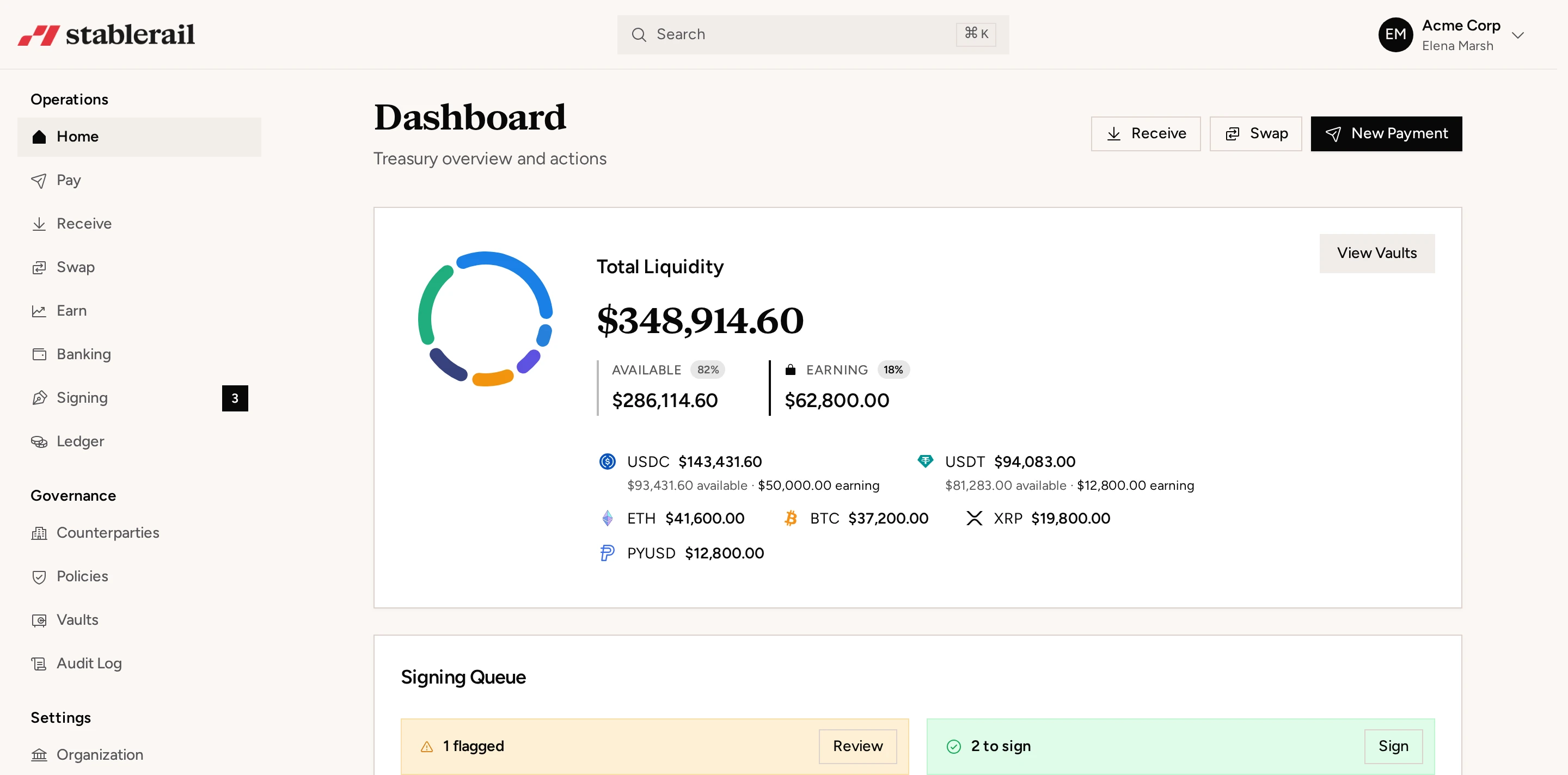
Stablerail simplifies policy enforcement by automating processes above custody and before signing. Its Policy Console allows you to set rules, such as requiring CFO approval for transfers over $5,000. These rules are automatically checked using tools like sanctions screening, anomaly detection, and counterparty risk scoring. The system then generates a Risk Dossier, which includes a verdict (PASS/FLAG/BLOCK) and plain-English explanations tied to your policy guidelines. Every step is logged in a detailed audit trail that meets regulatory and audit standards.
This automation reduces delays and lowers transaction costs, improving overall efficiency. Approvers can review the Risk Dossier, provide justifications for overrides if needed, and sign transactions using a secure MPC (multi-party computation) process.
Stablerail’s MPC wallets work across major EVM chains and support stablecoins like USDC and USDT. While you retain full control of your keys, the platform itself never has unilateral signing authority. Additional tools, such as the Treasury Hub for tracking balances across chains and the Vendor & B2B Payments module for governed transfers, make Stablerail a "copilot" in managing your treasury - offering the security of multi-signature governance alongside the benefits of automated compliance checks.
Multi-Signature Wallets vs. MPC Wallets
Multi-Signature vs MPC Wallets: Security and Cost Comparison for CFOs
Both multi-signature wallets and MPC (Multi-Party Computation) wallets offer enterprise-level security but achieve it through very different methods. Understanding these approaches can help CFOs determine the best fit for managing corporate stablecoin treasuries.
Security Model Comparison
Multi-signature wallets rely on multiple complete private keys stored on separate devices. Each signer holds an entire private key, and a transaction requires a predefined number of signatures to be authorized on-chain. This process is fully transparent, as all approvals are visible on the blockchain.
In contrast, MPC wallets use threshold signature schemes (TSS) to divide a private key into multiple fragments. No single device ever holds the full key. When a transaction needs approval, these key fragments work together off-chain to generate a single standard signature. Only the final signature is recorded on the blockchain, keeping the internal governance structure private.
Feature
Multi-Sig Wallet
MPC Wallet
Security Basis
Multiple complete private keys
Fragmented key shares (TSS)
Key Existence
Full keys exist on devices
Full key never exists on any device
Transaction Fees
High (multiple on-chain signatures)
Low (single standard signature)
Privacy
Low (quorum visible on-chain)
High (governance remains off-chain)
Flexibility
Rigid (difficult to change signers)
High (supports key rotation)
Blockchain Support
Limited (specific chains like BTC/ETH)
Broad (any ECDSA/EdDSA-compatible chain)
These technical differences are crucial when selecting a wallet solution for enterprise-level stablecoin operations.
Which Wallet Type Fits Enterprise Needs
For CFOs managing large-scale stablecoin treasuries, blockchain compatibility is a key consideration. Multi-sig wallets are often restricted to specific blockchains such as Bitcoin or Ethereum, requiring separate wallets for different chains. MPC wallets, however, generate standard ECDSA or EdDSA signatures, making them compatible with a wide range of blockchains, including Ethereum, Polygon, and Solana, without needing custom smart contracts.
Operational flexibility is another critical factor. In multi-sig setups, changing the approval quorum or adding new signers often requires transferring funds to a new wallet address, which can be disruptive and costly. MPC wallets allow these changes to be made off-chain, ensuring smooth operations without additional transaction fees.
Transaction costs also vary significantly. Since MPC wallets only produce a single standard signature, transaction fees remain consistent with regular transfers. For companies handling hundreds of payments each month, this can result in considerable savings.
Why Stablerail's MPC Approach Works
Stablerail's MPC-based wallets stand out by addressing the limitations of traditional multi-sig solutions while introducing an agentic control plane that enhances security and governance. With Stablerail, you maintain full control of your keys, and the platform never has unilateral signing authority.
The system includes mandatory pre-sign checks that run before any payment is executed. These checks cover sanctions screening, policy enforcement, behavioral anomaly detection, and counterparty risk assessments. Each check generates a detailed Risk Dossier with a verdict (PASS/FLAG/BLOCK) and plain-language explanations tied to your specific policies. This "copilot, not autopilot" approach ensures human oversight while automating crypto compliance processes.
Stablerail also offers policy-as-code governance, allowing you to define enforceable rules such as "Payments over $5,000 to new addresses require CFO approval" or "Weekend transfers exceeding $10,000 need additional verification." These rules are automatically applied to every transaction intent before signing. Every step, from intent creation to final approval, is logged in a complete audit trail that meets regulatory and board-level requirements.
The platform supports major EVM-compatible chains and stablecoins like USDC and USDT, with plans to add Solana. This broad compatibility, combined with off-chain governance and automated risk checks, makes Stablerail an ideal solution for finance teams managing $1 million to $50 million annually in stablecoin transactions.
Conclusion
Multi-signature wallets provide CFOs with a reliable way to reduce single points of failure in stablecoin treasury management. By requiring multiple signers for transactions, these wallets ensure that no single compromised key or rogue employee can drain corporate funds. The advantages are clear: enhanced internal controls, stronger compliance documentation, and lower fraud risks.
That said, traditional multi-sig setups aren’t without their drawbacks. They often come with higher transaction costs due to multiple on-chain signatures, limited compatibility with various blockchains, and inflexible quorum structures. For finance teams handling $1 million to $50 million in annual stablecoin transactions, these challenges can quickly become a burden.
MPC (multi-party computation)-based solutions address these pain points while maintaining distributed control. With reduced fees, broader blockchain support, and adaptable governance structures, MPC wallets offer a scalable approach to treasury operations. But key management alone isn’t enough - CFOs also need governance tools that enforce business rules before funds are moved.
This is where Stablerail steps in, acting as a control layer before signing. The platform automates critical processes like sanctions screening, policy enforcement, and anomaly detection through mandatory pre-sign checks. Each transaction generates a detailed audit trail with clear, plain-language explanations of the policies applied. For example, you can set rules such as "Payments over $5,000 to new addresses require CFO approval", and Stablerail enforces these automatically, replacing informal workflows like Slack approvals.
For CFOs considering multi-signature workflows, the lesson is simple: secure key management is just the start - intelligent governance transforms stablecoin payments into a streamlined, audit-ready process. Stablerail combines robust security with smart governance to meet the high standards required for effective treasury management.
FAQs
What M-of-N setup is best for my treasury?
The ideal M-of-N setup strikes a balance between security, efficiency, and oversight. Higher thresholds, like 3-of-5 or 4-of-7, enhance security by requiring multiple approvals, making it harder for unauthorized transactions to occur. These configurations are especially suited for large or high-risk treasuries and align well with strict governance policies.
On the other hand, lower thresholds, such as 2-of-3, might be more appropriate for smaller transactions or operations where speed is a priority. However, these setups come with increased risk due to fewer approval requirements.
Ultimately, the right setup depends on your risk tolerance, operational needs, and compliance requirements.
How do we avoid getting locked out of funds?
To avoid losing access to your funds, it's crucial to implement effective governance and security practices. Start by using multi-approval thresholds for large transactions. This means requiring multiple approvals before any high-value transfer is completed, adding an extra layer of oversight.
Additionally, automated pre-signature checks can help verify the validity of each transfer before it’s executed. This minimizes the risk of errors or unauthorized actions.
For even greater security, consider threshold cryptography, an advanced technique that divides private keys into multiple parts. This ensures that no single individual or entity has full control over the funds, significantly reducing the chances of key compromise.
Finally, integrate detailed audit trails and real-time monitoring into your system. These tools not only help you track every transaction but also provide immediate alerts for any suspicious activity, enabling swift action to maintain control and mitigate risks. Together, these measures create a secure framework for managing your funds.
When should we use MPC instead of multi-sig?
Choose MPC (Multi-Party Computation) over multi-sig when you need stronger security, better compliance with regulations, and automated policy enforcement. MPC removes single points of failure, offering a higher level of protection. It also supports scalable, off-chain governance for enterprise wallets, making it a great choice for organizations that demand strict controls and adaptability.
Related Blog Posts
Former CEO of Simple, a self-custodial wallet with $2B+ in transaction volume across 75+ countries.
More about the Stablerail team- Stablecoin treasury managementApprovals, limits, yield and reporting on one balance.
- Stablecoin payoutsBatch contractor and vendor payments with screening.
- USDT vs USDCWhich stablecoin your company should settle in.
- Stablecoin finance glossaryMPC, off-ramp, travel rule and the rest, in plain English.
- Product updatesEverything we ship, month by month.