
How Cross-Chain MPC Wallets Enhance Stablecoin Governance
How cross-chain MPC wallets secure stablecoin treasuries with distributed key shares, pre-sign policy enforcement, and unified cross-chain control.

Feb 9, 2026
Managing stablecoins across multiple blockchains is challenging. Traditional wallets often suffer from security risks, fragmented custody, and inflexible governance processes. Cross-chain MPC (Multi-Party Computation) wallets solve these issues by distributing private key management, enabling secure, policy-driven control over funds without requiring custom contracts for every blockchain.
Key Benefits of Cross-Chain MPC Wallets:
Enhanced Security: Private keys are split into encrypted shares, never fully reconstructed, reducing risks of theft or loss.
Governance Control: Policies like spending limits or approval workflows are enforced before transactions, ensuring compliance and transparency.
Cross-Chain Compatibility: Manage stablecoins like USDC or USDT across Ethereum, Solana, and more, all from a single wallet.
Compliance Tools: Built-in risk assessments flag or block problematic transactions before signing.
In contrast, traditional wallets - like single-signature or multi-signature solutions - are prone to single points of failure, rigid governance, and higher operational costs. Cross-chain MPC wallets offer a secure, flexible, and efficient alternative for businesses managing stablecoin treasuries.
1. Cross-Chain MPC Wallets
Security
Cross-chain MPC wallets address traditional security weaknesses by splitting private keys into encrypted fragments, known as "shares", which are distributed across multiple devices or servers. Thanks to Distributed Key Generation (DKG), these wallets ensure that a private key never exists as a complete entity at any stage. This marks a shift from older methods like Shamir's Secret Sharing, where the key was created in full before being divided. When a transaction needs approval, each participant uses their share to create a partial signature. These partial signatures combine to form a valid transaction signature without ever reconstructing the private key in memory.
This system also incorporates zero-trust validation, where each signer independently verifies the transaction's intent before contributing their share. This prevents any single compromised device or node from forcing an unauthorized transaction. Alexandre Karlov, Director of Cryptography and Security Engineering at Blockdaemon, explains:
"With MPC, trust is scaled out and distributed... trust rests on two independent 'rails' that must both succeed for assets to move: Quorum approval and Threshold cryptography".
These advancements lay the groundwork for more flexible governance structures, particularly for managing stablecoin treasuries.
Governance Flexibility
MPC wallets go beyond secure key management by separating authorization from cryptography, offering greater governance flexibility. Unlike traditional multi-signature wallets, which embed approval logic into on-chain smart contracts, MPC wallets manage authorization off-chain through a policy engine. This setup enforces rules before the cryptographic signing process begins.
This separation allows teams to adjust governance rules - like spending limits or approval workflows - without altering cryptographic materials or wallet addresses. For instance, a company could require CFO approval for payments over $5,000 and later adjust that threshold to $10,000 without redeploying contracts or rotating keys. This mirrors the adaptable governance controls familiar in traditional banking systems.
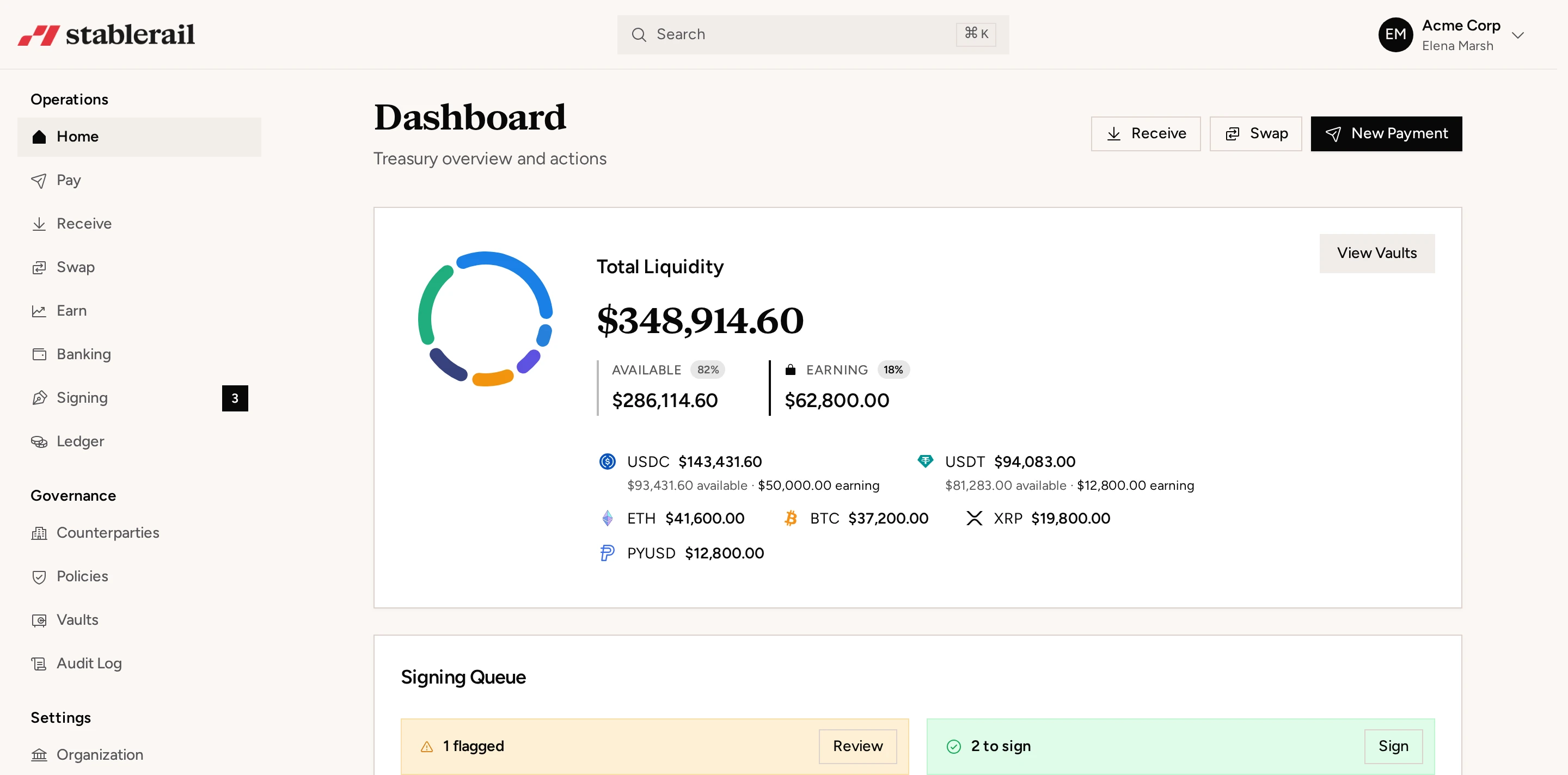
Platforms like Stablerail take advantage of this architecture by turning informal processes into enforceable "policy-as-code." Teams can define rules such as "weekend transfers over $10,000 require additional approval" or "only allow USDC on Base/Ethereum", and the system ensures these policies are applied consistently. This eliminates reliance on manual workflows like spreadsheets and Slack approvals, which often lack an audit trail.
Cross-Chain Support
MPC wallets function at the cryptographic level, producing standard ECDSA signatures for Bitcoin and Ethereum or EdDSA signatures for Solana. This means they don’t require custom smart contracts for each blockchain. On-chain, transactions appear identical to those from standard externally owned accounts (EOAs), preserving both privacy and predictable gas costs.
This design offers a unified control plane for managing assets across multiple blockchains. Instead of juggling separate wallets for USDC on Ethereum, USDT on Tron, and USDC on Solana, treasury teams can manage all balances from a single dashboard while applying consistent governance rules. As Cordial Systems highlights:
"Because MPC wallets operate at the cryptographic layer, they are blockchain-agnostic. Whether managing assets on Bitcoin, Ethereum, Cosmos SDK chains, or newer Layer-1s, the underlying MPC engine does not need to change - only the transaction payloads differ".
This setup also ensures operational continuity. Thanks to threshold cryptography (t-of-n quorums), wallets remain accessible even if one signer is offline or a device is lost. This "quorum liveness" is crucial for maintaining 24/7 stablecoin liquidity without creating single points of failure.
Compliance and Risk Mitigation
MPC wallets integrate compliance measures to proactively manage risks, offering pre-sign risk assessments that identify issues before transactions are signed. These wallets use built-in compliance tools to enforce sanctions screening, verify limits, detect anomalies, and assess counterparty risks. This ensures problematic transactions are flagged or blocked before funds are moved.
This approach incorporates blockchain intelligence tools to provide live risk scores, freeze deposits from flagged addresses, or reject payments that exceed predefined velocity limits. Importantly, these compliance agents operate independently of the signing infrastructure - they can block or flag transactions but cannot hold keys or initiate transfers.
The architecture also enforces separation of duties at the cryptographic level. Since MPC requires multiple independent parties to validate and sign transactions, no single individual can unilaterally execute or approve a payment. Every step, from transaction intent to final signing, is logged in detail, linking approvals to specific on-chain transaction hashes. This creates a thorough audit trail, offering CFOs the transparency they need for compliance and accountability.
Private vs Multisig vs MPC: Cube's Vault Propositions
2. Traditional Wallet Solutions
Traditional wallet solutions take a centralized approach to risk management, relying on reactive approvals rather than proactive safeguards. This approach exposes them to vulnerabilities that cross-chain MPC wallets aim to address, especially in the context of stablecoin governance.
Security
Traditional wallets face notable security challenges. Single-signature wallets, or EOAs, concentrate all risk in a single private key. If that key is lost or compromised, the funds are gone - no second chances. This creates a severe dependency on one individual, often referred to as "key-person risk".
A stark example of this occurred during the Multichain incident in May 2023. When CEO Zhaojun was detained, over $130 million in assets were lost. His personal cloud account controlled critical MPC node servers, and the team could no longer access mnemonic phrases or hardware wallets. This allowed an unauthorized cloud login to bypass the cryptographic safeguards entirely.
Multi-signature wallets, which require multiple approvals (M-of-N signatures), offer added protection but are not immune to flaws. Hardware Security Modules (HSMs) often store the full private key in a single unit, creating a single point of failure. As ChainUp highlights:
"A lost phone, a compromised laptop, or a suddenly unreachable signer can turn into a full-blown crisis when millions in user funds sit behind a single private key".
Governance Flexibility
Governance in traditional multi-signature wallets lacks flexibility. These wallets enforce approval policies directly on-chain, which makes them rigid and costly to adjust. For example, changing signers or thresholds often requires an on-chain transaction, and in some cases, even redeploying the contract - resulting in additional gas fees and delays. Cordial Systems emphasizes this issue:
"Changing signers requires redeploying the contract".
This rigidity becomes especially problematic for companies needing to adjust workflows, spending limits, or personnel access. Moreover, governance approvals are often managed through unsecured channels like Slack, Telegram, or email, leaving no clear audit trail for financial officers or regulators. Stablerail points out the risks:
"Wiring millions in USDC/USDT through wallets and spreadsheets means you lack a treasury system and face risks".
Many companies handling between $1 million and $50 million in annual stablecoin transactions rely on manual processes without a formal treasury system, further increasing governance challenges and operational risks.
Cross-Chain Support
Traditional multi-signature wallets are typically tied to specific protocols, requiring custom smart contracts and audits for each blockchain. This creates fragmented custody, with assets spread across hardware wallets, exchange accounts, and multisigs. Treasury teams are left managing isolated silos, making it hard to get a unified view of stablecoin balances, exposures, or pending approvals across chains.
On EVM-compatible chains, multi-signature wallets incur higher gas costs due to the complex contract logic needed for multiple signers. Updates, like adding or removing signers, require slow and expensive on-chain transactions. Cordial Systems explains:
"The entity that holds the HSM typically has unilateral signing power unless additional policy systems are layered on top".
This disjointed system not only increases the risk of errors but also makes it difficult to maintain consistent governance policies across different blockchains.
Compliance and Risk Mitigation
In traditional setups, compliance measures like sanctions screening and taint analysis are usually conducted manually after a transaction is queued, rather than before it’s signed. This reactive approach increases the risk of interacting with sanctioned or flagged entities.
While traditional multi-signature wallets provide on-chain transparency - showing thresholds, signers, and approval timestamps - the records lack the context needed for business decisions. They don’t explain the rationale or policies behind payments, leaving finance teams scrambling to justify decisions during audits or regulatory reviews. Without integrated compliance tools, these solutions make it harder to defend actions and maintain accountability.
Strengths and Weaknesses
Comparison of Traditional Wallets vs Multisig vs Cross-Chain MPC Wallets for Stablecoin Management
Here's a breakdown of how traditional wallets, multisig wallets, and cross-chain MPC wallets compare across key areas:
Dimension
Traditional EOA / Hardware
Multisig (Smart Contract)
Cross-Chain MPC Wallet
Security Model
Single private key (Single point of failure)
On-chain logic (n-of-m signatures)
Distributed key shares (Off-chain computation)
Chain Support
Native to specific chains
Chain-specific (requires new contracts)
Universal / Chain-agnostic
Compliance
Manual / After-the-fact
Transparent but rigid
Policy-as-code / Automated
Gas Costs
Low
High (on EVM chains)
Low (standard signature size)
Audit Trail
Fragmented (Slack/Email)
Native on-chain
Off-chain logs / SIEM integration
Privacy
High
Low (Signers/Thresholds visible)
High (Looks like single-sig)
Key Rotation
Requires address change
Requires contract update
Seamless (Address stays same)
This table highlights the differences in security, functionality, and operational efficiency among these wallet types. These distinctions play a key role in stablecoin treasury management, where governance and operational reliability are critical.
Cross-chain MPC wallets stand out for their flexibility. Unlike traditional setups, they allow signers and approval thresholds to be updated off-chain without altering the wallet address or redeploying contracts. Alexandre Karlov, Director of Cryptography and Security Engineering at Blockdaemon, explains the advantage of this distributed trust model:
"With MPC, trust is scaled out and distributed... trust rests on two independent 'rails' that must both succeed for assets to move: Quorum approval and Threshold cryptography".
That said, MPC technology does come with some trade-offs. It introduces a computational delay of about 100-500 milliseconds and requires network coordination among participants. This added complexity makes it less suitable for high-frequency trading, where speed down to the microsecond is crucial. While protocols like ECDSA and Schnorr can generate signatures in three rounds of communication, this coordination is inherently more complex than a single hardware wallet.
For businesses managing $1 million to $50 million in annual stablecoin transactions, the governance and compliance advantages often outweigh these limitations. Cross-chain MPC wallets streamline compliance by integrating off-chain logs and SIEM tools, automating processes that are manual in traditional systems. Many modern MPC platforms even incorporate AI-driven risk checks for real-time sanctions screening and taint analysis before transactions are signed. Stablerail has embraced this approach:
"The AI can only block, flag, and explain - never spend".
This ensures finance teams can maintain robust governance standards comparable to traditional banking, while still benefiting from the speed and efficiency of blockchain-based transactions.
Conclusion
Cross-chain MPC wallets are reshaping stablecoin treasury governance by combining advanced cryptographic security with streamlined control. Unlike traditional wallet setups - whether single-signature EOAs or on-chain multi-sig contracts - these wallets go beyond simply securing keys; they secure decisions. By distributing trust through cryptographic shares and embedding policy enforcement directly into the signing process, they create a governance model built for modern complexities. As Alexandre Karlov from Blockdaemon explains, this approach ensures that "trust rests on two independent 'rails' that must both succeed for assets to move: Quorum approval in accordance with policy [and] Threshold cryptography across multiple signing entities".
This article highlights how MPC wallets address critical pain points: they eliminate single points of failure, operate across multiple blockchains with ease, and uphold privacy while providing an off-chain audit trail. To maximize their potential, organizations should consider strategies like implementing policy-as-code to enforce spending limits and role-based access, using a hybrid model that combines MPC for high-frequency transactions and multi-sig for cold storage, and conducting independent audits of MPC protocols to ensure security and establish recovery mechanisms.
The future of stablecoin governance lies in systems where every control point is independently verifiable, policy-driven, and resistant to single-device failures. Platforms like Stablerail are leading this transition by introducing AI-driven risk checks - such as sanctions screening and anomaly detection - while ensuring that "The AI can only block, flag, and explain - never spend. Nothing moves without a human signature". This "copilot, not autopilot" approach blends the rigor of traditional banking oversight with the efficiency and transparency of blockchain technology.
Cross-chain MPC wallets represent more than just an incremental step forward. They provide the foundation for stablecoin treasury management that is secure, scalable, and compliant, equipping finance teams with the tools they need to navigate the demands of modern governance.
FAQs
How do cross-chain MPC wallets provide better security than traditional wallets?
Cross-chain MPC wallets take security to the next level by eliminating the vulnerabilities associated with a single point of failure. Instead of relying on one private key, these wallets use multi-party computation (MPC) to split key management among several parties or devices. The result? No single device or user has full control, which drastically lowers the risk of theft or accidental loss.
On top of that, transactions require approval from multiple parties, adding an extra layer of protection against unauthorized access. This distributed system ensures that even if one device is breached, your funds remain protected. When you combine this level of security with the ability to work seamlessly across multiple blockchains, cross-chain MPC wallets become a powerful way to safeguard digital assets.
How do cross-chain MPC wallets improve governance for stablecoin payments?
Cross-chain MPC wallets enhance stablecoin governance by offering secure and transparent payment workflows that align with compliance standards. They implement policy-as-code rules to manage transactions, such as requiring approvals for large payments or restricting transfers to specific stablecoins or blockchains.
These wallets also include pre-sign verification checks like sanctions screening, anomaly detection, and counterparty risk scoring. This ensures that every transaction adheres to your organization's policies. On top of that, they allow for human-in-the-loop approvals and maintain a comprehensive audit trail, equipping finance teams with the tools they need to handle payments confidently and responsibly.
How do cross-chain MPC wallets improve compliance and reduce risk?
Cross-chain MPC (Multi-Party Computation) wallets offer a blend of self-custodial security and advanced pre-signature checks, making them a powerful tool for reducing risks and improving compliance. These wallets store funds securely across multiple blockchains, ensuring that no single party has the authority to sign transactions alone. This setup helps safeguard against unauthorized access or fraudulent activity.
Before any payment is processed, these wallets carry out essential checks, including sanctions screening, enforcing company policies, detecting anomalies, and assessing counterparty risks. Finance teams can also set automated rules - such as transaction limits or approval thresholds - using policy-as-code. This ensures that every transaction adheres to both internal controls and external regulatory requirements.
To add another layer of security and accountability, each step of the transaction process - from the initial intent to final execution - is recorded in a detailed audit trail. This transparency not only supports compliance but also provides a clear record for oversight. By combining automated governance, human review, and thorough verification, these wallets help organizations manage risks and stay aligned with their policies.
Related Blog Posts
Former CEO of Simple, a self-custodial wallet with $2B+ in transaction volume across 75+ countries.
More about the Stablerail team- Stablecoin treasury managementApprovals, limits, yield and reporting on one balance.
- Stablecoin payoutsBatch contractor and vendor payments with screening.
- USDT vs USDCWhich stablecoin your company should settle in.
- Stablecoin finance glossaryMPC, off-ramp, travel rule and the rest, in plain English.
- Product updatesEverything we ship, month by month.