
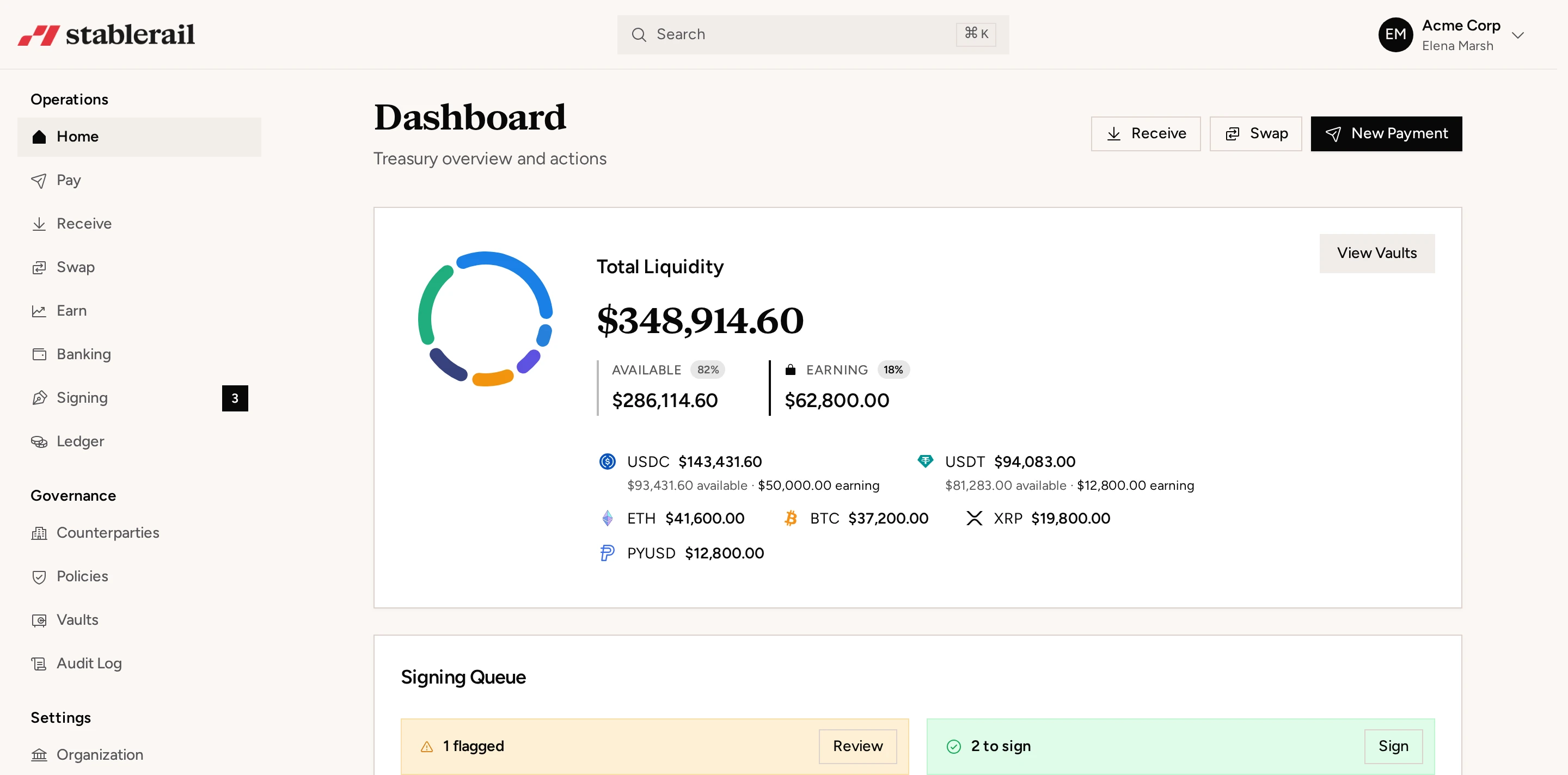
Stablecoin Governance: AI Copilots vs. Human Oversight
Hybrid stablecoin governance: AI handles pre-sign risk checks while humans approve, override, and ensure accountability.

Stablecoin transactions are growing fast, with volumes projected to hit $33 trillion by 2025. This growth raises a critical question: Who ensures payment safety - AI systems or humans? The answer lies in a hybrid model where AI copilots analyze risks in real-time, but humans make the final call.
Here’s the key takeaway:
AI copilots handle tasks like risk analysis, sanctions checks, and anomaly detection. They ensure consistency and speed, especially for high transaction volumes.
Humans bring judgment and context, making decisions in complex or high-stakes cases. They also provide accountability, crucial for regulatory compliance.
This balance ensures payments are secure, efficient, and compliant. Platforms like Stablerail demonstrate how AI and human oversight work together, offering tools for risk assessment, approval workflows, and audit trails. The goal? Faster decisions without losing control.
Crypto Regulation: Policy, Innovation, and Stablecoins Explained
Benefits of AI Copilots in Stablecoin Governance
AI copilots bring a new level of efficiency and accuracy to stablecoin governance by automating risk analysis. These tools don’t replace human decision-making but enhance it. By detecting risks that manual reviews might overlook and applying consistent standards across transactions, they make the governance process faster and more reliable.
Real-Time Pre-Signature Risk Analysis
Before a transaction is signed, AI copilots generate a Risk Dossier with a clear verdict: PASS, FLAG, or BLOCK. These dossiers include straightforward explanations supported by evidence like policy clauses, timestamps, and behavioral patterns. For instance, if a team attempts to send $50,000 to an unverified vendor at 2:00 AM on a weekend, the AI flags it as unusual based on the time and the lack of prior interactions with that vendor.
In addition to anomaly detection, AI copilots handle sanctions screening and taint analysis in real time. This ensures that transactions don’t involve flagged addresses, which could otherwise lead to frozen funds by stablecoin issuers like Circle or Tether. By simulating transaction outcomes and translating technical data into actionable insights, these tools eliminate the risky practice of "blind signing", where approvers might authorize payments without fully understanding the implications.
Consistency and Scalability
Manual governance processes often falter under high transaction volumes. AI copilots solve this by applying policy-as-code enforcement uniformly across all transactions. Whether it’s a single $10,000 payment or a batch of 500 payouts imported via CSV, the same rules apply without exception. For example, policies like "Weekend transfers over $10,000 require additional approval" or "Only allow USDC on Base/Ethereum" are automatically enforced without bias or fatigue.
By early 2026, 49% of institutions were already using stablecoins for payments. As transaction volumes grow, AI ensures that governance standards remain consistent. No transaction receives less scrutiny simply because the finance team is overwhelmed with hundreds of approvals in a single day. This uniformity, combined with the AI’s ability to provide clear, evidence-backed reports, ensures that every flagged transaction is justified and transparent.
Data-Driven Decisions with Evidence
AI copilots don’t just highlight risks - they explain them. Every flagged or blocked transaction comes with detailed evidence, such as which policy was triggered, what behavior deviated from the norm, and when it occurred. For example, if a payment violates velocity controls, the copilot specifies the limit that was exceeded and provides relevant transaction history.
This approach creates a tamper-evident audit trail that finance teams can rely on. Instead of piecing together approval chains from Slack messages or emails, all checks, flags, overrides, and signatures are automatically recorded with timestamps and references like Invoice IDs or Payroll Batch IDs. This comprehensive record simplifies audits and strengthens accountability with regulators, boards, or other stakeholders.
Why Human Oversight Matters in Stablecoin Transactions
AI copilots are great at spotting patterns and sticking to rules, but they lack the nuanced judgment needed for critical, high-stakes decisions. Humans bring context, evaluate reputational risks, and make calls that go beyond rigid policies.
Context-Based Decision-Making
AI analyzes transactions by comparing them to historical patterns and established guidelines, but it doesn’t always understand the reasoning behind unusual activity. Take this example: a $75,000 payment flagged at 11:00 PM might look suspicious to an algorithm. However, a human can verify that it’s a legitimate, urgent payment for emergency equipment repairs under a valid contract.
Humans also consider risks that algorithms might overlook. For instance, a payment to a politically exposed person (PEP) could technically pass sanctions checks but still require extra scrutiny. This decision might hinge on the organization’s risk tolerance and how the payment could affect its public image. These kinds of judgments require a broader understanding of the business environment, not just raw data.
This ability to interpret context naturally ties into the importance of clear accountability and override mechanisms.
Accountability and Overrides
Human oversight ensures accountability at every step. When a CFO or treasurer approves a flagged transaction, they take full responsibility for that decision - something an algorithm simply can’t do. This accountability becomes especially critical for sensitive actions like governance changes, wallet updates, or policy adjustments.
"Agents verify the context. Humans sign the transaction. The system protects the treasury - it never touches the money."
– Stablerail
Overrides are another key element. If AI mistakenly blocks a time-sensitive payment due to a false positive, a human can step in, authorize the transaction, and document the rationale. This flexibility strikes a balance: it avoids overly rigid automation while maintaining a tamper-evident audit trail that records the reason for the override, who approved it, and when it happened. Without these human-in-the-loop workflows, organizations risk either halting operations with overly strict rules or exposing themselves to unnecessary risks.
AI Copilots vs. Human Oversight: Key Differences
AI Copilots vs Human Oversight in Stablecoin Governance Comparison
AI systems excel at processing massive amounts of data in record time - an essential capability when B2B stablecoin payments surpass $6 billion per month. They’re exceptional at identifying technical anomalies and enforcing rules consistently, as previously discussed. On the other hand, humans bring the ability to interpret context, weigh reputational risks, and make judgment calls that go beyond rigid, rule-based systems.
The truth is, neither approach can stand alone. AI-only systems lack the ability to evaluate subtle nuances or take responsibility for decisions in edge cases. Meanwhile, human-only workflows struggle to keep up with the scale of demand - especially as 49% of financial institutions are already leveraging stablecoins for payments. With institutional payment flows requiring both speed and precision, combining the strengths of AI and human oversight becomes essential for managing stablecoin governance efficiently and securely.
Comparison Table: AI vs. Human Governance
Factor
AI Copilot (Automated)
Human Oversight (Manual)
Speed
Instant automated checks; human signs in seconds
Slower; manual checks and chat-based approvals
Accuracy
AI simulations catch duplicates and address changes
Prone to human error, including typos and blind signing
Compliance Risk
Real-time automated screening against global lists
Inconsistent; manual sanctions screening increases risk
Cost
Subscription-based; lowers fraud and audit costs
High operational costs and potential fraud losses
Scalability
High; processes batches efficiently (e.g., 500 transfers per session)
Limited by workforce size and manual effort
Audit Trail
Automated, CFO-grade “Proof-of-Control” receipts
Fragmented across tools like Slack, email, and spreadsheets
This side-by-side comparison highlights why a hybrid approach is the most practical solution for governance.
The Case for a Hybrid Approach
The differences between AI and human oversight make a strong argument for blending the two. As the comparison table illustrates, neither option is sufficient on its own. AI takes care of the heavy lifting - tasks like sanctions screening, enforcing policies, and detecting anomalies. Humans, meanwhile, step in to review flagged items, handle exceptions, and approve transactions. This division of responsibilities ensures smooth operations without compromising control.
The numbers back up this need for balance. McKinsey predicts agentic commerce will generate $1 trillion in U.S. retail revenue by 2030, while stablecoin transaction volumes are expected to hit $33 trillion by 2025. At such scales, finance teams simply can’t review every payment manually, but they also can’t afford to leave all decisions to algorithms. A hybrid model combines the best of both worlds, ensuring speed, accuracy, and accountability.
How Stablerail Combines AI and Human Governance
Stablerail operates as an agentic control plane, positioned between custody and the signing process. It never accesses funds or private keys but carefully evaluates each transaction before approval. Meanwhile, your treasury remains securely in MPC-based wallets under your control.
The system is designed with a clear principle in mind: AI performs the heavy analysis, while humans retain ultimate decision-making authority. This structure blends automated risk assessment with human oversight, creating a secure and efficient payment workflow.
Copilot Verification Before Signing
Before any stablecoin payment is executed, Stablerail runs pre-sign checks using specialized AI agents. These agents handle tasks like sanctions screening, taint and exposure analysis, policy enforcement, anomaly detection, and counterparty risk scoring. The system evaluates various factors, such as time-of-day patterns, payment amounts compared to usual activity, and payout trends, to identify anything unusual.
Each decision comes with a clear, plain-English explanation, detailing specific evidence like policy clauses, timestamps, and identified risks. As Stablerail puts it:
"Every payment is simulated before execution. First-time destinations, address changes, and duplicates are caught before you sign."
You can also set up rules through a policy-as-code approach, enabling Stablerail to automatically enforce machine-readable policies for every transaction intent.
Human-In-The-Loop Approvals
Once the AI agents complete their checks, human approvers step in to review the detailed risk dossier for contextual accuracy. While the AI provides a thorough risk analysis, the final decision is always made by human approvers. Stablerail's multi-step approval process ensures that flagged transactions are carefully evaluated by designated approvers, who can either approve or override payments with documented reasoning. This not only enhances accountability but also supports compliance with regulatory standards.
The platform also includes role-based access controls and segregation of duties, ensuring that the person initiating a payment intent is not the same individual approving or signing it. This mirrors the governance practices of traditional bank wire processes while leveraging the speed of blockchain settlements.
Audit Trails and Evidence-Based Governance
Every action within the system - from creating a payment intent to final signing - produces a tamper-evident audit trail. Stablerail logs critical details, such as identity data (requester, approver, signer), policy triggers (which rules applied and why), risk dossier specifics (sanctions status, anomaly flags, risk scores), business context (invoices, vendor history), and execution data (blockchain transaction ID, timestamp, asset, and chain).
This detailed Proof-of-Control receipt provides CFO-grade evidence that can be shared with auditors, boards, or regulators. Stablerail consolidates all governance records into one reliable source. Companies managing $1 million to $50 million annually in stablecoin transactions often partner with Stablerail through an annual subscription model that adjusts based on entities, user activity, and on-chain volume. This robust documentation supports compliance while balancing efficient AI analysis with responsible human oversight.
Stablerail Workflow: From Intent Creation to Secure Signing
Stablerail's workflow strikes a balance between AI-driven insights and human decision-making, ensuring secure and transparent payment processes. This approach unfolds across three key stages: intent creation, AI-powered risk analysis, and human-approved signing. The goal? To enforce governance before funds are moved, not after.
Step 1: Intent Creation
The process begins when finance teams create a payment intent. This can be done by uploading an invoice PDF, submitting a payout CSV file, or sending a request via API. This intent acts as a blueprint, providing all the necessary details for the next step - an in-depth risk analysis powered by AI.
Step 2: AI-Generated Risk Dossier
As soon as the intent is submitted, Stablerail’s system generates a Risk Dossier with one of three outcomes: PASS, FLAG, or BLOCK. This dossier is built using tools like sanctions screening, taint analysis, policy enforcement, behavioral anomaly detection, and counterparty risk scoring. For example, if a payment is flagged for being the first transfer to a new address exceeding $5,000, the dossier will specify the exact policy rule triggered and include insights into the recipient’s on-chain activity. Armed with this thorough analysis, the process moves to the human review stage.
Step 3: Approval and Signing
At this stage, approvers evaluate the Risk Dossier and decide to approve, override, or reject the payment. Every decision is backed by documented reasoning. To maintain security and accountability, role-based access controls and segregation of duties are enforced - ensuring that the person initiating the intent cannot also approve or sign it. Once approved, the transaction is signed using MPC-based wallets under company control. Finally, every action is logged in a tamper-proof audit trail, and a Proof-of-Control receipt is generated. This receipt includes identity data, policy triggers, risk scores, business context, and blockchain transaction details, ensuring a transparent and secure record of the transaction.
Conclusion
The discussion around AI copilots and human oversight in stablecoin governance isn’t about choosing one over the other. Instead, it’s about blending the strengths of both to build a system that’s fast, secure, and accountable. AI agents shine when it comes to tasks like real-time compliance checks, enforcing policy-as-code rules, and conducting large-scale, evidence-based risk assessments. However, human judgment plays a critical role in interpreting nuanced situations, stepping in to override automation when needed, and providing the accountability that regulators and boards expect. Together, these elements create a governance model designed to tackle the complexities of modern finance.
This idea of “copilot, not autopilot” allows finance teams to act swiftly without losing control. Stablerail demonstrates this balance with its agentic control plane, which integrates AI-powered pre-signature verification and human-controlled MPC signing authority. Every action is backed by a CFO-grade audit trail that includes policy triggers, risk scores, and relevant business context.
With stablecoins accounting for over 60% of on-chain value transfers and more than $16 billion in cryptocurrency being moved by organized crime networks in 2025, robust governance has never been more critical. The EU AI Act’s Article 14, which mandates effective human oversight of high-risk AI systems, reflects a growing regulatory emphasis: automation must always be paired with human accountability.
For businesses managing $1 million to $50 million annually in stablecoin transactions, Stablerail’s platform simplifies stablecoin treasury management. By replacing scattered wallets, spreadsheets, and informal approvals with a unified system, it ensures stability, security, and compliance - all without slowing operations. The future of stablecoin governance isn’t about AI taking over - it’s about AI helping humans make smarter, faster decisions. This partnership between automation and human insight is what will define the next generation of secure and efficient stablecoin governance.
FAQs
What should be automated by an AI copilot vs. decided by a human?
When it comes to routine, rule-based tasks, an AI copilot can take the lead. Think of things like compliance checks, anomaly detection, counterparty risk scoring, and enforcing policies (like transaction limits). These tasks are perfect for AI because they follow clear rules, helping to minimize errors while boosting efficiency.
On the other hand, humans should step in for decisions that require judgment. Approving high-value or unusual transactions, overriding system flags, or navigating complex scenarios are all areas where human insight is critical. This approach ensures that important decisions align with governance standards while still taking advantage of AI’s ability to enhance transparency and streamline operations.
How does pre-signature risk analysis prevent frozen or rejected stablecoin payments?
Pre-signature risk analysis plays a crucial role in avoiding frozen or rejected stablecoin payments. By running automated checks before transactions are signed, it ensures everything is in order. These checks cover key areas like sanctions compliance, exposure limits, and adherence to policies. They also evaluate counterparty risk and look for any unusual activity.
If the system detects a problem, it can flag or block the transaction, ensuring it stays within the rules. This process minimizes errors, strengthens compliance efforts, and creates a detailed audit trail, offering transparency and accountability every step of the way.
How do teams handle AI false positives without weakening compliance or auditability?
Teams handle AI false positives in stablecoin governance by implementing pre-signature checks and maintaining thorough documentation. These checks are mandatory and focus on identifying sanctions, anomalies, and counterparty risks. When a false positive occurs, teams provide clear, plain-English explanations backed by evidence, allowing human reviewers to override the AI's decision when necessary. Every step, including overrides, is meticulously recorded in an audit trail, ensuring compliance, transparency, and regulatory accountability while maintaining a clear record for audits.
Related Blog Posts
Former CEO of Simple, a self-custodial wallet with $2B+ in transaction volume across 75+ countries.
More about the Stablerail team- Stablecoin treasury managementApprovals, limits, yield and reporting on one balance.
- Stablecoin payoutsBatch contractor and vendor payments with screening.
- USDT vs USDCWhich stablecoin your company should settle in.
- Stablecoin finance glossaryMPC, off-ramp, travel rule and the rest, in plain English.
- Product updatesEverything we ship, month by month.