
Copilot vs Autopilot in Finance Systems
Compare copilot and autopilot AI in finance: copilot keeps human approvals and audit trails for high-risk payments; autopilot automates routine, low-risk tasks.

Feb 26, 2026
AI in finance systems boils down to one major decision: how much control do you want to give machines over your money? Here's the core difference:
Copilot Model: AI acts as an assistant. It reviews, flags risks, and explains decisions, but humans always approve transactions. Ideal for high-value payments requiring oversight and audit trails.
Autopilot Model: AI operates independently. It automates decisions and executes transactions based on pre-set rules. Best for fast, repetitive, low-risk tasks.
Key takeaway: Copilot ensures human accountability and regulatory compliance, while Autopilot prioritizes speed and efficiency. Your choice depends on your risk tolerance and operational needs.
Quick Comparison
Feature
Copilot Model
Autopilot Model
Control
Human approval required
Fully automated
Best For
High-value, low-frequency tasks
Low-value, high-frequency tasks
Speed
Slower (manual review)
Faster (instant execution)
Risk Management
Pre-sign risk checks
Automated safeguards
Accountability
Human oversight
Cryptographic mandates
Compliance
Audit-ready documentation
Machine-enforced policies
Bottom line: Use Copilot for critical, high-stakes decisions and Autopilot for routine, repetitive processes.
Copilot vs Autopilot AI Models in Finance Systems Comparison
What Copilot and Autopilot Mean in Finance Systems
AI is reshaping financial workflows, especially when it comes to accountability in systems like stablecoin treasury operations. In this space - where transactions are irreversible and settle almost instantly - choosing between a copilot or autopilot approach can significantly influence how risks are managed. Let’s break down how these two models impact decision-making and risk management.
Copilot: AI That Supports Human Decisions
The copilot model positions AI as a highly capable assistant. It doesn’t take action on its own but instead verifies, flags, and explains potential risks. Final authority always rests with a human. This ensures that no transaction proceeds without a thorough understanding of its context.
For instance, the AI in a copilot system reviews policies, transaction details, and on-chain data. It highlights risks and generates Pre-Sign Risk Dossiers that include clear verdicts - such as PASS, FLAG, or BLOCK - alongside policy references, timestamps, and evidence. This prevents "blind signing", where humans might approve payments without fully grasping the risks.
"The copilot can read policies, transaction context, and on-chain data. It cannot hold keys, initiate transfers, or sign. Its only role is to block, flag, and explain." – Stablerail
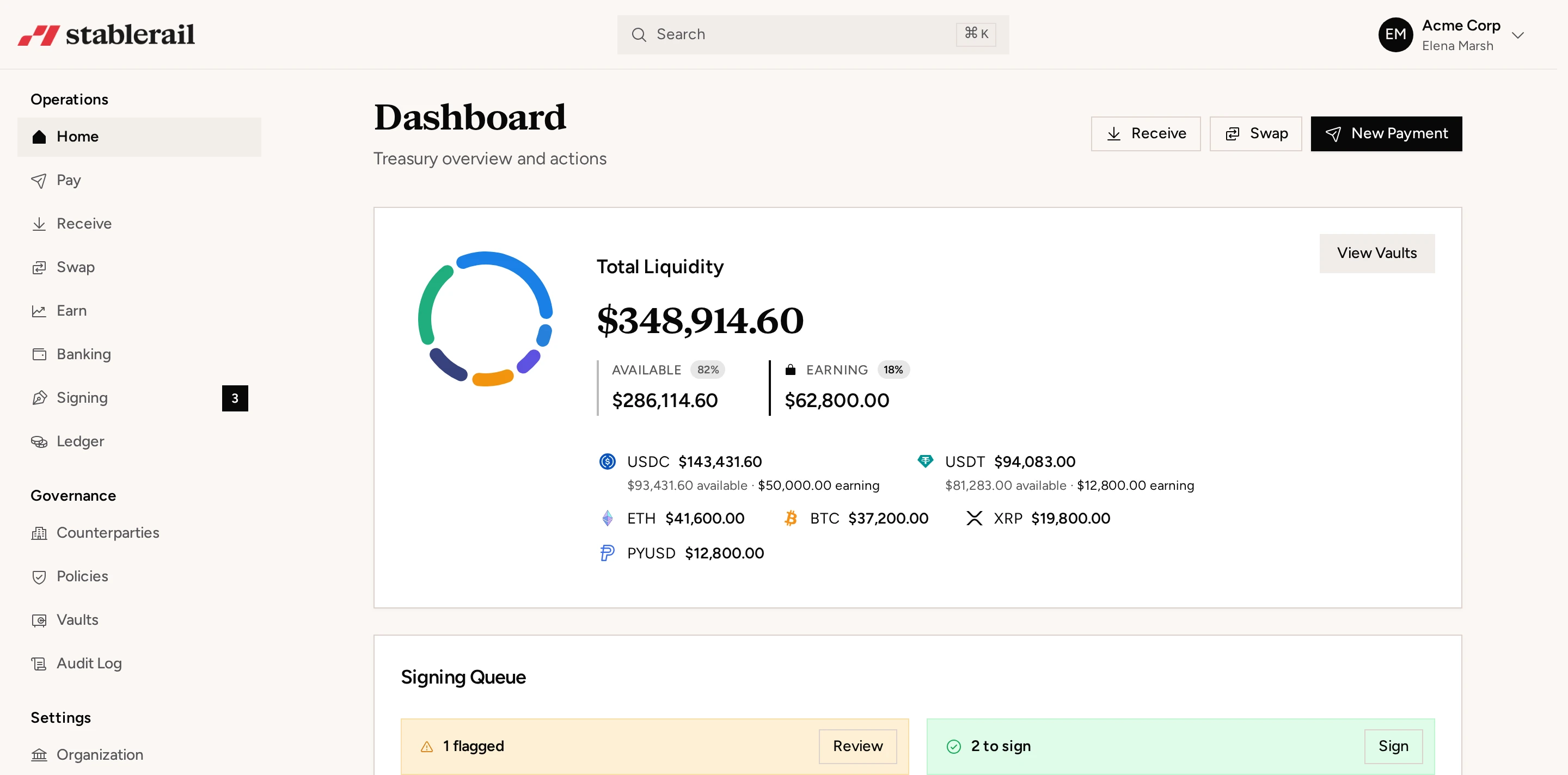
Take Stablerail’s platform as an example. Before any stablecoin payment is executed, AI agents perform essential pre-sign checks. These include sanctions screening, policy compliance, behavioral anomaly detection, and counterparty risk evaluation. A human then reviews the Risk Dossier and approves the transaction using MPC wallets for signing (multi-party computation). This setup keeps accountability centralized, strengthens operational defenses, and creates a detailed audit trail that meets regulatory standards.
Autopilot: AI That Executes Independently
The autopilot model, on the other hand, allows AI to take the reins. Here, AI agents can initiate, manage, and complete transactions without requiring constant human involvement. These actions are guided by pre-defined, cryptographically secured rules.
One recent deployment of an autopilot system for tasks like invoice processing and bookkeeping demonstrated impressive results - reducing manual effort by 80% in just six weeks. Importantly, every decision made by the AI came with an explainable rationale, ensuring transparency for audits.
While autopilot systems are excellent for automating high-frequency, low-risk tasks, they come with their own challenges. Without proper safeguards, errors could go unnoticed and compound over time. For this reason, successful autopilot implementations rely on strict mandates that define exactly what the AI can do, under what conditions, and when human intervention is necessary. This is especially critical in stablecoin treasury operations, where the irreversibility of transactions leaves no room for mistakes.
To address these challenges, many finance teams now combine both models. They automate routine tasks with autopilot systems while reserving human oversight for high-value or complex decisions. This tiered approach strikes a balance between efficiency and the rigorous accountability required in stablecoin treasury management.
How Trust and Accountability Differ Between Models
In stablecoin treasury operations, where transactions settle almost instantly and cannot be reversed, trust and accountability are non-negotiable. These two factors dictate not only how decisions are made but also who shoulders the responsibility when something goes wrong. The copilot and autopilot models address these needs in fundamentally different ways, each with unique consequences for finance teams managing high-stakes operations.
In copilot systems, trust hinges on human oversight. AI handles the analysis, but a human must review and approve every transaction, ensuring a clear line of accountability. Stablerail’s copilot model exemplifies this approach: "Agents verify, humans sign, keys remain distributed". These systems create a Pre-Sign Risk Dossier that includes verdicts and plain-English explanations, giving every transaction a thorough review process. Additionally, every action generates a Proof-of-Control receipt, which serves as a detailed record of what was paid, why it was approved, who signed off, and the associated risks. This setup ensures comprehensive human oversight and accountability.
Autopilot systems take a different route. Here, trust is built through cryptographically anchored mandates and immutable logs. Instead of relying on a single human for accountability, these systems use an "accountability stack" that incorporates identity-first architectures and runtime governance engines. Automated checks handle most decisions, escalating edge cases to humans when necessary, while every AI-driven action is linked to an explainable rationale for audit purposes.
Transparency is another area where these models diverge. Copilot workflows prioritize real-time, human-readable explanations because a person is legally responsible for each transaction. In contrast, autopilot workflows rely on technical transparency, such as immutable audit trails and policy-as-code, which can be replayed to demonstrate why a decision was made. As one industry expert put it, "Autopilot success is not about giving agents maximum freedom; it's about bounding them within mandates that are both machine-enforceable and human-verifiable".
Comparison: Trust, Accountability, and Transparency
Criterion
Copilot Model
Autopilot Model
Trust Mechanism
Human-in-the-loop; AI explains, human signs
Verifiable mandates and cryptographic proofs
Accountability
Proof-of-Control receipts and explicit human sign-off
Identity-anchored permissions and auditable trails
Auditability
CFO-grade records for every action and override
Immutable logs and cryptographic provenance tracing
Error Handling
Pre-sign risk dossiers and manual overrides
Automated verification checks and runtime enforcement agents
Regulatory Compliance
Defensible receipts for auditors and boards
Policy-as-code and runtime governance engines
Evidence Generation
Plain-English reasons for every transaction verdict
Explainable rationales mapped to deterministic rules
These different approaches to trust and accountability play a critical role in shaping stablecoin treasury governance. They affect everything from regulatory compliance to operational reliability. With nearly half of institutions - 49% as of early 2026 - already using stablecoins for payments, choosing between copilot and autopilot models is more than just a technical decision. It’s about deciding where accountability lies in a world where transactions are final and regulators demand clear, auditable evidence of control. These models are part of a broader governance framework that balances the power of AI automation with the necessity of human oversight.
How Each Model Handles Decision-Making in Stablecoin Treasuries
Expanding on trust and accountability, this section explores how different models influence decision-making in stablecoin treasuries. The two primary approaches - copilot and autopilot - highlight distinct workflows. In a copilot setup, AI serves as a support system, conducting checks and flagging risks, while humans retain the final say on transactions. On the other hand, autopilot workflows rely on automated execution through predefined mandates, integrating cryptographic permissions and deterministic rules. These choices impact transaction speed, oversight, and compliance risk, emphasizing the balance between operational efficiency and regulatory assurance.
Copilot Workflows: Pre-Transaction Checks and Human Approvals
In copilot workflows, every stablecoin transaction is treated as a decision requiring human evaluation. AI acts as a verification layer, performing tasks like sanctions screening, taint analysis, policy enforcement, anomaly detection, and counterparty risk scoring. These checks aim to identify potential issues, such as first-time payment destinations or changes in recipient addresses.
"Agents verify the context. Humans sign the transaction. The system protects the treasury - it never touches the money" - Stablerail
When a payment intent is initiated - whether through invoice, CSV, or API - AI generates a Pre-Sign Risk Dossier. This dossier provides a verdict (PASS, FLAG, or BLOCK) along with plain-English explanations backed by specific evidence.
A human then reviews the dossier to approve, override, or reject the transaction. If approved, the transaction proceeds to the signing phase, secured by MPC (multi-party computation) vaults. A Proof-of-Control receipt is created, documenting the transaction details, approval rationale, signer information, and risk assessment. This ensures an auditable trail for regulators, auditors, and boards.
This workflow is ideal for high-value treasury operations where human oversight is critical.
Autopilot Workflows: Decisions Without Human Approval
Autopilot workflows take a different approach, executing transactions automatically based on predefined mandates. Here, human involvement shifts to setting policy parameters and monitoring outcomes, rather than approving individual transactions.
These systems use a sophisticated policy engine to evaluate transaction details - such as identity, risk levels, jurisdiction, and history - to determine whether to approve, deny, hold, or escalate for further review. For example, an autopilot system managing liquidity might automatically allocate idle stablecoin balances to yield protocols, withdrawing funds only when needed for scheduled payments. This is often referred to as a "yield-in-transit" strategy.
However, autopilot workflows are not without risks. They can experience silent failures, such as missed alerts, and raise accountability concerns, especially as legal frameworks for autonomous decisions continue to evolve.
To address these challenges, autopilot systems incorporate safeguards like multi-agent quorums and runtime governance engines. A Proposer-Verifier-Executor workflow ensures no irreversible actions occur without consensus. Additionally, enforcement agents monitor transactions, and every step is logged with clear, explainable rationales, creating an immutable audit trail - leveraging the same principles of immutability and verifiable logs mentioned earlier.
Autopilot workflows are better suited for high-frequency, low-value tasks - such as cash forecasting, invoice processing, micro-payments, and liquidity rebalancing - where speed is essential and the financial risk of individual errors is minimal.
Pros and Cons of Copilot vs. Autopilot
When it comes to managing stablecoin treasuries, the choice between copilot and autopilot systems boils down to transaction volume, risk tolerance, and the level of human oversight required. Each model has its own strengths and weaknesses, offering distinct trade-offs based on specific operational needs.
Copilot systems shine in scenarios where auditability and oversight are essential. These systems work best for high-value transactions, where accountability is a top priority. On the other hand, autopilot systems are all about speed and scalability. They handle high-frequency tasks efficiently, minimizing the need for human intervention, but they require robust safeguards to mitigate risks.
Key Differences in Functionality
Execution Speed: Autopilot systems process transactions in milliseconds, operating 24/7, whereas copilot systems rely on human approval, which can take minutes or even hours.
Risk: While autopilot systems reduce manual labor, they carry a higher risk of silent failures, making stringent safeguards critical. Copilot systems, by contrast, use pre-sign risk dossiers to ensure careful oversight and prevent blind approvals.
Compliance: Autopilot systems enforce compliance automatically and in real-time, eliminating the possibility of "optional compliance." Meanwhile, copilot systems provide audit-ready documentation for regulators and boards, making them ideal for organizations under heavy scrutiny.
Comparing the Two Models
Factor
Copilot Model
Autopilot Model
Execution Speed
Minutes to hours (human approval)
Milliseconds (automated 24/7)
Scalability
Medium (limited by manual approvals)
High (handles millions of tasks)
Risk Management
Pre-sign risk dossiers
Verifiable mandates and safeguards
Accountability
Centralized (human oversight)
Distributed (accountability stack)
Primary Benefit
Auditability and oversight
Reduced manual effort
Compliance
Audit-ready proof
Machine-enforced policies
Best Use Case
High-value treasuries (>$100,000)
Micropayments, yield harvesting
Choosing the Right Model
For companies managing $1–50 million annually in stablecoins, copilot systems are a natural fit, especially when regulatory scrutiny demands thorough documentation and oversight. As noted by Auto-post.io, "Autopilot success is not about giving agents maximum freedom; it's about bounding them within mandates that are both machine-enforceable and human-verifiable". This highlights the need for clear boundaries and safeguards in autopilot systems.
If your operations involve high-frequency, low-value tasks like micropayments or yield harvesting, autopilot systems offer unmatched efficiency. However, for high-value, low-frequency transactions where regulatory compliance and accountability are crucial, copilot systems - like those offered by Stablerail - combine AI-powered risk assessments with human oversight to ensure secure and reliable treasury management.
Why Copilot Works Better for Stablecoin Treasury Governance
Managing a stablecoin treasury is no small task - there’s simply too much at stake for a fully autonomous system to handle without oversight. The copilot model strikes the right balance by combining AI intelligence with human accountability, a necessity in today’s high-stakes environment. Consider this: as of February 2, 2026, USDT’s market cap stands at $185.2 billion, with USDC at $70.6 billion, and institutional adoption has climbed to 49% of organizations. At this scale, every decision must be defensible to auditors, boards, and regulators, making human oversight non-negotiable.
The strength of the copilot model lies in its ability to separate verification from execution. AI agents handle the grunt work - screening for sanctions, ensuring policy compliance, and flagging problematic counterparties. But humans retain the final authority to approve or reject transactions. This division of labor mitigates the biggest risk in treasury management: unauthorized or erroneous autonomous transfers.
Policy-as-code governance enhances the copilot framework by automating risk assessments. Instead of relying on outdated tools like spreadsheets or Slack approvals, machine-enforceable rules create a detailed pre-flight risk dossier. This dossier provides a clear decision - PASS, FLAG, or BLOCK - along with plain-English explanations. Such automation catches critical risks, like address changes or duplicate entries, and prevents scenarios that could freeze your company’s funds. It’s about eliminating guesswork while ensuring every decision is backed by data.
Another key feature is the Proof-of-Control receipt generated for every transaction. This document details what was paid, why it was approved, who signed off, and the risk assessment verdict. Such transparency is vital for defending decisions to banking partners or meeting regulatory requirements like SOX compliance. For example, in November 2025, Briefcase showcased this principle with their finance autopilot system. They only auto-published accounting entries that passed strict, rules-based verification, reducing manual effort by 80% while still leaving room for human review in edge cases.
For companies managing $1–50 million in stablecoins annually, the copilot model ensures speed, security, and auditability. With AI handling risk checks and humans overseeing final decisions, organizations can maintain operational efficiency while meeting regulatory demands. This is precisely why Stablerail’s architecture operates above custody and before signing - it safeguards the decision-making process, not just the keys.
Conclusion: Picking the Right AI Model for Your Finance System
When deciding between a copilot or autopilot approach for your treasury operations, the question isn't about which technology is more advanced - it’s about what aligns with your finance team’s ability to manage and mitigate risks. Autopilot systems offer speed and autonomy, but they come with challenges like silent failures and vulnerabilities to prompt injection attacks. With stablecoin transaction volumes projected to hit $33 trillion by 2025 and nearly half of institutions already using stablecoins for payments, the need for systems with strong human oversight has never been greater.
The copilot model directly addresses the core challenge of stablecoin treasury management: irreversibility. On-chain transfers settle in seconds, and once executed, they cannot be undone. This makes human validation essential at every stage. A "verify-then-sign" workflow ensures that while AI agents handle tasks like sanctions screening, policy enforcement, and counterparty risk scoring, humans retain the final authority to approve transactions. This principle, emphasized by industry leaders, captures the essence of secure treasury management.
In stablecoin operations, the biggest risk isn’t settlement failure - it’s authorization failure. For teams managing $1–50 million in stablecoin transactions, the copilot model offers a balance of operational efficiency and robust oversight. It streamlines high-volume approvals while maintaining the detailed audit trails regulators demand.
While autopilot systems might shine in high-speed, low-stakes micropayments, the copilot approach is the only option that ensures comprehensive oversight for high-stakes transactions. By separating verification from execution, enforcing strict separation of duties, and maintaining regulatory-grade accountability, the copilot model stands out as the safest and most reliable choice for managing corporate funds in irreversible payment channels. This blend of human oversight and AI-driven efficiency ensures transactions are both swift and secure.
FAQs
When should finance teams choose copilot over autopilot?
Finance teams should consider a copilot approach when tasks require human oversight, verification, and nuanced decision-making. In this setup, AI acts as an assistant, performing tasks like pre-sign checks, sanctions screening, policy enforcement, and spotting anomalies. However, ultimate control remains firmly in human hands. This method works best for complex or high-stakes financial processes where compliance, governance, and accountability are non-negotiable. It allows teams to balance the efficiency of AI with the critical judgment and control only humans can provide.
How do mandates and policy-as-code prevent autopilot mistakes?
Mandates and policy-as-code serve as built-in safeguards by embedding enforceable rules directly into transaction workflows. These rules - like approval thresholds or transaction limits - ensure that AI-driven actions are subject to human oversight and compliance checks. By blocking unauthorized or non-compliant transactions, they minimize errors and promote transparency. This approach allows teams to confirm that every action aligns with governance standards before execution, maintaining both control and accountability.
What audit evidence shows human control in a copilot workflow?
When demonstrating human oversight in a copilot workflow, detailed audit evidence is essential. This includes thorough records of critical actions like intent creation, checks conducted, flags raised, overrides made, approvals granted, and final sign-offs. These records form a clear audit trail, backed by supporting details such as policy references and precise timestamps, ensuring both transparency and accountability.
Related Blog Posts
Former CEO of Simple, a self-custodial wallet with $2B+ in transaction volume across 75+ countries.
More about the Stablerail team- Stablecoin treasury managementApprovals, limits, yield and reporting on one balance.
- Stablecoin payoutsBatch contractor and vendor payments with screening.
- USDT vs USDCWhich stablecoin your company should settle in.
- Stablecoin finance glossaryMPC, off-ramp, travel rule and the rest, in plain English.
- Product updatesEverything we ship, month by month.