
BVNK Alternatives in the UK for Business Stablecoin and Fiat Treasury
A practical guide to BVNK alternatives for UK businesses managing GBP, USDC and USDT, covering Faster Payments, CHAPS, BACS, custody, conversion, payouts, cards, pricing and eligibility.

UK businesses evaluating BVNK alternatives should start with the operating requirement: does the company need to manage its own GBP, USDC and USDT, or provide payment infrastructure to customers?
This distinction matters. Embedded payment APIs can be useful for marketplaces and fintech products, but a finance team managing corporate funds usually needs a different set of tools: named or virtual fiat account details, reliable GBP payment rails, stablecoin custody, conversion, supplier payouts, cards and clear transaction evidence.
The right UK business account setup may be one integrated platform or a combination of a bank, exchange and wallet. This guide compares the main models and explains what to verify before opening an account.
Start with the GBP payment rails
“Supports GBP” does not necessarily mean that a provider offers every UK payment method. Ask which rails are available for incoming and outgoing payments, whether the account details are in your company’s name, and whether third-party payments are permitted.
| Rail | Typical timing | Common use | Points to verify |
|---|---|---|---|
| Faster Payments | Usually seconds or minutes, 24/7 | Routine UK collections and payouts | Per-payment limits, weekend availability and beneficiary checks |
| CHAPS | Same business day when submitted before the provider’s cutoff | Large or time-sensitive GBP transfers | Cutoff time, sending fee and whether inbound and outbound CHAPS are supported |
| BACS | Normally a three-working-day cycle | Payroll, direct credits and recurring bulk payments | Whether direct submission, files or only receipt of BACS credits is available |
The Faster Payments scheme supports transactions up to £1 million, but individual banks and payment providers often impose lower limits. A provider may also apply different limits to new beneficiaries or recently opened accounts.
For international activity, check SWIFT availability and access to EUR and USD rails. A treasury platform may support GBP through Faster Payments, CHAPS and BACS while also providing SEPA or SEPA Instant for EUR and ACH or Fedwire for USD.
Four alternatives to compare
There is no single category of BVNK alternatives. UK companies typically compare four operating models.
| Model | Best suited to | Main advantage | Potential gap |
|---|---|---|---|
| Integrated stablecoin treasury platform | Companies regularly holding and moving GBP, USDC or USDT | Fiat rails, conversion, custody and payouts in one workflow | Eligibility depends on jurisdiction, industry and transaction profile |
| Institutional crypto exchange | Treasuries focused on execution and liquidity | Trading depth and multiple order types | May offer fewer accounts-payable, card or approval workflows |
| Fintech business account plus external wallet | Businesses primarily operating in fiat with occasional stablecoin activity | Familiar banking and expense tools | Transfers between separate providers create reconciliation and policy issues |
| Bank plus OTC desk or custodian | Large, infrequent conversions requiring negotiated execution | Specialist execution and relationship support | More counterparties, onboarding processes and operational handoffs |
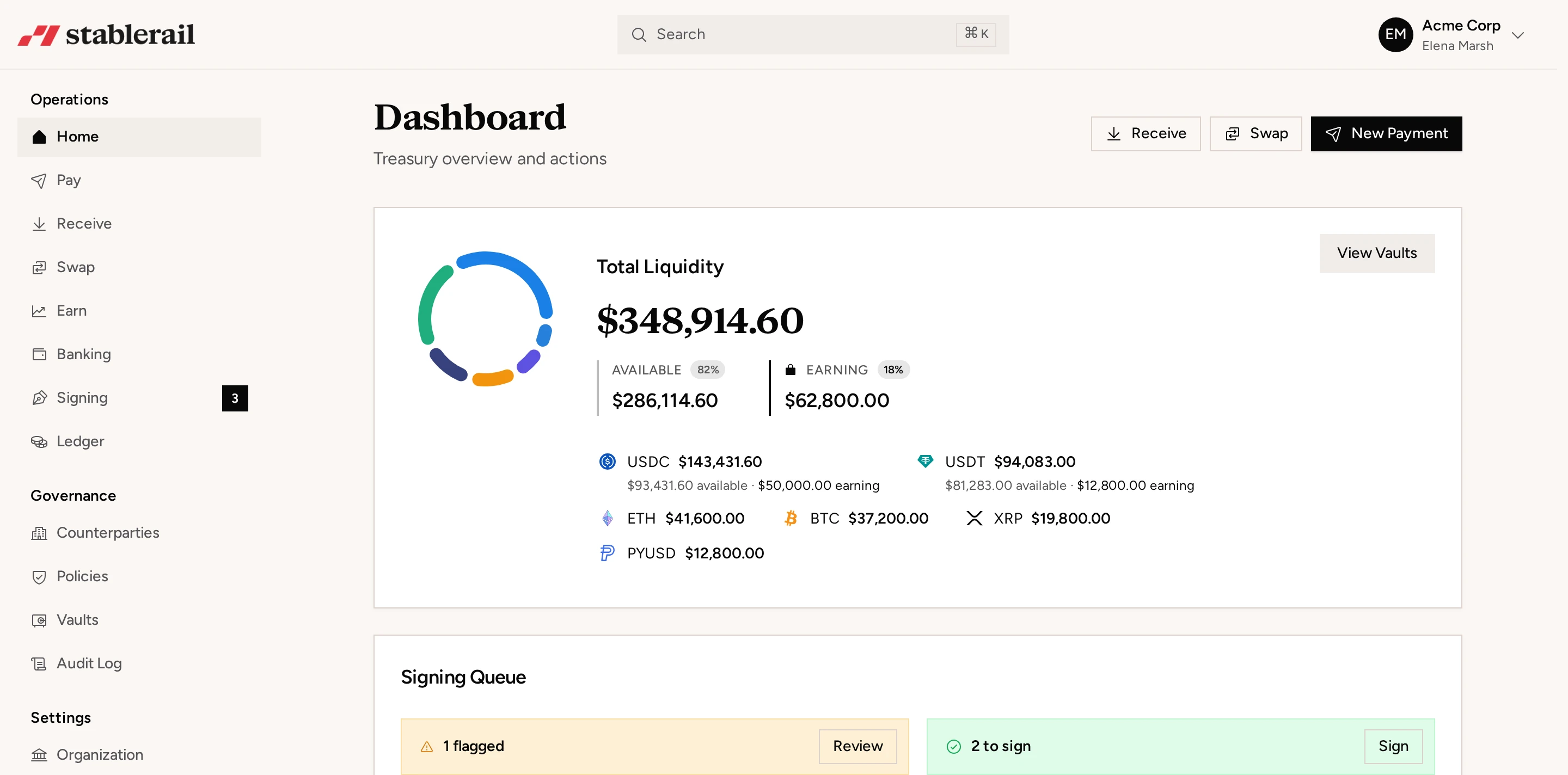
Stablerail fits the integrated treasury model. It combines multi-currency fiat balances and payment rails with self-custodial MPC vaults for USDC and USDT. MPC, or multi-party computation, divides signing authority so that no single person or device holds a complete private key. Quorum rules can require more than one approver before funds move.
This structure is intended for managing the company’s own funds rather than adding stablecoin infrastructure to a customer-facing product.
Compare custody before comparing token support
A provider can support USDC and USDT without offering the same custody model. Determine who controls the assets and what happens when a transaction is approved.
- Self-custodial vault: the business controls transaction signing, usually through an MPC or multisignature setup.
- Custodial balance: the provider controls the underlying wallets and records the company’s balance internally.
- External wallet connection: the provider handles conversion or execution, while the company maintains a separate wallet.
Self-custody offers direct control, but finance teams must configure approvers, recovery procedures and destination allowlists. Custodial models can simplify operations but introduce counterparty and withdrawal-access considerations.
Also compare network support. Stablerail supports payouts across Ethereum, Base, Arbitrum, Polygon, Tron, BNB Chain, Optimism and Solana. The correct network depends on the recipient, token contract, fees and settlement policy. Sending a supported token over the wrong network can make recovery difficult or impossible.
Businesses focusing on a particular asset can review the practical account requirements for USDC business accounts and USDT business accounts.
Review conversion as a complete corridor
Do not compare only the advertised conversion fee. Price the complete route, such as GBP to USDC on Base or USDT on Tron, including:
- the quoted exchange rate and any spread;
- platform or conversion fees;
- blockchain network fees;
- deposit or withdrawal charges;
- minimum and maximum transaction sizes;
- the period for which the quote is valid; and
- costs for returning funds from stablecoins to GBP.
Stablerail publishes pricing by corridor rather than implying that every route costs the same. Finance teams should compare a live quote using their expected monthly volume and preferred network. A low headline fee can be offset by a wider exchange-rate spread or additional withdrawal cost.
Settlement timing also depends on both sides of the conversion. A blockchain transfer may confirm quickly while the fiat payment is delayed by a bank cutoff, compliance review or unmatched payment reference.
Test the full payment workflow
A stablecoin treasury should support more than buying and selling tokens. Map the day-to-day tasks the finance team must complete:
- receive GBP through local account details or a virtual IBAN;
- convert GBP into USDC or USDT;
- send batch vendor, contractor or payroll payments;
- pay invoices across the recipient’s required blockchain network;
- fund virtual or physical corporate cards from treasury balances;
- set card limits and merchant category code controls; and
- export transaction histories and evidence for accounting.
For frequent disbursements, check whether the provider supports batch creation, reusable beneficiaries, approval stages and status reporting. Stablerail’s stablecoin payout tools cover vendor and contractor payments across supported networks.
Cards require separate scrutiny. Confirm which balance funds the card, whether stablecoins are converted at authorisation or in advance, the exchange rate used, card availability by country, ATM rules and any monthly or transaction limits.
Confirm eligibility before designing the workflow
Availability is not determined by UK incorporation alone. Providers commonly assess the company’s jurisdiction, industry, beneficial owners, expected volumes, counterparties and source of funds during know-your-business checks.
Prepare the following documents:
- Companies House registration details and constitutional documents;
- ownership and director information;
- identity and address evidence for relevant individuals;
- business model, website and customer or supplier profile;
- expected fiat and stablecoin volumes;
- source-of-funds evidence, such as contracts, invoices or bank statements; and
- wallet addresses or transaction history where relevant.
Ask about prohibited industries and jurisdictions before starting onboarding. Also confirm whether the provider accepts payments from customers and other third parties, because some accounts are restricted to transfers between accounts held in the company’s own name.
A practical decision checklist
Before selecting a BVNK alternative, run a small test covering the full treasury cycle: receive GBP, convert it, approve a stablecoin payout, return part of the balance to GBP and export the records.
The preferred provider should meet the company’s actual requirements for Faster Payments, CHAPS and BACS; custody and signing; supported tokens and networks; transparent corridor pricing; payout and card workflows; and UK eligibility. If no single platform meets every requirement, document how funds and approval evidence will move between the bank, exchange and wallet.
For companies regularly operating in both fiat and stablecoins, an integrated stablecoin treasury can remove several handoffs. The final decision should still be based on tested payment routes, contractual terms, custody structure and total cost—not the length of a provider’s feature list.
Finance writers covering stablecoin treasury, payments, compliance, and risk controls.
More about the Stablerail team- Stablecoin treasury managementApprovals, limits, yield and reporting on one balance.
- Stablecoin payoutsBatch contractor and vendor payments with screening.
- USDT vs USDCWhich stablecoin your company should settle in.
- Stablecoin finance glossaryMPC, off-ramp, travel rule and the rest, in plain English.
- Product updatesEverything we ship, month by month.