
COCA x Stablerail: Stablecoins for Businesses and People
COCA and Stablerail address complementary sides of stablecoin adoption: controlled corporate treasury for finance teams and self-custodial spending for individuals.
COCA and Stablerail serve complementary parts of the stablecoin market. Stablerail helps finance teams manage company-owned USDC and USDT with approvals, screening, payouts, cards and audit evidence. COCA gives individuals a self-custodial way to hold and spend stablecoins through an app and card. The partnership connects the B2B treasury use case with the B2C experience without treating corporate and personal money as the same workflow.
Two sides of practical stablecoin adoption
Stablecoins can function as payment and treasury infrastructure for companies, while also giving individuals a way to hold and spend digital dollars or euros. Those use cases share the same underlying asset category, but they require different products, controls and user experiences.
A company may need several people to approve a payment, evidence that a destination address was screened, and a transaction record suitable for accounting review. An individual generally needs a simple way to access funds, make purchases and retain control of a personal wallet. Combining those requirements in one undifferentiated product would create unnecessary complexity for both users.
The COCA and Stablerail partnership reflects that division. The corporate side is designed for finance teams managing their company’s own funds. COCA is designed for individuals using stablecoins in everyday life. Together, the products address business-to-business and business-to-consumer adoption while preserving the controls appropriate to each context.
How the business and individual use cases differ
The most important distinction is not whether both products use stablecoins. It is who owns the funds, who can authorize activity and what evidence must exist after a transaction.
| Area | Corporate stablecoin treasury | Personal stablecoin banking |
|---|---|---|
| Primary user | CFOs, controllers, treasury teams and authorized employees | Individuals managing their own money |
| Funds managed | Company-owned USDC or USDT | Personal stablecoin balances |
| Authorization | Multiple approvers or a defined signing quorum may be required | The individual controls transactions from a personal account or wallet |
| Payment controls | Counterparty review, address screening, approval evidence and role separation | Consumer security, wallet access and card controls |
| Common activity | Vendor payments, contractor payouts, treasury conversion and employee spending | Everyday purchases, saving, transfers and card spending |
| Records required | Exportable evidence for accounting, reconciliation and audit review | Personal transaction history and account statements |
| Card purpose | Controlled company spending with employee-level limits | Personal spending from the user’s balance |
This separation matters operationally. Giving one employee unilateral access to a corporate wallet can undermine segregation of duties. Requiring a consumer to complete a multistep treasury approval workflow, on the other hand, would make routine personal spending impractical.
Stablecoin treasury for businesses
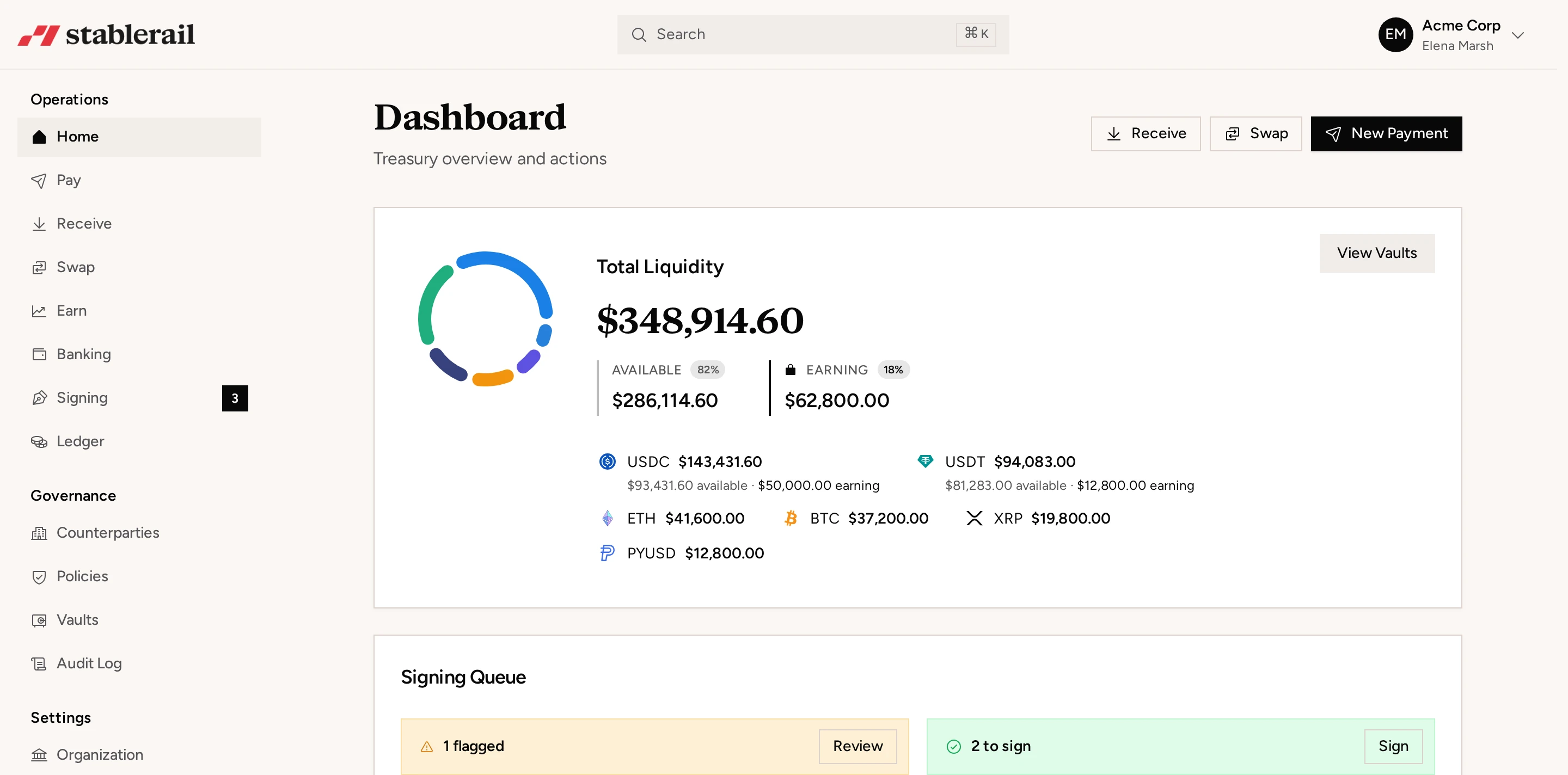
Stablerail is a corporate stablecoin treasury platform for companies managing their own USDC and USDT. Finance teams can use one workspace for balances, payments, approval workflows, corporate cards, global payouts, fiat conversion and exportable audit evidence.
The defining feature of a corporate treasury product is controlled authorization. A finance team can establish who prepares a payment, who reviews it and how many authorized signers must approve it. The payment should not be treated as complete merely because someone entered the beneficiary and amount; execution occurs only after the required signing quorum has been met.
Controls before a stablecoin payment
Stablecoin transfers introduce a control issue that bank-account workflows do not always make obvious: blockchain addresses are long strings that can be copied incorrectly, replaced or associated with sanctioned activity. Because blockchain transfers are generally irreversible once confirmed, checks need to occur before signing.
Sanctions and address screening before send helps the finance team review the destination before authorizing the transaction. Screening does not replace vendor due diligence or guarantee that a payment is risk-free. It adds a documented pre-execution control to the broader process of verifying the legal entity, invoice, wallet address and business purpose.
Payouts, conversion and company spending
Not every recipient wants to receive the same asset or payment rail. A distributed company might pay one vendor in USDC, another through a fiat payout, and employee expenses through corporate cards. A treasury platform can coordinate those activities while keeping them tied to the company’s source of funds and internal approval process.
Fiat conversion is also an operational requirement rather than a minor convenience. Companies still have payroll, taxes, rent and suppliers that may require local currency. Availability, settlement routes and account or card eligibility depend on the company’s jurisdiction and the providers involved, so finance teams should confirm coverage before designing a workflow around a particular rail.
Self-custodial stablecoin banking for people
COCA focuses on the personal side of stablecoin use. Its app and card are intended to help individuals hold and use stablecoins for everyday financial activity rather than administer a company treasury.
The product uses MPC-based wallet technology, which is designed to avoid reliance on a single traditional seed phrase while allowing the user to retain control of personal funds. MPC, or multiparty computation, divides the cryptographic signing process so that no single complete private key needs to exist in one location. Users should still review the product’s recovery process and understand what happens if they lose a device or access credentials.
The COCA card extends the wallet experience to ordinary purchases, including supported digital-wallet and card-payment environments. COCA also promotes rewards and balance-earning features. Rates, eligible transactions, subscriptions, tiers and geographic availability can change, so users should rely on current in-app terms rather than treating a promotional rate as permanent.
For an individual, the core value is usability: stablecoins can move beyond wallet-to-wallet transfers and become available for daily spending. The associated controls remain consumer-oriented. The user is not expected to collect invoice evidence, maintain a corporate approval matrix or demonstrate segregation of duties for each purchase.
What the partnership does—and does not—mean
The partnership brings together complementary products, but it does not erase the boundary between company and personal funds. A corporate treasury account is not a substitute for an employee’s personal wallet, and an employee’s personal wallet should not become an informal company payment account.
For businesses, that distinction protects the accounting trail. If a company sends compensation, reimbursement or another approved payment to an individual, the corporate record should identify the recipient, amount, asset, purpose, approvers, destination and transaction reference. After receipt, the individual can decide how to hold or spend the funds within the capabilities and terms of the personal product.
A clean handoff is the goal: the company controls approval and evidence up to the payout; the recipient controls personal use after receipt.
The announcement also should not be read as a promise of automatic transfers, universal card availability or guaranteed conversion terms between the two products. Eligibility, supported assets, fees, rewards and payment routes should be verified independently before either a business or individual relies on them.
A practical payment flow from company to recipient
A controlled stablecoin payout can follow a straightforward sequence without mixing the corporate and consumer environments:
- Establish the obligation. Record the approved invoice, reimbursement, compensation item or other business purpose.
- Verify the recipient. Confirm the legal name and independently validate the destination wallet or payout details.
- Choose the payment method. Determine whether the recipient should receive a stablecoin or local currency based on the agreement, jurisdiction and available rails.
- Screen before sending. Review the destination address and relevant sanctions results before anyone signs the transaction.
- Apply approvals. Route the payment to the required reviewers and signers under the company’s authority matrix.
- Reconcile execution. Match the final amount, fees, asset and transaction reference to the underlying obligation.
- Retain evidence. Export the payment record, approvals and screening evidence for the accounting close and future review.
Once a personal stablecoin payment is received, the recipient can hold it, transfer it or spend it using the features available through COCA. That downstream choice should not alter the company’s original classification of the payment.
Finance-team checklist before adoption
- Document whether the company, an employee or a contractor owns the funds at every stage.
- Define preparer, reviewer and signer roles before funding the treasury wallet.
- Verify beneficiary wallet addresses through a channel separate from the original payment request.
- Screen destinations before signing and define how potential matches are escalated.
- Confirm supported jurisdictions, assets, cards, fiat rails and recipient eligibility.
- Record the accounting treatment for stablecoin balances, conversion differences and network fees.
- Test exports and reconciliation using a low-value transaction before processing routine payouts.
- Keep personal wallets outside the company’s treasury and bookkeeping workflow unless a documented payment has transferred ownership.
A shared mission with separate responsibilities
Both companies aim to make stablecoins easier to use as money rather than leaving them isolated inside specialist crypto workflows. The business product concentrates on governance, payments and financial records. COCA concentrates on the individual experience of holding and spending.
That combination is useful precisely because the responsibilities remain separate. Companies need deliberate controls before funds leave treasury. People need convenient access after funds become theirs. A partnership spanning those two environments can support broader stablecoin adoption without pretending that a CFO approving a vendor payment and a consumer buying groceries have the same requirements.
Frequently asked questions
Can a business pay employees or contractors in stablecoins?
A business can make stablecoin payouts where the payment is lawful, contractually agreed and supported in the relevant jurisdictions. Finance teams should document the obligation, verify the recipient’s wallet, apply approvals, screen the address and retain transaction evidence for accounting and tax review.
What is the difference between a corporate stablecoin wallet and a personal wallet?
A corporate wallet holds company-owned funds and should use defined roles, multiple approvals, screening and audit records. A personal wallet holds an individual’s funds and is controlled for that person’s own transfers and spending.
How should finance teams control stablecoin payments?
Use segregation of duties so one person does not prepare and approve the same payment without oversight. Verify the beneficiary and wallet independently, screen the address before signing, require the appropriate signing quorum and reconcile the blockchain transaction to its invoice or business purpose.
Can employees spend company stablecoins with a card?
Corporate cards can allow authorized employees to spend against company funds while the business sets limits and retains transaction records. Availability depends on jurisdiction and program eligibility, and the card should remain separate from an employee’s personal stablecoin account.
Does the COCA and Stablerail partnership combine business and personal funds?
No. The products serve complementary use cases, but company-owned treasury and an individual’s personal balance remain separate. The company controls the payment and evidence before a payout, while the recipient controls personal use after the funds have been received.
Writes for Stablerail on stablecoin treasury operations.
More about the Stablerail team- Stablecoin treasury managementApprovals, limits, yield and reporting on one balance.
- Stablecoin payoutsBatch contractor and vendor payments with screening.
- USDT vs USDCWhich stablecoin your company should settle in.
- Stablecoin finance glossaryMPC, off-ramp, travel rule and the rest, in plain English.
- Product updatesEverything we ship, month by month.