
Opening a Stablecoin Business Account: KYB Documents and Timelines
A practical guide to stablecoin business account opening, including KYB documents by entity type, beneficial ownership checks, common delays and realistic onboarding timelines.
%22%20x1%3D%220%22%20y1%3D%220%22%20x2%3D%221%22%20y2%3D%221%22%3E%0A%20%20%20%20%20%20%20%20%3Cstop%20offset%3D%220%25%22%20stop-color%3D%22%232E0709%22%20%2F%3E%0A%20%20%20%20%20%20%20%20%3Cstop%20offset%3D%2250%25%22%20stop-color%3D%22%234A0F14%22%20%2F%3E%0A%20%20%20%20%20%20%20%20%3Cstop%20offset%3D%22100%25%22%20stop-color%3D%22%236B181C%22%20%2F%3E%0A%20%20%20%20%20%20%3C%2FlinearGradient%3E%0A%20%20%20%20%20%20%3CradialGradient%20id%3D%22glow%22%20cx%3D%22421%22%20cy%3D%22-411%22%20r%3D%22520%22%20gradientUnits%3D%22userSpaceOnUse%22%3E%0A%20%20%20%20%20%20%20%20%3Cstop%20offset%3D%220%25%22%20stop-color%3D%22%23FFB199%22%20stop-opacity%3D%220.45%22%20%2F%3E%0A%20%20%20%20%20%20%20%20%3Cstop%20offset%3D%2255%25%22%20stop-color%3D%22%23FFB199%22%20stop-opacity%3D%220.08%22%20%2F%3E%0A%20%20%20%20%20%20%20%20%3Cstop%20offset%3D%22100%25%22%20stop-color%3D%22%23FFB199%22%20stop-opacity%3D%220%22%20%2F%3E%0A%20%20%20%20%20%20%3C%2FradialGradient%3E%0A%20%20%20%20%20%20%3ClinearGradient%20id%3D%22glass%22%20x1%3D%220%22%20y1%3D%220%22%20x2%3D%221%22%20y2%3D%221%22%3E%0A%20%20%20%20%20%20%20%20%3Cstop%20offset%3D%220%25%22%20stop-color%3D%22%23F8D6D2%22%20stop-opacity%3D%220.26%22%20%2F%3E%0A%20%20%20%20%20%20%20%20%3Cstop%20offset%3D%22100%25%22%20stop-color%3D%22%23FFFFFF%22%20stop-opacity%3D%220.08%22%20%2F%3E%0A%20%20%20%20%20%20%3C%2FlinearGradient%3E%0A%20%20%20%20%20%20%3ClinearGradient%20id%3D%22accent%22%20x1%3D%220%22%20y1%3D%220%22%20x2%3D%221%22%20y2%3D%221%22%3E%0A%20%20%20%20%20%20%20%20%3Cstop%20offset%3D%220%25%22%20stop-color%3D%22%23FFB199%22%20%2F%3E%0A%20%20%20%20%20%20%20%20%3Cstop%20offset%3D%22100%25%22%20stop-color%3D%22%23E85D3A%22%20%2F%3E%0A%20%20%20%20%20%20%3C%2FlinearGradient%3E%0A%20%20%20%20%20%20%3Cfilter%20id%3D%22soft%22%3E%3CfeGaussianBlur%20stdDeviation%3D%2210%22%20%2F%3E%3C%2Ffilter%3E%0A%20%20%20%20%3C%2Fdefs%3E%0A%20%20%20%20%3Crect%20width%3D%221600%22%20height%3D%22900%22%20fill%3D%22url(%23bg)%22%20%2F%3E%0A%20%20%20%20%3Crect%20width%3D%221600%22%20height%3D%22900%22%20fill%3D%22url(%23glow)%22%20%2F%3E%0A%20%20%20%20%3Cpath%20d%3D%22M%20800%20210%20A%20240%20240%200%200%201%201040%20450%20L%20930%20450%20A%20130%20130%200%200%200%20800%20320%20Z%22%20fill%3D%22url(%23glass)%22%20stroke%3D%22%23F4CDC5%22%20stroke-opacity%3D%220.4%22%2F%3E%3Cpath%20d%3D%22M%201040%20450%20A%20240%20240%200%200%201%20592.1539030917347%20570%20L%20687.4166975080229%20515%20A%20130%20130%200%200%200%20930%20450%20Z%22%20fill%3D%22url(%23accent)%22%20stroke%3D%22%23F4CDC5%22%20stroke-opacity%3D%220.4%22%2F%3E%3Cpath%20d%3D%22M%20592.1539030917347%20570%20A%20240%20240%200%200%201%20571.7464360891631%20375.83592135001254%20L%20676.3626528816301%20409.8277907312568%20A%20130%20130%200%200%200%20687.4166975080229%20515%20Z%22%20fill%3D%22url(%23glass)%22%20stroke%3D%22%23F4CDC5%22%20stroke-opacity%3D%220.4%22%2F%3E%3Cpath%20d%3D%22M%20571.7464360891631%20375.83592135001254%20A%20240%20240%200%200%201%20800%20210%20L%20800%20320%20A%20130%20130%200%200%200%20676.3626528816301%20409.8277907312568%20Z%22%20fill%3D%22url(%23glass)%22%20stroke%3D%22%23F4CDC5%22%20stroke-opacity%3D%220.4%22%2F%3E%0A%20%20%20%20%3Crect%20x%3D%2226%22%20y%3D%2226%22%20width%3D%221548%22%20height%3D%22848%22%20rx%3D%2218%22%20fill%3D%22none%22%20stroke%3D%22%23F2D0C8%22%20stroke-opacity%3D%220.12%22%2F%3E%0A%20%20%3C%2Fsvg%3E)
Opening a stablecoin business account usually involves more than submitting a certificate of incorporation. The provider must understand who owns and controls the company, how the business makes money, where funds will come from and how the account will be used.
For finance teams, the fastest route through business onboarding is to prepare a complete document pack before applying. This guide explains the typical KYB requirements, documents needed by entity type, common reasons applications are delayed or declined, and realistic planning timelines.
What a stablecoin business account includes
A stablecoin business account can combine access to USDC or USDT with treasury operations such as fiat transfers, stablecoin conversion and business payouts. Depending on eligibility and available corridors, this may include EUR, USD or GBP balances and payment rails such as SEPA, ACH, Fedwire, SWIFT or Faster Payments.
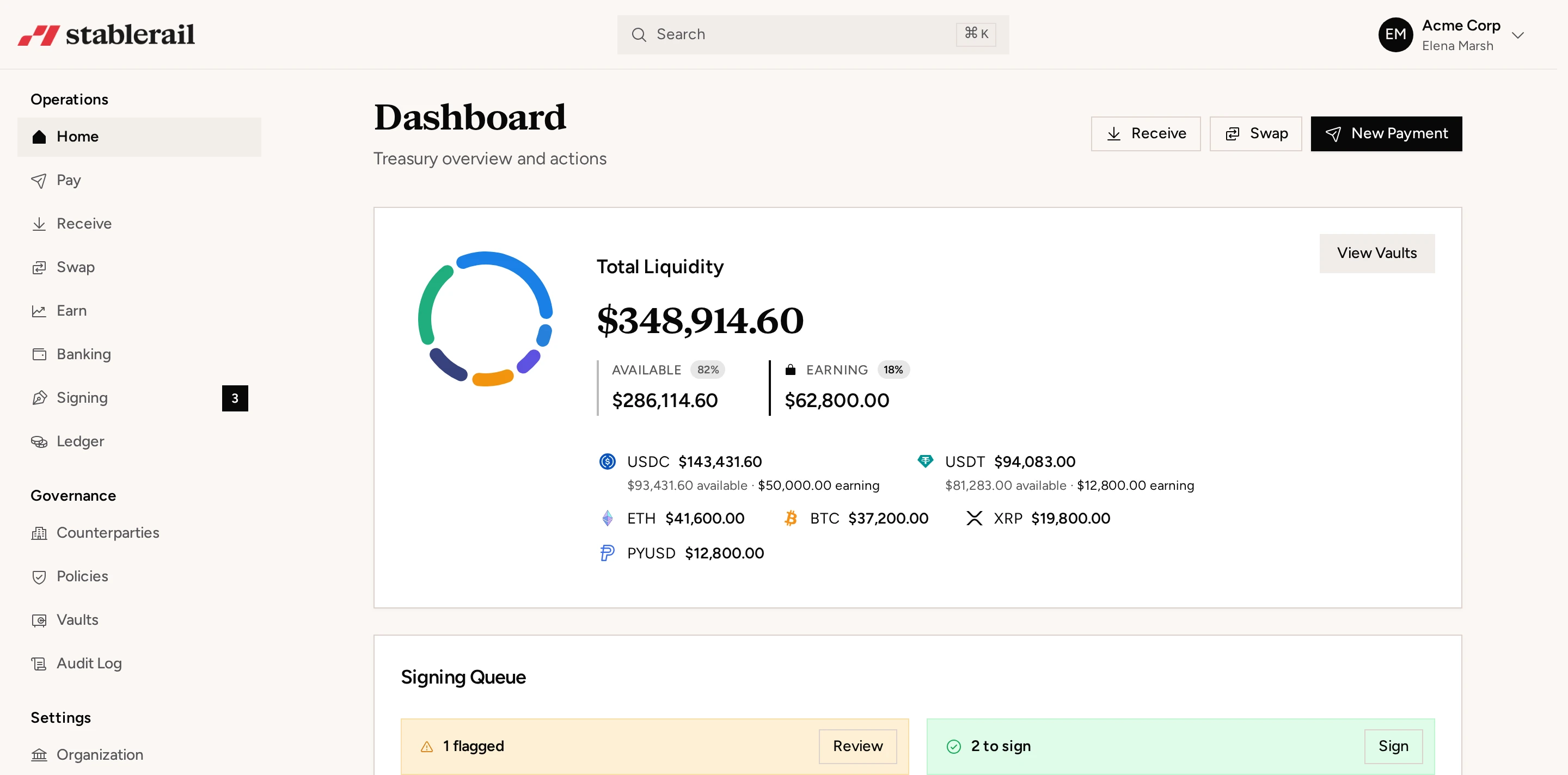
With Stablerail, approved businesses can use self-custodial MPC vaults, where signing authority is distributed rather than relying on a single private key. Finance teams can also configure quorum approvals, payment limits and wallet allowlists. Network availability may include Ethereum, Base, Arbitrum, Polygon, Tron, BNB Chain, Optimism and Solana.
These capabilities remain subject to jurisdiction, industry and product eligibility. A stablecoin account is also not automatically the same as a bank deposit account. Review the legal entity providing each fiat or digital-asset service, applicable safeguarding arrangements and product terms before funding.
The crypto business account opening process
Although the exact sequence varies by provider and jurisdiction, crypto business account opening normally follows five stages:
1. Eligibility check
The provider checks the company's country of incorporation, operating countries, industry and expected activity. Some products may not be available in every jurisdiction. Using the eligibility checker before collecting documents can prevent unnecessary work.
2. Company verification
You submit formation documents, registry information, registered and operating addresses, tax details and evidence that the company is active. The legal name, registration number and address must agree across the application and supporting records.
3. Ownership and control checks
Directors, authorized signers and ultimate beneficial owners, or UBOs, are identified and verified. A UBO is a natural person who ultimately owns or controls the entity. The relevant ownership threshold depends on the provider and applicable rules, but 25% is a common threshold.
4. Business and funds review
The reviewer assesses what the company sells, who its customers and suppliers are, expected payment corridors, anticipated volumes, and the source of fiat or stablecoins. Companies already holding USDC or USDT may be asked for wallet addresses, transaction records or evidence showing how the assets were acquired.
5. Approval and account setup
Once approved, the company can set up users, signing rules, allowlists and account limits. Fiat rails, stablecoin networks or conversion services may require additional checks and can become available at different times.
Core KYB requirements
Most applicants should expect to provide the following:
- Formation evidence: certificate of incorporation, articles of association or equivalent constitutional documents.
- Registry evidence: a recent company extract, certificate of good standing or official registry link.
- Address evidence: a lease, utility bill, bank statement or official correspondence for the operating address when it differs from the registered office.
- Ownership information: a shareholder register, cap table and ownership chart extending to the individual UBOs.
- Management details: register of directors and identification for directors, UBOs and authorized users.
- Identity documents: valid passports or national identity cards, and sometimes proof of residential address.
- Tax information: tax identification number and, where relevant, VAT or sales-tax registration.
- Business evidence: website, pitch deck, customer contracts, supplier invoices, bank statements or management accounts.
- Account-use information: expected monthly volume, transaction size, currencies, stablecoins, networks and countries involved.
- Source of funds: bank statements, investment agreements, revenue records, token-sale documents or exchange statements, depending on how the treasury was funded.
Documents may need to be recent, certified, notarized or translated. Confirm those conditions before ordering copies or paying for certification.
Documents needed by entity type
| Entity type | Typical additional documents | Common complication |
|---|---|---|
| Limited company or corporation | Shareholder register, director register, articles and ownership chart | Old cap tables or nominee shareholders that do not reveal the UBO |
| LLC | Operating agreement, member register and manager details | The formation certificate does not show current members |
| Partnership | Partnership agreement, partner register and authority to open the account | Unclear signing authority or ownership percentages |
| Holding company | Group chart, subsidiary records and explanation of intercompany flows | No clear operating activity or source of group funds |
| Trust- or foundation-owned company | Trust deed or foundation charter, settlor, trustee, protector and beneficiary details | Complex control relationships requiring enhanced review |
| Nonprofit or association | Charter, governing-body list, funding records and program description | Cross-border donations or activities in higher-risk regions |
If another company owns the applicant, expect to provide records for every layer until the ownership chain reaches natural persons. Publicly listed parents may follow a different evidence process.
Realistic onboarding timelines
There is no universal approval time. The following ranges are useful for internal planning, not a Stablerail service commitment:
| Application profile | Indicative review time |
|---|---|
| Simple operating company, one jurisdiction, complete documents | Approximately 1–5 business days |
| Several owners or countries, additional source-of-funds evidence | Approximately 5–10 business days |
| Layered ownership, regulated activity or higher-risk corridors | Two weeks or longer |
The clock should be understood as active review time after a complete submission. Waiting for an applicant to answer questions can add days or weeks. Fiat account details, conversion access and transaction limits may also be activated separately after the main entity review.
Common rejection and delay reasons
An incomplete application is more often delayed than immediately rejected. Common problems include:
- Mismatched records: names, addresses or ownership percentages differ between the form, registry and cap table.
- Hidden ownership layers: the ownership chart stops at another company rather than identifying individuals.
- Weak business evidence: a new or generic website does not clearly explain the product, customers or revenue model.
- Unsupported volume: projected transaction values are much higher than contracts, revenue or funding records suggest.
- Unclear source of stablecoins: the company cannot connect wallet balances to revenue, investments, exchange purchases or prior transfers.
- Restricted activity or jurisdiction: the industry, operating country or payment corridor falls outside the provider's risk appetite.
- Screening concerns: sanctions exposure, adverse media or high-risk wallet activity requires additional review or makes the relationship ineligible.
- Expired or unreadable documents: identity documents are expired, scans are cropped, or registry extracts are too old.
Do not obscure a complicated structure or sensitive activity. A clear explanation with supporting evidence is generally easier to review than an application that creates inconsistencies.
How to prepare a review-ready application
- Download fresh registry documents and confirm that all company details match the application.
- Create a dated ownership chart showing percentages at every layer.
- Collect valid identification and address evidence from relevant directors, UBOs and signers.
- Write a short description of products, customer types, countries, payment flows and expected monthly volumes.
- Prepare evidence for the source of both fiat and stablecoin balances.
- List the blockchains and wallet addresses the company expects to use.
- Nominate one internal contact who can answer follow-up questions promptly.
After approval, finance teams can evaluate the operational setup for a USDC business account, including vault permissions, payment approvals, supported networks and fiat conversion routes. The key to a faster KYB review is straightforward: submit current documents, disclose the full ownership chain and ensure expected account activity matches the evidence provided.
Finance writers covering stablecoin treasury, payments, compliance, and risk controls.
More about the Stablerail team- Stablecoin treasury managementApprovals, limits, yield and reporting on one balance.
- Stablecoin payoutsBatch contractor and vendor payments with screening.
- USDT vs USDCWhich stablecoin your company should settle in.
- Stablecoin finance glossaryMPC, off-ramp, travel rule and the rest, in plain English.
- Product updatesEverything we ship, month by month.