
BVNK Alternatives in the UK for Business Stablecoin and Fiat Treasury
A practical comparison of BVNK alternatives for UK businesses managing GBP, USDC and USDT, covering payment rails, custody, conversion costs, approvals and onboarding.
The best BVNK alternative depends on whether your business needs an integrated treasury platform, an exchange, separate bank and wallet accounts, or payment infrastructure. UK finance teams should compare actual access to Faster Payments, CHAPS and BACS; supported USDC and USDT networks; custody and approval controls; total conversion costs; account ownership; payout workflows; and the legal treatment of fiat balances.

How to choose a BVNK alternative in the UK
UK businesses should compare BVNK alternatives by operating model rather than by the number of currencies or features advertised. The decisive question is whether the provider can support the company’s own GBP, USDC or USDT through one controlled treasury workflow—or whether it supplies only a fiat payment account, exchange account, wallet or infrastructure for building customer-facing products.
Start with a representative transaction from beginning to end. For example, a customer pays GBP into the business account, treasury converts part of the balance into USDC, and finance pays overseas contractors on Base or Solana. That workflow can involve multiple counterparties, fees, approval steps and settlement periods. A provider that supports each component separately may not deliver an integrated process.
What finance teams should compare
| Requirement | What to verify | Why it matters |
|---|---|---|
| GBP account | Account holder name, dedicated or pooled details, balance structure and reconciliation data | Determines how receipts are identified and who has the legal claim to the balance |
| UK payment rails | Inbound and outbound Faster Payments, CHAPS and BACS; limits, cut-offs and approval deadlines | “GBP support” does not mean every rail is available in both directions |
| Stablecoins | USDC and USDT support by blockchain network, including deposit and withdrawal availability | The same token issued on different networks is not operationally interchangeable |
| Custody | Who controls transaction signing, where assets sit and what happens if the provider becomes unavailable | Custody changes counterparty exposure, access to assets and internal control design |
| Conversion | Quoted rate, benchmark rate, spread, explicit fees, minimum size and settlement timing | A headline fee rarely captures the complete cost of a corridor |
| Payouts | Batch processing, beneficiary records, address screening, status tracking and failed-payment handling | Manual wallet-by-wallet transfers are difficult to control at scale |
| Governance | Roles, approval thresholds, signing quorum and exportable transaction evidence | Finance needs segregation of duties and evidence for review and audit |
| Eligibility | Supported entities, industries, jurisdictions, ownership structures and expected volumes | A product may appear suitable but remain unavailable to the applicant |
The four main types of BVNK alternative
1. Combined fiat and stablecoin treasury platforms
This model is intended to bring fiat conversion, stablecoin holdings and payments into one finance workflow. It can reduce hand-offs between a bank, exchange and wallet, but teams must still identify the entities involved in holding fiat, executing conversion and supporting transfers.
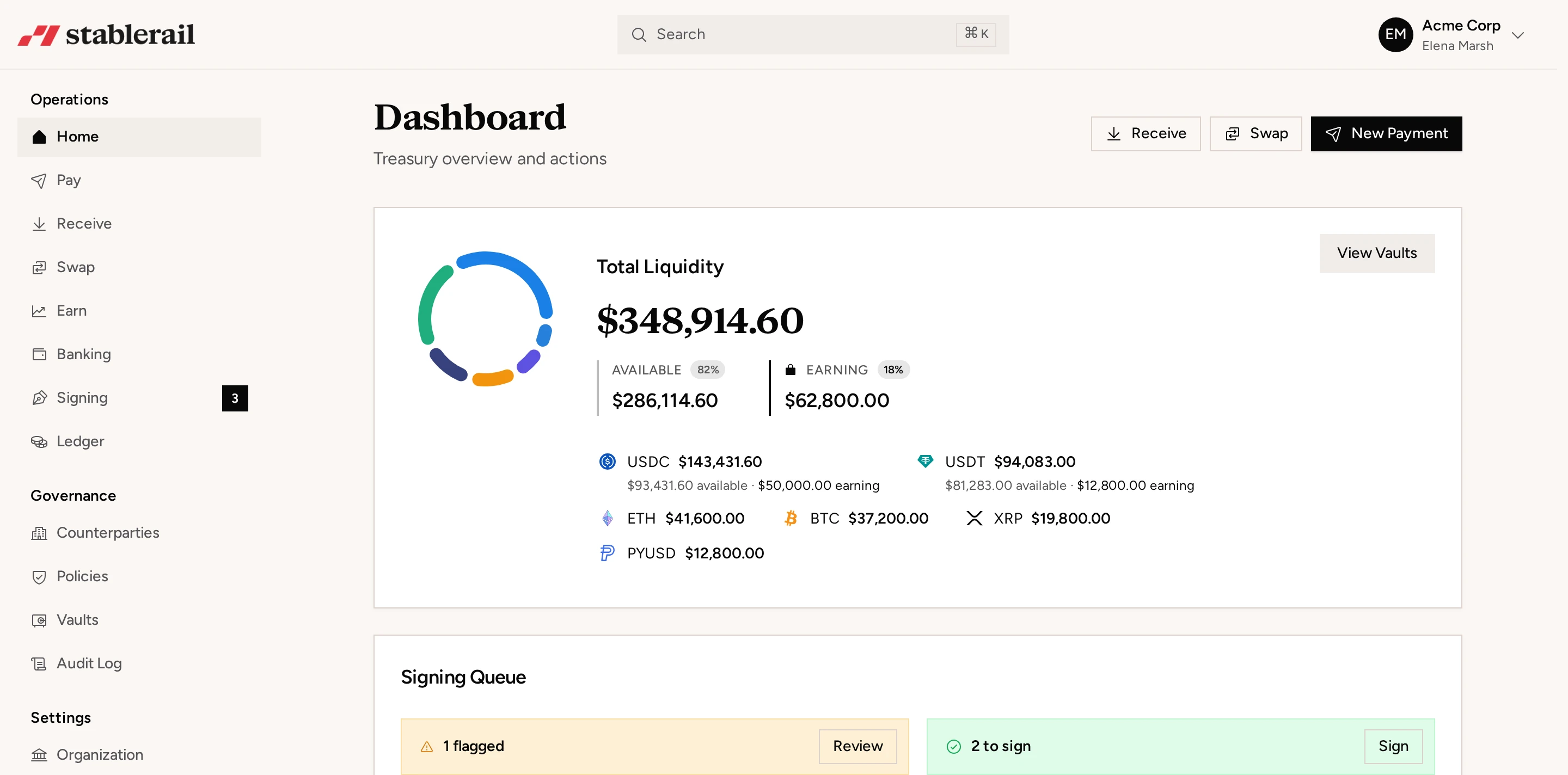
Stablerail fits this category for companies managing their own funds in USDC and USDT. Its controls include approvals and signing quorum, sanctions and address screening before a send, global payouts, fiat conversion, corporate cards and exportable audit evidence. Availability of particular fiat corridors, jurisdictions and services should be confirmed during onboarding.
This model is generally the closest fit when stablecoins are used regularly for treasury or operating payments. It is less relevant when the business needs infrastructure to hold or move funds on behalf of customers.
2. Crypto exchanges with business accounts
An exchange may suit businesses that prioritise liquidity, trading pairs and frequent conversion. Business accounts can provide fiat deposit and withdrawal methods alongside access to stablecoins, but an exchange is not automatically a complete treasury system.
Confirm whether GBP payment details are dedicated to the company, whether Faster Payments works for both deposits and withdrawals, and how withdrawal approvals are controlled. Compare trading fees with spreads, fiat withdrawal fees, stablecoin withdrawal charges and blockchain network costs. Assets will commonly remain under the exchange’s custody until withdrawn, so counterparty and access risk need explicit review.
3. A UK bank or payment account plus a separate wallet
A conventional business account combined with a wallet or institutional custodian can preserve familiar GBP operations while separating blockchain assets. This can work well when stablecoin transactions are occasional, specialist or deliberately isolated from the main treasury.
The disadvantage is fragmentation. Finance must reconcile multiple ledgers, coordinate conversion through another provider and document transfers between accounts. Before adopting this structure, confirm that the bank or payment institution permits the expected transactions with exchanges, stablecoin providers and wallet counterparties. A technically possible transfer may still trigger compliance review or account restrictions.
4. Payment infrastructure providers
Infrastructure providers are designed primarily for companies embedding wallets, conversion or payment capabilities into their own products. They may emphasise APIs, orchestration and white-labelled services rather than a dashboard and control environment for the finance team’s own funds.
A CFO should establish whether the proposal includes corporate accounts, role-based access, approval workflows, statements and reconciliation exports. Otherwise, the business may be evaluating product infrastructure rather than a practical BVNK treasury alternative.
Which operating model fits the requirement?
| Operating model | Best suited to | Main advantage | Primary trade-off |
|---|---|---|---|
| Combined treasury platform | Recurring fiat-to-stablecoin flows and operating payouts | Fewer operational hand-offs | Eligibility and corridor coverage must be verified |
| Business exchange account | Conversion and trading-led activity | Liquidity and market access | May lack treasury approvals, payout tools or named GBP details |
| Bank plus separate wallet | Occasional stablecoin activity | Clear separation of fiat and digital assets | More reconciliation and manual coordination |
| Payment infrastructure | Embedding payments into a customer product | Flexible product integration | Not necessarily designed for corporate treasury funds |
Faster Payments, CHAPS and BACS serve different workflows
Support for GBP should be tested at rail and direction level. Faster Payments generally operates continuously and is intended for near-real-time transfers, but transaction limits and screening processes vary by provider. Ask for the actual per-payment and daily limits that would apply to your legal entity rather than relying on the scheme’s theoretical capability.
CHAPS supports same-business-day, high-value GBP payments. Submission cut-offs, provider processing times and fees apply, making it important to distinguish between a provider accepting an instruction and the payment reaching the beneficiary that day.
BACS Direct Credit is commonly used for payroll and supplier files and follows a three-business-day processing cycle. A provider may support incoming Faster Payments without offering outbound CHAPS or BACS file submission. Obtain written confirmation of each required direction, limit and cut-off.
Compare the complete cost of a real corridor
Do not select a provider using one conversion percentage. Request a worked quote for a representative route, such as converting £100,000 into USDC and making 50 payments on the network your recipients use. The quote should identify:
- GBP deposit, account or transfer fees;
- the GBP-to-USD foreign exchange rate and spread;
- fiat-to-stablecoin conversion charges;
- blockchain network and provider payout fees;
- minimum conversion or withdrawal amounts;
- fees and spreads for converting unused stablecoins back to GBP; and
- the time at which the rate is fixed and funds become available.
Ask the provider to show the final stablecoin amount delivered and the GBP proceeds from reversing the transaction. This exposes costs hidden in exchange rates and helps treasury compare providers on an equivalent basis.
Custody and controls are balance-sheet decisions
Under a custodial model, a provider or its custody partner controls the wallets and processes withdrawals. Under a self-controlled or self-custodial arrangement, the company retains authority over transaction signing, although technology providers can still be operational dependencies. The label alone is insufficient: finance should document who can sign, recover access, change approvers and move assets during an outage.
Test the payment workflow before approval. A credible control design should answer whether the preparer can also release a transfer, whether multiple approvals can be required, how a new beneficiary is reviewed, when an address is screened, and what evidence can be exported. Stablecoin transactions are generally irreversible once confirmed, so prevention is more useful than relying on a post-payment recovery process.
Understand the legal treatment of fiat balances
A payment account is not necessarily a bank account. Ask which regulated entity provides the fiat account, whether the balance is a bank deposit or safeguarded electronic money, where funds are held and what would happen if the provider or an underlying partner failed.
Do not assume that safeguarded funds receive the same protection as eligible deposits at a UK-authorised bank. Stablecoin and cryptoasset balances also should not be treated as though they automatically receive deposit protection. Finance and legal teams should review the actual contractual structure instead of relying on terms such as “business account” or “wallet.”
Eligibility and onboarding preparation
Providers usually conduct Know Your Business checks covering the legal entity, directors, beneficial owners, source of funds, expected activity and transaction counterparties. Complex ownership, higher-risk industries or exposure to unsupported jurisdictions can require additional review or result in rejection.
Prepare incorporation records, an ownership chart, director and beneficial-owner identification, operating-address evidence, recent financial or bank information, and a concise description of expected fiat and stablecoin flows. Include expected monthly volumes, source and destination countries, tokens, networks and reasons for using stablecoins.
Finance-team selection checklist
- Map the five largest inbound, conversion and payout flows by currency and network.
- Confirm whether Faster Payments, CHAPS and BACS are available inbound, outbound or both.
- List every required token-network pair, such as USDC on Base or USDT on Tron.
- Request all-in quotes for representative transactions, including the reverse conversion.
- Document custody, signing authority, approval quorum and access-recovery procedures.
- Test beneficiary setup, address screening, batch payments and failed-payment handling.
- Review the legal treatment of fiat and stablecoin balances with finance and legal teams.
- Obtain written confirmation of entity, industry, jurisdiction and volume eligibility.
- Export sample statements, transaction records and approval evidence for the auditors.
The strongest BVNK alternative is therefore not the provider with the longest feature list. It is the one whose account structure, payment rails, stablecoin networks, controls and total corridor cost match the company’s real treasury flows without creating unmanageable reconciliation or counterparty risk.
Frequently asked questions
What is the best BVNK alternative for a UK business?
The best alternative depends on the operating need. A combined treasury platform may suit recurring fiat and stablecoin payments, while an exchange may be better for conversion-led activity and a bank-plus-wallet structure may suit occasional stablecoin use.
Which BVNK alternatives support Faster Payments, CHAPS and BACS?
Rail availability varies by provider, account partner and customer eligibility. Ask whether each rail is available for incoming and outgoing payments, then confirm company-specific limits, cut-offs, fees and account-holder details in writing.
How should a business compare stablecoin conversion fees?
Request an all-in quote for a real corridor rather than comparing headline percentages. Include foreign exchange spread, conversion fees, fiat transfer charges, blockchain costs, payout fees and the cost of converting unused stablecoins back to GBP.
Is a stablecoin treasury account protected by the FSCS?
Do not assume that it is. Protection depends on the legal nature of each balance and the entity holding it; safeguarded electronic money, bank deposits and stablecoins are treated differently, so the contractual structure should be reviewed carefully.
What should a CFO check about stablecoin custody?
Confirm who controls transaction signing, how many approvals are required, who can change approvers and how access is recovered. The team should also test beneficiary controls, address screening, transaction evidence and the process during a provider outage.
Finance writers covering stablecoin treasury, payments, compliance, and risk controls.
More about the Stablerail team- Stablecoin treasury managementApprovals, limits, yield and reporting on one balance.
- Stablecoin payoutsBatch contractor and vendor payments with screening.
- USDT vs USDCWhich stablecoin your company should settle in.
- Stablecoin finance glossaryMPC, off-ramp, travel rule and the rest, in plain English.
- Product updatesEverything we ship, month by month.