
Manage company balances, payments, cards and approvals in one workspace.
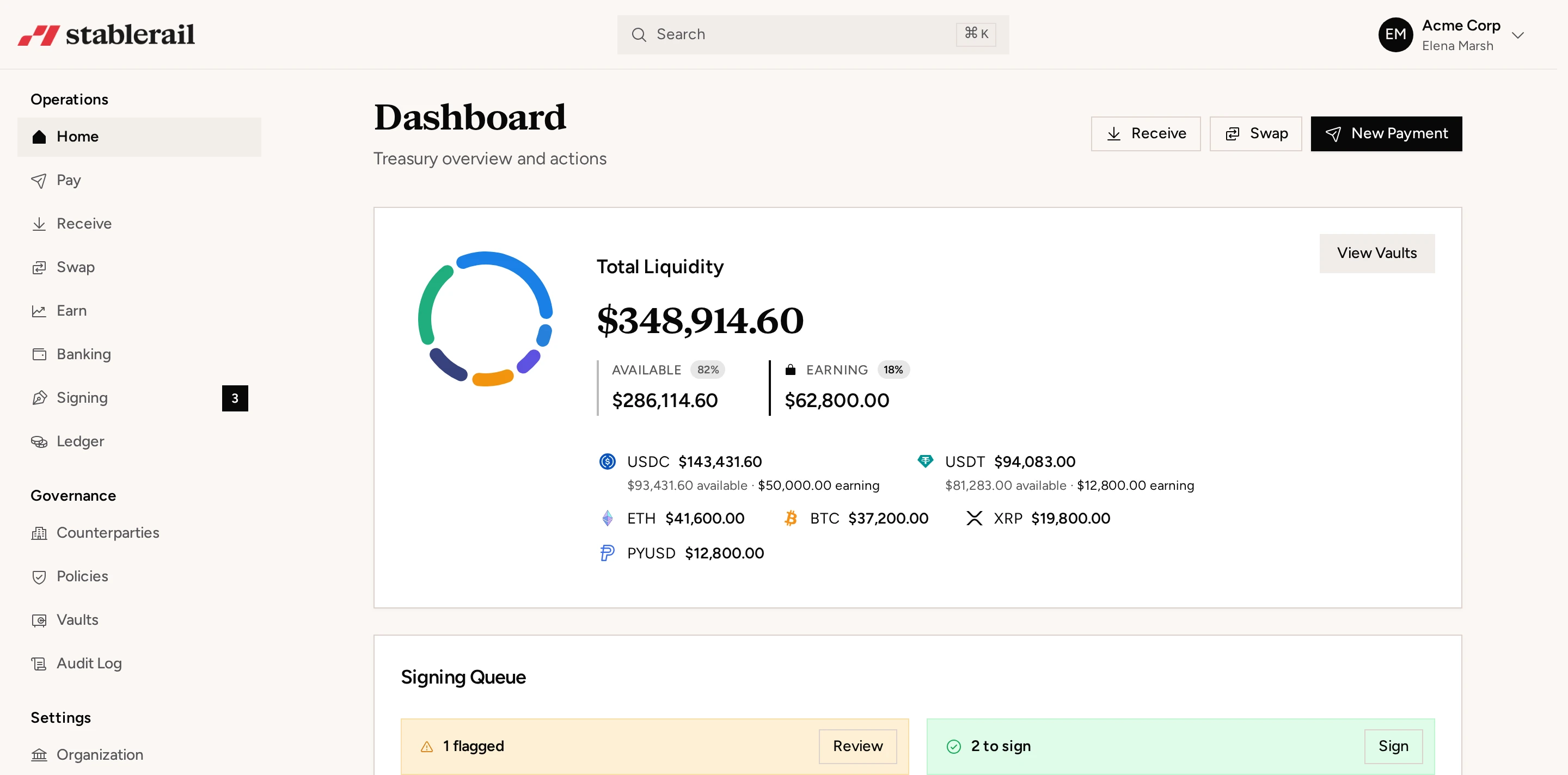
Corporate treasury built around USDT
Most companies end up holding USDT on an exchange login shared by two people. That is not treasury. Stablerail gives the finance team control of the company's own funds.
What the treasury covers
- Self-custodial vaults with quorum signing — no shared exchange login.
- Approval limits and allowlists set at organisation level.
- Sanctions and wallet-risk screening before release, with the result stored as evidence.
- Batch payouts to vendors and contractors across Tron, Base, Ethereum and more.
- Corporate cards and fiat off-ramps funded from the same balance.
USDT next to USDC
Companies rarely settle in one asset. Corridor liquidity decides: Tron-based USDT dominates several emerging-market payout routes, while USDC is often preferred where regulated reporting matters. The practical comparison is in USDT vs USDC, and the USDC-first view is on the USDC business account page.
Frequently asked questions
Can a company hold USDT without an exchange account?
Yes. Stablerail provides corporate stablecoin treasury with self-custody: your organisation holds the MPC key shares and signs with a quorum, so digital assets are not sitting on someone else's balance sheet.
Which networks are supported for USDT?
Tron, Ethereum, Arbitrum, Base, Polygon, BNB Chain, Optimism and Solana. The accepted network is stored on each counterparty record so wrong-chain sends are not a judgement call.
Can we convert USDT to fiat?
Yes, through regulated partners after KYB. Corridor availability and pricing are published on the payout pricing page.
Is USDT or USDC better for a business account?
USDT has deeper liquidity in emerging-market corridors; USDC has stronger regulated reporting in the US and EU. Most companies hold both and pick per corridor.
What does it cost?
A flat monthly subscription by volume tier with published overage rates, rather than a percentage on every transaction.
Keep reading
Corporate stablecoin treasury, cards and payouts.
Receive, approve, screen, pay, card-spend and off-ramp — with audit evidence on every transaction.