
Announcing 0% conversion: USDC to USD and EURC to EUR
USDC-to-USD and EURC-to-EUR conversions now have no conversion fee or spread. Receiving fiat and sending same-currency payments on supported rails are also free.
Converting USDC to USD and EURC to EUR inside a Stablerail business account now costs 0%, with no spread added to the conversion. Receiving fiat is free, as are same-currency fiat payments over ACH, SEPA, SEPA Instant and UK Faster Payments. A fee applies when the payment changes currency, while network or third-party rail charges may still apply where applicable.
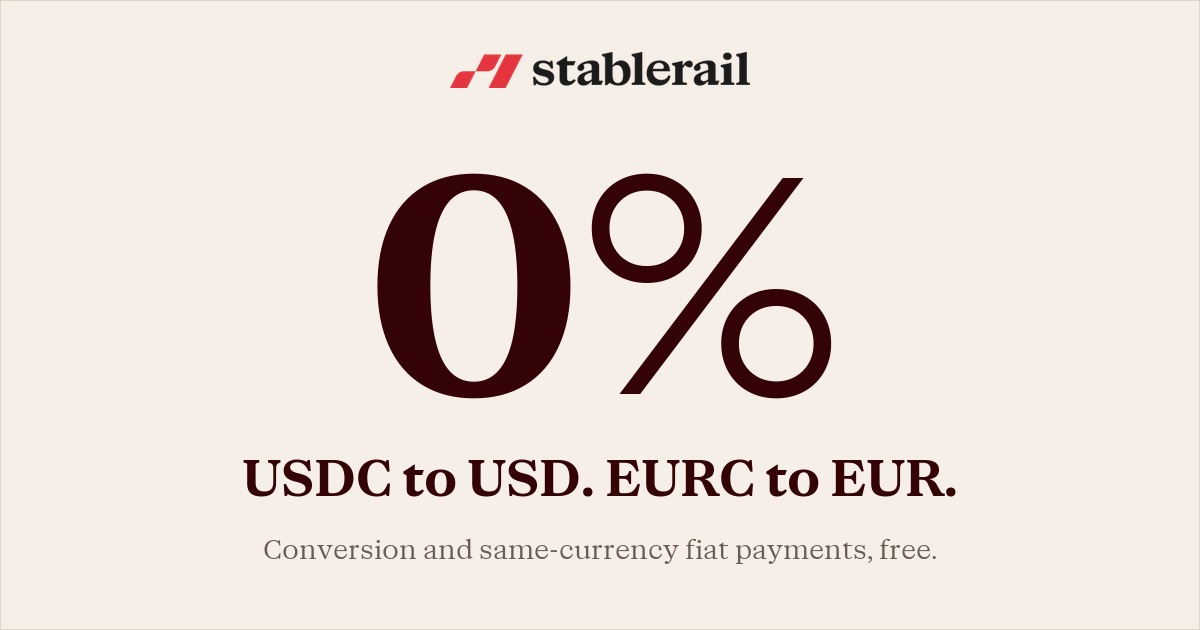
Converting USDC to USD and EURC to EUR inside a Stablerail business account now has a 0% conversion fee, with no spread applied. Receiving fiat is also free, and same-currency fiat payments are free over ACH, SEPA, SEPA Instant and UK Faster Payments. Cross-currency payments remain subject to the rate for your plan.
What changed
The pricing change removes the cost of a common stablecoin treasury step: moving from a digital currency balance into the corresponding bank currency before making a payment.
The 0% rate applies to the specific conversion directions announced here: USDC to USD and EURC to EUR. It means there is no conversion fee and no spread added to those conversions. It does not mean that every possible transaction, blockchain transfer or foreign-exchange payment is free.
| Activity | Price | What finance teams should know |
|---|---|---|
| Receive fiat | Free | No fee is charged for receiving a fiat payment into the account. |
| Convert USDC to USD | 0% | No conversion fee or spread is applied to the USDC-to-USD conversion. |
| Convert EURC to EUR | 0% | No conversion fee or spread is applied to the EURC-to-EUR conversion. |
| Send same-currency fiat | Free | Applies to supported ACH, SEPA, SEPA Instant and UK Faster Payments transactions. |
| Send a cross-currency payment | 0.79%, 0.49% or 0.29% | The rate depends on the plan. Enterprise accounts can have custom pricing. |
| Use an underlying network or third-party rail | Varies where charged | Any charge imposed by the underlying rail is separate from the 0% conversion rate. |
Plan subscriptions, volume limits and signer counts are unchanged. Existing customers do not need to enable a new setting; the updated pricing is reflected on their next applicable payment.
Why 0% conversion matters for stablecoin treasury
A supplier payment funded with stablecoins can contain several economically distinct steps. The business may receive a stablecoin, transfer it into a treasury wallet, convert it into bank money and then send a domestic or regional fiat payment. If each step has its own fee or spread, the total cost can be difficult to identify before the payment is approved.
Removing the fee and spread from the paired conversion makes the cost model easier to explain. If a company holds USDC and needs to pay a US supplier in USD, the USDC-to-USD conversion does not create an additional percentage charge. If it holds EURC and needs to pay a supplier in EUR, the same principle applies.
A cross-currency payment is different. For example, funding a EUR supplier payment from a USD balance changes the currency of the funds, so the plan's cross-currency rate applies. The pricing distinction is therefore based on whether the payment stays within the matching currency or requires foreign exchange.
The practical rule: converting USDC to USD or EURC to EUR has no conversion fee or spread. A fee applies when the payment itself changes currency.
How common payment scenarios are priced
| Starting balance | Supplier payment | Required steps | Relevant charge |
|---|---|---|---|
| USDC | USD by ACH | Convert USDC to USD, then send USD | 0% conversion; same-currency ACH payment is free |
| EURC | EUR by SEPA | Convert EURC to EUR, then send EUR | 0% conversion; same-currency SEPA payment is free |
| EURC | EUR by SEPA Instant | Convert EURC to EUR, then send EUR | 0% conversion; same-currency SEPA Instant payment is free |
| USD | EUR payment | Convert the payment currency from USD to EUR | Cross-currency rate for the account's plan |
| EUR | USD payment | Convert the payment currency from EUR to USD | Cross-currency rate for the account's plan |
These examples describe the account-level conversion and payment charges. A blockchain network fee may still arise when stablecoins are transferred onchain, and another underlying rail charge may apply where the rail itself imposes one. Payment timing can also vary by rail, banking cut-off, destination and counterparty bank; the 0% rate is a pricing change, not a promise that all rails settle at the same speed.
How a USDC-funded supplier payment works
A typical USDC-to-USD supplier payment can be handled as one controlled workflow:
- Receive USDC from a customer or another approved source into the self-custodied treasury wallet.
- Select the amount of USDC that needs to be converted into USD.
- Review the conversion before confirming it. The conversion fee is 0%, and no spread is added.
- Create the supplier payment, select or verify the counterparty and attach the invoice or other supporting document.
- Complete sanctions and address screening before the payment is sent.
- Collect the approvals and signatures required by the company's signing quorum.
- Send the USD payment by ACH and retain the receipt, screening result and approval trail with the payment record.
The equivalent EUR workflow converts EURC into EUR and sends the resulting funds over SEPA or SEPA Instant where supported. Keeping the conversion, approval and payout evidence together reduces the work required to reconstruct why a payment was made and who authorised it.
What 0% does and does not include
There is no conversion fee or spread on USDC-to-USD and EURC-to-EUR conversions. The same-currency payout is also free when it uses one of the listed supported rails.
Cross-currency payments are not included. If the destination currency differs from the fiat balance used to fund the payment, the applicable plan rate is 0.79%, 0.49% or 0.29%, with custom pricing available on Enterprise.
Network and third-party rail charges are separate. Moving a stablecoin onchain may require a network fee. A fee imposed directly by an underlying payment rail may also remain payable where applicable.
Custody treatment does not change. Digital assets remain self-custodied. Fiat balances are held with banking partners and are not self-custodied. Treasury teams should reflect that distinction in wallet controls, account mappings and internal custody documentation.
Accounting events still need to be recorded. A zero-fee conversion may simplify reconciliation, but it does not remove the need to record the stablecoin disposal or conversion, the resulting fiat balance and the later supplier payment. The appropriate accounting and tax treatment depends on the company's policies and jurisdiction.
A finance checklist before the first payment
- Confirm the currency pair: check that the transaction is USDC to USD or EURC to EUR.
- Separate conversion from foreign exchange: identify whether the supplier will receive the same fiat currency or whether a cross-currency fee applies.
- Review the full route: include any onchain transfer and underlying rail charges, not only the account conversion fee.
- Verify the beneficiary: confirm bank details, legal name and invoice information before approval.
- Apply the signing quorum: require the correct approvers rather than relying on a single operator.
- Retain evidence: export the conversion record, screening result, approvals, supporting documents and payout receipt for reconciliation and audit.
- Map the ledger entries: reconcile the wallet debit, fiat credit and supplier-payment debit as separate events.
Controls and audit evidence remain essential
Lower pricing should not reduce payment controls. Stablecoin-funded payouts still need clear separation between preparation, approval and signing. Finance teams should also be able to show the source balance, beneficiary, invoice, screening outcome, approval history and final payment receipt.
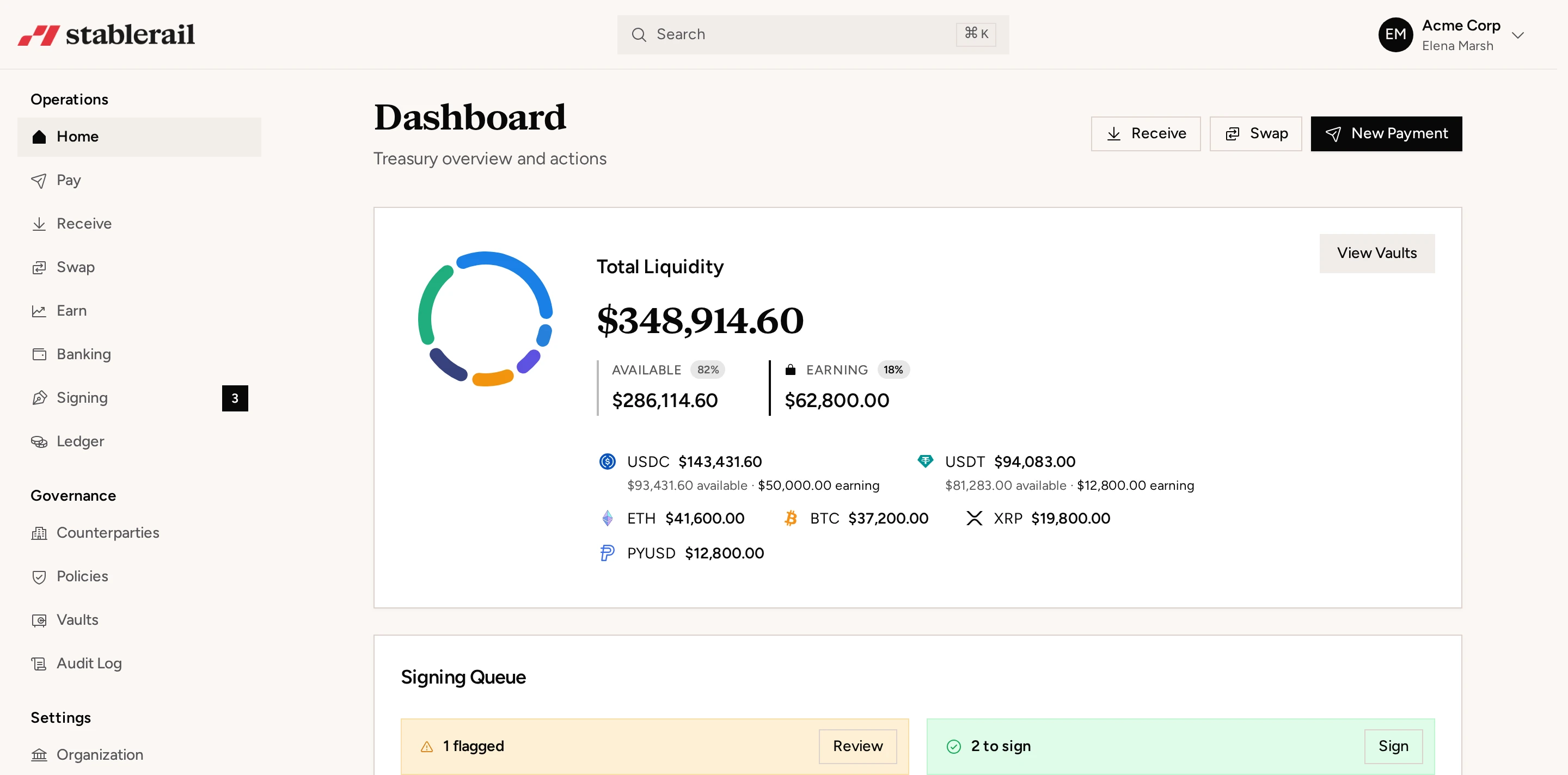
Stablerail combines stablecoin treasury, approvals and signing quorum, pre-send sanctions and address screening, global payouts, fiat off-ramp, corporate cards and exportable audit evidence in one business account. The pricing change affects the conversion and same-currency payment costs described above; it does not alter the underlying approval, custody or evidence requirements.
Getting started
Existing customers receive the new pricing automatically on their next applicable payment, with nothing to switch on. Before sending a payment, review the quoted route and currency to confirm whether it is a free paired conversion and same-currency payout or a cross-currency transaction charged at the account's plan rate.
Frequently asked questions
Is converting USDC to USD free?
Yes. USDC-to-USD conversion inside the account has a 0% conversion fee, and no spread is applied. Blockchain network fees or other underlying rail charges may still apply where relevant.
Is EURC to EUR conversion also free?
Yes. Converting EURC to EUR has no conversion fee or added spread. A subsequent same-currency EUR payment over SEPA or SEPA Instant is also free on supported transactions.
Are ACH and SEPA payments free after conversion?
Same-currency fiat payments over ACH, SEPA, SEPA Instant and UK Faster Payments are free. If the payment requires a change of currency, the cross-currency rate for the account's plan applies.
When does a cross-currency payment fee apply?
The fee applies when the currency used to fund the payment differs from the currency received by the beneficiary, such as paying EUR from USD. Plan rates are 0.79%, 0.49% or 0.29%, with custom pricing available on Enterprise.
Does 0% conversion mean there are no transaction costs at all?
No. The 0% rate covers the USDC-to-USD or EURC-to-EUR conversion fee and spread. Onchain network fees, charges imposed by an underlying rail, subscriptions and cross-currency payment fees remain separate where applicable.
How should finance teams reconcile a free stablecoin conversion?
Record the stablecoin reduction, the corresponding fiat increase and the later supplier payment as separate events. Retain the conversion record, approval trail, screening result, supporting invoice and payout receipt, even when the conversion fee is zero.
Writes for Stablerail on stablecoin treasury operations.
More about the Stablerail team- Stablecoin treasury managementApprovals, limits, yield and reporting on one balance.
- Stablecoin payoutsBatch contractor and vendor payments with screening.
- USDT vs USDCWhich stablecoin your company should settle in.
- Stablecoin finance glossaryMPC, off-ramp, travel rule and the rest, in plain English.
- Product updatesEverything we ship, month by month.