
AI Agent Wallets: How They Work and How to Control Treasury Access
Learn how AI agent wallets prepare and execute stablecoin transactions, which custody model to choose, and how to control permissions, approvals and signing.
An AI agent wallet lets software prepare, submit or execute blockchain transactions, but it should not give an AI unrestricted control of corporate funds. For treasury use, separate transaction preparation from approval and signing, restrict the agent to specific assets, networks and beneficiaries, and use a dedicated low-balance vault. Require independent checks for new addresses, larger payments and permission changes, with complete audit evidence for every transaction.

An AI agent wallet lets software prepare, submit or execute blockchain transactions, but it should not give an AI unrestricted control of corporate funds. For treasury use, separate transaction preparation from approval and signing, restrict the agent to specific assets, networks and beneficiaries, and use a dedicated low-balance vault. Require independent checks for new addresses, larger payments and permission changes, with complete audit evidence for every transaction.
What is an AI agent wallet?
An AI agent wallet is a blockchain wallet, smart account or wallet-connected workflow through which an AI agent can initiate transaction activity. A company might use one to draft vendor payments, schedule contractor payouts or propose a transfer of USDC between approved operational vaults.
The term does not describe one custody model. In some implementations, the agent holds a signing key. In others, it can only construct an unsigned transaction for people or a separate signing system to approve. That distinction determines how much damage a compromised agent, prompt or data source could cause.
For corporate treasury, the safer default is to treat the agent like an accounts payable operator. It may collect instructions and prepare a payment batch, but funds do not leave the wallet until an independent approval and signing process is complete.
How an AI agent transaction works
A controlled transaction usually passes through five stages:
- Instruction: The agent receives a request from an invoice, payment file, finance system or approved treasury procedure.
- Preparation: It creates a transaction proposal containing the token, blockchain network, recipient address, amount and fee settings.
- Validation: The workflow checks the proposal against permitted assets, networks, beneficiaries, amounts and time windows. The destination should also be screened before funds are sent.
- Approval and signing: Authorised people or signing participants review the request. The required signing quorum produces a valid signature only after the applicable approvals are complete.
- Broadcast and reconciliation: The signed transaction is submitted to the network. The transaction hash, fee, confirmation status and supporting evidence are recorded for reconciliation.
These are separate permissions. The ability to create transaction data does not need to include the ability to approve, sign or broadcast it. Broadcast access alone is less sensitive because a signed transaction generally cannot be changed without invalidating its signature, but it should still be logged and monitored.
Blockchain fees and settlement behavior continue to apply. A transaction may be visible quickly but should not be treated as final merely because it appears in a block explorer. The treasury team should define when each supported network has reached an acceptable level of finality and how failed, replaced or delayed transactions are handled.
Choose the agent’s authority level first
The central design decision is not whether to use AI. It is how far the agent’s authority extends. Finance teams should choose the lowest level that delivers the intended operational benefit.
| Authority level | What the agent can do | Primary risk | Recommended controls |
|---|---|---|---|
| Read only | View balances, transaction status and approved records | Exposure of confidential treasury information | Restricted data access, separate production credentials and access logging |
| Prepare only | Create an unsigned transaction or payment proposal | Manipulated amounts, networks or recipient addresses reaching an approver | Human review, destination verification, screening and clear display of transaction details |
| Prepare and request approval | Create a proposal and route it to designated approvers | Approval fatigue or misleading supporting data | Segregation of duties, quorum approval and independent source-document checks |
| Limited execution | Complete narrowly defined payments without case-by-case human approval | Repeated transfers following prompt injection, credential compromise or faulty instructions | Dedicated low-balance vault, beneficiary restrictions, cumulative limits, expiry and rapid revocation |
| Unrestricted signing | Sign arbitrary transactions from a treasury wallet | Immediate loss of all accessible funds | Avoid for corporate treasury; retain signing authority outside the agent environment |
Limited execution should be considered only after the prepare-and-approve workflow is stable. An automation limit is not a substitute for oversight: a compromised agent may repeat smaller payments, so cumulative value, transaction count and time-based restrictions matter as much as the per-transaction maximum.
Compare wallet custody and signing models
Wallet architecture determines where signing authority resides, but no architecture eliminates the need to validate the transaction itself.
| Model | How signing works | Treasury consideration |
|---|---|---|
| Agent-held private key | The agent runtime can sign directly with a complete key | Simple to automate, but compromise of the runtime or key can permit immediate fund movement |
| Provider-custodied account | A third party controls signing infrastructure and withdrawal procedures | Operational control depends on the provider’s access, approval and recovery arrangements |
| Smart contract wallet | On-chain account logic determines which signatures or actions are accepted | Can restrict execution, but introduces contract, configuration and network-specific risks |
| MPC wallet with quorum signing | Multiple key shares participate without reconstructing a complete private key in one place | Supports separation of signing participants, but an authorised quorum can still sign a malicious transaction |
MPC protects key material; it does not establish that the recipient, network or amount is correct. If the required participants approve a fraudulent address, the resulting signature remains cryptographically valid. Custody, transaction validation and approval controls therefore need to operate together.
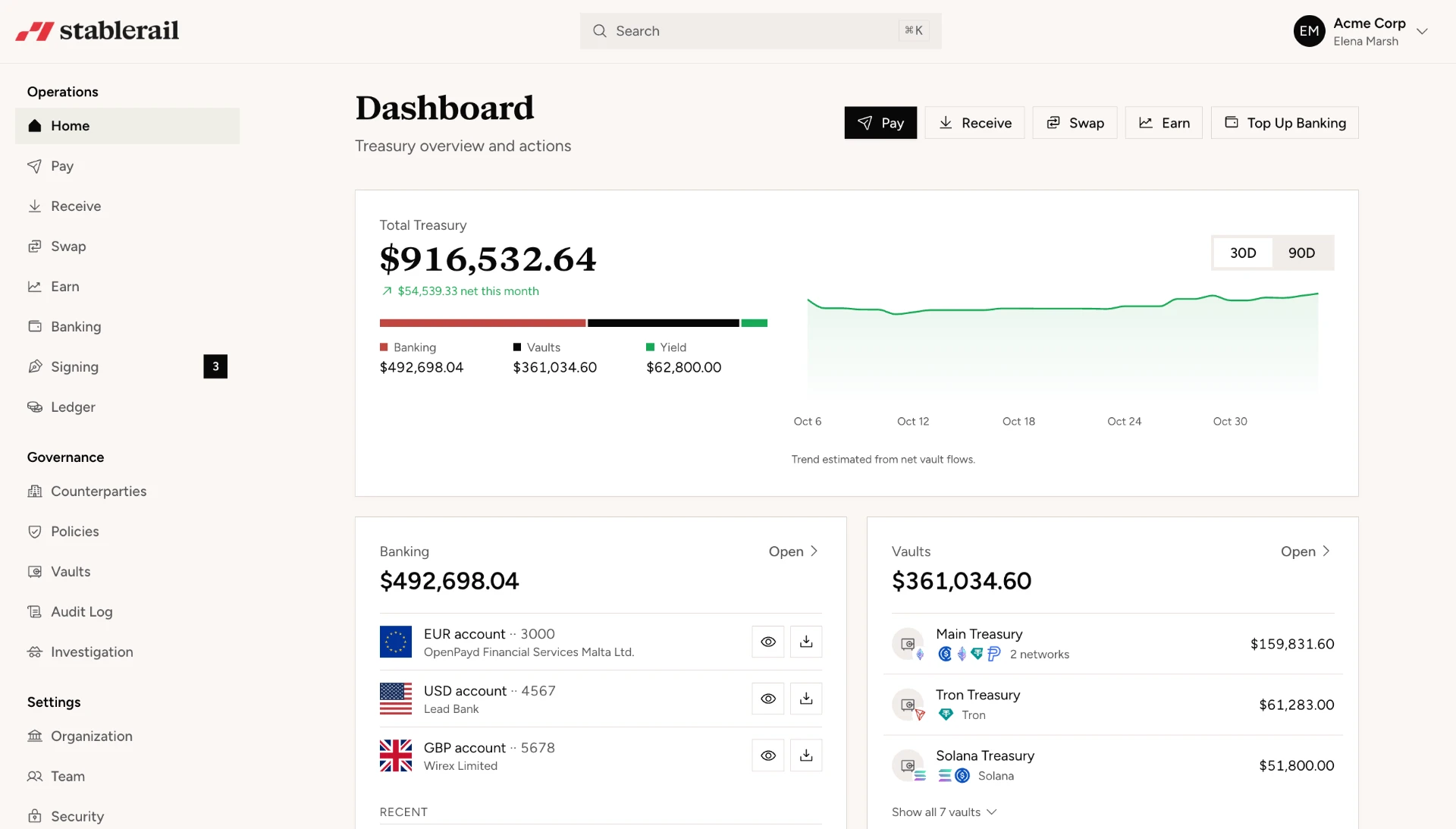
For example, Stablerail is designed for companies managing their own USDC or USDT and combines approval workflows and signing quorum with stablecoin treasury operations. An AI system can prepare a payment while signing authority remains with the company’s controlled approval process.
Scope permissions to the smallest practical mandate
“Wallet access” is too broad to function as a treasury permission. The mandate should identify each element the agent may use:
- Vault: Use a dedicated operational vault rather than the main reserve wallet.
- Asset: Permit only the required token. Token symbols are not sufficient identifiers because unrelated assets may use the same symbol.
- Network: Approve each blockchain separately and verify the token’s contract or native asset identifier on that network.
- Destination: Limit payments to verified beneficiaries where the workflow supports destination restrictions.
- Action: Separate creation, approval, signing and broadcast capabilities.
- Time: Expire temporary access and one-time mandates rather than leaving them active indefinitely.
- Value: Restrict individual transactions, cumulative outflow and the balance available to the agent-connected workflow.
An address approved for one network should not automatically be treated as approved on another, even where the visible address format is identical. The beneficiary record should bind the legal entity, wallet address, blockchain network, token and payment purpose together.
Set limits and escalation rules
Finance teams should use overlapping limits rather than one maximum payment amount. Relevant controls include a per-transaction ceiling, cumulative daily or weekly outflow, transaction-count limits, beneficiary-specific limits and a cap on the operational vault balance.
Approval requirements should escalate when risk changes. New or modified beneficiaries should receive independent verification regardless of payment size. Larger transfers, reserve-wallet movements, unusual transaction frequency and permission changes should require additional approvers or signing participants.
There is no universal safe limit. A useful starting point is the smallest balance, transaction amount and operating window that supports normal payments. Replenishment of the operational vault should use a separate approval process so the agent cannot increase its own available funds.
Combine beneficiary verification with address screening
Beneficiary controls and wallet screening answer different questions. Verification confirms that an address belongs to the intended recipient on the intended network. Sanctions and address screening can identify relevant risk indicators associated with the destination. Passing one check does not satisfy the other.
Address verification should happen outside the AI-generated conversation or source document. A finance employee can confirm details through a trusted contact method, record who performed the check and retain evidence. Any later address change should be treated as a new instruction rather than a routine edit.
Screening should occur close to execution because address risk information can change. Stablerail supports sanctions and address screening before send, alongside approvals, signing quorum and exportable audit evidence for corporate stablecoin activity.
Protect the agent environment and credentials
Never place a seed phrase, complete private key or unrestricted signing credential in a prompt, model context, source repository or general-purpose configuration file. Prompt filtering cannot make exposed signing material safe.
Give the agent a unique, revocable identity with only the permissions it needs. Separate test and production access, restrict who can alter integrations and log credential and permission changes. Assume that invoices, email messages, websites and connected tools may contain malicious instructions intended to redirect the agent.
The incident procedure should cover disabling the agent, revoking credentials, stopping pending requests, removing permissions and transferring the remaining operational balance if the wallet may be compromised. Finance, security and authorised signers should know who can perform each action without depending on the affected agent.
Retain evidence beyond the blockchain record
A transaction hash proves that a transaction occurred; it does not explain why the company sent it or who approved it. For every payment, retain:
- The invoice, payroll file or original payment instruction
- The proposed asset, network, recipient and amount
- Beneficiary verification, destination status and screening result
- The approvers and signing participants
- Permission changes, exceptions and relevant timestamps
- The transaction hash, network fee, final status and accounting reference
The record should let a controller reconstruct initiation, review, approval, signing and settlement without relying on the agent’s narrative. Agent output can be supporting context, but system events and human approval records should be the authoritative evidence.
AI agent wallet rollout checklist
- Begin with read-only or prepare-only access and require human approval for every payment.
- Use a dedicated low-balance vault with one required token and explicitly approved networks.
- Verify each beneficiary independently and screen the address before sending.
- Separate the people who approve beneficiaries, payments and signing access where practical.
- Test rejected payments, wrong-network instructions, duplicate requests and changed addresses.
- Document revocation, emergency fund movement and reconciliation procedures.
- Review exceptions and audit evidence before considering any limited automatic execution.
The objective is not to make an AI agent the treasury administrator. It is to give the agent a narrow, observable and revocable operating mandate while accountable people retain control over custody, approvals and signing.
Frequently asked questions
Can an AI agent control a crypto wallet?
Yes, an AI agent can be connected to software that prepares, signs or broadcasts blockchain transactions. For corporate treasury, it is safer to let the agent prepare transactions while independent approvers and signing participants retain authority over fund movement.
What is the safest wallet setup for an AI agent?
A safer setup uses a dedicated low-balance operational wallet, narrowly scoped permissions and signing authority outside the agent environment. Restrict the agent to specific tokens, networks and verified beneficiaries, and require escalation for new addresses, larger payments and permission changes.
Can MPC prevent an AI agent from sending funds to the wrong address?
MPC prevents a complete private key from residing with one participant, but it does not determine whether a transaction is legitimate. Destination verification, address screening, transaction review and quorum approval are still necessary.
Should an AI agent be allowed to sign stablecoin transactions automatically?
Automatic signing creates materially more risk than transaction preparation. If used at all, it should be limited to a dedicated wallet, verified beneficiaries, narrow cumulative limits and an expiring mandate, with manual approval retained for exceptions and changes.
What should an AI wallet audit trail include?
Retain the original payment instruction, proposed token, network, recipient and amount, plus verification and screening results. The record should also identify approvers and signing participants, permission changes, timestamps, network fees, transaction hash and final status.
Finance writers covering stablecoin treasury, payments, compliance, and risk controls.
More about the Stablerail team- Stablecoin treasury managementApprovals, limits, yield and reporting on one balance.
- Stablecoin payoutsBatch contractor and vendor payments with screening.
- USDT vs USDCWhich stablecoin your company should settle in.
- Stablecoin finance glossaryMPC, off-ramp, travel rule and the rest, in plain English.
- Product updatesEverything we ship, month by month.