
Best Corporate Crypto Card in 2026: How to Evaluate Providers
Compare corporate crypto cards by funding model, total fees, controls, regional coverage, custody and accounting data—not cashback alone.
The best corporate crypto card in 2026 is the one that matches your company’s stablecoin funding, approval, geographic and accounting requirements. Before comparing rewards, verify when USDC or USDT is converted, who controls funds, the full cost of FX and card use, where cards can be issued, and whether transaction exports reconcile authorisations, settlements, refunds and fees. Pilot the strongest candidate before a broad rollout.

The best corporate crypto card is not necessarily the one advertising the highest cashback rate. For a company holding USDC or USDT, the better choice is the card programme that fits its treasury controls, cardholder locations, conversion requirements and month-end accounting process. Finance teams should compare the complete movement of funds and data before evaluating rewards.
What is a corporate crypto card?
A corporate crypto card connects company-held digital assets to ordinary card spending. Employees pay merchants in local currency, while stablecoins are converted, reserved or used to settle a card balance according to the provider’s funding model. The merchant generally receives fiat through the card network and does not need to accept cryptocurrency.
The term crypto card can obscure important structural differences. One provider may require USDC to be converted into a prefunded fiat balance. Another may convert stablecoins when a transaction is authorised or settled. A third may extend credit secured by digital assets. These structures create different liquidity, custody, accounting and counterparty risks.
Start with the card funding model
Ask each provider to diagram the flow from the company’s wallet or treasury balance through card authorisation, conversion and final merchant settlement. The diagram should identify every legal entity that holds or converts funds.
| Funding model | How it works | Primary benefit | Finance question to resolve |
|---|---|---|---|
| Prefunded fiat | The company converts stablecoins and loads a fiat card balance before spending. | Available card balance is easier to forecast. | How much working capital must sit outside the stablecoin treasury? |
| Automatic conversion | Stablecoins are converted when a purchase is authorised or settled. | Reduces manual prefunding. | Which event fixes the conversion rate, spread and fee? |
| Secured credit | Stablecoins support a credit facility and the company repays the card bill later. | Separates purchase timing from asset conversion. | What are the collateral, repayment, margin and liquidation terms? |
| Unified treasury balance | Cards operate within a platform handling stablecoin balances, fiat conversion and treasury records. | Can reduce movement between disconnected systems. | Is card settlement held separately, and can every movement be exported? |
Card authorisation and settlement are separate events. A hotel may place a deposit hold on Monday, increase it during a stay and settle a different amount on Friday. Finance should determine when funds are reserved, which exchange rate applies, how incremental authorisations work and when unused reserves become available after a reversal.
Asset support must also be checked by token and network. Support for USDC does not imply support for USDC on every blockchain. The same is true for USDT. Require a written list of accepted token contracts, networks, deposit addresses and confirmation requirements. A test transfer should precede any material funding because sending assets over an unsupported network may require recovery or lead to loss.
Calculate total card cost, not the advertised fee
Model the annual cost using expected purchase currencies, transaction volume, employee locations and funding behaviour. Cashback should be treated as an offset only after the underlying costs and eligibility conditions are understood.
| Cost component | What to request | How to test it |
|---|---|---|
| Platform and card fees | Account, virtual card, physical card, replacement and delivery charges | Apply the schedule to the planned number of entities and cardholders. |
| Stablecoin conversion | Explicit fee, rate source, spread and quote-validity period | Compare the executed rate with the stated reference at the relevant timestamp. |
| Foreign exchange | Billing currency, network conversion rules and provider markup | Price purchases where the merchant and billing currencies differ. |
| Transaction charges | Per-payment, cross-border and regional charges | Segment expected spending by merchant location and transaction type. |
| Funding and withdrawal | Network, deposit, redemption and fiat withdrawal charges | Include both routine rebalancing and an exit of the remaining balance. |
| Disputes and cash access | Chargeback, retrieval, administrative and ATM fees | Confirm whether cash withdrawals are permitted and how disputes are billed. |
Ask providers for written calculations covering realistic transactions, such as a €1,000 purchase in France, a £1,000 purchase in the UK and a ¥100,000 purchase in Japan funded from USDC. Each example should show the stablecoin debited, reference rate, spread, FX charge, card fee and final amount posted.
A useful comparison is total cost divided by purchase value, calculated for each transaction scenario and for the projected annual portfolio. This exposes differences that a single headline percentage can hide.
Test spending controls in real workflows
Controls should limit employee access without forcing treasury staff to approve every routine purchase manually. Evaluate per-transaction, daily, monthly and lifetime limits, together with restrictions by merchant category, country, currency, online usage, contactless use and cash withdrawal.
Also check who can issue a card, reveal its details, change a limit, freeze it and close it. Sensitive actions should fit the company’s separation-of-duties model. Merchant category code restrictions are useful but are not absolute controls because merchants can be classified incorrectly. Test representative vendors before relying on an MCC block.
Virtual cards can improve control over subscriptions and vendors when the provider supports dedicated limits or cards restricted to a defined use. Finance should verify how cancelled subscriptions, offline transactions and delayed presentments behave after a card is frozen or terminated.
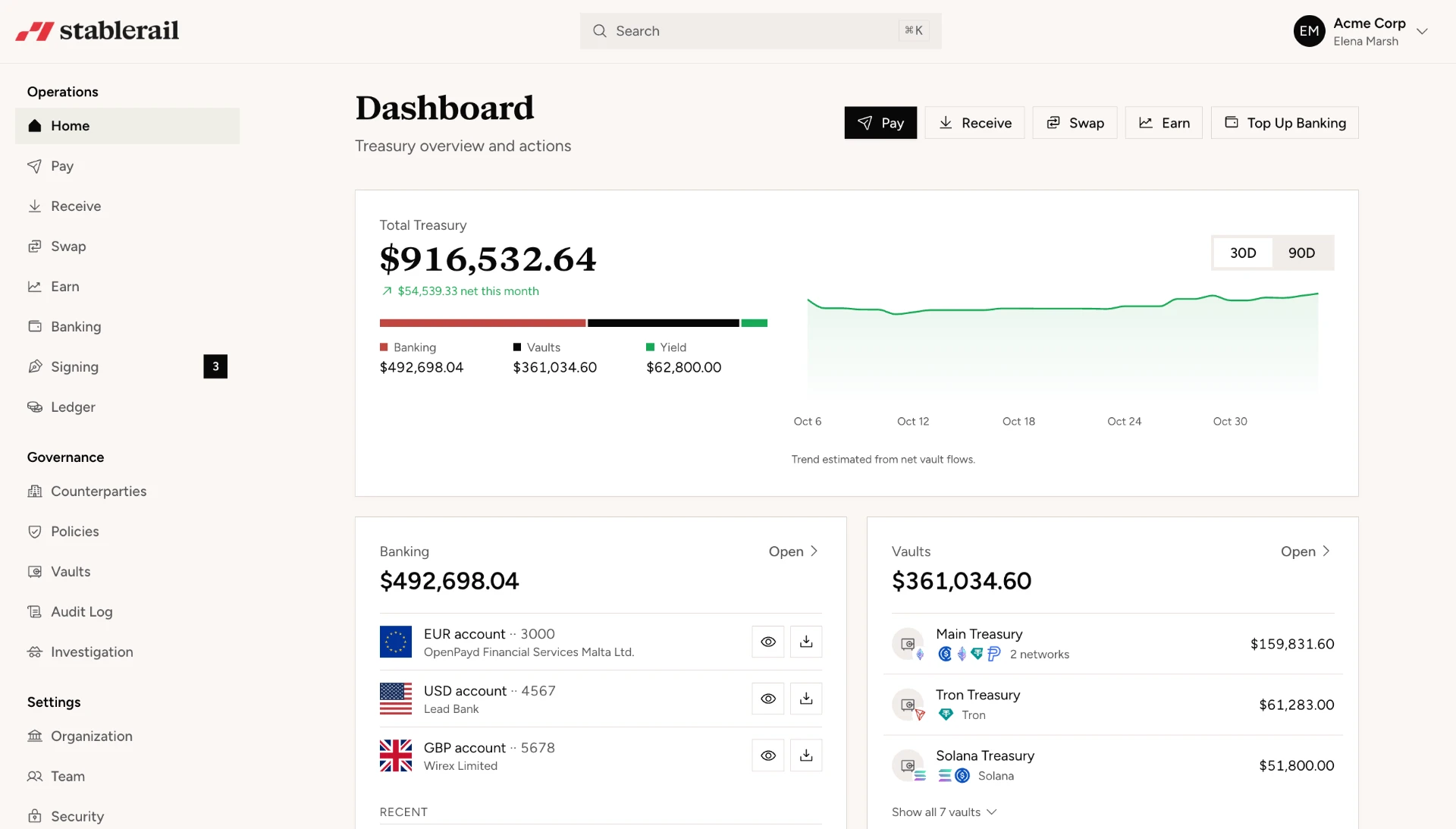
Stablerail combines corporate cards with a USDC and USDT treasury for a company’s own funds, including approvals and signing quorum, sanctions and address screening before sends, fiat conversion, global payouts and exportable audit evidence. As with any provider, companies should request current fees, limits and eligibility for their entities and cardholder locations.
Confirm company and cardholder eligibility
Approval of a corporate account does not guarantee that cards can be issued to every employee. Request a country matrix covering eligible incorporation jurisdictions, restricted industries, cardholder residence, physical card delivery, virtual card availability, billing currencies and domestic or international usage restrictions.
Onboarding may require registration documents, ownership details, information about directors and ultimate beneficial owners, expected activity and evidence supporting source of funds. Complex ownership or higher-risk activity can lead to additional review. Obtain an initial eligibility assessment before building a rollout plan around a provider.
For a distributed workforce, verify the maximum number of cards, programme-level spending limits, replacement procedures and what happens when an employee moves country. Confirm whether cards are issued to the company, individual employees or both, and who bears liability under the card agreement.
Review custody and access to treasury funds
Determine who controls the USDC or USDT before funding, while money is reserved for card transactions and after settlement. Even if a company controls its main treasury wallet, funds transferred into a separate card balance may be held under a different legal and operational structure.
For each stage, identify the legal holder, wallet or account type, withdrawal process and effect of a provider or card partner outage. Ask whether balances are segregated, whether card reserves can be withdrawn immediately and what contractual claims the company has if a service provider becomes insolvent.
Approval and signing arrangements should also match treasury policy. Confirm which actions require multiple approvers, how approvers are changed, how credentials are recovered and whether one administrator can both create and approve a movement. Document emergency procedures before funding the account.
Demand accounting-ready transaction data
A card programme can save time at purchase while creating substantial reconciliation work later. Finance should receive authorisations, settlements, reversals, refunds, disputes, conversion entries and fees as distinct records rather than as an unexplained net debit.
Each record should include a persistent transaction identifier, cardholder, merchant, original currency, billing currency, timestamps, exchange rate and applicable fees. Useful allocation fields include entity, department, project, cost centre, memo, tax category and receipt status.
Run a sample close before rollout. Include hotel deposits, restaurant tips, partial refunds, subscriptions, declined transactions, chargebacks and purchases authorised before the reporting cut-off but settled afterward. The exports should reconcile the card statement, stablecoin movement and conversion records without relying on manual matching by amount alone.
Use a weighted provider scorecard
| Category | Example weight | Evidence to review |
|---|---|---|
| Funding, conversion and settlement | 25% | Flow diagram, supported networks and transaction examples |
| Total fees and FX cost | 20% | Written fee schedule and scenario pricing |
| Spending controls | 15% | Role tests, limit changes and representative merchants |
| Regional coverage | 15% | Entity and cardholder country matrix |
| Accounting and exports | 15% | Sample data and month-end reconciliation |
| Custody and resilience | 10% | Contracts, approval design, withdrawal and outage procedures |
Adjust the weights to the operating model. A globally distributed company may give regional coverage greater weight, while a business with concentrated advertising or cloud spending may prioritise virtual card controls, programme limits and reliable settlement.
Pilot before expanding card access
- Obtain written terms, fee schedules, country coverage and supported-network details.
- Fund the programme with a limited amount using a verified token and network.
- Issue cards to a small group with conservative limits and defined use cases.
- Test purchases, reversals, refunds, FX transactions, limit changes and card freezing.
- Complete a full reconciliation from stablecoin funding through the card statement and general ledger export.
- Document approval, incident, employee departure and provider exit procedures before scaling.
The best corporate crypto card in 2026 is therefore the programme whose funding mechanics, legal structure, geographic reach, controls and records match the company’s actual operating model. A controlled pilot using realistic transactions provides better evidence than rewards, marketing claims or a feature checklist alone.
Frequently asked questions
What is the best corporate crypto card for a company holding USDC?
The best option depends on how the company wants USDC converted, controlled and reported. Compare supported networks, conversion timing, total fees, cardholder countries, spending controls and whether exports reconcile stablecoin funding with individual card settlements.
Can a business use USDT or USDC to fund employee cards?
Some corporate card programmes accept USDC, USDT or both, but supported blockchains vary. Confirm the exact token contract and network before transferring funds, as support for an asset does not mean every network is accepted.
How do corporate crypto card fees work?
Costs can include platform subscriptions, card issuance, stablecoin conversion spreads, foreign exchange, cross-border charges, funding or withdrawal fees and dispute fees. Model the complete cost of representative purchases instead of comparing one advertised percentage.
Are corporate crypto cards custodial or self-custodial?
The structure varies by provider and may change across the transaction lifecycle. A company might control its main treasury balance while funds reserved for card settlement are held by a provider or partner, so finance should map custody at every stage.
What accounting data should a corporate crypto card provide?
Finance should receive separate records for authorisations, settlements, reversals, refunds, conversions and fees. Each record should include a stable identifier, currencies, exchange rate, timestamps, cardholder and allocation fields so the card statement and stablecoin movements can be reconciled.
Finance writers covering stablecoin treasury, payments, compliance, and risk controls.
More about the Stablerail team- Stablecoin treasury managementApprovals, limits, yield and reporting on one balance.
- Stablecoin payoutsBatch contractor and vendor payments with screening.
- USDT vs USDCWhich stablecoin your company should settle in.
- Stablecoin finance glossaryMPC, off-ramp, travel rule and the rest, in plain English.
- Product updatesEverything we ship, month by month.