
Why Audits Matter for Enterprise Stablecoin Adoption
Stablecoin audits support enterprise adoption only when finance teams understand their scope. Compare reserve attestations, financial audits, code reviews, control reports and internal transaction evidence.
Stablecoin audits matter because enterprises need independent evidence about reserves, financial reporting, technology and operational controls before holding or moving USDC or USDT. However, no single audit proves that a token is always redeemable, secure or suitable for a company’s use. Finance teams should combine issuer assurance, contract reviews, control reports and their own approval, screening, reconciliation and audit records.
%22%20x1%3D%220%22%20y1%3D%220%22%20x2%3D%221%22%20y2%3D%221%22%3E%0A%20%20%20%20%20%20%20%20%3Cstop%20offset%3D%220%25%22%20stop-color%3D%22%23450B10%22%20%2F%3E%0A%20%20%20%20%20%20%20%20%3Cstop%20offset%3D%2250%25%22%20stop-color%3D%22%23681A1F%22%20%2F%3E%0A%20%20%20%20%20%20%20%20%3Cstop%20offset%3D%22100%25%22%20stop-color%3D%22%238A2A2D%22%20%2F%3E%0A%20%20%20%20%20%20%3C%2FlinearGradient%3E%0A%20%20%20%20%20%20%3CradialGradient%20id%3D%22glow%22%20cx%3D%221247%22%20cy%3D%22-210%22%20r%3D%22520%22%20gradientUnits%3D%22userSpaceOnUse%22%3E%0A%20%20%20%20%20%20%20%20%3Cstop%20offset%3D%220%25%22%20stop-color%3D%22%23FF7A59%22%20stop-opacity%3D%220.45%22%20%2F%3E%0A%20%20%20%20%20%20%20%20%3Cstop%20offset%3D%2255%25%22%20stop-color%3D%22%23FF7A59%22%20stop-opacity%3D%220.08%22%20%2F%3E%0A%20%20%20%20%20%20%20%20%3Cstop%20offset%3D%22100%25%22%20stop-color%3D%22%23FF7A59%22%20stop-opacity%3D%220%22%20%2F%3E%0A%20%20%20%20%20%20%3C%2FradialGradient%3E%0A%20%20%20%20%20%20%3ClinearGradient%20id%3D%22glass%22%20x1%3D%220%22%20y1%3D%220%22%20x2%3D%221%22%20y2%3D%221%22%3E%0A%20%20%20%20%20%20%20%20%3Cstop%20offset%3D%220%25%22%20stop-color%3D%22%23F8D6D2%22%20stop-opacity%3D%220.26%22%20%2F%3E%0A%20%20%20%20%20%20%20%20%3Cstop%20offset%3D%22100%25%22%20stop-color%3D%22%23FFFFFF%22%20stop-opacity%3D%220.08%22%20%2F%3E%0A%20%20%20%20%20%20%3C%2FlinearGradient%3E%0A%20%20%20%20%20%20%3ClinearGradient%20id%3D%22accent%22%20x1%3D%220%22%20y1%3D%220%22%20x2%3D%221%22%20y2%3D%221%22%3E%0A%20%20%20%20%20%20%20%20%3Cstop%20offset%3D%220%25%22%20stop-color%3D%22%23FF7A59%22%20%2F%3E%0A%20%20%20%20%20%20%20%20%3Cstop%20offset%3D%22100%25%22%20stop-color%3D%22%23C73128%22%20%2F%3E%0A%20%20%20%20%20%20%3C%2FlinearGradient%3E%0A%20%20%20%20%20%20%3Cfilter%20id%3D%22soft%22%3E%3CfeGaussianBlur%20stdDeviation%3D%2210%22%20%2F%3E%3C%2Ffilter%3E%0A%20%20%20%20%3C%2Fdefs%3E%0A%20%20%20%20%3Crect%20width%3D%221600%22%20height%3D%22900%22%20fill%3D%22url(%23bg)%22%20%2F%3E%0A%20%20%20%20%3Crect%20width%3D%221600%22%20height%3D%22900%22%20fill%3D%22url(%23glow)%22%20%2F%3E%0A%20%20%20%20%3Crect%20x%3D%22340%22%20y%3D%22220%22%20width%3D%22118%22%20height%3D%22108%22%20rx%3D%2210%22%20fill%3D%22url(%23accent)%22%20fill-opacity%3D%220.9%22%20stroke%3D%22%23F4CDC5%22%20stroke-opacity%3D%220.4%22%2F%3E%3Crect%20x%3D%22480%22%20y%3D%22220%22%20width%3D%22118%22%20height%3D%22108%22%20rx%3D%2210%22%20fill%3D%22url(%23accent)%22%20fill-opacity%3D%220.9%22%20stroke%3D%22%23F4CDC5%22%20stroke-opacity%3D%220.4%22%2F%3E%3Crect%20x%3D%22620%22%20y%3D%22220%22%20width%3D%22118%22%20height%3D%22108%22%20rx%3D%2210%22%20fill%3D%22url(%23glass)%22%20fill-opacity%3D%221%22%20stroke%3D%22%23F4CDC5%22%20stroke-opacity%3D%220.4%22%2F%3E%3Crect%20x%3D%22760%22%20y%3D%22220%22%20width%3D%22118%22%20height%3D%22108%22%20rx%3D%2210%22%20fill%3D%22url(%23accent)%22%20fill-opacity%3D%220.9%22%20stroke%3D%22%23F4CDC5%22%20stroke-opacity%3D%220.4%22%2F%3E%3Crect%20x%3D%22900%22%20y%3D%22220%22%20width%3D%22118%22%20height%3D%22108%22%20rx%3D%2210%22%20fill%3D%22url(%23glass)%22%20fill-opacity%3D%221%22%20stroke%3D%22%23F4CDC5%22%20stroke-opacity%3D%220.4%22%2F%3E%3Crect%20x%3D%221040%22%20y%3D%22220%22%20width%3D%22118%22%20height%3D%22108%22%20rx%3D%2210%22%20fill%3D%22url(%23accent)%22%20fill-opacity%3D%220.9%22%20stroke%3D%22%23F4CDC5%22%20stroke-opacity%3D%220.4%22%2F%3E%3Crect%20x%3D%221180%22%20y%3D%22220%22%20width%3D%22118%22%20height%3D%22108%22%20rx%3D%2210%22%20fill%3D%22url(%23glass)%22%20fill-opacity%3D%221%22%20stroke%3D%22%23F4CDC5%22%20stroke-opacity%3D%220.4%22%2F%3E%3Crect%20x%3D%22340%22%20y%3D%22350%22%20width%3D%22118%22%20height%3D%22108%22%20rx%3D%2210%22%20fill%3D%22url(%23accent)%22%20fill-opacity%3D%220.9%22%20stroke%3D%22%23F4CDC5%22%20stroke-opacity%3D%220.4%22%2F%3E%3Crect%20x%3D%22480%22%20y%3D%22350%22%20width%3D%22118%22%20height%3D%22108%22%20rx%3D%2210%22%20fill%3D%22url(%23glass)%22%20fill-opacity%3D%221%22%20stroke%3D%22%23F4CDC5%22%20stroke-opacity%3D%220.4%22%2F%3E%3Crect%20x%3D%22620%22%20y%3D%22350%22%20width%3D%22118%22%20height%3D%22108%22%20rx%3D%2210%22%20fill%3D%22url(%23glass)%22%20fill-opacity%3D%221%22%20stroke%3D%22%23F4CDC5%22%20stroke-opacity%3D%220.4%22%2F%3E%3Crect%20x%3D%22760%22%20y%3D%22350%22%20width%3D%22118%22%20height%3D%22108%22%20rx%3D%2210%22%20fill%3D%22url(%23glass)%22%20fill-opacity%3D%221%22%20stroke%3D%22%23F4CDC5%22%20stroke-opacity%3D%220.4%22%2F%3E%3Crect%20x%3D%22900%22%20y%3D%22350%22%20width%3D%22118%22%20height%3D%22108%22%20rx%3D%2210%22%20fill%3D%22url(%23accent)%22%20fill-opacity%3D%220.9%22%20stroke%3D%22%23F4CDC5%22%20stroke-opacity%3D%220.4%22%2F%3E%3Crect%20x%3D%221040%22%20y%3D%22350%22%20width%3D%22118%22%20height%3D%22108%22%20rx%3D%2210%22%20fill%3D%22url(%23glass)%22%20fill-opacity%3D%221%22%20stroke%3D%22%23F4CDC5%22%20stroke-opacity%3D%220.4%22%2F%3E%3Crect%20x%3D%221180%22%20y%3D%22350%22%20width%3D%22118%22%20height%3D%22108%22%20rx%3D%2210%22%20fill%3D%22url(%23accent)%22%20fill-opacity%3D%220.9%22%20stroke%3D%22%23F4CDC5%22%20stroke-opacity%3D%220.4%22%2F%3E%3Crect%20x%3D%22340%22%20y%3D%22480%22%20width%3D%22118%22%20height%3D%22108%22%20rx%3D%2210%22%20fill%3D%22url(%23accent)%22%20fill-opacity%3D%220.9%22%20stroke%3D%22%23F4CDC5%22%20stroke-opacity%3D%220.4%22%2F%3E%3Crect%20x%3D%22480%22%20y%3D%22480%22%20width%3D%22118%22%20height%3D%22108%22%20rx%3D%2210%22%20fill%3D%22url(%23accent)%22%20fill-opacity%3D%220.9%22%20stroke%3D%22%23F4CDC5%22%20stroke-opacity%3D%220.4%22%2F%3E%3Crect%20x%3D%22620%22%20y%3D%22480%22%20width%3D%22118%22%20height%3D%22108%22%20rx%3D%2210%22%20fill%3D%22url(%23accent)%22%20fill-opacity%3D%220.9%22%20stroke%3D%22%23F4CDC5%22%20stroke-opacity%3D%220.4%22%2F%3E%3Crect%20x%3D%22760%22%20y%3D%22480%22%20width%3D%22118%22%20height%3D%22108%22%20rx%3D%2210%22%20fill%3D%22url(%23glass)%22%20fill-opacity%3D%221%22%20stroke%3D%22%23F4CDC5%22%20stroke-opacity%3D%220.4%22%2F%3E%3Crect%20x%3D%22900%22%20y%3D%22480%22%20width%3D%22118%22%20height%3D%22108%22%20rx%3D%2210%22%20fill%3D%22url(%23glass)%22%20fill-opacity%3D%221%22%20stroke%3D%22%23F4CDC5%22%20stroke-opacity%3D%220.4%22%2F%3E%3Crect%20x%3D%221040%22%20y%3D%22480%22%20width%3D%22118%22%20height%3D%22108%22%20rx%3D%2210%22%20fill%3D%22url(%23glass)%22%20fill-opacity%3D%221%22%20stroke%3D%22%23F4CDC5%22%20stroke-opacity%3D%220.4%22%2F%3E%3Crect%20x%3D%221180%22%20y%3D%22480%22%20width%3D%22118%22%20height%3D%22108%22%20rx%3D%2210%22%20fill%3D%22url(%23glass)%22%20fill-opacity%3D%221%22%20stroke%3D%22%23F4CDC5%22%20stroke-opacity%3D%220.4%22%2F%3E%3Crect%20x%3D%22340%22%20y%3D%22610%22%20width%3D%22118%22%20height%3D%22108%22%20rx%3D%2210%22%20fill%3D%22url(%23glass)%22%20fill-opacity%3D%221%22%20stroke%3D%22%23F4CDC5%22%20stroke-opacity%3D%220.4%22%2F%3E%3Crect%20x%3D%22480%22%20y%3D%22610%22%20width%3D%22118%22%20height%3D%22108%22%20rx%3D%2210%22%20fill%3D%22url(%23accent)%22%20fill-opacity%3D%220.9%22%20stroke%3D%22%23F4CDC5%22%20stroke-opacity%3D%220.4%22%2F%3E%3Crect%20x%3D%22620%22%20y%3D%22610%22%20width%3D%22118%22%20height%3D%22108%22%20rx%3D%2210%22%20fill%3D%22url(%23accent)%22%20fill-opacity%3D%220.9%22%20stroke%3D%22%23F4CDC5%22%20stroke-opacity%3D%220.4%22%2F%3E%3Crect%20x%3D%22760%22%20y%3D%22610%22%20width%3D%22118%22%20height%3D%22108%22%20rx%3D%2210%22%20fill%3D%22url(%23glass)%22%20fill-opacity%3D%221%22%20stroke%3D%22%23F4CDC5%22%20stroke-opacity%3D%220.4%22%2F%3E%3Crect%20x%3D%22900%22%20y%3D%22610%22%20width%3D%22118%22%20height%3D%22108%22%20rx%3D%2210%22%20fill%3D%22url(%23glass)%22%20fill-opacity%3D%221%22%20stroke%3D%22%23F4CDC5%22%20stroke-opacity%3D%220.4%22%2F%3E%3Crect%20x%3D%221040%22%20y%3D%22610%22%20width%3D%22118%22%20height%3D%22108%22%20rx%3D%2210%22%20fill%3D%22url(%23glass)%22%20fill-opacity%3D%221%22%20stroke%3D%22%23F4CDC5%22%20stroke-opacity%3D%220.4%22%2F%3E%3Crect%20x%3D%221180%22%20y%3D%22610%22%20width%3D%22118%22%20height%3D%22108%22%20rx%3D%2210%22%20fill%3D%22url(%23accent)%22%20fill-opacity%3D%220.9%22%20stroke%3D%22%23F4CDC5%22%20stroke-opacity%3D%220.4%22%2F%3E%0A%20%20%20%20%3Crect%20x%3D%2226%22%20y%3D%2226%22%20width%3D%221548%22%20height%3D%22848%22%20rx%3D%2218%22%20fill%3D%22none%22%20stroke%3D%22%23F2D0C8%22%20stroke-opacity%3D%220.12%22%2F%3E%0A%20%20%3C%2Fsvg%3E)
Stablecoin audits help enterprises replace issuer claims with independently examined evidence, but they are not a single certificate of safety. A reserve attestation, financial statement audit, smart-contract review and control assurance report each answer a different question. Finance teams must assess the scope and limitations of each report, then operate their own controls over wallets, approvals, counterparties, accounting and redemption.
Why stablecoin audits matter for enterprise adoption
Before a company holds or pays with USDC or USDT, its finance, risk and compliance teams need to answer several distinct questions. Are sufficient reserve assets reported? How liquid are those assets? Which legal entity issues and redeems the token? Has the relevant contract deployment been reviewed? Who can authorize a payment? Can every transfer be connected to an invoice, approval, screening result and accounting entry?
No single audit answers all of these questions. Even a well-scoped engagement only provides assurance against defined criteria, for a specified entity, system or period. Enterprise due diligence therefore requires an evidence stack: issuer disclosures, independent assurance, technical reviews, contractual analysis and the company’s own transaction records.
Audits and attestations are not the same
The words audit and attestation are often used interchangeably in stablecoin discussions. Finance teams should instead identify the exact engagement performed.
A financial statement audit examines financial statements covering a reporting period. The auditor assesses risk, tests selected evidence and expresses an opinion on whether the statements are fairly presented under the applicable accounting framework. It provides reasonable assurance, not a guarantee that every balance is correct or that the issuer will remain solvent.
An attestation engagement evaluates specified subject matter against defined criteria. A reserve engagement might assess management’s assertion that qualifying reserve assets equalled or exceeded tokens in circulation at a stated time. The level of assurance and procedures depend on the engagement. A point-in-time conclusion does not necessarily address reserve movements between reporting dates, the issuer’s complete liabilities or its ability to process redemptions during disruption.
| Evidence | Question it helps answer | Important limitation |
|---|---|---|
| Reserve attestation | Did reported reserve assets satisfy defined criteria at the stated date or time? | May not cover activity between reporting dates, other liabilities or redemption operations under stress. |
| Financial statement audit | Were the audited entity’s financial statements fairly presented under the stated framework? | Does not guarantee token value, continuous liquidity, future solvency or immediate redemption. |
| Smart-contract review | Did reviewers identify vulnerabilities in the code and deployment examined? | Cannot prove that code is defect-free or cover contracts, networks and upgrades outside its scope. |
| Control assurance report | Were specified controls suitably designed and, where tested, operating effectively? | Scope, testing period, exceptions, subservice providers and customer responsibilities vary. |
| Internal transaction evidence | Can the company prove who requested, approved, screened, executed and reconciled a transfer? | Evidence is reliable only when records are complete, access-controlled, retained and reviewed. |
What reserve assurance can and cannot establish
Reserve reports help a finance team assess whether reported backing assets correspond to tokens outstanding under the engagement’s criteria. Review the effective date, publication frequency, asset categories, valuation method, custodial arrangements and identity of the assurance provider. Confirm whether the report identifies the issuer and reserve-holding entities rather than referring only to a brand or consolidated group.
Reserve composition matters as much as the headline total. Cash, government obligations and other instruments have different settlement, credit, duration and market risks. Teams should look for disclosures about asset maturity, custody, segregation, encumbrances and claims that may rank ahead of token holders. They should also determine which customers may redeem directly, through which legal entity, and under what contractual conditions.
Reserve assurance is not price assurance. A token can trade away from its reference value even when reported assets meet the stated criteria. Secondary-market liquidity, banking disruption, network congestion, exchange conditions and changes in confidence can all affect execution prices and access to cash.
Why financial statement audits provide a broader view
An issuer-level financial audit may cover assets, liabilities, income, expenses, cash flows and disclosures over a financial period. This broader view can reveal matters that a reserve snapshot does not address, including operating liabilities, related-party balances, legal contingencies or events after the reporting date.
Finance teams should read the auditor’s report and financial statement notes rather than relying on an issuer’s summary. Check the reporting period, accounting framework, audit opinion, qualifications, emphasis paragraphs, going-concern disclosures and subsequent events. Most importantly, confirm that the audited entity is relevant to the token’s issuance and redemption obligations. An audit of an affiliated company may provide little evidence about the entity that owes redemption proceeds.
Technical reviews address a different risk layer
Stablecoins rely on blockchain contracts that govern transfers and may include administrative functions. A security review can identify coding errors, access-control weaknesses and unsafe interactions in the version examined. It does not assess reserve quality or eliminate technology risk.
Match every technical report to the official contract address, blockchain, code version and review date. A review of one network deployment does not automatically cover deployments on other networks, bridges, wrappers or later upgrades. Teams should also document who can mint, burn, pause, freeze or upgrade the token and how those powers affect the intended use case.
This validation should continue at payment time. A correct beneficiary address on the wrong network can still lead to loss or recovery work. Payment procedures should verify the asset, network and destination independently before authorization.
Control reports must be read by scope, not label
Control assurance reports may address access management, change management, transaction processing, custody, incident handling or other operational processes. Their value depends on what was actually examined. Determine whether the report assesses control design at a point in time or tests operating effectiveness over a period.
Read reported exceptions and the auditor’s conclusion, not just the cover page. Note excluded systems, locations and subservice organizations. Pay particular attention to complementary user-entity controls: safeguards the service provider expects its customers to implement. If the report assumes that customers review user access or approve transactions, the company cannot treat those responsibilities as outsourced.
Issuer assurance does not replace internal controls
Even strong issuer reporting cannot prevent an employee from approving the wrong beneficiary, selecting the wrong network or sending funds without supporting documentation. The company remains responsible for controlling its own stablecoin activity.
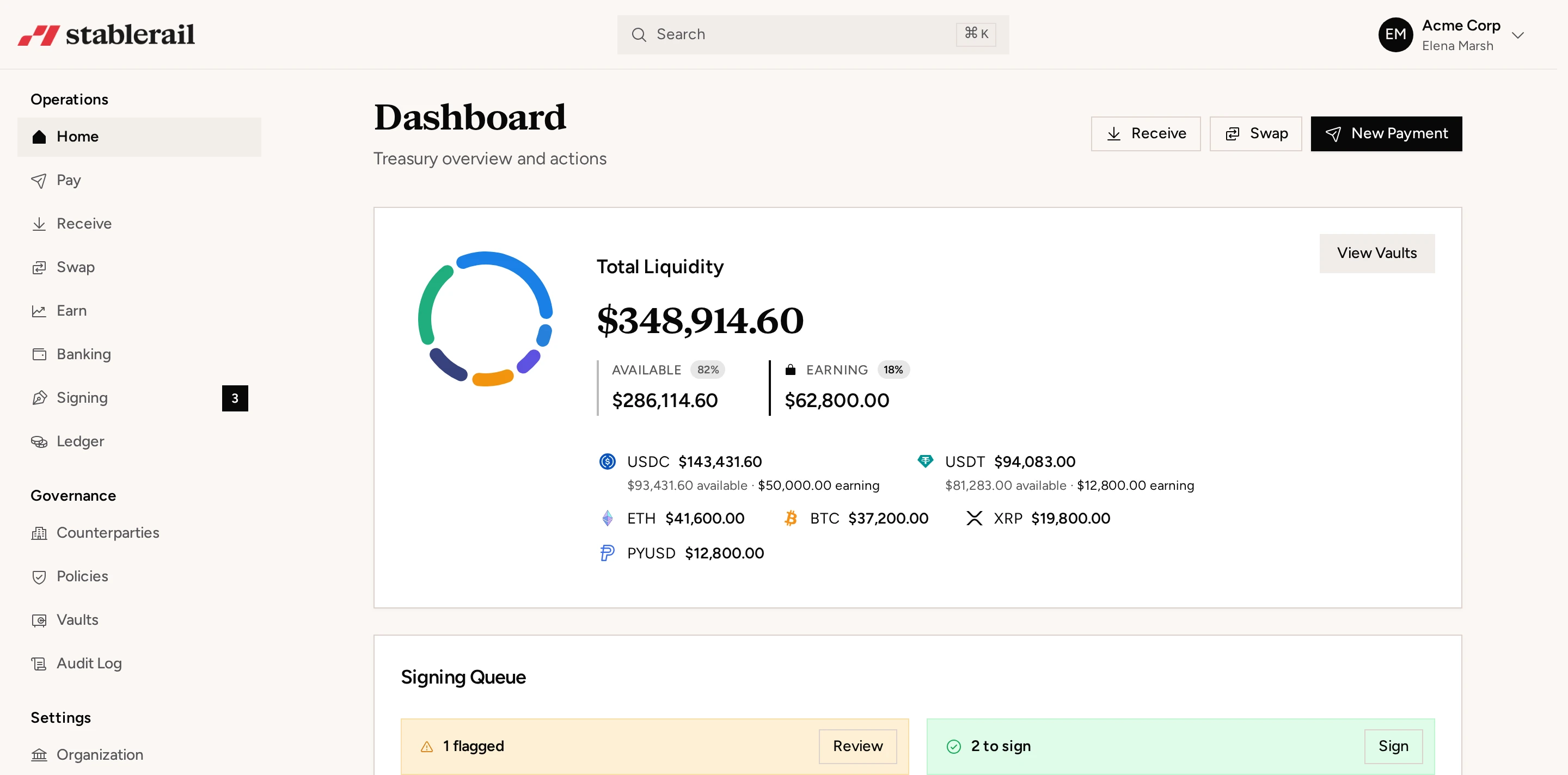
A Stablerail business account can bring USDC and USDT treasury operations together with approval and signing quorum, sanctions and address screening before send, global payouts, a fiat off-ramp and exportable audit evidence. Whatever operating platform a company chooses, its control design should cover the full transaction lifecycle.
- Initiation: require a valid business purpose, approved beneficiary and supporting invoice, payroll file or treasury instruction.
- Authorization: separate payment creation from approval and require an appropriate signing quorum for material transfers.
- Verification: confirm token, network and destination address through an independent channel.
- Screening: retain the counterparty, sanctions and address-screening result associated with the transfer.
- Execution: capture the transaction hash, sending wallet, receiving wallet, asset, network, amount, fee and timestamp.
- Reconciliation: match blockchain activity to the subledger, general ledger and underlying business document.
- Review: investigate rejected, delayed, duplicated, unmatched or manually overridden transactions.
A due diligence checklist for finance teams
- Define the use case. Record the token, legal entities, networks, expected balances, payment types and fiat entry and exit routes.
- Map issuer obligations. Identify the issuing and redemption entities, governing terms, eligible customers, fees, minimums and relevant jurisdictions.
- Inspect reserve evidence. Assess report frequency, effective date, asset composition, valuation criteria, custody and encumbrance disclosures.
- Verify independent assurance. Record the practitioner, engagement type, assurance level, period, criteria, conclusion, exceptions and limitations.
- Validate technology. Confirm official contract addresses for every intended network and match them to relevant security reviews.
- Design operational controls. Set user roles, approval thresholds, signing requirements, beneficiary procedures, screening steps and escalation paths.
- Document accounting treatment. Agree recognition, valuation, transaction-fee treatment, gains or losses and period-end procedures with accounting advisers.
- Test redemption and contingency routes. Perform controlled tests of stablecoin-to-fiat settlement and document fallback providers and bank-account dependencies.
- Set a review calendar. Assign owners to monitor new reports, contract changes, issuer terms, access rights and control exceptions.
Build an evidence package for every material transfer
Blockchain records prove that a transaction occurred, but they do not explain why it was authorized or how it should be accounted for. A complete evidence package should connect the transaction hash to the payment request, beneficiary record, approval history, screening outcome, invoice or treasury instruction, accounting entry and any related fiat bank reference.
Evidence should be exportable and retained under the company’s recordkeeping policy. Access to alter beneficiary data, approve payments or export logs should itself be controlled. Finance teams should periodically sample transactions from the ledger back to source evidence and from source documents forward to the blockchain and bank records.
Use stablecoin audits as part of a continuing control process
Stablecoin audits matter because they reduce specific information gaps: reserve attestations address a defined reserve assertion, financial audits examine broader reporting, technical reviews assess code, and control reports evaluate specified processes. None provides a permanent guarantee of liquidity, security or compliance.
The strongest enterprise approach is to identify the question each document answers, record what remains outside its scope and assign an internal control to the remaining risk. Due diligence should be refreshed when an issuer publishes new assurance, changes its terms, adds a network, upgrades a contract or alters redemption arrangements. Adoption becomes more defensible when independent reports and internal transaction evidence form one traceable, continuously maintained record.
Frequently asked questions
Is a stablecoin reserve attestation the same as an audit?
No. A reserve attestation evaluates a defined assertion against stated criteria, often at a particular date or time. A financial statement audit covers financial statements over a reporting period and may include assets, liabilities, results and disclosures.
Does a stablecoin audit guarantee that USDC or USDT can always be redeemed?
No audit guarantees continuous redemption, price stability or future solvency. Finance teams must separately review redemption eligibility, contractual terms, banking dependencies, reserve liquidity and tested fiat off-ramp routes.
What should a CFO check in a stablecoin reserve report?
Check the reporting date, frequency, assurance provider, engagement criteria, tokens outstanding and reserve composition. Also review custody, valuation, maturity, segregation and encumbrance disclosures, and confirm that the named legal entities are relevant to issuance and redemption.
What evidence should a company retain for stablecoin payments?
Retain the payment request, invoice or treasury instruction, beneficiary details, approval history, screening result, transaction hash, asset, network, addresses, amount, fee and accounting entry. If the payment has a fiat leg, connect it to the corresponding bank or off-ramp reference.
How often should enterprise stablecoin due diligence be updated?
Review new issuer and assurance reports when published, and reassess immediately after material changes to contracts, networks, issuer terms or redemption arrangements. Internal access, approval rules, beneficiaries and transaction exceptions should also be reviewed on a defined finance and risk calendar.
Finance writers covering stablecoin treasury, payments, compliance, and risk controls.
More about the Stablerail team- Stablecoin treasury managementApprovals, limits, yield and reporting on one balance.
- Stablecoin payoutsBatch contractor and vendor payments with screening.
- USDT vs USDCWhich stablecoin your company should settle in.
- Stablecoin finance glossaryMPC, off-ramp, travel rule and the rest, in plain English.
- Product updatesEverything we ship, month by month.