
Why Audits Matter for Enterprise Stablecoin Adoption
Stablecoin assurance is a stack, not a single report. Learn how to assess reserves, financial audits, smart contracts, provider controls and transaction evidence.
Stablecoin audits matter because enterprises need evidence about more than whether tokens are backed. Finance teams must assess issuer finances, reserve assets, redemption rights, smart-contract risks, service-provider controls and their own transaction processes. No single report covers every risk. A defensible adoption decision combines independent assurance with verified contract details, documented approvals, wallet screening, reconciliation and records linking each blockchain transfer to its business purpose.
%22%20x1%3D%220%22%20y1%3D%220%22%20x2%3D%221%22%20y2%3D%221%22%3E%0A%20%20%20%20%20%20%20%20%3Cstop%20offset%3D%220%25%22%20stop-color%3D%22%233E090D%22%20%2F%3E%0A%20%20%20%20%20%20%20%20%3Cstop%20offset%3D%2250%25%22%20stop-color%3D%22%235C1218%22%20%2F%3E%0A%20%20%20%20%20%20%20%20%3Cstop%20offset%3D%22100%25%22%20stop-color%3D%22%237B1F22%22%20%2F%3E%0A%20%20%20%20%20%20%3C%2FlinearGradient%3E%0A%20%20%20%20%20%20%3CradialGradient%20id%3D%22glow%22%20cx%3D%22740%22%20cy%3D%22-216%22%20r%3D%22520%22%20gradientUnits%3D%22userSpaceOnUse%22%3E%0A%20%20%20%20%20%20%20%20%3Cstop%20offset%3D%220%25%22%20stop-color%3D%22%23FF8E72%22%20stop-opacity%3D%220.45%22%20%2F%3E%0A%20%20%20%20%20%20%20%20%3Cstop%20offset%3D%2255%25%22%20stop-color%3D%22%23FF8E72%22%20stop-opacity%3D%220.08%22%20%2F%3E%0A%20%20%20%20%20%20%20%20%3Cstop%20offset%3D%22100%25%22%20stop-color%3D%22%23FF8E72%22%20stop-opacity%3D%220%22%20%2F%3E%0A%20%20%20%20%20%20%3C%2FradialGradient%3E%0A%20%20%20%20%20%20%3ClinearGradient%20id%3D%22glass%22%20x1%3D%220%22%20y1%3D%220%22%20x2%3D%221%22%20y2%3D%221%22%3E%0A%20%20%20%20%20%20%20%20%3Cstop%20offset%3D%220%25%22%20stop-color%3D%22%23F8D6D2%22%20stop-opacity%3D%220.26%22%20%2F%3E%0A%20%20%20%20%20%20%20%20%3Cstop%20offset%3D%22100%25%22%20stop-color%3D%22%23FFFFFF%22%20stop-opacity%3D%220.08%22%20%2F%3E%0A%20%20%20%20%20%20%3C%2FlinearGradient%3E%0A%20%20%20%20%20%20%3ClinearGradient%20id%3D%22accent%22%20x1%3D%220%22%20y1%3D%220%22%20x2%3D%221%22%20y2%3D%221%22%3E%0A%20%20%20%20%20%20%20%20%3Cstop%20offset%3D%220%25%22%20stop-color%3D%22%23FF8E72%22%20%2F%3E%0A%20%20%20%20%20%20%20%20%3Cstop%20offset%3D%22100%25%22%20stop-color%3D%22%23D94030%22%20%2F%3E%0A%20%20%20%20%20%20%3C%2FlinearGradient%3E%0A%20%20%20%20%20%20%3Cfilter%20id%3D%22soft%22%3E%3CfeGaussianBlur%20stdDeviation%3D%2210%22%20%2F%3E%3C%2Ffilter%3E%0A%20%20%20%20%3C%2Fdefs%3E%0A%20%20%20%20%3Crect%20width%3D%221600%22%20height%3D%22900%22%20fill%3D%22url(%23bg)%22%20%2F%3E%0A%20%20%20%20%3Crect%20width%3D%221600%22%20height%3D%22900%22%20fill%3D%22url(%23glow)%22%20%2F%3E%0A%20%20%20%20%0A%20%20%20%20%3Cpath%20d%3D%22M%20500%20600%20A%20300%20300%200%200%201%201100%20600%22%20fill%3D%22none%22%20stroke%3D%22url(%23glass)%22%20stroke-width%3D%2260%22%2F%3E%0A%20%20%20%20%3Cpath%20d%3D%22M%20500%20600%20A%20300%20300%200%200%201%20902.6060429977007%20318.0922137642275%22%20fill%3D%22none%22%20stroke%3D%22url(%23accent)%22%20stroke-width%3D%2260%22%20stroke-linecap%3D%22round%22%2F%3E%0A%20%20%20%20%3Ccircle%20cx%3D%22800%22%20cy%3D%22600%22%20r%3D%2232%22%20fill%3D%22%233E090D%22%20stroke%3D%22url(%23accent)%22%20stroke-width%3D%226%22%2F%3E%0A%20%20%20%20%3Cline%20x1%3D%22800%22%20y1%3D%22600%22%20x2%3D%22882.0848343981605%22%20y2%3D%22374.47377101138204%22%20stroke%3D%22%23FFF1ED%22%20stroke-width%3D%2210%22%20stroke-linecap%3D%22round%22%2F%3E%0A%20%20%0A%20%20%20%20%3Crect%20x%3D%2226%22%20y%3D%2226%22%20width%3D%221548%22%20height%3D%22848%22%20rx%3D%2218%22%20fill%3D%22none%22%20stroke%3D%22%23F2D0C8%22%20stroke-opacity%3D%220.12%22%2F%3E%0A%20%20%3C%2Fsvg%3E)
Stablecoin audits matter because enterprises need evidence about more than whether tokens are backed. Finance teams must assess issuer finances, reserve assets, redemption rights, smart-contract risks, service-provider controls and their own transaction processes. No single report covers every risk. A defensible adoption decision combines independent assurance with verified contract details, documented approvals, wallet screening, reconciliation and records linking each blockchain transfer to its business purpose.
Stablecoin assurance is a stack, not a single audit
Holding USDC, USDT or another fiat-referenced token introduces several layers of exposure. The issuer may face reserve, liquidity or legal risk. The token contract may contain technical or administrative risks. A custodian, exchange or treasury platform may have operational weaknesses. The company itself may approve a payment incorrectly, use the wrong network or fail to retain evidence supporting the transfer.
Different reports answer different questions. Finance leaders should avoid treating the word audited as a universal seal of safety. Instead, identify the decision that must be supported, obtain evidence addressing that decision and record the remaining limitations.
| Evidence | Question it helps answer | What it does not prove | Review focus |
|---|---|---|---|
| Reserve attestation | Did specified assets support the reported tokens at the measurement date? | Future solvency, immediate redemption or all issuer liabilities | Entity, date, assets, token population, scope and exceptions |
| Financial statement audit | Were the issuer’s financial statements fairly presented for the covered period? | Continuous reserve sufficiency or guaranteed redemption | Opinion, framework, liabilities, related parties and subsequent events |
| Smart-contract review | Did reviewers identify weaknesses in the code and functions examined? | Safety of later versions, bridges, administrator keys or integrations | Contract address, network, version, exclusions and unresolved findings |
| Provider control report | Were specified operational controls designed or operating as described? | Controls outside the system boundary or controls the customer must perform | Period, scope, exceptions, subservice providers and customer controls |
| Legal and redemption review | What contractual rights does the company have against the issuer or provider? | That banking access and liquidity will remain available in every scenario | Eligible redeemers, fees, timing, suspension rights and governing entity |
| Internal transaction evidence | Why was a transfer made, who approved it and how was it recorded? | Issuer solvency or provider security | Approvals, beneficiary, invoice, transaction hash and reconciliation |
Audits and attestations are not interchangeable
An audit generally involves an independent accounting firm examining financial statements and supporting evidence under a defined auditing standard. The resulting opinion addresses whether those statements are fairly presented, in all material respects, for the reporting period and framework specified.
An attestation addresses a narrower assertion or subject matter prepared by another party. For a stablecoin issuer, management may assert that specified reserve assets equaled or exceeded tokens in circulation at a particular measurement time. The practitioner reports a conclusion based on the engagement’s criteria and scope.
That distinction matters operationally. A point-in-time reserve attestation may provide useful evidence of backing without examining every liability, redemption obligation or control throughout the period. Conversely, audited financial statements may provide broader financial context while offering less frequent information about reserve composition. Enterprises often need both, alongside legal and operational review.
How to read a stablecoin reserve report
The headline reserve ratio is only the starting point. Treasury and risk teams should read the report itself and capture the following details:
- Reporting entity: Identify the legal issuer and confirm that the assets in scope relate to the tokens the company intends to hold.
- Measurement date: Determine whether the conclusion applies at one time or over a period, then note the publication delay and reporting cadence.
- Reserve composition: Separate cash, bank deposits, government securities, money market instruments and other assets. Different assets carry different liquidity and counterparty risks.
- Custody and concentration: Look for disclosed banks, custodians and material concentrations rather than assuming reserves are diversified.
- Token population: Confirm which token, networks and circulating supply are included. Do not assume that a bridged representation receives the same treatment as an issuer-native token.
- Practitioner’s conclusion: Record the engagement standard, criteria, limitations, qualifications and any information explicitly excluded.
A clean reserve report is not a promise that every holder can redeem immediately at par. Redemption depends on the holder’s contractual rights, account eligibility, minimums, fees, reserve liquidity, banking access and the issuer’s ability to process requests. Finance should therefore review redemption terms separately and test the intended conversion route before relying on it for working capital.
Financial audits reveal broader issuer risk
Audited financial statements may cover assets, liabilities, revenue, expenses, cash flows and disclosures over a reporting period. They can help a company understand risks that a reserve snapshot does not show, such as contingent liabilities, related-party activity or dependence on particular counterparties.
Read the auditor’s opinion and the notes rather than relying on an issuer’s summary. Check the reporting framework, period end, entities included, material subsidiaries, subsequent events, qualifications and any going-concern language. Also determine how old the statements are relative to the proposed adoption date.
An audit remains retrospective and uses materiality. It reduces information risk but cannot guarantee future solvency, liquidity, token price stability or uninterrupted access to banking and blockchain networks.
Smart-contract reviews address a different failure mode
A stablecoin is represented on a blockchain by software with functions governing transfers and, depending on its design, minting, burning, pausing, freezing or upgrades. A technical review may assess those functions, privileged administrator roles and known vulnerability classes.
The report must match the exact blockchain, contract address and deployed version the enterprise plans to use. Technical teams should document excluded components, unresolved findings and whether the contract can be changed after deployment. They should also examine how administrator powers are controlled and what happens if transfers are paused or an address is frozen.
A historic code review is not permanent assurance. New vulnerabilities can emerge, administrator credentials can be compromised and external systems such as bridges, wallets and exchanges create separate risks. Before every new asset or network is approved, independently obtain the contract address from authoritative issuer materials and verify it through a second source.
Provider reports do not replace company controls
Control reports from custodians, exchanges or treasury platforms may describe controls over access, transaction authorization, security, availability or financial reporting. Finance should distinguish between an assessment of control design at a date and testing of operating effectiveness over a period.
Review the system boundary, covered products, testing period, exceptions and subservice providers. Pay particular attention to complementary user entity controls: actions the report assumes the customer performs. These may include removing departed employees, reviewing access, configuring approval authority, validating beneficiaries and reconciling transactions.
Assurance over a provider’s system does not establish that the company configured or used that system correctly.
The internal authority matrix should therefore determine who can initiate, approve and sign transactions, including the required quorum. Sanctions and address screening should occur before a transfer, with a documented process for reviewing alerts and stopping questionable payments.
Blockchain records are not a complete audit trail
A blockchain can show that tokens moved between addresses, but it does not establish the business purpose, legal beneficiary, approver, invoice, exchange rate or accounting treatment. An enterprise audit trail must connect on-chain activity to internal records.
For each transfer, retain the initiating user, approvals, beneficiary name, verified wallet address, token, network, amount, network fee, transaction hash and confirmation status. Attach the invoice, payroll file or treasury instruction, plus fiat conversion details and provider fees where applicable. Finally, link the transfer to the general ledger entry and reconciliation status.
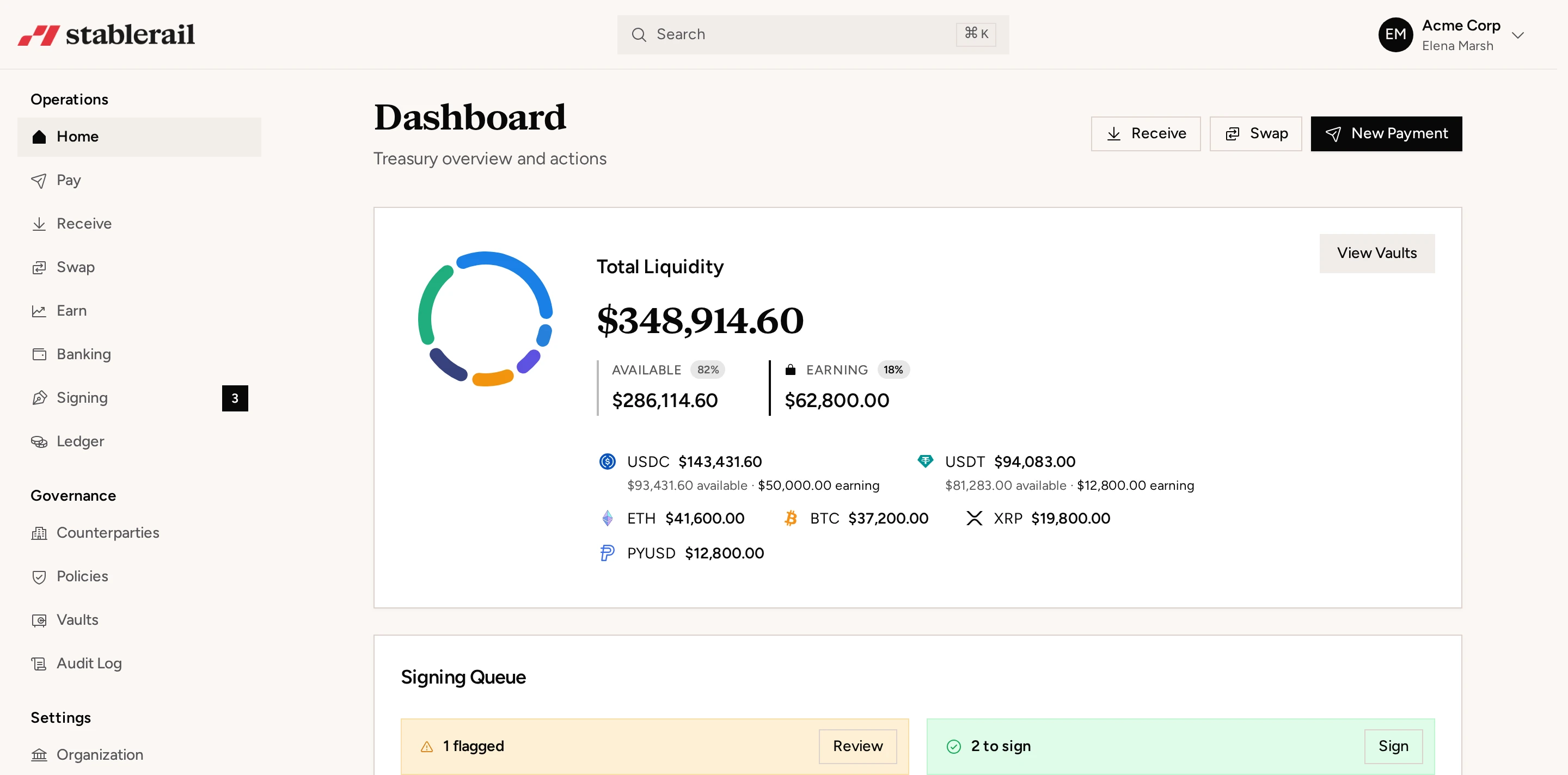
Stablerail supports corporate USDC and USDT treasury operations with approvals and signing quorum, sanctions and address screening before send, fiat conversion, global payouts, corporate cards and exportable audit evidence. Those capabilities still need to be configured around the company’s authority matrix, accounting policy and evidence-retention requirements.
A practical pre-adoption checklist
- Approve the asset: Record the issuer, legal terms, reserve composition, assurance reports, redemption route and approved use cases.
- Approve the network: Verify the contract address, administrator powers, smart-contract review and required confirmation process.
- Assess each provider: Review eligibility, fiat rails, fees, limits, settlement process, system boundaries and incident procedures.
- Define authority: Set initiator, approver and signer roles; require an appropriate quorum; and document emergency access procedures.
- Control beneficiaries: Verify wallet ownership where feasible, screen addresses before sending and require additional review for changes.
- Test the workflow: Run a limited transfer and redemption or fiat-conversion cycle, then confirm accounting and evidence capture.
- Reconcile and monitor: Reconcile wallet activity to the ledger and investigate unexpected tokens, network fees or unmatched transfers.
- Schedule reassessment: Review evidence periodically and after a change in issuer, reserves, contract, network, provider or redemption terms.
Use assurance to support a decision, not replace it
The right review cadence depends on exposure. An occasional vendor payment does not create the same liquidity and operational dependency as maintaining a material operating balance or processing frequent payouts. Companies should set thresholds for balance size, transaction value and workflow criticality that trigger deeper review or senior approval.
The final adoption record should state what evidence was reviewed, which risks it addresses, what remains outside scope and who accepted the residual risk. Reserve attestations, financial audits, code reviews and provider reports each reduce a different information gap. Combined with transaction-level controls and reconciliation, they give finance teams a defensible basis for using stablecoins without mistaking assurance for certainty.
Frequently asked questions
What is a stablecoin audit?
The phrase may refer to several different engagements, including an audit of an issuer’s financial statements, a reserve attestation or a smart-contract review. Finance teams should identify the exact scope, date, criteria and conclusion rather than relying on the word “audit.”
Is a stablecoin reserve attestation the same as an audit?
No. A reserve attestation usually evaluates a specific management assertion, often about reserve assets and tokens in circulation at a measurement date. A financial statement audit covers broader statements for a reporting period, although neither guarantees future liquidity or redemption.
What should a company check before holding USDC or USDT?
Review the issuing entity, reserve reports, audited financial statements if available, legal and redemption terms, supported networks and exact contract addresses. The company should also approve providers, establish signing and approval controls, screen destination addresses, test conversion routes and define accounting procedures.
Does a blockchain transaction hash provide enough audit evidence?
No. A transaction hash proves that an on-chain transaction occurred, but it does not explain its business purpose, beneficiary, authorization or accounting treatment. The hash should be linked to approvals, source documents, wallet details, fees, conversion records and the general ledger.
How often should stablecoin assurance reports be reviewed?
Review frequency should reflect the size, frequency and operational importance of the company’s stablecoin activity. Reassessment is also necessary after material changes to the issuer, reserve policy, contract, network, provider or redemption process.
Finance writers covering stablecoin treasury, payments, compliance, and risk controls.
More about the Stablerail team- Stablecoin treasury managementApprovals, limits, yield and reporting on one balance.
- Stablecoin payoutsBatch contractor and vendor payments with screening.
- USDT vs USDCWhich stablecoin your company should settle in.
- Stablecoin finance glossaryMPC, off-ramp, travel rule and the rest, in plain English.
- Product updatesEverything we ship, month by month.