
Internal Controls for Managing Stablecoin Treasury and Payment Risk
A practical control framework for corporate USDC and USDT operations, covering approved networks, wallet access, payment approvals, address screening, exposure limits, reconciliation and incident response.
Effective stablecoin treasury controls verify the asset, token contract, network and destination before payment; separate preparation, approval and reconciliation; require signing quorum and risk-based limits; screen addresses before sending; and match every transaction hash to approvals and accounting records. Finance teams should also limit exposure by issuer, network, wallet and conversion partner, while maintaining tested procedures for access compromise, payment errors, depegging and network disruption.
%22%20x1%3D%220%22%20y1%3D%220%22%20x2%3D%221%22%20y2%3D%221%22%3E%0A%20%20%20%20%20%20%20%20%3Cstop%20offset%3D%220%25%22%20stop-color%3D%22%232A0608%22%20%2F%3E%0A%20%20%20%20%20%20%20%20%3Cstop%20offset%3D%2250%25%22%20stop-color%3D%22%23420D12%22%20%2F%3E%0A%20%20%20%20%20%20%20%20%3Cstop%20offset%3D%22100%25%22%20stop-color%3D%22%23621619%22%20%2F%3E%0A%20%20%20%20%20%20%3C%2FlinearGradient%3E%0A%20%20%20%20%20%20%3CradialGradient%20id%3D%22glow%22%20cx%3D%22279%22%20cy%3D%22-295%22%20r%3D%22520%22%20gradientUnits%3D%22userSpaceOnUse%22%3E%0A%20%20%20%20%20%20%20%20%3Cstop%20offset%3D%220%25%22%20stop-color%3D%22%23FF9577%22%20stop-opacity%3D%220.45%22%20%2F%3E%0A%20%20%20%20%20%20%20%20%3Cstop%20offset%3D%2255%25%22%20stop-color%3D%22%23FF9577%22%20stop-opacity%3D%220.08%22%20%2F%3E%0A%20%20%20%20%20%20%20%20%3Cstop%20offset%3D%22100%25%22%20stop-color%3D%22%23FF9577%22%20stop-opacity%3D%220%22%20%2F%3E%0A%20%20%20%20%20%20%3C%2FradialGradient%3E%0A%20%20%20%20%20%20%3ClinearGradient%20id%3D%22glass%22%20x1%3D%220%22%20y1%3D%220%22%20x2%3D%221%22%20y2%3D%221%22%3E%0A%20%20%20%20%20%20%20%20%3Cstop%20offset%3D%220%25%22%20stop-color%3D%22%23F8D6D2%22%20stop-opacity%3D%220.26%22%20%2F%3E%0A%20%20%20%20%20%20%20%20%3Cstop%20offset%3D%22100%25%22%20stop-color%3D%22%23FFFFFF%22%20stop-opacity%3D%220.08%22%20%2F%3E%0A%20%20%20%20%20%20%3C%2FlinearGradient%3E%0A%20%20%20%20%20%20%3ClinearGradient%20id%3D%22accent%22%20x1%3D%220%22%20y1%3D%220%22%20x2%3D%221%22%20y2%3D%221%22%3E%0A%20%20%20%20%20%20%20%20%3Cstop%20offset%3D%220%25%22%20stop-color%3D%22%23FF9577%22%20%2F%3E%0A%20%20%20%20%20%20%20%20%3Cstop%20offset%3D%22100%25%22%20stop-color%3D%22%23D03B2D%22%20%2F%3E%0A%20%20%20%20%20%20%3C%2FlinearGradient%3E%0A%20%20%20%20%20%20%3Cfilter%20id%3D%22soft%22%3E%3CfeGaussianBlur%20stdDeviation%3D%2210%22%20%2F%3E%3C%2Ffilter%3E%0A%20%20%20%20%3C%2Fdefs%3E%0A%20%20%20%20%3Crect%20width%3D%221600%22%20height%3D%22900%22%20fill%3D%22url(%23bg)%22%20%2F%3E%0A%20%20%20%20%3Crect%20width%3D%221600%22%20height%3D%22900%22%20fill%3D%22url(%23glow)%22%20%2F%3E%0A%20%20%20%20%3Crect%20x%3D%22260%22%20y%3D%22637%22%20width%3D%2292%22%20height%3D%2283%22%20rx%3D%228%22%20fill%3D%22url(%23glass)%22%20stroke%3D%22%23F4CDC5%22%20stroke-opacity%3D%220.45%22%2F%3E%3Crect%20x%3D%22400%22%20y%3D%22700%22%20width%3D%2292%22%20height%3D%2220%22%20rx%3D%228%22%20fill%3D%22url(%23glass)%22%20stroke%3D%22%23F4CDC5%22%20stroke-opacity%3D%220.45%22%2F%3E%3Crect%20x%3D%22540%22%20y%3D%22895%22%20width%3D%2292%22%20height%3D%22-175%22%20rx%3D%228%22%20fill%3D%22url(%23glass)%22%20stroke%3D%22%23F4CDC5%22%20stroke-opacity%3D%220.45%22%2F%3E%3Crect%20x%3D%22680%22%20y%3D%22674%22%20width%3D%2292%22%20height%3D%2246%22%20rx%3D%228%22%20fill%3D%22url(%23accent)%22%20stroke%3D%22%23F4CDC5%22%20stroke-opacity%3D%220.45%22%2F%3E%3Crect%20x%3D%22820%22%20y%3D%22799%22%20width%3D%2292%22%20height%3D%22-79%22%20rx%3D%228%22%20fill%3D%22url(%23glass)%22%20stroke%3D%22%23F4CDC5%22%20stroke-opacity%3D%220.45%22%2F%3E%3Crect%20x%3D%22960%22%20y%3D%22920%22%20width%3D%2292%22%20height%3D%22-200%22%20rx%3D%228%22%20fill%3D%22url(%23glass)%22%20stroke%3D%22%23F4CDC5%22%20stroke-opacity%3D%220.45%22%2F%3E%3Crect%20x%3D%221100%22%20y%3D%22950%22%20width%3D%2292%22%20height%3D%22-230%22%20rx%3D%228%22%20fill%3D%22url(%23glass)%22%20stroke%3D%22%23F4CDC5%22%20stroke-opacity%3D%220.45%22%2F%3E%3Crect%20x%3D%221240%22%20y%3D%22868%22%20width%3D%2292%22%20height%3D%22-148%22%20rx%3D%228%22%20fill%3D%22url(%23glass)%22%20stroke%3D%22%23F4CDC5%22%20stroke-opacity%3D%220.45%22%2F%3E%3Cline%20x1%3D%22240%22%20y1%3D%22724%22%20x2%3D%221430%22%20y2%3D%22724%22%20stroke%3D%22%23F0BBAF%22%20stroke-opacity%3D%220.4%22%20stroke-width%3D%223%22%2F%3E%0A%20%20%20%20%3Crect%20x%3D%2226%22%20y%3D%2226%22%20width%3D%221548%22%20height%3D%22848%22%20rx%3D%2218%22%20fill%3D%22none%22%20stroke%3D%22%23F2D0C8%22%20stroke-opacity%3D%220.12%22%2F%3E%0A%20%20%3C%2Fsvg%3E)
Stablecoin treasury combines familiar payment controls with blockchain-specific risks. A transfer may confirm quickly, but an incorrect address, network or token contract can make recovery difficult or impossible. Finance teams therefore need preventive controls before signing, execution controls at release and detective controls after settlement.
For every payment, the control record should identify five things: the approved asset and network, the permitted destination, the required approvals and signing quorum, the applicable exposure limit and the evidence required for reconciliation. The same framework should cover wallets, exchanges, conversion providers and the fiat bank accounts used for funding or redemption.
Build an approved asset and network matrix
USDC or USDT is not a complete payment instruction. A stablecoin ticker can appear on multiple networks, while bridged or unsupported versions may have different issuers, liquidity and redemption paths. Finance should maintain a controlled matrix for each permitted token and network combination.
| Matrix field | Control requirement | Risk addressed |
|---|---|---|
| Asset and issuer | Record the approved stablecoin and issuing entity. | Issuer and reserve exposure |
| Contract or mint address | Verify the official identifier for each network using an authoritative source. | Imitation or bridged tokens |
| Network | Specify the permitted blockchain rather than relying on the ticker alone. | Wrong-network transfers |
| Approved use | Define whether the route is permitted for collections, vendor payments, payroll, conversion or treasury transfers. | Use outside treasury policy |
| Transaction and balance limits | Set limits by asset, network, wallet and payment purpose. | Concentration and loss severity |
| Liquidity route | Document the approved exchange, issuer or fiat conversion path. | Redemption and counterparty risk |
| Fee asset | Identify the native token needed for network fees and set a replenishment process. | Failed or delayed payments |
Confirm that the receiving platform supports the exact asset, contract and network before sending. Support for a blockchain does not necessarily mean support for every token on it. Record expected confirmation requirements, conversion steps and fee treatment as part of the route rather than assuming all stablecoin payments settle on identical terms.
Separate wallets by purpose and exposure
Wallet structure is an internal control, not merely a technical choice. A practical model separates a primary treasury wallet from lower-balance operating wallets used for routine payments. Dedicated collection addresses can make incoming funds easier to identify and reconcile.
The operating wallet should hold only the amount needed for near-term activity. Replenishment from the treasury wallet should require a deliberate approval. This reduces the value exposed to compromised day-to-day access without forcing every routine payment through the highest-security process.
Where the custody model supports multiple signers or multi-party computation, define the signing quorum for each wallet. Governance records should state who may create requests, approve transactions, sign, add or remove users, change quorum rules and initiate recovery. Changes to signers or recovery settings should require stronger authorization than an ordinary payment because those changes can bypass later transaction controls.
Verify recipients and control address changes
An address allowlist restricts payments to destinations that have completed review. Each entry should include the legal counterparty, wallet address, network, approved purpose, verification date, reviewer and supporting evidence. Treat the same address on a different network as a separate instruction.
Verify a new address through a channel independent of the payment request. For example, confirm a vendor's address with a known contact using details already held in the vendor master file, rather than replying to the email that supplied the address. A changed address should be treated as a new destination, not a routine amendment.
For a material first payment, consider a small test transfer followed by confirmation from the recipient before releasing the remaining amount. A test verifies technical receipt, but it does not replace counterparty due diligence, sanctions screening or approval of the commercial obligation.
Separate preparation, approval and reconciliation
No individual should be able to create a recipient, prepare a payment, approve it and reconcile it without independent review. At minimum, separate payment preparation from approval. Reconciliation should be performed or reviewed by someone outside daily payment execution.
Small finance teams may not have three different employees available. Compensating controls can include two-person approval, restricted wallet balances, an independently controlled allowlist and periodic review by the controller or CFO.
Apply risk-based approval thresholds
Approval requirements should increase with risk. Relevant factors include value, destination history, wallet changes, payment purpose, asset and network, and whether the transaction moves funds outside the normal operating structure. Threshold amounts should reflect the company's liquidity, payment volume and loss tolerance.
| Transaction condition | Minimum control | Additional review |
|---|---|---|
| Routine payment to an established recipient | Preparer plus independent approver | Confirm invoice, asset, network and allowlist match |
| New recipient or changed address | Independent address verification before approval | Consider a waiting period or test transfer |
| Payment above the standard limit | Additional approver or higher signing quorum | Review supporting contract and total counterparty exposure |
| Large treasury transfer | Senior finance approval and treasury-wallet quorum | Check post-transfer liquidity and concentration limits |
| Batch payout | Approve both the batch total and recipient-level detail | Highlight new, changed, rejected or duplicated destinations |
| Emergency transaction | Documented exception authorization | Prompt post-transaction review and incident record |
Approvers need enough information to make a real decision. The approval screen or evidence pack should show the legal recipient, wallet address, asset, network, amount, purpose, supporting document, screening result, applicable limit and whether the destination recently changed.
Screen before sending and monitor after release
Screen the destination against applicable sanctions data and blockchain address-risk indicators before authorization. Save the result, time and address screened with the payment evidence. If approval is delayed or the destination changes, perform the check again under the company's screening procedure.
Screening is not a substitute for knowing the counterparty. An address without a current alert may still be controlled by the wrong recipient or used for an unsupported purpose. Combine address screening with vendor records, contracts, invoices and an explanation of the transaction's business purpose.
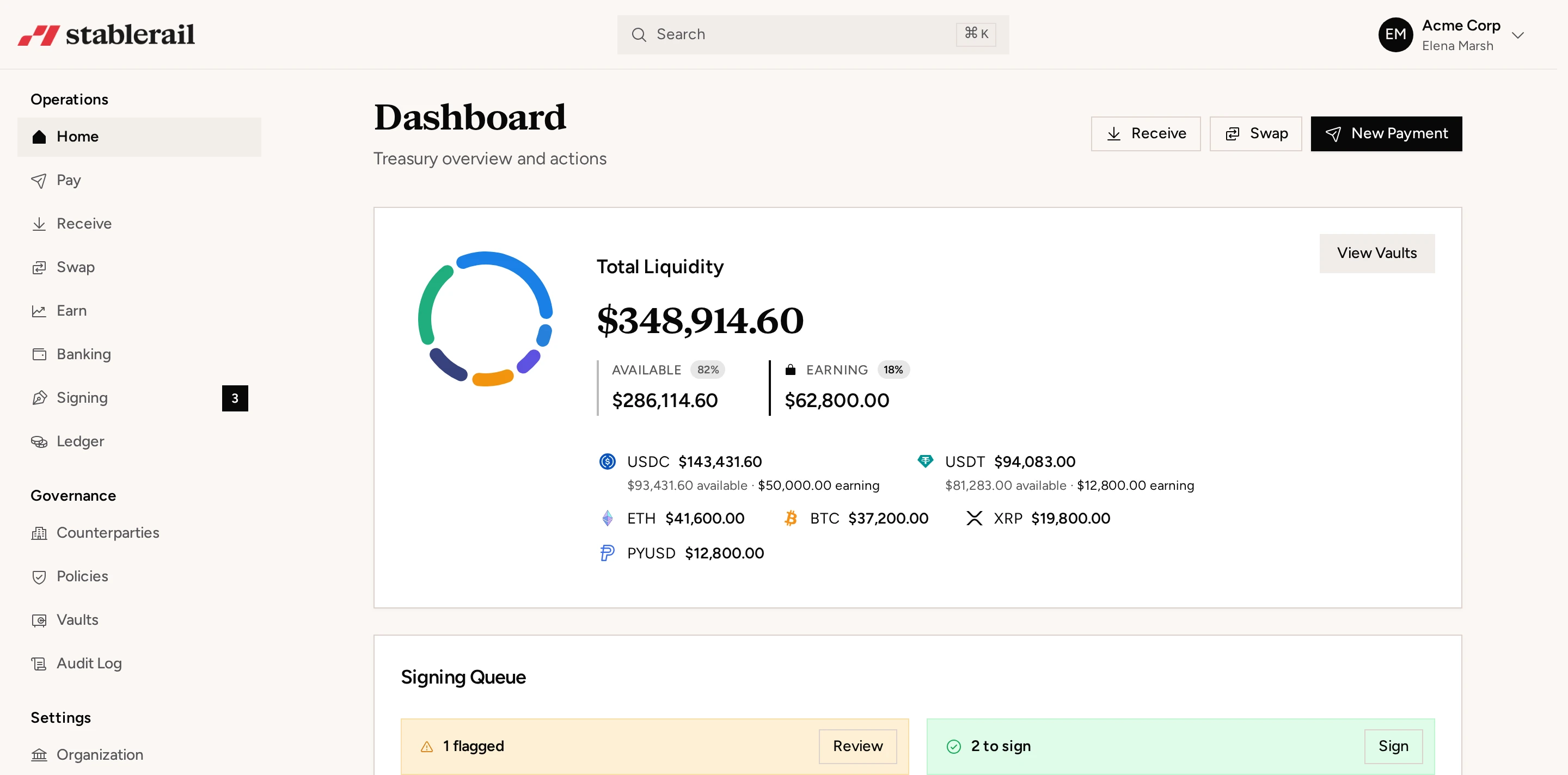
After release, monitor whether the transfer was broadcast, confirmed, failed, replaced or remained pending. Do not mark the payable as settled solely because a request was approved. Stablerail supports pre-send sanctions and address screening, approval and signing quorum, global payouts, fiat conversion and exportable audit evidence for corporate USDC and USDT treasury operations.
Limit exposure across the whole treasury stack
A transaction limit controls one payment; an exposure limit controls the cumulative amount at risk. Set maximum or target balances by stablecoin issuer, token, network, wallet, exchange or conversion partner, banking partner and any yield product. Keep operating cash separate from funds deliberately allocated to an earning strategy.
Define escalation triggers rather than relying only on fixed limits. Relevant events include a stablecoin moving away from its intended peg, delayed redemption, reduced liquidity, network disruption, unusually high transaction fees, a sanctions alert or excessive reliance on one conversion route. The response may include pausing new payments, reducing balances, changing the settlement route or escalating to senior finance and legal review.
Reconcile the blockchain, platform and ledger
Active payment wallets should normally be reconciled daily and after material treasury movements. Use the transaction hash to connect the blockchain transfer to the payment request, approval record, invoice and accounting entry.
For each transaction, compare the requested amount with the delivered amount; confirm the token, network and destination; record network and conversion fees separately; verify confirmation status; and match wallet, platform and general ledger balances. Where fiat is involved, also match the related bank debit or credit and the conversion record.
Investigate unmatched items promptly. Common causes include network fees posted separately, duplicate requests, deposits sent through the wrong route, pending transactions, timing differences between systems and conversions recorded using inconsistent exchange rates. Document the resolution rather than carrying an unexplained variance into later periods.
Prepare for incidents and retain evidence
The incident playbook should identify who can pause payouts, revoke access, increase approval requirements and contact the wallet provider, conversion provider, bank, issuer or recipient. Cover compromised credentials, incorrect transfers, sanctions alerts, stablecoin depegging, network disruption and reconciliation breaks.
For a mistaken payment, preserve the transaction hash and approval trail, contact the recipient immediately and avoid issuing a replacement until the first transfer is resolved. For suspected access compromise, suspend the affected user, review recent activity and move funds only under the approved recovery procedure.
Retain the payment request, invoice or contract, approvals, address-verification evidence, screening result, transaction hash, fee record, accounting entry and any exception documentation. Access reviews, signer changes and allowlist amendments also need an auditable history.
Finance team implementation checklist
- Approve each token contract, network, use case and conversion route.
- Separate treasury, operating and collection wallets and cap their balances.
- Define who can prepare, approve, sign, administer users and reconcile.
- Verify and screen every new or changed destination before payment.
- Apply higher quorum and review to large, unusual or emergency transfers.
- Reconcile active wallets daily using transaction hashes.
- Test access removal, recovery, limits, allowlists and incident escalation periodically.
The objective is not to add equal friction to every transfer. Strong internal controls make ordinary payments repeatable while concentrating additional review on new recipients, changed addresses, large transfers, exceptions and changes to wallet governance.
Frequently asked questions
What internal controls are needed for a stablecoin treasury?
Core controls include an approved asset and network matrix, segregated wallets, restricted signer access, independent payment approval, recipient allowlisting, pre-send address screening, transaction and exposure limits, and ledger reconciliation. Finance should also retain evidence and maintain tested procedures for payment errors, compromised access, depegging and network disruption.
How should a company reconcile USDC or USDT transactions?
Match each transaction hash to the payment request, approval, invoice and accounting entry. Confirm the token, network, destination, delivered amount, network fee, conversion fee and blockchain status, then reconcile wallet, platform, bank and general ledger balances.
How can a small finance team segregate stablecoin payment duties?
At minimum, keep payment preparation separate from approval and require two people to release funds. If a separate reconciler is unavailable, use compensating controls such as low operating-wallet balances, independently managed recipient allowlists and periodic review by the controller or CFO.
Should companies use a test transaction for a new wallet address?
A small test transfer can confirm that the recipient controls the address and that the asset and network are compatible. It should supplement, not replace, independent address verification, sanctions screening, counterparty due diligence and approval of the underlying payment.
How often should stablecoin wallets be reconciled?
Active payment wallets should generally be reconciled daily and after material treasury transfers. Less active wallets may follow a risk-based schedule, but every balance and transaction should still be included in the period-end close and independently reviewed.
Finance writers covering stablecoin treasury, payments, compliance, and risk controls.
More about the Stablerail team- Stablecoin treasury managementApprovals, limits, yield and reporting on one balance.
- Stablecoin payoutsBatch contractor and vendor payments with screening.
- USDT vs USDCWhich stablecoin your company should settle in.
- Stablecoin finance glossaryMPC, off-ramp, travel rule and the rest, in plain English.
- Product updatesEverything we ship, month by month.