
USDT Business Account: What Your Company Needs Beyond an Exchange Login
Learn how to evaluate a USDT business account for TRON and other networks, company approvals, fiat off-ramps, payouts, compliance and reconciliation.
A USDT business account should give a company more than trading access. It should support the USDT networks the business uses, role-based transaction approvals, secure signing, beneficiary and address checks, fiat conversion, payment rails, and exportable accounting evidence. The right setup reduces reliance on shared exchange credentials and turns USDT holdings into a controlled treasury workflow for collections, payouts and operating cash.
%22%20x1%3D%220%22%20y1%3D%220%22%20x2%3D%221%22%20y2%3D%221%22%3E%0A%20%20%20%20%20%20%20%20%3Cstop%20offset%3D%220%25%22%20stop-color%3D%22%232A0608%22%20%2F%3E%0A%20%20%20%20%20%20%20%20%3Cstop%20offset%3D%2250%25%22%20stop-color%3D%22%23420D12%22%20%2F%3E%0A%20%20%20%20%20%20%20%20%3Cstop%20offset%3D%22100%25%22%20stop-color%3D%22%23621619%22%20%2F%3E%0A%20%20%20%20%20%20%3C%2FlinearGradient%3E%0A%20%20%20%20%20%20%3CradialGradient%20id%3D%22glow%22%20cx%3D%22899%22%20cy%3D%2218%22%20r%3D%22520%22%20gradientUnits%3D%22userSpaceOnUse%22%3E%0A%20%20%20%20%20%20%20%20%3Cstop%20offset%3D%220%25%22%20stop-color%3D%22%23FF9577%22%20stop-opacity%3D%220.45%22%20%2F%3E%0A%20%20%20%20%20%20%20%20%3Cstop%20offset%3D%2255%25%22%20stop-color%3D%22%23FF9577%22%20stop-opacity%3D%220.08%22%20%2F%3E%0A%20%20%20%20%20%20%20%20%3Cstop%20offset%3D%22100%25%22%20stop-color%3D%22%23FF9577%22%20stop-opacity%3D%220%22%20%2F%3E%0A%20%20%20%20%20%20%3C%2FradialGradient%3E%0A%20%20%20%20%20%20%3ClinearGradient%20id%3D%22glass%22%20x1%3D%220%22%20y1%3D%220%22%20x2%3D%221%22%20y2%3D%221%22%3E%0A%20%20%20%20%20%20%20%20%3Cstop%20offset%3D%220%25%22%20stop-color%3D%22%23F8D6D2%22%20stop-opacity%3D%220.26%22%20%2F%3E%0A%20%20%20%20%20%20%20%20%3Cstop%20offset%3D%22100%25%22%20stop-color%3D%22%23FFFFFF%22%20stop-opacity%3D%220.08%22%20%2F%3E%0A%20%20%20%20%20%20%3C%2FlinearGradient%3E%0A%20%20%20%20%20%20%3ClinearGradient%20id%3D%22accent%22%20x1%3D%220%22%20y1%3D%220%22%20x2%3D%221%22%20y2%3D%221%22%3E%0A%20%20%20%20%20%20%20%20%3Cstop%20offset%3D%220%25%22%20stop-color%3D%22%23FF9577%22%20%2F%3E%0A%20%20%20%20%20%20%20%20%3Cstop%20offset%3D%22100%25%22%20stop-color%3D%22%23D03B2D%22%20%2F%3E%0A%20%20%20%20%20%20%3C%2FlinearGradient%3E%0A%20%20%20%20%20%20%3Cfilter%20id%3D%22soft%22%3E%3CfeGaussianBlur%20stdDeviation%3D%2210%22%20%2F%3E%3C%2Ffilter%3E%0A%20%20%20%20%3C%2Fdefs%3E%0A%20%20%20%20%3Crect%20width%3D%221600%22%20height%3D%22900%22%20fill%3D%22url(%23bg)%22%20%2F%3E%0A%20%20%20%20%3Crect%20width%3D%221600%22%20height%3D%22900%22%20fill%3D%22url(%23glow)%22%20%2F%3E%0A%20%20%20%20%3Crect%20x%3D%22280%22%20y%3D%22200%22%20width%3D%22623%22%20height%3D%2244%22%20rx%3D%226%22%20fill%3D%22url(%23glass)%22%20stroke%3D%22%23F4CDC5%22%20stroke-opacity%3D%220.35%22%2F%3E%0A%20%20%20%20%20%20%3Ccircle%20cx%3D%22250%22%20cy%3D%22222%22%20r%3D%2210%22%20fill%3D%22url(%23accent)%22%20opacity%3D%221%22%2F%3E%3Crect%20x%3D%22280%22%20y%3D%22270%22%20width%3D%22511%22%20height%3D%2244%22%20rx%3D%226%22%20fill%3D%22url(%23glass)%22%20stroke%3D%22%23F4CDC5%22%20stroke-opacity%3D%220.35%22%2F%3E%0A%20%20%20%20%20%20%3Ccircle%20cx%3D%22250%22%20cy%3D%22292%22%20r%3D%2210%22%20fill%3D%22url(%23accent)%22%20opacity%3D%221%22%2F%3E%3Crect%20x%3D%22280%22%20y%3D%22340%22%20width%3D%22455%22%20height%3D%2244%22%20rx%3D%226%22%20fill%3D%22url(%23glass)%22%20stroke%3D%22%23F4CDC5%22%20stroke-opacity%3D%220.35%22%2F%3E%0A%20%20%20%20%20%20%3Ccircle%20cx%3D%22250%22%20cy%3D%22362%22%20r%3D%2210%22%20fill%3D%22url(%23accent)%22%20opacity%3D%221%22%2F%3E%3Crect%20x%3D%22280%22%20y%3D%22410%22%20width%3D%22577%22%20height%3D%2244%22%20rx%3D%226%22%20fill%3D%22url(%23glass)%22%20stroke%3D%22%23F4CDC5%22%20stroke-opacity%3D%220.35%22%2F%3E%0A%20%20%20%20%20%20%3Ccircle%20cx%3D%22250%22%20cy%3D%22432%22%20r%3D%2210%22%20fill%3D%22url(%23accent)%22%20opacity%3D%221%22%2F%3E%3Crect%20x%3D%22280%22%20y%3D%22480%22%20width%3D%22638%22%20height%3D%2244%22%20rx%3D%226%22%20fill%3D%22url(%23glass)%22%20stroke%3D%22%23F4CDC5%22%20stroke-opacity%3D%220.35%22%2F%3E%0A%20%20%20%20%20%20%3Ccircle%20cx%3D%22250%22%20cy%3D%22502%22%20r%3D%2210%22%20fill%3D%22%23F8D6D2%22%20opacity%3D%220.4%22%2F%3E%3Crect%20x%3D%22280%22%20y%3D%22550%22%20width%3D%22519%22%20height%3D%2244%22%20rx%3D%226%22%20fill%3D%22url(%23glass)%22%20stroke%3D%22%23F4CDC5%22%20stroke-opacity%3D%220.35%22%2F%3E%0A%20%20%20%20%20%20%3Ccircle%20cx%3D%22250%22%20cy%3D%22572%22%20r%3D%2210%22%20fill%3D%22url(%23accent)%22%20opacity%3D%221%22%2F%3E%3Crect%20x%3D%22280%22%20y%3D%22620%22%20width%3D%22459%22%20height%3D%2244%22%20rx%3D%226%22%20fill%3D%22url(%23glass)%22%20stroke%3D%22%23F4CDC5%22%20stroke-opacity%3D%220.35%22%2F%3E%0A%20%20%20%20%20%20%3Ccircle%20cx%3D%22250%22%20cy%3D%22642%22%20r%3D%2210%22%20fill%3D%22url(%23accent)%22%20opacity%3D%221%22%2F%3E%3Crect%20x%3D%22280%22%20y%3D%22690%22%20width%3D%22429%22%20height%3D%2244%22%20rx%3D%226%22%20fill%3D%22url(%23glass)%22%20stroke%3D%22%23F4CDC5%22%20stroke-opacity%3D%220.35%22%2F%3E%0A%20%20%20%20%20%20%3Ccircle%20cx%3D%22250%22%20cy%3D%22712%22%20r%3D%2210%22%20fill%3D%22url(%23accent)%22%20opacity%3D%221%22%2F%3E%3Crect%20x%3D%22200%22%20y%3D%22170%22%20width%3D%221200%22%20height%3D%22600%22%20rx%3D%2220%22%20fill%3D%22none%22%20stroke%3D%22%23F4CDC5%22%20stroke-opacity%3D%220.3%22%2F%3E%0A%20%20%20%20%3Crect%20x%3D%2226%22%20y%3D%2226%22%20width%3D%221548%22%20height%3D%22848%22%20rx%3D%2218%22%20fill%3D%22none%22%20stroke%3D%22%23F2D0C8%22%20stroke-opacity%3D%220.12%22%2F%3E%0A%20%20%3C%2Fsvg%3E)
An exchange account can be suitable for occasional USDT purchases or sales, but it is rarely a complete treasury system. Companies collecting revenue, paying suppliers or converting USDT into operating cash also need controlled signing, network-specific wallets, payment approvals, fiat rails and evidence that accounting and compliance teams can review.
A USDT business account is an operating setup for those workflows. The term does not automatically mean a bank account, nor does it guarantee deposit protection or a particular regulatory status. Finance teams must verify the provider’s custody model, legal terms, supported entities, available currencies and banking arrangements.
Exchange login versus a USDT business account
The central distinction is purpose. An exchange is primarily a marketplace for trading and conversion. A business stablecoin account should be designed around how a company receives, safeguards, approves, sends, converts and reconciles funds.
| Requirement | Typical exchange workflow | Business stablecoin account workflow | Finance question to ask |
|---|---|---|---|
| Primary use | Trading and asset conversion | Collections, treasury, payouts and conversion | Can it support routine operating payments? |
| Wallet control | The exchange generally controls the private keys | May use custodial, self-custodial or distributed-signing arrangements | Who can move funds, and how are keys recovered? |
| User access | Account roles may still lead to one withdrawal workflow | Separate preparation, review and approval roles | Can one person create and approve the same payment? |
| Networks | Deposits and withdrawals are limited to networks selected by the exchange | Defined wallets and workflows for supported networks | Are the exact USDT networks used by counterparties supported? |
| Fiat access | Depends on the exchange and its banking partners | Off-ramp and payment rails may be integrated where available | Which rails are available to this legal entity? |
| Payouts | Often entered as individual withdrawals | Beneficiary records, approval status and potentially batch payouts | Can invoice data and payment references be retained? |
| Evidence | Trade and withdrawal history | Approvals, transaction hashes, screening results and exportable records | Can the team reconstruct who approved a payment and why? |
Start with the USDT network, not only the ticker
USDT is issued on multiple blockchains. A balance labelled “USDT” is not enough information for a transfer: sender and recipient must use the same supported network. Finance teams should also confirm the token contract or asset identifier rather than relying only on a ticker, particularly when bridged or lookalike tokens may be present.
A network mismatch can lead to a failed deposit, a manual recovery process or permanent loss. Providers sometimes support a network for deposits but not withdrawals, or temporarily suspend one direction. Confirm current availability before giving a payment address to a customer or approving a material transfer.
| Operating issue | TRON USDT | Ethereum USDT | Control to apply |
|---|---|---|---|
| Common label | TRC-20 USDT | ERC-20 USDT | Show the full network name in invoices and beneficiary records |
| Fee resource | TRON Bandwidth and Energy; insufficient resources can cause TRX to be consumed | ETH is used for network gas | Maintain the required native asset or use a provider that handles fees |
| Address handling | Use a TRON-compatible destination | Use an Ethereum-compatible destination | Validate the network and run a test payment where appropriate |
| Availability | Provider may require a defined confirmation threshold | Provider may require a defined confirmation threshold | Separate on-chain inclusion from the provider’s credited balance |
Operational controls for TRON USDT
TRON USDT is frequently used in cross-border supplier and contractor workflows, but its resource model needs to be reflected in treasury procedures. TRC-20 transfers consume network resources. When sufficient Bandwidth or Energy is unavailable, the wallet may burn TRX to complete the transaction, so a wallet holding only USDT may not be ready to send.
For every TRON payment, record the token, network, destination address and expected fee treatment. Do not copy a fresh address from email or chat each time. Establish the beneficiary through a controlled process, verify address changes through a separate channel, and screen the destination before release.
Choose a custody and signing model deliberately
A company has key-person risk when one employee controls the exchange password, email account and authentication device. Shared credentials make that problem worse: they weaken attribution, complicate employee departures and make it difficult to prove who authorised a transfer.
Custodial and self-custodial models allocate responsibility differently. With custody, the provider controls the private keys and processes instructions under its account controls. With self-custody, the company controls transaction signing and bears more responsibility for signer security, recovery and continuity.
Some self-custodial systems use multi-party computation, or MPC, to distribute the signing process so that a complete private key does not need to exist on one device. This is distinct from an on-chain multisignature wallet, where multiple blockchain signatures may be visible. Neither label is sufficient on its own; the finance team needs to understand the actual approval, recovery and access design.
A workable segregation-of-duties model allows a treasury operator to prepare a payment while separate authorised users approve it. The team should document:
- Who can create, edit, approve and release transactions.
- How many approvals are required and whether thresholds vary by amount.
- How a signer is removed when changing role or leaving the company.
- How access is recovered if a device or authorised user is unavailable.
- What emergency process applies without allowing one person to bypass controls.
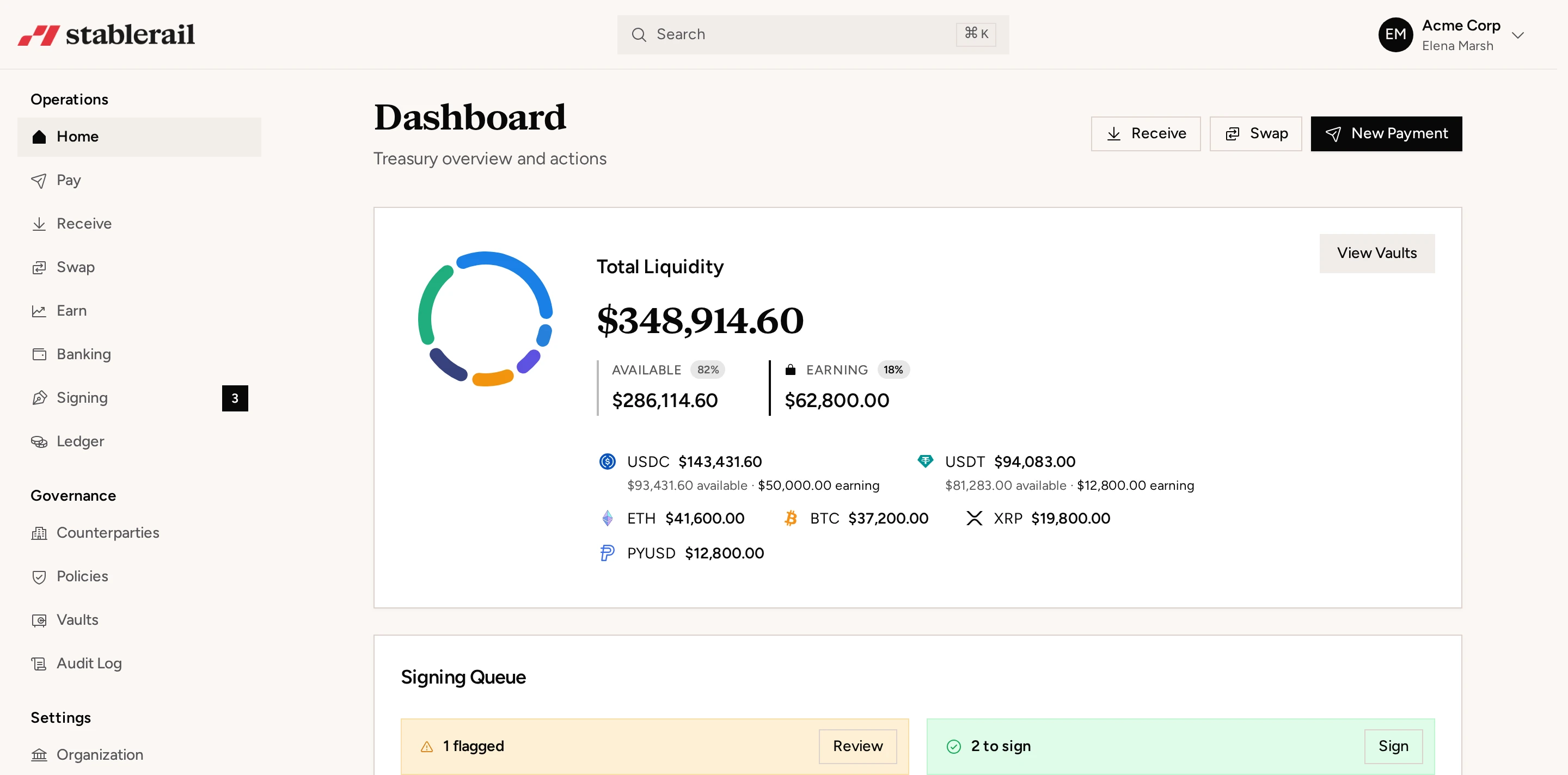
Stablerail provides one business account for USDC and USDT treasury, with approvals and signing quorum, sanctions and address screening before send, global payouts, fiat off-ramp, corporate cards and exportable audit evidence.
Connect USDT to fiat operating cash
Holding USDT does not settle a EUR tax bill, a USD payroll file or a GBP supplier invoice. A useful account must provide a clear route from the stablecoin balance to the company’s eligible fiat destination.
Depending on the provider, legal entity and currency, available rails can include SEPA or SEPA Instant for EUR, ACH or Fedwire for USD, Faster Payments, BACS or CHAPS for GBP, and SWIFT for international transfers. Availability should be confirmed during onboarding rather than inferred from a provider’s general coverage page.
An off-ramp normally involves selecting the USDT network and amount, reviewing the conversion rate and fees, choosing a verified fiat destination, obtaining approvals and submitting the transaction. Final timing can depend on blockchain confirmations, compliance review, banking cutoffs, weekends, holidays and the receiving institution. Treat “instant” as a rail capability, not a guarantee that every conversion will arrive immediately.
Compare the full conversion cost
Do not evaluate an off-ramp only by its headline fee. Compare the quoted exchange rate with an external market reference at the same time, then add transaction charges, network fees, banking fees and any intermediary deductions. The amount expected by the beneficiary and the amount actually received should both be captured for reconciliation.
Build evidence into payouts and reconciliation
Individual exchange withdrawals become difficult to control when a company has many invoices, contractors or customer refunds. The payment record should connect the business purpose, internal approval and blockchain settlement.
For each transfer, retain the beneficiary’s legal name, invoice or payroll reference, amount, token, network, destination address, approvers, timestamps, transaction hash and fiat conversion record where relevant. Screening can identify address or sanctions concerns before funds are sent, but it does not replace supplier onboarding, contractual checks or source-of-funds review.
Accounting teams should also define how they record USDT, transaction fees, conversion gains or losses and fiat settlement under the company’s accounting policy. A block explorer proves that a transaction occurred; it does not explain its business purpose, approval or ledger treatment.
Prepare for company onboarding
Business providers conduct Know Your Business checks, with requirements varying by jurisdiction, ownership and activity. A finance team should be ready to provide incorporation and constitutional documents, operating and registered addresses, directors and authorised users, beneficial ownership information, expected volumes, payment corridors and evidence supporting source of funds where requested.
A clear explanation of why the company uses USDT, which networks it needs, who its counterparties are and how funds reach fiat accounts can reduce avoidable follow-up. Jurisdiction, industry and use-case eligibility should be checked before the company redesigns its treasury process around a provider.
USDT business account selection checklist
- Map the flows: list collection, treasury, payout and off-ramp use cases by token, network and currency.
- Verify support: confirm deposit and withdrawal support for each required network and legal entity.
- Test controls: review roles, approval quorum, signer recovery and employee offboarding.
- Confirm fiat routes: document eligible accounts, payment rails, cutoffs, fees and review steps.
- Inspect evidence: export a sample payment record and ensure it includes approvals, screening and transaction data.
- Run a controlled test: complete a small end-to-end payment and reconcile the ledger before migrating material balances.
The right setup is not simply another place to hold USDT. It is a controlled operating environment that connects blockchain networks, company approvals, payouts, fiat conversion and audit evidence without forcing the finance team to reconstruct treasury activity from an exchange login.
Frequently asked questions
Can a company open a USDT business account?
Yes, subject to the provider’s entity, jurisdiction and industry eligibility requirements. The company will generally need to complete KYB checks and explain its ownership, expected transaction volumes, source of funds and intended USDT payment flows.
What is the difference between a USDT business account and an exchange account?
An exchange account is primarily designed for trading and conversion. A USDT business account is intended to add treasury controls such as multiple-user approvals, defined payout workflows, address screening, fiat off-ramp access and exportable transaction evidence.
Does a TRON USDT wallet need TRX?
TRC-20 USDT transfers consume TRON Bandwidth and Energy. If the wallet does not have sufficient network resources, TRX may be consumed to execute the transaction, so finance teams must understand how their wallet or provider funds network fees.
How can a business convert USDT into fiat currency?
The business sends or converts USDT through an eligible off-ramp and directs the fiat proceeds to a verified company destination. Available currencies, payment rails, fees and settlement timing depend on the provider, legal entity, compliance review and receiving bank.
What records should a company keep for USDT payments?
Keep the beneficiary, business purpose, invoice reference, amount, token, blockchain network, destination address, approvers, timestamps and transaction hash. Where conversion is involved, also retain the quoted rate, fees, fiat destination and amount received.
Finance writers covering stablecoin treasury, payments, compliance, and risk controls.
More about the Stablerail team- Stablecoin treasury managementApprovals, limits, yield and reporting on one balance.
- Stablecoin payoutsBatch contractor and vendor payments with screening.
- USDT vs USDCWhich stablecoin your company should settle in.
- Stablecoin finance glossaryMPC, off-ramp, travel rule and the rest, in plain English.
- Product updatesEverything we ship, month by month.