
BVNK Competitors: Comparing Stablecoin Payments, Accounts, and Fiat Infrastructure
Compare BVNK with stablecoin business accounts, API infrastructure, issuer platforms and custody providers across fiat access, payouts, controls and integration needs.
The best BVNK competitor depends on whether you need a finance operating account or infrastructure embedded into a product. Compare Stablerail for stablecoin treasury workflows, Bridge and Zero Hash for API-led infrastructure, Circle for USDC minting and redemption, Fireblocks for wallet controls, and Coinbase Prime for institutional custody and execution. Validate entity eligibility, fiat rails, custody, pricing and reconciliation before choosing.
%22%20x1%3D%220%22%20y1%3D%220%22%20x2%3D%221%22%20y2%3D%221%22%3E%0A%20%20%20%20%20%20%20%20%3Cstop%20offset%3D%220%25%22%20stop-color%3D%22%232E0709%22%20%2F%3E%0A%20%20%20%20%20%20%20%20%3Cstop%20offset%3D%2250%25%22%20stop-color%3D%22%234A0F14%22%20%2F%3E%0A%20%20%20%20%20%20%20%20%3Cstop%20offset%3D%22100%25%22%20stop-color%3D%22%236B181C%22%20%2F%3E%0A%20%20%20%20%20%20%3C%2FlinearGradient%3E%0A%20%20%20%20%20%20%3CradialGradient%20id%3D%22glow%22%20cx%3D%221036%22%20cy%3D%22-248%22%20r%3D%22520%22%20gradientUnits%3D%22userSpaceOnUse%22%3E%0A%20%20%20%20%20%20%20%20%3Cstop%20offset%3D%220%25%22%20stop-color%3D%22%23FFB199%22%20stop-opacity%3D%220.45%22%20%2F%3E%0A%20%20%20%20%20%20%20%20%3Cstop%20offset%3D%2255%25%22%20stop-color%3D%22%23FFB199%22%20stop-opacity%3D%220.08%22%20%2F%3E%0A%20%20%20%20%20%20%20%20%3Cstop%20offset%3D%22100%25%22%20stop-color%3D%22%23FFB199%22%20stop-opacity%3D%220%22%20%2F%3E%0A%20%20%20%20%20%20%3C%2FradialGradient%3E%0A%20%20%20%20%20%20%3ClinearGradient%20id%3D%22glass%22%20x1%3D%220%22%20y1%3D%220%22%20x2%3D%221%22%20y2%3D%221%22%3E%0A%20%20%20%20%20%20%20%20%3Cstop%20offset%3D%220%25%22%20stop-color%3D%22%23F8D6D2%22%20stop-opacity%3D%220.26%22%20%2F%3E%0A%20%20%20%20%20%20%20%20%3Cstop%20offset%3D%22100%25%22%20stop-color%3D%22%23FFFFFF%22%20stop-opacity%3D%220.08%22%20%2F%3E%0A%20%20%20%20%20%20%3C%2FlinearGradient%3E%0A%20%20%20%20%20%20%3ClinearGradient%20id%3D%22accent%22%20x1%3D%220%22%20y1%3D%220%22%20x2%3D%221%22%20y2%3D%221%22%3E%0A%20%20%20%20%20%20%20%20%3Cstop%20offset%3D%220%25%22%20stop-color%3D%22%23FFB199%22%20%2F%3E%0A%20%20%20%20%20%20%20%20%3Cstop%20offset%3D%22100%25%22%20stop-color%3D%22%23E85D3A%22%20%2F%3E%0A%20%20%20%20%20%20%3C%2FlinearGradient%3E%0A%20%20%20%20%20%20%3Cfilter%20id%3D%22soft%22%3E%3CfeGaussianBlur%20stdDeviation%3D%2210%22%20%2F%3E%3C%2Ffilter%3E%0A%20%20%20%20%3C%2Fdefs%3E%0A%20%20%20%20%3Crect%20width%3D%221600%22%20height%3D%22900%22%20fill%3D%22url(%23bg)%22%20%2F%3E%0A%20%20%20%20%3Crect%20width%3D%221600%22%20height%3D%22900%22%20fill%3D%22url(%23glow)%22%20%2F%3E%0A%20%20%20%20%3Cellipse%20cx%3D%22560%22%20cy%3D%22660%22%20rx%3D%2278%22%20ry%3D%2218%22%20fill%3D%22url(%23accent)%22%20stroke%3D%22%23F4CDC5%22%20stroke-opacity%3D%220.5%22%2F%3E%3Cellipse%20cx%3D%221100%22%20cy%3D%22660%22%20rx%3D%2278%22%20ry%3D%2218%22%20fill%3D%22url(%23glass)%22%20stroke%3D%22%23F4CDC5%22%20stroke-opacity%3D%220.5%22%2F%3E%3Cellipse%20cx%3D%221100%22%20cy%3D%22630%22%20rx%3D%2278%22%20ry%3D%2218%22%20fill%3D%22url(%23glass)%22%20stroke%3D%22%23F4CDC5%22%20stroke-opacity%3D%220.5%22%2F%3E%3Cellipse%20cx%3D%221100%22%20cy%3D%22600%22%20rx%3D%2278%22%20ry%3D%2218%22%20fill%3D%22url(%23glass)%22%20stroke%3D%22%23F4CDC5%22%20stroke-opacity%3D%220.5%22%2F%3E%3Cellipse%20cx%3D%221100%22%20cy%3D%22570%22%20rx%3D%2278%22%20ry%3D%2218%22%20fill%3D%22url(%23glass)%22%20stroke%3D%22%23F4CDC5%22%20stroke-opacity%3D%220.5%22%2F%3E%0A%20%20%20%20%3Crect%20x%3D%2226%22%20y%3D%2226%22%20width%3D%221548%22%20height%3D%22848%22%20rx%3D%2218%22%20fill%3D%22none%22%20stroke%3D%22%23F2D0C8%22%20stroke-opacity%3D%220.12%22%2F%3E%0A%20%20%3C%2Fsvg%3E)
Businesses comparing BVNK alternatives usually need more than a way to send stablecoins. They may need to collect fiat, hold USDC or USDT, convert funds, pay beneficiaries globally and produce records that finance and compliance teams can reconcile. The right choice depends first on the operating model: a business account, embedded infrastructure, an issuer relationship or a custody and execution stack.
A provider with broad API coverage is not automatically a substitute for an operating account. Conversely, a treasury dashboard designed for a finance team may not provide the components a fintech needs to serve thousands of end users. Compare products against the legal entities, currencies, stablecoins, networks and transaction workflows you will actually use.
BVNK competitors at a glance
The providers below overlap with BVNK in different ways. Product availability, supported jurisdictions and account features can vary by customer entity and change over time, so treat this as a model comparison rather than a promise of availability.
| Provider | Primary operating model | Typical fit | Main point to validate |
|---|---|---|---|
| BVNK | Stablecoin payment and fiat infrastructure | Businesses collecting, converting and paying in fiat and stablecoins | Which accounts, rails and payout corridors are available to your entity |
| Stablerail | Business account for stablecoin treasury | Finance teams moving USDC or USDT and requiring approvals, payouts and fiat off-ramp | Coverage for your currencies, beneficiary countries and preferred blockchain networks |
| Bridge | API-first stablecoin infrastructure | Developers embedding stablecoin orchestration and cross-border movement | Which compliance, ledger and end-user responsibilities remain with you |
| Circle | Stablecoin issuer account and APIs | Eligible institutions with flows centred on USDC | Entity eligibility, supported banking routes and whether USDC-only coverage is sufficient |
| Zero Hash | Embedded digital-asset infrastructure | Platforms adding funding, conversion or settlement to their own product | Jurisdiction-specific product availability and the required integration scope |
| Fireblocks | Wallet and transaction infrastructure | Enterprises prioritising digital-asset security and approval workflows | Which banking, liquidity and payout partners must be added separately |
| Coinbase Prime | Institutional custody and execution platform | Institutions combining custody, trading and treasury activity | Whether payment collection and local payout rails meet operational needs |
Start with the operating model
The most important distinction is what your company is buying and what it must operate itself.
Direct business account
The company opens an account, holds supported balances and initiates transactions through a dashboard or API. This model generally fits treasury, accounts payable and finance operations because users can manage funds without building a customer-facing product. Buyers should still confirm whether fiat details are named or pooled, who legally holds each balance, and how funds are safeguarded or custodied.
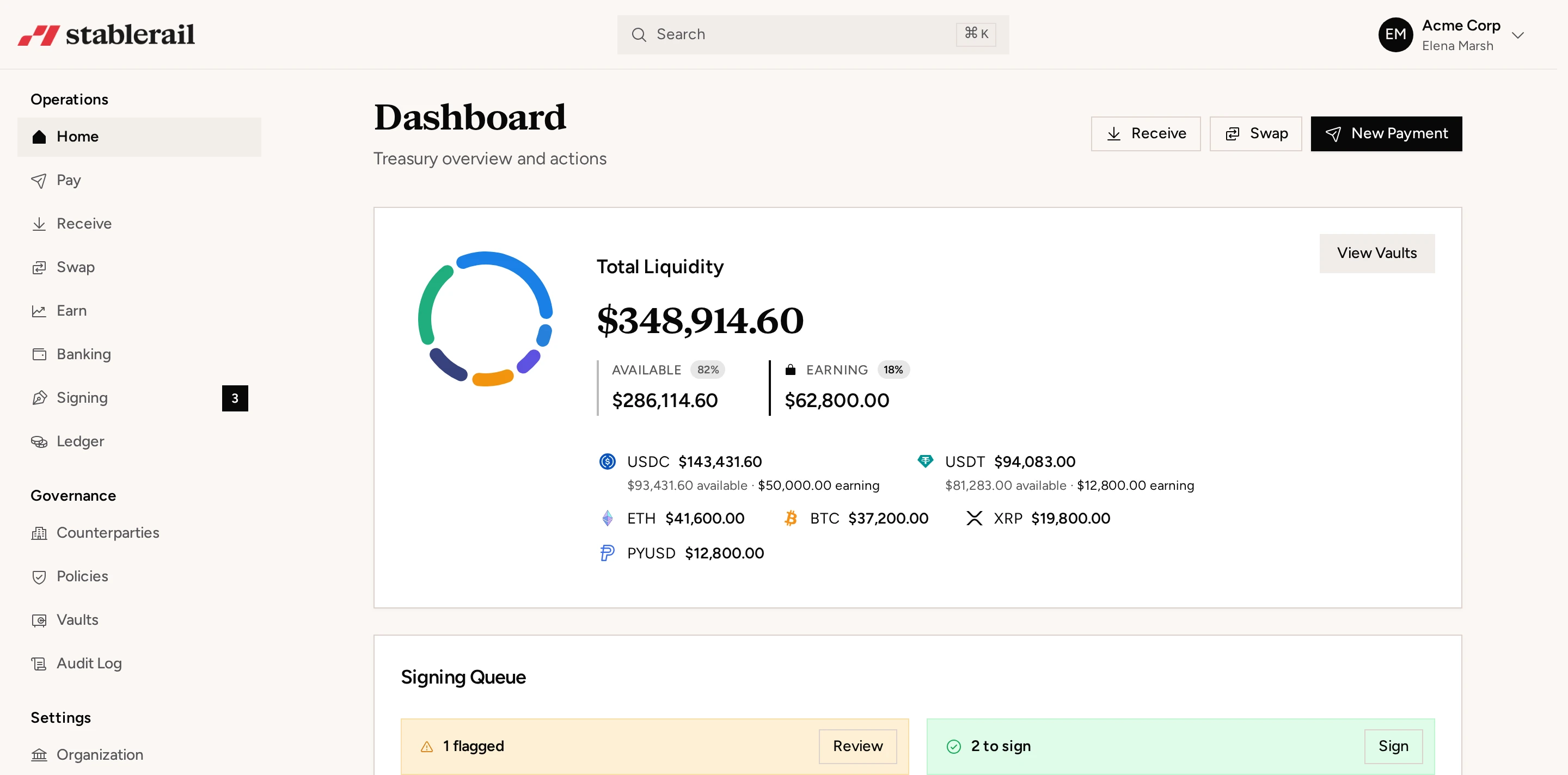
For example, Stablerail combines a business account for USDC and USDT with approvals and signing quorum, sanctions and address screening before send, global payouts, fiat off-ramp, corporate cards and exportable audit evidence. Those controls are relevant when finance needs one workflow for payment preparation, authorisation and reconciliation rather than a collection of wallet and banking tools.
Embedded infrastructure
Bridge and Zero Hash are closer fits when a company wants to place stablecoin functionality inside its own application. APIs can abstract parts of banking, conversion and blockchain movement, but they do not eliminate the need for product design, engineering, accounting and customer support.
Establish who maintains the customer ledger, verifies end users, calculates fees, handles refunds and resolves transactions placed under compliance review. Also test API idempotency, webhook retries, status transitions and the identifiers used to connect a fiat deposit, conversion and blockchain payout in your ledger.
Issuer account
Circle is most relevant when the core requirement is institutional access to USDC minting and redemption. An issuer relationship may provide a direct path between eligible fiat funds and the issuer’s stablecoin, but it should not be assumed to replace a multicurrency operating account. A business needing USDT, local beneficiary payouts or several domestic collection methods may need additional providers.
Custody and institutional platforms
Fireblocks focuses on wallet and transaction infrastructure, while Coinbase Prime combines institutional custody and execution capabilities. Either can form an important part of a treasury stack, especially when asset security or market execution is the primary requirement. They are less direct substitutes for a stablecoin business account if separate banking, liquidity, conversion and accounts-payable workflows must still be assembled.
Compare fiat access at the entity level
Claims such as “global coverage” can refer to very different capabilities. A provider may support payouts to a country without onboarding companies incorporated there. It may also offer a currency through international wires but not provide local account details or domestic payment rails.
For every required currency, document the complete flow: sender, collection account, account holder name, payment rail, conversion step, settlement asset and beneficiary route. Ask whether incoming third-party payments are permitted, whether virtual account details are unique to your company or customer, and what reference fields are returned for reconciliation.
| Requirement | Evidence to request | Why it matters |
|---|---|---|
| Customer eligibility | Written confirmation for each parent and operating entity | A supported payout country may still be an unsupported incorporation country |
| Fiat collection | Account naming, supported senders, currencies and payment rails | Pooled accounts and missing references can complicate receivables matching |
| Conversion | Rate source, spread or fee, quote expiry and execution record | The displayed rate may not equal the final all-in conversion cost |
| Stablecoin transfer | Supported token contract and network for deposits and withdrawals | Sending the right ticker on an unsupported network can lead to recovery work or loss |
| Beneficiary payout | Destination coverage, beneficiary requirements and return process | Reachability does not guarantee predictable settlement or repair handling |
Calculate total cost by corridor
Do not compare providers using one advertised transaction fee. Price representative flows from the original funding account through to the amount received by the beneficiary. The total can include account fees, fiat transfer charges, foreign-exchange spread, stablecoin conversion charges, blockchain network fees, payout fees and correspondent-bank deductions.
Settlement timing also has several stages. A fiat transfer may arrive at the provider but remain unavailable while it is matched or reviewed. A conversion quote may expire before approval. A blockchain transaction may be broadcast quickly but require confirmations before the recipient credits it. International wires can involve intermediary banks and beneficiary-bank checks.
For each corridor, ask the provider to show:
- The amount debited from the funding account.
- When the exchange rate is fixed and how long the quote remains valid.
- Who pays blockchain and intermediary-bank charges.
- The expected amount delivered to the beneficiary.
- The transaction records supplied for each stage.
- What happens if the transfer is rejected, returned or sent to an unsupported address.
Examine custody, approvals and compliance controls
Custody terminology can hide material differences. Determine who controls the signing keys, whether the provider or customer can move funds unilaterally, and what happens if a signer becomes unavailable. Review recovery procedures, user offboarding and the process for changing an approval quorum.
Finance teams should be able to separate payment preparation from authorisation. Test role-based access, multiple approvals, beneficiary controls and a complete history of who created, approved, rejected and submitted a transaction. Compliance teams should verify when sanctions and address screening occurs, what can block a transfer and what evidence is retained.
Operational test: ask a provider to demonstrate one payment from beneficiary creation through approval, screening, settlement, accounting export and audit retrieval. A feature list will not reveal manual steps or missing evidence.
Test reconciliation before signing
Stablecoin transfers are final on-chain, but finance records still need corrections, fee allocation and counterparty context. The provider should expose stable identifiers across dashboard exports, APIs, webhooks and statements. Confirm that records include asset, network, gross amount, fee, net amount, wallet address, transaction hash, timestamps and transaction status where applicable.
Run test cases for a partial payment, duplicate API request, rejected beneficiary, returned fiat payout and delayed compliance review. Determine whether exports can be imported into your accounting or treasury system without manually rebuilding the transaction history.
Finance-team selection checklist
- List required legal entities, fiat currencies, local rails and named account details.
- Specify USDC or USDT, token contracts, networks and expected transaction sizes.
- Map custody, signing authority, approval quorum and recovery responsibilities.
- Price at least three real corridors from funding through beneficiary receipt.
- Test batch payouts, API idempotency, webhooks, returns and reconciliation exports.
- Review sanctions screening, address screening, beneficiary controls and audit evidence.
- Confirm limits, cut-off times, support escalation and the process for frozen or failed transfers.
How to choose the right BVNK alternative
Choose based on the operating burden your company is prepared to own. A finance team paying vendors may prefer an integrated account with approvals, stablecoin balances and off-ramp workflows. A fintech building payments into its product may value API flexibility and accept responsibility for its interface, ledger and support operation. An institution focused on USDC issuance, wallet infrastructure or execution may be better served by a specialist platform.
There is no universal best BVNK competitor. The defensible decision is the provider that supports your entities and corridors, makes custody responsibilities explicit, shows the full cost of each flow and produces records your finance team can reconcile without creating a parallel manual process.
Frequently asked questions
What is the best alternative to BVNK for a business?
The best alternative depends on whether the business needs an operating account or embedded payment infrastructure. Treasury teams should prioritise approvals, fiat access, stablecoin support and reconciliation, while fintechs should compare APIs, ledger responsibilities and end-user compliance requirements.
How should I compare BVNK with Bridge?
Compare the operating model rather than API feature counts alone. BVNK is generally evaluated for business payment and fiat-to-stablecoin workflows, while Bridge is typically considered for embedding stablecoin movement into a product; confirm which party owns compliance, ledgering, support and failed-payment handling.
Is Circle a direct competitor to BVNK?
Circle overlaps with BVNK where an eligible institution needs to move between fiat and USDC. It is less direct when the requirement includes USDT, multicurrency business-account features, local collection rails or broader beneficiary payout workflows.
What fees should businesses compare for stablecoin payments?
Compare the full corridor cost: account charges, fiat transfer fees, conversion spread, stablecoin fees, blockchain network costs, payout charges and possible intermediary-bank deductions. Request the expected funding debit and beneficiary receipt for several representative transactions.
What due diligence documents are needed for a stablecoin business account?
Providers commonly request incorporation documents, ownership information, director and beneficial-owner identification, business activity details, expected volumes and source-of-funds evidence. Stablecoin companies may also be asked for compliance policies, flow-of-funds diagrams and details of their customers, counterparties or wallet-screening process.
Finance writers covering stablecoin treasury, payments, compliance, and risk controls.
More about the Stablerail team- Stablecoin treasury managementApprovals, limits, yield and reporting on one balance.
- Stablecoin payoutsBatch contractor and vendor payments with screening.
- USDT vs USDCWhich stablecoin your company should settle in.
- Stablecoin finance glossaryMPC, off-ramp, travel rule and the rest, in plain English.
- Product updatesEverything we ship, month by month.