
BVNK Alternatives for Stablecoin Accounts, Payments, and Fiat Rails
Compare BVNK alternatives by operating model, fiat account structure, stablecoin coverage, treasury controls, payout workflows, total cost and audit evidence.
The main BVNK alternatives are Stablerail for day-to-day stablecoin treasury, Circle Mint for direct USDC or EURC access, Bridge and Zero Hash for embedded payment infrastructure, Fireblocks for wallet governance, and Coinbase Prime for institutional custody and execution. Choose according to whether you need an operating account, APIs, issuer access, or custody—not by comparing stablecoin support alone.
%22%20x1%3D%220%22%20y1%3D%220%22%20x2%3D%221%22%20y2%3D%221%22%3E%0A%20%20%20%20%20%20%20%20%3Cstop%20offset%3D%220%25%22%20stop-color%3D%22%232A0608%22%20%2F%3E%0A%20%20%20%20%20%20%20%20%3Cstop%20offset%3D%2250%25%22%20stop-color%3D%22%23420D12%22%20%2F%3E%0A%20%20%20%20%20%20%20%20%3Cstop%20offset%3D%22100%25%22%20stop-color%3D%22%23621619%22%20%2F%3E%0A%20%20%20%20%20%20%3C%2FlinearGradient%3E%0A%20%20%20%20%20%20%3CradialGradient%20id%3D%22glow%22%20cx%3D%22659%22%20cy%3D%22159%22%20r%3D%22520%22%20gradientUnits%3D%22userSpaceOnUse%22%3E%0A%20%20%20%20%20%20%20%20%3Cstop%20offset%3D%220%25%22%20stop-color%3D%22%23FF9577%22%20stop-opacity%3D%220.45%22%20%2F%3E%0A%20%20%20%20%20%20%20%20%3Cstop%20offset%3D%2255%25%22%20stop-color%3D%22%23FF9577%22%20stop-opacity%3D%220.08%22%20%2F%3E%0A%20%20%20%20%20%20%20%20%3Cstop%20offset%3D%22100%25%22%20stop-color%3D%22%23FF9577%22%20stop-opacity%3D%220%22%20%2F%3E%0A%20%20%20%20%20%20%3C%2FradialGradient%3E%0A%20%20%20%20%20%20%3ClinearGradient%20id%3D%22glass%22%20x1%3D%220%22%20y1%3D%220%22%20x2%3D%221%22%20y2%3D%221%22%3E%0A%20%20%20%20%20%20%20%20%3Cstop%20offset%3D%220%25%22%20stop-color%3D%22%23F8D6D2%22%20stop-opacity%3D%220.26%22%20%2F%3E%0A%20%20%20%20%20%20%20%20%3Cstop%20offset%3D%22100%25%22%20stop-color%3D%22%23FFFFFF%22%20stop-opacity%3D%220.08%22%20%2F%3E%0A%20%20%20%20%20%20%3C%2FlinearGradient%3E%0A%20%20%20%20%20%20%3ClinearGradient%20id%3D%22accent%22%20x1%3D%220%22%20y1%3D%220%22%20x2%3D%221%22%20y2%3D%221%22%3E%0A%20%20%20%20%20%20%20%20%3Cstop%20offset%3D%220%25%22%20stop-color%3D%22%23FF9577%22%20%2F%3E%0A%20%20%20%20%20%20%20%20%3Cstop%20offset%3D%22100%25%22%20stop-color%3D%22%23D03B2D%22%20%2F%3E%0A%20%20%20%20%20%20%3C%2FlinearGradient%3E%0A%20%20%20%20%20%20%3Cfilter%20id%3D%22soft%22%3E%3CfeGaussianBlur%20stdDeviation%3D%2210%22%20%2F%3E%3C%2Ffilter%3E%0A%20%20%20%20%3C%2Fdefs%3E%0A%20%20%20%20%3Crect%20width%3D%221600%22%20height%3D%22900%22%20fill%3D%22url(%23bg)%22%20%2F%3E%0A%20%20%20%20%3Crect%20width%3D%221600%22%20height%3D%22900%22%20fill%3D%22url(%23glow)%22%20%2F%3E%0A%20%20%20%20%0A%20%20%3Cpath%20d%3D%22M400%20360%20L%20800%20220%20L%201200%20360%20L%201200%20410%20L%20400%20410%20Z%22%20fill%3D%22url(%23glass)%22%20stroke%3D%22%23F4CDC5%22%20stroke-opacity%3D%220.6%22%2F%3E%0A%20%20%3Crect%20x%3D%22460%22%20y%3D%22430%22%20width%3D%2280%22%20height%3D%22240%22%20fill%3D%22url(%23glass)%22%20stroke%3D%22%23F4CDC5%22%20stroke-opacity%3D%220.5%22%2F%3E%3Crect%20x%3D%22640%22%20y%3D%22430%22%20width%3D%2280%22%20height%3D%22240%22%20fill%3D%22url(%23glass)%22%20stroke%3D%22%23F4CDC5%22%20stroke-opacity%3D%220.5%22%2F%3E%3Crect%20x%3D%22820%22%20y%3D%22430%22%20width%3D%2280%22%20height%3D%22240%22%20fill%3D%22url(%23glass)%22%20stroke%3D%22%23F4CDC5%22%20stroke-opacity%3D%220.5%22%2F%3E%3Crect%20x%3D%221000%22%20y%3D%22430%22%20width%3D%2280%22%20height%3D%22240%22%20fill%3D%22url(%23accent)%22%20stroke%3D%22%23F4CDC5%22%20stroke-opacity%3D%220.5%22%2F%3E%0A%20%20%3Crect%20x%3D%22380%22%20y%3D%22690%22%20width%3D%22840%22%20height%3D%2236%22%20rx%3D%226%22%20fill%3D%22url(%23glass)%22%20stroke%3D%22%23F4CDC5%22%20stroke-opacity%3D%220.6%22%2F%3E%0A%20%20%3Ccircle%20cx%3D%22800%22%20cy%3D%22310%22%20r%3D%2222%22%20fill%3D%22url(%23accent)%22%2F%3E%0A%0A%20%20%20%20%3Crect%20x%3D%2226%22%20y%3D%2226%22%20width%3D%221548%22%20height%3D%22848%22%20rx%3D%2218%22%20fill%3D%22none%22%20stroke%3D%22%23F2D0C8%22%20stroke-opacity%3D%220.12%22%2F%3E%0A%20%20%3C%2Fsvg%3E)
Finance teams comparing BVNK alternatives should first define the operating model they need. A provider that can mint a stablecoin is not necessarily a business account, while a secure wallet platform may not provide usable fiat account details, domestic payment rails or accounting-ready exports. The right choice depends on who controls the assets, how fiat enters and leaves, and how each transaction is approved and reconciled.
Start with the operating model
Most alternatives fall into four categories. Some providers span more than one, but the primary model determines what your team must build or source elsewhere.
- Business operating account: A finance interface for holding or moving stablecoins, converting to and from fiat, paying beneficiaries and exporting transaction evidence.
- Embedded payments infrastructure: APIs for adding wallets, stablecoin conversion or payment flows to your own product. Your company may still need to build approvals, beneficiary management, reconciliation and customer-facing workflows.
- Issuer-direct access: Minting and redeeming a specific issuer’s stablecoin, subject to eligibility. This can reduce intermediaries but does not automatically provide multi-asset treasury operations.
- Custody and wallet infrastructure: Technology for securing assets, governing transactions and connecting to exchanges or liquidity providers. Fiat accounts and payment rails may come from separate partners.
This distinction prevents a misleading feature comparison. Two providers may both support USDC, yet one gives finance users an operational account while the other supplies APIs that require engineering and compliance integration.
BVNK alternatives compared by use case
| Provider | Primary model | Best suited to | Main point to verify |
|---|---|---|---|
| Stablerail | Stablecoin business account | Companies operating with USDC or USDT that need approvals, cards, global payouts and fiat off-ramp | Entity, jurisdiction, currency and corridor eligibility |
| Circle Mint | Issuer-direct access | Eligible institutions minting or redeeming USDC or EURC | Supported settlement methods, networks and account eligibility; USDT is outside the issuer model |
| Bridge | Embedded stablecoin infrastructure | Companies adding stablecoin orchestration, wallets or payment flows to a product | Which account, rail and geography combinations are available under the proposed program |
| Zero Hash | Embedded digital-asset infrastructure | Platforms offering custody, liquidity or settlement functions to their customers | Contracting entity, product configuration, market coverage and implementation responsibilities |
| Fireblocks | Wallet and transaction infrastructure | Enterprises prioritising wallet governance, signing controls and provider connectivity | Which fiat accounts, conversion routes and payment rails require third-party providers |
| Coinbase Prime | Institutional custody and execution | Institutions combining digital-asset custody, trading and treasury activity | Whether supported fiat funding and withdrawal routes match day-to-day operating requirements |
Product coverage changes by country, contracting entity and customer type. Treat the table as a model-based shortlist, then obtain written confirmation of every required asset, network, currency and payment direction.
Where a stablecoin operating account fits
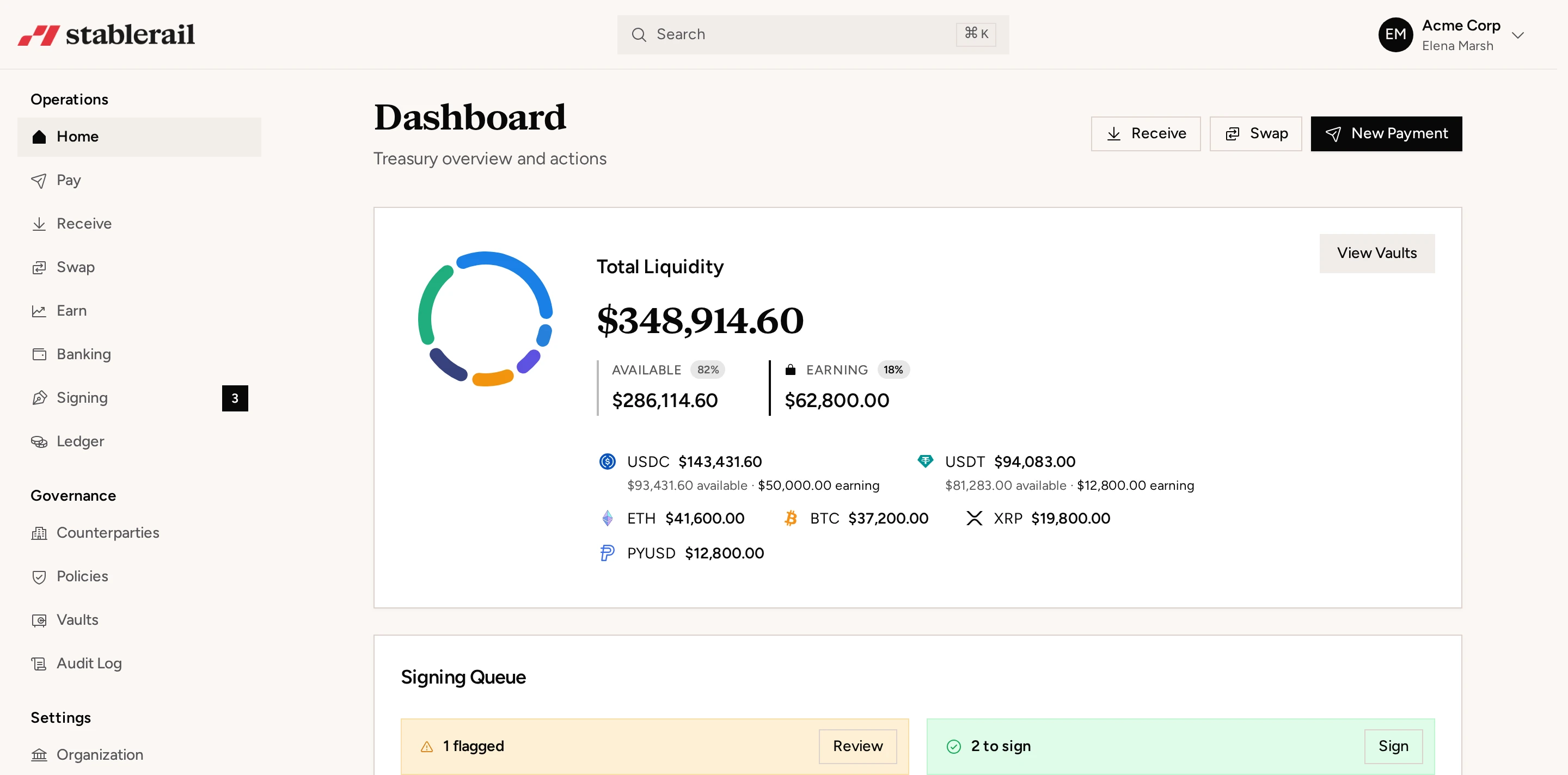
Stablerail is designed for companies using stablecoins in normal treasury operations rather than embedding infrastructure into a customer product. It combines a USDC and USDT business account with approvals and signing quorum, sanctions and address screening before send, corporate cards, global payouts, fiat off-ramp and exportable audit evidence. This model can reduce the number of separate wallet, payment and evidence systems a finance team must reconcile.
An integrated account is not automatically the right answer. A company building stablecoin features for thousands of end users may prefer an API-led provider. A fund focused on execution and safekeeping may prioritise institutional custody. A business dealing almost exclusively in USDC may benefit from direct issuer access if it meets the relevant requirements.
Verify what “fiat account” actually means
Support for USD, EUR or GBP does not necessarily mean your company receives local account details. Ask whether the arrangement is a named account, a dedicated virtual account mapped to your company, or a pooled client account funded using a reference. The difference affects payer acceptance, reconciliation, return handling and the evidence available to auditors.
| Rail | Typical use | Questions finance should ask |
|---|---|---|
| SEPA Credit Transfer | Routine EUR receipts and payments | Is the IBAN dedicated? Are inbound and outbound payments supported? What are the cut-offs and return procedures? |
| SEPA Instant | Time-sensitive EUR payments where both institutions participate | Is it available continuously? What transaction limits and beneficiary-verification controls apply? |
| ACH | Domestic US collections and payments | Are credits and debits supported? Who handles returns, and when does a received balance become available? |
| Fedwire | Urgent or higher-value domestic USD transfers | What are the operating cut-offs, payment limits, fees and recall procedures? |
| Faster Payments | Routine and time-sensitive GBP transfers | Are both directions available, and are account details assigned to your legal entity? |
| CHAPS | High-value same-day GBP payments | What cut-off, fixed charge and beneficiary-review process apply? |
| SWIFT | Cross-border transfers and currencies without a local rail | Which correspondents are involved? Can fees be deducted in transit? Are payment tracking and charge options available? |
Settlement descriptions are not guarantees. Compliance reviews, bank holidays, local cut-offs, beneficiary errors and correspondent banks can delay funds. Confirm when a balance becomes available for conversion or withdrawal, not merely when the transfer is marked received.
Compare conversion by net proceeds
A quoted foreign-exchange spread is only one part of on-ramp or off-ramp cost. The total may include a conversion fee, minimum charge, bank-transfer fee, blockchain network fee and correspondent deduction. Prefunding requirements or settlement delays can also create working-capital costs.
Request worked quotes using your actual flows. For example, ask each provider to show the net EUR delivered to your bank account after converting and withdrawing 100,000 USDC. The quote should identify the reference price, when the rate locks, every provider and rail fee, expected network costs, and who bears market movement if settlement is delayed.
Decision rule: compare the amount received, time to usable funds and internal work required—not the advertised spread in isolation.
Check assets and networks as pairs
“Supports USDT” is incomplete without the network. USDT on Tron and USDT on Ethereum are different asset-and-network combinations with different addresses, fee mechanics and beneficiary requirements. The same applies to USDC across supported networks.
Create a matrix covering deposits, withdrawals, conversion and payouts for each required pair. Verify whether the platform validates network and address compatibility before signing, estimates fees, handles insufficient gas, and records the transaction hash. For batch payments, test CSV or API submission, duplicate detection, beneficiary templates, payment references, approval stages and partial failures.
A failed batch should not become a manual accounting puzzle. Finance needs to know which payments succeeded, which failed, whether failed amounts remain available, and how each blockchain transaction maps to an invoice, contractor or payroll record.
Evaluate custody, approvals and audit evidence
Ask whether assets are held in segregated wallets, omnibus wallets or wallets controlled through your organisation’s signing arrangement. Do not infer legal ownership or insolvency treatment from the interface; review the contract and custody structure with counsel.
Approval controls should be tested using realistic scenarios. Can a preparer create a payment without approving it? Can signing require more than one authorised person? What happens when an approver leaves, loses access or is unavailable? Confirm how administrators, finance users and signers are added or removed.
Screening should occur before funds are sent, with a documented process for alerts and false positives. Audit exports should connect the beneficiary, amount, asset, network, initiator, approvers, screening result, transaction hash, fees and accounting reference. Screenshots are a weak substitute for structured, exportable evidence.
Finance-team evaluation checklist
- Define the model: operating account, embedded APIs, issuer access or custody infrastructure.
- Confirm eligibility: legal entity, jurisdiction, industry, beneficial owners and intended corridors.
- Map fiat access: account ownership, currencies, rails, payment directions, cut-offs and returns.
- Map stablecoin coverage: exact asset-and-network pairs for deposits, withdrawals and payouts.
- Calculate net cost: conversion, provider, bank, network and correspondent charges.
- Test controls: user roles, approval separation, signing quorum, screening and access removal.
- Inspect evidence: balance, transaction, approval, screening, fee and reconciliation exports.
- Document exceptions: failed transfers, wrong networks, recalls, frozen reviews and escalation routes.
Run a controlled pilot before migrating
Shortlist two or three providers and execute the same end-to-end test with each. Receive fiat, complete an on-ramp, transfer stablecoins to an approved wallet, run a small batch payout, complete an off-ramp and reconcile the entire flow in the accounting system.
Record the net amount delivered, elapsed time to available funds, number of manual steps, quality of payment references, approval evidence and exception handling. Include at least one deliberately rejected or failed payment so the team can see how funds and records are restored.
The strongest BVNK alternative is the provider that completes your real treasury cycle with acceptable control, evidence and operational effort. A long feature list matters less than whether the account structure, rails, networks and approval model work together for your legal entity.
Frequently asked questions
What is the best BVNK alternative for a stablecoin business account?
The best alternative depends on whether you need a finance operating account or infrastructure to embed in a product. For day-to-day USDC or USDT treasury, prioritise fiat access, approvals, screening, payouts and audit exports; for embedded customer flows, compare API-led providers instead.
Which BVNK alternatives support both USDC and USDT?
Support must be confirmed by asset, network, legal entity and transaction type. A provider may support both assets for custody but not for conversion or payouts, while an issuer-direct USDC account will not provide direct USDT issuance.
How should a CFO compare stablecoin on-ramp and off-ramp costs?
Compare net proceeds from a standard transaction rather than the quoted spread alone. Include conversion charges, minimum fees, bank-transfer costs, blockchain fees, correspondent deductions, settlement time and any prefunding requirement.
What is the difference between a stablecoin account and a custody platform?
A stablecoin operating account typically combines asset movement with fiat conversion, payment workflows and finance records. A custody platform primarily protects and governs digital assets, and may require separate banks, exchanges or payment providers for fiat operations.
What should finance teams test before changing stablecoin providers?
Run a controlled cycle covering fiat receipt, on-ramp, wallet transfer, batch payout, off-ramp and accounting reconciliation. Test approvals, a failed payment, screening evidence, transaction exports and the escalation process as well as successful transfers.
Finance writers covering stablecoin treasury, payments, compliance, and risk controls.
More about the Stablerail team- Stablecoin treasury managementApprovals, limits, yield and reporting on one balance.
- Stablecoin payoutsBatch contractor and vendor payments with screening.
- USDT vs USDCWhich stablecoin your company should settle in.
- Stablecoin finance glossaryMPC, off-ramp, travel rule and the rest, in plain English.
- Product updatesEverything we ship, month by month.