
Stablecoin to Fiat Off-Ramps: Converting USDC and USDT to Bank Money
A finance-focused guide to converting USDC and USDT into fiat, covering quotes, networks, banking rails, controls, settlement timing and audit evidence.
A stablecoin off-ramp converts USDC or USDT into fiat delivered to a bank account or fiat balance. Before sending funds, confirm the token and blockchain network, payout currency, beneficiary, banking rail, exchange rate, total fees and settlement window. Finance teams should also require appropriate approvals and retain the quote, transaction hash, conversion confirmation and bank record so the disposal and fiat receipt can be reconciled.
%22%20x1%3D%220%22%20y1%3D%220%22%20x2%3D%221%22%20y2%3D%221%22%3E%0A%20%20%20%20%20%20%20%20%3Cstop%20offset%3D%220%25%22%20stop-color%3D%22%233E090D%22%20%2F%3E%0A%20%20%20%20%20%20%20%20%3Cstop%20offset%3D%2250%25%22%20stop-color%3D%22%235C1218%22%20%2F%3E%0A%20%20%20%20%20%20%20%20%3Cstop%20offset%3D%22100%25%22%20stop-color%3D%22%237B1F22%22%20%2F%3E%0A%20%20%20%20%20%20%3C%2FlinearGradient%3E%0A%20%20%20%20%20%20%3CradialGradient%20id%3D%22glow%22%20cx%3D%22745%22%20cy%3D%22140%22%20r%3D%22520%22%20gradientUnits%3D%22userSpaceOnUse%22%3E%0A%20%20%20%20%20%20%20%20%3Cstop%20offset%3D%220%25%22%20stop-color%3D%22%23FF8E72%22%20stop-opacity%3D%220.45%22%20%2F%3E%0A%20%20%20%20%20%20%20%20%3Cstop%20offset%3D%2255%25%22%20stop-color%3D%22%23FF8E72%22%20stop-opacity%3D%220.08%22%20%2F%3E%0A%20%20%20%20%20%20%20%20%3Cstop%20offset%3D%22100%25%22%20stop-color%3D%22%23FF8E72%22%20stop-opacity%3D%220%22%20%2F%3E%0A%20%20%20%20%20%20%3C%2FradialGradient%3E%0A%20%20%20%20%20%20%3ClinearGradient%20id%3D%22glass%22%20x1%3D%220%22%20y1%3D%220%22%20x2%3D%221%22%20y2%3D%221%22%3E%0A%20%20%20%20%20%20%20%20%3Cstop%20offset%3D%220%25%22%20stop-color%3D%22%23F8D6D2%22%20stop-opacity%3D%220.26%22%20%2F%3E%0A%20%20%20%20%20%20%20%20%3Cstop%20offset%3D%22100%25%22%20stop-color%3D%22%23FFFFFF%22%20stop-opacity%3D%220.08%22%20%2F%3E%0A%20%20%20%20%20%20%3C%2FlinearGradient%3E%0A%20%20%20%20%20%20%3ClinearGradient%20id%3D%22accent%22%20x1%3D%220%22%20y1%3D%220%22%20x2%3D%221%22%20y2%3D%221%22%3E%0A%20%20%20%20%20%20%20%20%3Cstop%20offset%3D%220%25%22%20stop-color%3D%22%23FF8E72%22%20%2F%3E%0A%20%20%20%20%20%20%20%20%3Cstop%20offset%3D%22100%25%22%20stop-color%3D%22%23D94030%22%20%2F%3E%0A%20%20%20%20%20%20%3C%2FlinearGradient%3E%0A%20%20%20%20%20%20%3Cfilter%20id%3D%22soft%22%3E%3CfeGaussianBlur%20stdDeviation%3D%2210%22%20%2F%3E%3C%2Ffilter%3E%0A%20%20%20%20%3C%2Fdefs%3E%0A%20%20%20%20%3Crect%20width%3D%221600%22%20height%3D%22900%22%20fill%3D%22url(%23bg)%22%20%2F%3E%0A%20%20%20%20%3Crect%20width%3D%221600%22%20height%3D%22900%22%20fill%3D%22url(%23glow)%22%20%2F%3E%0A%20%20%20%20%0A%20%20%20%20%3Cpath%20d%3D%22M%20500%20600%20A%20300%20300%200%200%201%201100%20600%22%20fill%3D%22none%22%20stroke%3D%22url(%23glass)%22%20stroke-width%3D%2260%22%2F%3E%0A%20%20%20%20%3Cpath%20d%3D%22M%20500%20600%20A%20300%20300%200%200%201%201098.8584094275236%20573.8532771757026%22%20fill%3D%22none%22%20stroke%3D%22url(%23accent)%22%20stroke-width%3D%2260%22%20stroke-linecap%3D%22round%22%2F%3E%0A%20%20%20%20%3Ccircle%20cx%3D%22800%22%20cy%3D%22600%22%20r%3D%2232%22%20fill%3D%22%233E090D%22%20stroke%3D%22url(%23accent)%22%20stroke-width%3D%226%22%2F%3E%0A%20%20%20%20%3Cline%20x1%3D%22800%22%20y1%3D%22600%22%20x2%3D%221039.086727542019%22%20y2%3D%22579.082621740562%22%20stroke%3D%22%23FFF1ED%22%20stroke-width%3D%2210%22%20stroke-linecap%3D%22round%22%2F%3E%0A%20%20%0A%20%20%20%20%3Crect%20x%3D%2226%22%20y%3D%2226%22%20width%3D%221548%22%20height%3D%22848%22%20rx%3D%2218%22%20fill%3D%22none%22%20stroke%3D%22%23F2D0C8%22%20stroke-opacity%3D%220.12%22%2F%3E%0A%20%20%3C%2Fsvg%3E)
A stablecoin off-ramp converts USDC or USDT into fiat delivered to a bank account or fiat balance. A controlled off-ramp process verifies the token and network, locks or accepts a conversion quote, applies treasury approvals, transfers the stablecoins, and dispatches the fiat through a rail such as ACH, Fedwire, SEPA or SWIFT. The transaction is complete only when the bank credit and accounting records reconcile with the on-chain disposal.
How a business stablecoin off-ramp works
Although the transaction may appear to be a simple sale, it crosses three systems: a blockchain, a conversion venue and a banking rail. Each has its own identifiers, processing rules and potential delays.
- Select the stablecoin and network. Specify both the token and blockchain. USDT on Tron and USDT on Ethereum are different transfer routes, even though both represent USDT.
- Choose the fiat destination. Select the settlement currency, beneficiary account and banking rail. Confirm whether the provider permits payments to third parties or only to an account held in the company’s name.
- Review the quote. Check the amount sold, reference rate, execution rate, spread, explicit fees, expected proceeds and quote expiry.
- Approve the transaction. Apply the company’s approval limits and signing quorum. The person requesting the conversion should not be the only person able to release a material transfer.
- Transfer the stablecoins. Use deposit instructions generated for the precise asset and network. Verify the address through an approved channel before signing.
- Wait for confirmations and conversion. The provider credits the deposit after its required blockchain confirmations and then executes or completes the conversion under the quoted terms.
- Dispatch and reconcile the fiat. The provider sends the proceeds through the selected bank rail. Finance matches the blockchain transaction, conversion confirmation and bank credit.
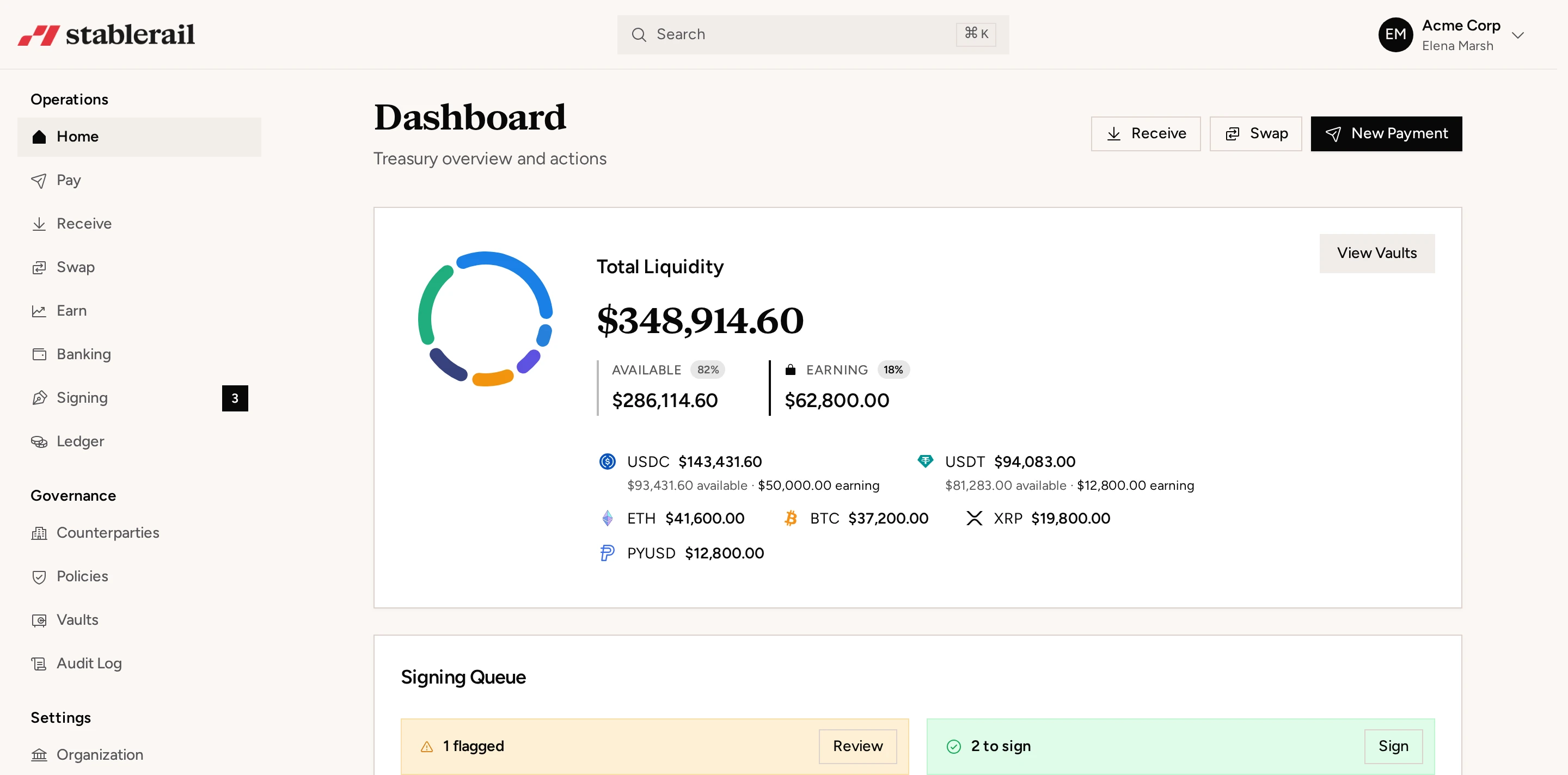
Stablerail brings USDC and USDT treasury, approvals and signing quorum, sanctions and address screening before send, fiat off-ramp, global payouts and exportable audit evidence into one business account. Availability still depends on KYB approval, jurisdiction, industry, asset, blockchain network and fiat corridor.
Confirm the entire corridor before sending
An off-ramp corridor is more specific than “USDC to USD” or “USDT to EUR.” It combines the legal entity, stablecoin, source network, payout currency, destination country, beneficiary type and bank rail. Support for one component does not imply support for every combination.
| Corridor component | What finance should confirm | Failure risk |
|---|---|---|
| Stablecoin | USDC or USDT, including the exact token accepted | Unsupported or imitation token is deposited |
| Blockchain network | Ethereum, Tron, Base, Solana or another specifically supported network | Funds require manual recovery or cannot be recovered |
| Fiat currency | USD, EUR, GBP or another available settlement currency | Unexpected foreign exchange conversion |
| Beneficiary | Company-owned account or an approved third party | Payment is rejected or held for review |
| Destination country | Country eligibility and complete bank details | Corridor is unavailable despite currency support |
| Bank rail | ACH, Fedwire, SEPA, SWIFT, Faster Payments or another available rail | Wrong timing, fee profile or account identifiers |
Never infer the network from the wallet address alone. Some networks use similar address formats, and an address previously used for one route may no longer be valid for another. Treasury operators should obtain current deposit instructions, compare the full address, confirm any memo or tag, and run a test transfer when the operational risk justifies it.
Compare quotes using final fiat proceeds
The advertised spread is not the total cost. Compare providers and routes using the stablecoin amount surrendered against the net fiat amount expected at the destination. A quote should identify whether network, conversion, banking and foreign exchange costs are included or charged separately.
| Cost component | What it covers | What to record |
|---|---|---|
| Conversion spread | Difference between the reference price and execution price | Reference rate, quoted rate and timestamp |
| Conversion fee | Explicit charge for selling the stablecoin | Flat, percentage or tiered fee |
| Network fee | Blockchain cost of transferring the stablecoin | Amount paid, asset used and transaction hash |
| Bank rail fee | Charge for dispatching the fiat payment | Sender, recipient and possible intermediary fees |
| Foreign exchange cost | Conversion from the stablecoin’s dollar reference into another currency | Currency pair, rate and whether FX is embedded |
USDC and USDT reference the US dollar, but a business should not assume every USD conversion will execute at exactly one dollar per token. The provider’s pricing, liquidity, fees and market conditions can change the proceeds. Converting USDT or USDC into EUR or GBP also introduces a separate foreign exchange rate.
For an apples-to-apples comparison, calculate the effective rate as net fiat received divided by stablecoins sold. If bank charges may be deducted after dispatch, distinguish quoted proceeds from the amount expected to arrive. For large orders, also check minimum and maximum transaction sizes, account limits and whether the quote will remain valid throughout the internal approval process.
How long does USDC or USDT settlement take?
Total settlement time is the combination of blockchain confirmation, conversion processing and bank delivery. A fast blockchain does not guarantee immediate fiat arrival: a payment can still miss a bank cutoff, encounter a compliance review or wait through a weekend or holiday.
| Fiat rail | Typical use | General scheme timing |
|---|---|---|
| SEPA Instant | EUR payments to participating institutions | Usually seconds, subject to participation, availability and limits |
| SEPA Credit Transfer | Standard EUR payments | Commonly by the next business day |
| ACH | Domestic USD payments | Same-day when eligible or one to three business days |
| Fedwire | Urgent domestic USD payments | Same business day when submitted before applicable cutoffs |
| SWIFT | Cross-border bank payments | Often one to five business days, depending on correspondent banks |
| Faster Payments | Domestic GBP payments | Usually seconds or minutes, subject to bank controls |
| CHAPS | High-value or urgent GBP payments | Same business day before the relevant cutoff |
| BACS | Routine GBP payments | Generally follows a three-business-day processing cycle |
These are rail characteristics, not delivery guarantees. Beneficiary errors, enhanced review, insufficient payment information, correspondent banks and recipient-bank processing can extend the timeline. Record the provider’s cutoff timezone rather than assuming it matches the treasury team’s local time.
KYB and account setup requirements
Business off-ramps normally require know-your-business checks before conversion or payout. The review establishes the legal entity, ownership, authorised users, business activity, expected volumes and intended corridors.
- Certificate of incorporation or current registry extract
- Formation documents and registered address
- Directors, authorised signatories and ultimate beneficial owners
- Identity and address evidence for relevant individuals
- Business model, website and expected transaction activity
- Source-of-funds evidence, contracts, invoices or transaction history where requested
KYB approval does not mean every token, network, currency, country or beneficiary type is available. Before funding the account, ask for confirmation of required corridors, transaction limits and restrictions on third-party payouts. Notify the provider when ownership, directors, business activity or expected volume changes materially.
Treasury controls for off-ramp transactions
Off-ramping changes both custody and asset form, so it should follow documented authority limits. Separate quote initiation, approval and reconciliation where staffing permits. Maintain an approved list of beneficiary accounts and require independent verification for new or amended banking details.
A transaction is not operationally complete when the stablecoins leave the wallet. It is complete when the expected fiat reaches the verified destination and the full evidence chain has been reconciled.
Address and sanctions screening should occur before the transfer rather than after release. Screening does not replace verification of the beneficiary, network or business purpose. For recurring conversions, define how much rate movement is acceptable between quote request and execution, and require a new approval when a quote expires or proceeds fall outside the approved tolerance.
Evidence for accounting and audit
The audit file must connect an on-chain disposal to the conversion and final bank entry. Retain the original records rather than relying only on screenshots or manually entered ledger descriptions.
- The quote, including timestamp, expiry, rates, spread, fees and expected proceeds
- The request and approval record, including the people and authority levels involved
- The transaction hash, asset, network, addresses and stablecoin amount
- The provider’s conversion confirmation and fiat payment reference
- The beneficiary details and bank statement showing the final credit
- The invoice, contract or treasury memo documenting the business purpose
- Relevant address or sanctions screening evidence
Record transaction fees separately where required by the company’s accounting policy. If the stablecoin’s carrying amount differs from the fiat proceeds, the entry may include a realised gain or loss. The precise classification depends on the applicable accounting framework, tax rules and documented company policy, so it should be agreed with the company’s accountant or auditor.
Pre-transaction checklist
- Confirm that the correct legal entity has completed KYB.
- Verify the stablecoin, token contract where relevant, blockchain and deposit address.
- Confirm the fiat currency, beneficiary, country and bank rail.
- Check available balance, transaction limits and approval authority.
- Review the rate, spread, fees, net proceeds and quote expiry.
- Check the cutoff timezone and realistic settlement window.
- Screen the destination and independently verify changed payment details.
- Save approvals, transaction records, conversion confirmation and bank evidence.
- Reconcile the stablecoin disposal, fees, gain or loss and fiat receipt.
The safest operational rule is simple: validate the complete corridor and net proceeds before releasing stablecoins. That prevents most avoidable network errors, rejected payments, unexpected costs and gaps between wallet, provider and bank records.
Frequently asked questions
How do I convert USDC to money in a business bank account?
Use a business off-ramp that supports your exact USDC network, settlement currency, destination country and bank rail. Review and approve the quote, send USDC to the specified address, and retain the conversion confirmation and bank credit for reconciliation.
Can a company convert USDT directly to USD or EUR?
Yes, where the provider supports the company’s jurisdiction, USDT network and requested fiat corridor. A USDT-to-EUR conversion also includes foreign exchange from the token’s US dollar reference into euros, so compare net EUR proceeds rather than only the stablecoin spread.
How long does a stablecoin-to-fiat off-ramp take?
Timing includes blockchain confirmation, conversion processing and bank settlement. The bank leg may take seconds on an eligible instant rail or several business days for a cross-border transfer, with cutoffs, reviews, holidays and correspondent banks potentially adding delay.
What fees apply when converting USDC or USDT to fiat?
Costs can include a conversion spread, explicit conversion fee, blockchain network fee, bank rail fee and foreign exchange cost. Compare the net fiat expected at the beneficiary account against the total stablecoins sold.
What records should a company keep for a stablecoin off-ramp?
Keep the quote, approval record, transaction hash, token and network details, conversion confirmation, payment reference and bank statement. Also retain the business-purpose document and any required address or sanctions screening evidence so the records form one traceable chain.
Finance writers covering stablecoin treasury, payments, compliance, and risk controls.
More about the Stablerail team- Stablecoin treasury managementApprovals, limits, yield and reporting on one balance.
- Stablecoin payoutsBatch contractor and vendor payments with screening.
- USDT vs USDCWhich stablecoin your company should settle in.
- Stablecoin finance glossaryMPC, off-ramp, travel rule and the rest, in plain English.
- Product updatesEverything we ship, month by month.