
How to Choose Stablecoin Reconciliation Tools for Treasury
A practical framework for evaluating stablecoin reconciliation tools across wallet data, fiat settlement, exception handling, accounting exports and audit evidence.
Choose a stablecoin reconciliation tool that connects every USDC or USDT movement to its business purpose, fees, conversion, fiat settlement and ledger entry. Test it with your own multi-wallet, multi-chain data, including failed and returned payments. Prioritise stable identifiers, transparent exception handling, accounting-ready exports and evidence showing who approved each transaction—not merely a dashboard of blockchain activity.
%22%20x1%3D%220%22%20y1%3D%220%22%20x2%3D%221%22%20y2%3D%221%22%3E%0A%20%20%20%20%20%20%20%20%3Cstop%20offset%3D%220%25%22%20stop-color%3D%22%233E090D%22%20%2F%3E%0A%20%20%20%20%20%20%20%20%3Cstop%20offset%3D%2250%25%22%20stop-color%3D%22%235C1218%22%20%2F%3E%0A%20%20%20%20%20%20%20%20%3Cstop%20offset%3D%22100%25%22%20stop-color%3D%22%237B1F22%22%20%2F%3E%0A%20%20%20%20%20%20%3C%2FlinearGradient%3E%0A%20%20%20%20%20%20%3CradialGradient%20id%3D%22glow%22%20cx%3D%22270%22%20cy%3D%22210%22%20r%3D%22520%22%20gradientUnits%3D%22userSpaceOnUse%22%3E%0A%20%20%20%20%20%20%20%20%3Cstop%20offset%3D%220%25%22%20stop-color%3D%22%23FF8E72%22%20stop-opacity%3D%220.45%22%20%2F%3E%0A%20%20%20%20%20%20%20%20%3Cstop%20offset%3D%2255%25%22%20stop-color%3D%22%23FF8E72%22%20stop-opacity%3D%220.08%22%20%2F%3E%0A%20%20%20%20%20%20%20%20%3Cstop%20offset%3D%22100%25%22%20stop-color%3D%22%23FF8E72%22%20stop-opacity%3D%220%22%20%2F%3E%0A%20%20%20%20%20%20%3C%2FradialGradient%3E%0A%20%20%20%20%20%20%3ClinearGradient%20id%3D%22glass%22%20x1%3D%220%22%20y1%3D%220%22%20x2%3D%221%22%20y2%3D%221%22%3E%0A%20%20%20%20%20%20%20%20%3Cstop%20offset%3D%220%25%22%20stop-color%3D%22%23F8D6D2%22%20stop-opacity%3D%220.26%22%20%2F%3E%0A%20%20%20%20%20%20%20%20%3Cstop%20offset%3D%22100%25%22%20stop-color%3D%22%23FFFFFF%22%20stop-opacity%3D%220.08%22%20%2F%3E%0A%20%20%20%20%20%20%3C%2FlinearGradient%3E%0A%20%20%20%20%20%20%3ClinearGradient%20id%3D%22accent%22%20x1%3D%220%22%20y1%3D%220%22%20x2%3D%221%22%20y2%3D%221%22%3E%0A%20%20%20%20%20%20%20%20%3Cstop%20offset%3D%220%25%22%20stop-color%3D%22%23FF8E72%22%20%2F%3E%0A%20%20%20%20%20%20%20%20%3Cstop%20offset%3D%22100%25%22%20stop-color%3D%22%23D94030%22%20%2F%3E%0A%20%20%20%20%20%20%3C%2FlinearGradient%3E%0A%20%20%20%20%20%20%3Cfilter%20id%3D%22soft%22%3E%3CfeGaussianBlur%20stdDeviation%3D%2210%22%20%2F%3E%3C%2Ffilter%3E%0A%20%20%20%20%3C%2Fdefs%3E%0A%20%20%20%20%3Crect%20width%3D%221600%22%20height%3D%22900%22%20fill%3D%22url(%23bg)%22%20%2F%3E%0A%20%20%20%20%3Crect%20width%3D%221600%22%20height%3D%22900%22%20fill%3D%22url(%23glow)%22%20%2F%3E%0A%20%20%20%20%3Ccircle%20cx%3D%22800%22%20cy%3D%22450%22%20r%3D%22280%22%20fill%3D%22url(%23glass)%22%20stroke%3D%22%23F4CDC5%22%20stroke-opacity%3D%220.45%22%2F%3E%3Cellipse%20cx%3D%22800%22%20cy%3D%22450%22%20rx%3D%22280%22%20ry%3D%22280%22%20fill%3D%22none%22%20stroke%3D%22%23F4CDC5%22%20stroke-opacity%3D%220.35%22%2F%3E%3Cellipse%20cx%3D%22800%22%20cy%3D%22450%22%20rx%3D%22224%22%20ry%3D%22280%22%20fill%3D%22none%22%20stroke%3D%22%23F4CDC5%22%20stroke-opacity%3D%220.35%22%2F%3E%3Cellipse%20cx%3D%22800%22%20cy%3D%22450%22%20rx%3D%22168%22%20ry%3D%22280%22%20fill%3D%22none%22%20stroke%3D%22%23F4CDC5%22%20stroke-opacity%3D%220.35%22%2F%3E%3Cellipse%20cx%3D%22800%22%20cy%3D%22450%22%20rx%3D%22112%22%20ry%3D%22280%22%20fill%3D%22none%22%20stroke%3D%22%23F4CDC5%22%20stroke-opacity%3D%220.35%22%2F%3E%3Cellipse%20cx%3D%22800%22%20cy%3D%22450%22%20rx%3D%2256%22%20ry%3D%22280%22%20fill%3D%22none%22%20stroke%3D%22%23F4CDC5%22%20stroke-opacity%3D%220.35%22%2F%3E%3Cellipse%20cx%3D%22800%22%20cy%3D%22240%22%20rx%3D%22107.15136106222515%22%20ry%3D%2214%22%20fill%3D%22none%22%20stroke%3D%22%23F4CDC5%22%20stroke-opacity%3D%220.3%22%2F%3E%3Cellipse%20cx%3D%22800%22%20cy%3D%22380%22%20rx%3D%22258.68626910316027%22%20ry%3D%2214%22%20fill%3D%22none%22%20stroke%3D%22%23F4CDC5%22%20stroke-opacity%3D%220.3%22%2F%3E%3Cellipse%20cx%3D%22800%22%20cy%3D%22520%22%20rx%3D%22258.68626910316027%22%20ry%3D%2214%22%20fill%3D%22none%22%20stroke%3D%22%23F4CDC5%22%20stroke-opacity%3D%220.3%22%2F%3E%3Cellipse%20cx%3D%22800%22%20cy%3D%22660%22%20rx%3D%22107.15136106222515%22%20ry%3D%2214%22%20fill%3D%22none%22%20stroke%3D%22%23F4CDC5%22%20stroke-opacity%3D%220.3%22%2F%3E%3Cpath%20d%3D%22M%20550%20530%20Q%20800%20250%201050%20410%22%20fill%3D%22none%22%20stroke%3D%22url(%23accent)%22%20stroke-width%3D%228%22%20stroke-dasharray%3D%2214%2012%22%2F%3E%3Ccircle%20cx%3D%22680%22%20cy%3D%22490%22%20r%3D%2214%22%20fill%3D%22url(%23accent)%22%2F%3E%3Ccircle%20cx%3D%22980%22%20cy%3D%22330%22%20r%3D%2214%22%20fill%3D%22url(%23accent)%22%2F%3E%0A%20%20%20%20%3Crect%20x%3D%2226%22%20y%3D%2226%22%20width%3D%221548%22%20height%3D%22848%22%20rx%3D%2218%22%20fill%3D%22none%22%20stroke%3D%22%23F2D0C8%22%20stroke-opacity%3D%220.12%22%2F%3E%0A%20%20%3C%2Fsvg%3E)
Choose a stablecoin reconciliation tool that connects every USDC or USDT movement to its business purpose, fees, conversion, fiat settlement and ledger entry. Test it with your own multi-wallet, multi-chain data, including failed and returned payments. Prioritise stable identifiers, transparent exception handling, accounting-ready exports and evidence showing who approved each transaction—not merely a dashboard of blockchain activity.
Start with the reconciliation workflow
Before comparing products, map the records created from instruction through settlement. A stablecoin-to-fiat payout can produce an approved invoice, a payment instruction, an on-chain transfer, a network fee in the chain’s native asset, a conversion, a provider fee, a bank payment and a journal entry.
The tool must preserve the relationship among these records. A list of transactions is insufficient when one invoice is funded by several transfers, one conversion funds multiple fiat payments or a batch contains hundreds of beneficiaries.
For each workflow, define a primary business identifier such as an invoice ID, payout ID or batch ID. It should remain attached to the transaction hash, conversion reference, bank reference and journal line. Blockchain transaction hashes are important evidence, but they are not a substitute for business identifiers: failed or replaced transactions can result in more than one hash for one instruction.
Compare the data captured, not the dashboard
Ask each vendor to export a representative transaction. Confirm whether the fields shown in the interface are also available in CSV, API or journal output.
| Area | Minimum useful records | Selection test |
|---|---|---|
| Business context | Invoice, beneficiary, batch, legal entity, department and approver references | Can finance explain the commercial purpose without opening another system? |
| On-chain transfer | Transaction hash, network, token contract, amount, addresses, timestamp and status | Can the transfer be independently verified and distinguished from similarly named tokens? |
| Fees | Network, service and conversion fees; fee currency; payer; gross and net amounts | Are fees recorded separately rather than presented as an unexplained variance? |
| Conversion | Source and destination currencies, quoted and executed rates, execution time and proceeds | Can treasury reproduce the difference between stablecoin principal and fiat received? |
| Fiat settlement | Rail, payment reference, beneficiary, value date, status and return details | Does tracking continue after conversion until the bank-side outcome is known? |
| Accounting | Debit and credit accounts, entity, cost centre, tax field, journal ID and posting status | Can the file be imported without manually rebuilding its dimensions? |
| Controls and evidence | Creator, approvers, signing outcome, screening result, edits and export history | Can a reviewer reconstruct who authorised the movement and what checks occurred? |
Test multi-wallet, multi-chain and entity coverage
A treasury may hold USDC or USDT in operational, reserve and payout wallets controlled by different legal entities. Counterparties may also require different networks. Consolidation should not erase the wallet, network, token contract or entity behind each balance.
Verify that the tool can group addresses by owner and purpose, identify transfers between company-controlled wallets, and avoid treating internal movements as revenue or expense. It should separate stablecoin principal from native network fees and display balances by token, network, wallet and legal entity.
Token identification should use the network and contract or mint address, not the symbol alone. Test actual files from every material network because transaction structures, fee records and confirmation models differ. Also check how the tool handles an asset sent on the wrong supported network or received at an address without a usable business reference.
Separate instruction, execution and settlement status
“Sent” is not a complete status. A useful model distinguishes drafted, approved, signed, broadcast, confirmed, failed, dropped and replaced transactions. The exact confirmation and finality rules depend on the network, so treasury should document when it treats a transfer as operationally complete.
Fiat status must continue beyond the stablecoin conversion. A bank payment can be submitted and later rejected, returned or delayed. Retain the instruction time, blockchain execution time, conversion time and fiat value date as separate fields. They may fall in different accounting periods around weekends, bank cut-offs or month-end.
Make exception handling a core buying criterion
Automatic match rates from a vendor demonstration reveal little if the sample contains only clean one-to-one payments. Use cases should include split payments, many-to-one batches, unidentified receipts, fee deductions, duplicates, replacements and returned settlements.
An effective exception queue should show why an item failed to match, the amount and currency affected, its owner, supporting documents, notes and resolution history. Matching tolerances should be configurable by workflow or currency. A tolerance should not silently write off a difference; the resolution should retain an approver and accounting treatment.
- Split one invoice across multiple wallet transfers.
- Allocate one transfer across several invoices.
- Import the same transaction hash twice.
- Replace or fail a transaction after approval.
- Deduct a fee from principal rather than charging it separately.
- Return the fiat leg after the on-chain leg has completed.
Review rates, fees and valuation separately
A conversion record should include the gross amount, quoted rate, executed rate, execution timestamp, each fee component and net proceeds. This allows treasury to distinguish a provider fee from a rate difference or bank charge.
Do not assume the conversion rate is also the period-end accounting rate. Ask which valuation source and timestamp are used for balance reporting, whether both can be exported and how corrections are handled. Finance should document its accounting policy with its advisers rather than allowing the software’s default labels to determine ledger treatment.
Inspect accounting exports in the target system
Request a sample CSV, API payload or journal file and load it into a test environment for the company’s ERP or accounting platform. Useful exports provide stable record IDs, currency codes, debit and credit accounts, legal-entity and cost-centre dimensions, business references, and separate lines for principal, network fees, conversion fees and exchange differences.
Test more than initial posting. Reimport the same file to see whether it creates duplicates. Correct a transaction and confirm that the original history remains visible. Check how locked periods, reversals and reposting are handled. A consistent export with stable identifiers is often more operationally useful than a polished report that cannot be reproduced.
Require evidence that supports review and audit
Audit-ready reporting means another person can trace a journal line back to source evidence. It does not mean a report automatically satisfies an auditor. Depending on the workflow, an evidence package may include the instruction, invoice, beneficiary, transaction hash, wallet addresses, approval history, signing quorum outcome, address-screening result, conversion details, fee breakdown and bank reference.
Access and change records should identify who created, approved, edited and exported information. Sensitive signing material should never be exposed merely to prove that a quorum was reached. Confirm how long records are retained and whether evidence can be exported in a readable format if the vendor relationship ends.
Run a structured selection test
Use a representative period of company data rather than a small vendor-created sample. Include multiple wallets, at least two relevant networks, an internal transfer, a payout batch, a failed or replaced transaction, a conversion, an unidentified receipt and a delayed or returned fiat payment.
Score tools against the same criteria: field completeness, correct matching, time required to resolve exceptions, network coverage, export usability, duplicate prevention and evidence completeness. Treasury, accounting and finance systems owners should review the results together.
- Map each payment workflow and its source systems.
- List mandatory identifiers, accounting dimensions and evidence.
- Prepare normal and exception transactions from real operations.
- Export results and test them in the target ledger.
- Trace several journal lines back to approvals and settlement evidence.
- Document unresolved gaps, manual controls and owners before selection.
Choose integration depth deliberately
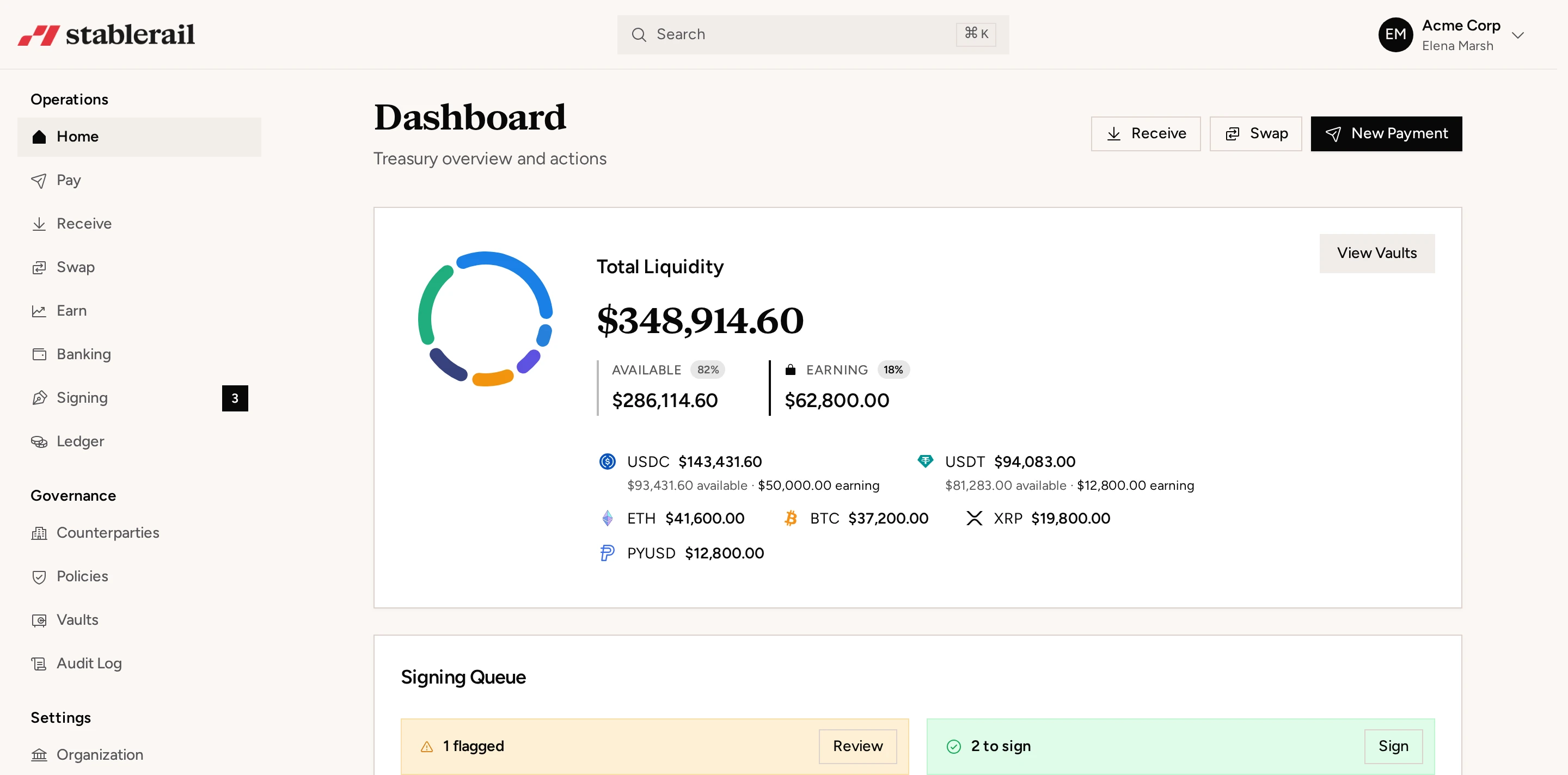
A standalone reconciliation product may be appropriate when treasury uses several custodians, wallets and off-ramps. An integrated account can reduce the records that must be stitched together when it handles more of the workflow. For example, Stablerail brings USDC and USDT treasury, approvals and signing quorum, sanctions and address screening before send, global payouts, fiat off-ramp, corporate cards and exportable audit evidence into one business account.
The best choice is the system that consistently explains why money moved, where it settled and how it reached the ledger. Treat unsupported networks, missing bank statuses, unstable export IDs and weak exception ownership as operational control gaps—not cosmetic product limitations.
Frequently asked questions
What should a stablecoin reconciliation tool track?
It should connect each USDC or USDT movement to a business event, transaction hash, wallet and network, fees, conversion details, fiat settlement and ledger entry. It should also retain approvals, screening results, status changes and supporting references needed for review.
How do you reconcile stablecoin transactions to the general ledger?
Assign a stable business identifier to the invoice, payout or transfer and carry it through the blockchain, conversion, bank settlement and journal records. Post principal, network fees, provider fees and exchange differences separately according to the company’s documented accounting policy.
How should internal transfers between company wallets be reconciled?
Both addresses should be identified as company-controlled and assigned to the correct legal entities. The tool should record the movement between wallets without classifying it as external revenue or expense, while separately accounting for the network fee.
What stablecoin reconciliation exceptions should treasury test?
Test split and batched payments, unidentified receipts, duplicate imports, deducted fees, failed or replaced transactions, wrong-network deposits and returned fiat settlements. The system should show the reason, owner, evidence, approval and resolution history for each exception.
Can blockchain confirmations prove that a stablecoin payout settled?
They prove that the on-chain transaction reached the relevant confirmation state, but not that a related fiat payout reached the beneficiary. Stablecoin-to-fiat workflows require separate tracking for conversion, bank submission, value date, rejection and return status.
Finance writers covering stablecoin treasury, payments, compliance, and risk controls.
More about the Stablerail team- Stablecoin treasury managementApprovals, limits, yield and reporting on one balance.
- Stablecoin payoutsBatch contractor and vendor payments with screening.
- USDT vs USDCWhich stablecoin your company should settle in.
- Stablecoin finance glossaryMPC, off-ramp, travel rule and the rest, in plain English.
- Product updatesEverything we ship, month by month.