
Stablecoin Risk Monitoring Platforms: Audit Logs, RBAC, and Evidence Capture
A procurement guide to stablecoin risk monitoring platforms, covering wallet screening, audit logs, role-based access, case workflows and exportable evidence.
The best stablecoin risk monitoring platform combines accurate USDC and USDT screening with controls that prove how every alert was handled. Finance and compliance teams should require complete audit logs, role-based access, structured case workflows, historical screening snapshots and portable evidence exports. Before buying, test the platform with your actual token contracts, networks, transaction volumes, approval model and record-retention requirements.
%22%20x1%3D%220%22%20y1%3D%220%22%20x2%3D%221%22%20y2%3D%221%22%3E%0A%20%20%20%20%20%20%20%20%3Cstop%20offset%3D%220%25%22%20stop-color%3D%22%23360A0E%22%20%2F%3E%0A%20%20%20%20%20%20%20%20%3Cstop%20offset%3D%2250%25%22%20stop-color%3D%22%23551217%22%20%2F%3E%0A%20%20%20%20%20%20%20%20%3Cstop%20offset%3D%22100%25%22%20stop-color%3D%22%237A1D20%22%20%2F%3E%0A%20%20%20%20%20%20%3C%2FlinearGradient%3E%0A%20%20%20%20%20%20%3CradialGradient%20id%3D%22glow%22%20cx%3D%22878%22%20cy%3D%22448%22%20r%3D%22520%22%20gradientUnits%3D%22userSpaceOnUse%22%3E%0A%20%20%20%20%20%20%20%20%3Cstop%20offset%3D%220%25%22%20stop-color%3D%22%23FFA587%22%20stop-opacity%3D%220.45%22%20%2F%3E%0A%20%20%20%20%20%20%20%20%3Cstop%20offset%3D%2255%25%22%20stop-color%3D%22%23FFA587%22%20stop-opacity%3D%220.08%22%20%2F%3E%0A%20%20%20%20%20%20%20%20%3Cstop%20offset%3D%22100%25%22%20stop-color%3D%22%23FFA587%22%20stop-opacity%3D%220%22%20%2F%3E%0A%20%20%20%20%20%20%3C%2FradialGradient%3E%0A%20%20%20%20%20%20%3ClinearGradient%20id%3D%22glass%22%20x1%3D%220%22%20y1%3D%220%22%20x2%3D%221%22%20y2%3D%221%22%3E%0A%20%20%20%20%20%20%20%20%3Cstop%20offset%3D%220%25%22%20stop-color%3D%22%23F8D6D2%22%20stop-opacity%3D%220.26%22%20%2F%3E%0A%20%20%20%20%20%20%20%20%3Cstop%20offset%3D%22100%25%22%20stop-color%3D%22%23FFFFFF%22%20stop-opacity%3D%220.08%22%20%2F%3E%0A%20%20%20%20%20%20%3C%2FlinearGradient%3E%0A%20%20%20%20%20%20%3ClinearGradient%20id%3D%22accent%22%20x1%3D%220%22%20y1%3D%220%22%20x2%3D%221%22%20y2%3D%221%22%3E%0A%20%20%20%20%20%20%20%20%3Cstop%20offset%3D%220%25%22%20stop-color%3D%22%23FFA587%22%20%2F%3E%0A%20%20%20%20%20%20%20%20%3Cstop%20offset%3D%22100%25%22%20stop-color%3D%22%23DC4A38%22%20%2F%3E%0A%20%20%20%20%20%20%3C%2FlinearGradient%3E%0A%20%20%20%20%20%20%3Cfilter%20id%3D%22soft%22%3E%3CfeGaussianBlur%20stdDeviation%3D%2210%22%20%2F%3E%3C%2Ffilter%3E%0A%20%20%20%20%3C%2Fdefs%3E%0A%20%20%20%20%3Crect%20width%3D%221600%22%20height%3D%22900%22%20fill%3D%22url(%23bg)%22%20%2F%3E%0A%20%20%20%20%3Crect%20width%3D%221600%22%20height%3D%22900%22%20fill%3D%22url(%23glow)%22%20%2F%3E%0A%20%20%20%20%3Crect%20x%3D%22240%22%20y%3D%22240%22%20width%3D%22360%22%20height%3D%22420%22%20rx%3D%2220%22%20fill%3D%22url(%23glass)%22%20stroke%3D%22%23F4CDC5%22%20stroke-opacity%3D%220.55%22%2F%3E%0A%20%20%20%20%20%20%3Crect%20x%3D%22270%22%20y%3D%22290%22%20width%3D%22160%22%20height%3D%2218%22%20rx%3D%224%22%20fill%3D%22%23F8D6D2%22%20opacity%3D%220.6%22%2F%3E%0A%20%20%20%20%20%20%3Crect%20x%3D%22270%22%20y%3D%22370%22%20width%3D%22260%22%20height%3D%2248%22%20rx%3D%226%22%20fill%3D%22%23F8D6D2%22%20opacity%3D%220.8%22%2F%3E%0A%20%20%20%20%20%20%3Cpolyline%20points%3D%22270%2C590%20330%2C560%20390%2C580%20450%2C520%20510%2C540%20570%2C490%22%20fill%3D%22none%22%20stroke%3D%22%23FF8E72%22%20stroke-width%3D%225%22%2F%3E%3Crect%20x%3D%22640%22%20y%3D%22240%22%20width%3D%22360%22%20height%3D%22420%22%20rx%3D%2220%22%20fill%3D%22url(%23glass)%22%20stroke%3D%22%23F4CDC5%22%20stroke-opacity%3D%220.55%22%2F%3E%0A%20%20%20%20%20%20%3Crect%20x%3D%22670%22%20y%3D%22290%22%20width%3D%22160%22%20height%3D%2218%22%20rx%3D%224%22%20fill%3D%22%23F8D6D2%22%20opacity%3D%220.6%22%2F%3E%0A%20%20%20%20%20%20%3Crect%20x%3D%22670%22%20y%3D%22370%22%20width%3D%22260%22%20height%3D%2248%22%20rx%3D%226%22%20fill%3D%22%23F8D6D2%22%20opacity%3D%220.8%22%2F%3E%0A%20%20%20%20%20%20%3Cpolyline%20points%3D%22670%2C590%20730%2C560%20790%2C580%20850%2C520%20910%2C540%20970%2C490%22%20fill%3D%22none%22%20stroke%3D%22%23FF8E72%22%20stroke-width%3D%225%22%2F%3E%3Crect%20x%3D%221040%22%20y%3D%22240%22%20width%3D%22360%22%20height%3D%22420%22%20rx%3D%2220%22%20fill%3D%22url(%23accent)%22%20stroke%3D%22%23F4CDC5%22%20stroke-opacity%3D%220.55%22%2F%3E%0A%20%20%20%20%20%20%3Crect%20x%3D%221070%22%20y%3D%22290%22%20width%3D%22160%22%20height%3D%2218%22%20rx%3D%224%22%20fill%3D%22%23F8D6D2%22%20opacity%3D%220.6%22%2F%3E%0A%20%20%20%20%20%20%3Crect%20x%3D%221070%22%20y%3D%22370%22%20width%3D%22260%22%20height%3D%2248%22%20rx%3D%226%22%20fill%3D%22%23F8D6D2%22%20opacity%3D%220.95%22%2F%3E%0A%20%20%20%20%20%20%3Cpolyline%20points%3D%221070%2C590%201130%2C560%201190%2C580%201250%2C520%201310%2C540%201370%2C490%22%20fill%3D%22none%22%20stroke%3D%22%23FFF1ED%22%20stroke-width%3D%225%22%2F%3E%0A%20%20%20%20%3Crect%20x%3D%2226%22%20y%3D%2226%22%20width%3D%221548%22%20height%3D%22848%22%20rx%3D%2218%22%20fill%3D%22none%22%20stroke%3D%22%23F2D0C8%22%20stroke-opacity%3D%220.12%22%2F%3E%0A%20%20%3C%2Fsvg%3E)
A stablecoin risk monitoring platform should do more than identify a risky address. It should preserve the rule, data, user actions and evidence behind each decision so an auditor or regulator can reconstruct what happened later. For companies moving USDC or USDT, the strongest platform is the one that covers the exact assets and networks in use while enforcing access controls, structured investigations and reliable evidence retention.
What a stablecoin monitoring platform should cover
Stablecoin controls operate at several points in the payment lifecycle. A platform may need to screen a beneficiary before approval, monitor a transaction after broadcast and re-screen past activity when sanctions lists or wallet attribution change.
- Wallet screening: Assess a wallet before onboarding, withdrawal, payout, refund or treasury transfer.
- Transaction monitoring: Review incoming and outgoing transfers for direct or indirect exposure to sanctions, mixers, scams, illicit services and other configured risk categories.
- Ongoing monitoring: Re-screen addresses and transactions when sanctions data, attribution or risk intelligence changes.
- Alert investigation: Assign alerts, gather context, record dispositions and escalate material cases.
- Evidence preservation: Retain the screening result, rule version, timestamps, notes, approvals and supporting files used for the decision.
Coverage must be verified at the token-contract and network level. Support for Ethereum does not automatically establish equivalent coverage for native USDC, bridged versions of USDC or every USDT contract. Teams using Ethereum, Tron, Solana or other networks should submit the exact contracts, address formats and transaction types they expect the vendor to monitor.
Attribution depth can also vary by network and risk type. Ask for sample explanations showing the exposure path, number of hops, counterparty label, label source and date of the underlying intelligence. A high-risk score without an understandable reason is difficult to investigate or defend.
Controls to test during procurement
| Control | Minimum requirement | Practical acceptance test |
|---|---|---|
| Asset and network coverage | Support for every token contract, network and transaction type used by the business | Submit representative USDC and USDT transfers on each production rail and compare the returned data |
| Audit logs | User, configuration, workflow and export events with timestamps and prior values | Change a threshold and confirm the log records the old value, new value, actor and time |
| Role-based access | Separate analyst, approver, administrator and read-only auditor permissions | Attempt restricted actions from each test account and inspect denied-access records |
| Case management | Assignments, structured dispositions, escalation, attachments and approval history | Close a case, reopen it and verify that both states and all comments remain visible |
| Historical evidence | Ability to reproduce or preserve the result used at the time of a decision | Export a case, simulate a label change and confirm the original result is still available |
| Data portability | Bulk export of alerts, cases, notes, attachments and audit records in usable formats | Export a representative data set and have an independent reviewer reconstruct a decision |
| Integration resilience | Documented handling of retries, duplicates, delayed responses and status changes | Send duplicate requests, delay a webhook and interrupt an API call without losing the case trail |
Audit logs
An audit log should cover more than completed transactions. It should record sign-ins, failed access attempts, user and role changes, rule edits, threshold changes, alert assignments, status updates, comments, evidence uploads, approvals and exports.
Do not treat an ordinary activity feed as an immutable record. Ask whether administrators can edit or delete entries, how corrections are represented and whether records are append-only or merely displayed that way. If a vendor describes logs as immutable or tamper-evident, request documentation explaining the technical mechanism, privileged access model and verification process.
Retention and portability matter equally. Confirm how long each log type is retained, whether retention varies by package and whether logs can be exported automatically to storage controlled by your company. The contract should address access to those records when the relationship ends.
Role-based access and separation of duties
Role-based access control should mirror the operating model. Analysts may investigate alerts, managers may approve exceptions or closures, administrators may manage integrations and auditors may need read-only access. No user should receive administrative rights simply because the platform lacks a narrower role.
Test whether access can be scoped by legal entity, business line, jurisdiction, wallet or case type. Also evaluate single sign-on, multi-factor authentication, automated provisioning and deprovisioning, session controls, service-account permissions and the evidence available for periodic access reviews.
Pay particular attention to conflicting permissions. A user who can change a rule and approve cases generated under that rule may bypass intended oversight. The same concern applies if an administrator can delete evidence or alter closure reasons without an independent record.
Case workflows and evidence capture
A case should preserve a complete decision trail. Useful fields include alert owner, priority, linked transfers, exposure path, investigation notes, attachments, disposition, escalation status and manager approval. Structured closure reasons are preferable to free text alone because they support consistent reporting.
Teams should be able to distinguish a false positive from an approved risk exception, a confirmed sanctions match or a referral for further investigation. If an analyst changes the disposition, the original value and reason for the change should remain available.
Evidence must show what was known at the time. A defensible export may include wallet addresses, transaction hashes, asset and network, token contract, risk labels, exposure paths, applicable rule and threshold, screening timestamps, analyst notes, supporting files and approval history. If a wallet is reclassified months later, the company may still need the original screening result that informed its action.
Platforms to include in a shortlist
Chainalysis, TRM Labs, Elliptic, Merkle Science and Scorechain are reasonable candidates for a blockchain analytics and stablecoin monitoring procurement process. This is a shortlist rather than a ranking: product modules, network support, commercial packaging and evidence controls can change, and each claimed capability should be validated directly.
| Platform | Areas to evaluate | Controls to verify explicitly |
|---|---|---|
| Chainalysis | Wallet screening, transaction monitoring and links between alert review and investigation | Audit-log scope, historical snapshots, evidence formats, retention and module dependencies |
| TRM Labs | Screening, alert triage, cross-chain analysis and API or webhook workflows | RBAC granularity, administrator logging, case approvals and evidence preservation |
| Elliptic | API-based screening, analyst review and explanations of wallet or transaction risk | Case-management depth, configuration logs, auditor access and bulk export options |
| Merkle Science | Network coverage, configurable risk monitoring, behavioral indicators and case handling | Permission boundaries, audit-trail protection, data residency and export completeness |
| Scorechain | Asset coverage, monitoring rules, investigations and compliance reporting | Log retention, record alteration controls, approval steps and high-volume processing |
Ask every vendor to map its proposal to your requirements line by line. A capability shown in a demonstration may belong to a different module or service tier. Record whether each requirement is standard, configurable, dependent on another product or unavailable.
How to run a meaningful proof of concept
A polished demonstration is not a proof of operational fitness. Give each vendor the same test set, expected outputs and scoring method. Use production-like examples without exposing unnecessary customer information.
- List every legal entity, wallet, stablecoin contract, blockchain and transaction type in scope.
- Test clean activity plus direct and indirect exposure to your relevant risk categories.
- Create analyst, manager, administrator and auditor accounts to test permission boundaries.
- Change a rule, close and reopen a case, upload evidence and export the full record.
- Test duplicate webhooks, API timeouts, delayed data and chain reorganizations.
- Model normal volume and peak payout periods, including likely alert and case volumes.
Measure more than alert counts. Compare whether the platform explains why an alert fired, how much time an analyst needs to reach a disposition and whether different analysts reach consistent outcomes. Review false positives by risk category rather than relying on a single aggregate rate.
Pricing can depend on addresses screened, transactions monitored, API calls, active users, alerts or investigation modules. Map the charging mechanism to forecast transaction growth and peak activity. Contract review should also cover overage treatment, retention, implementation dependencies, support channels and the process for retrieving data at termination.
Monitoring versus transaction execution controls
Blockchain monitoring identifies and documents risk, but it does not necessarily control who can initiate or approve a transfer. Treasury teams should map monitoring to transaction execution: when screening occurs, what blocks a payment, who can override an alert and how the final approval is recorded.
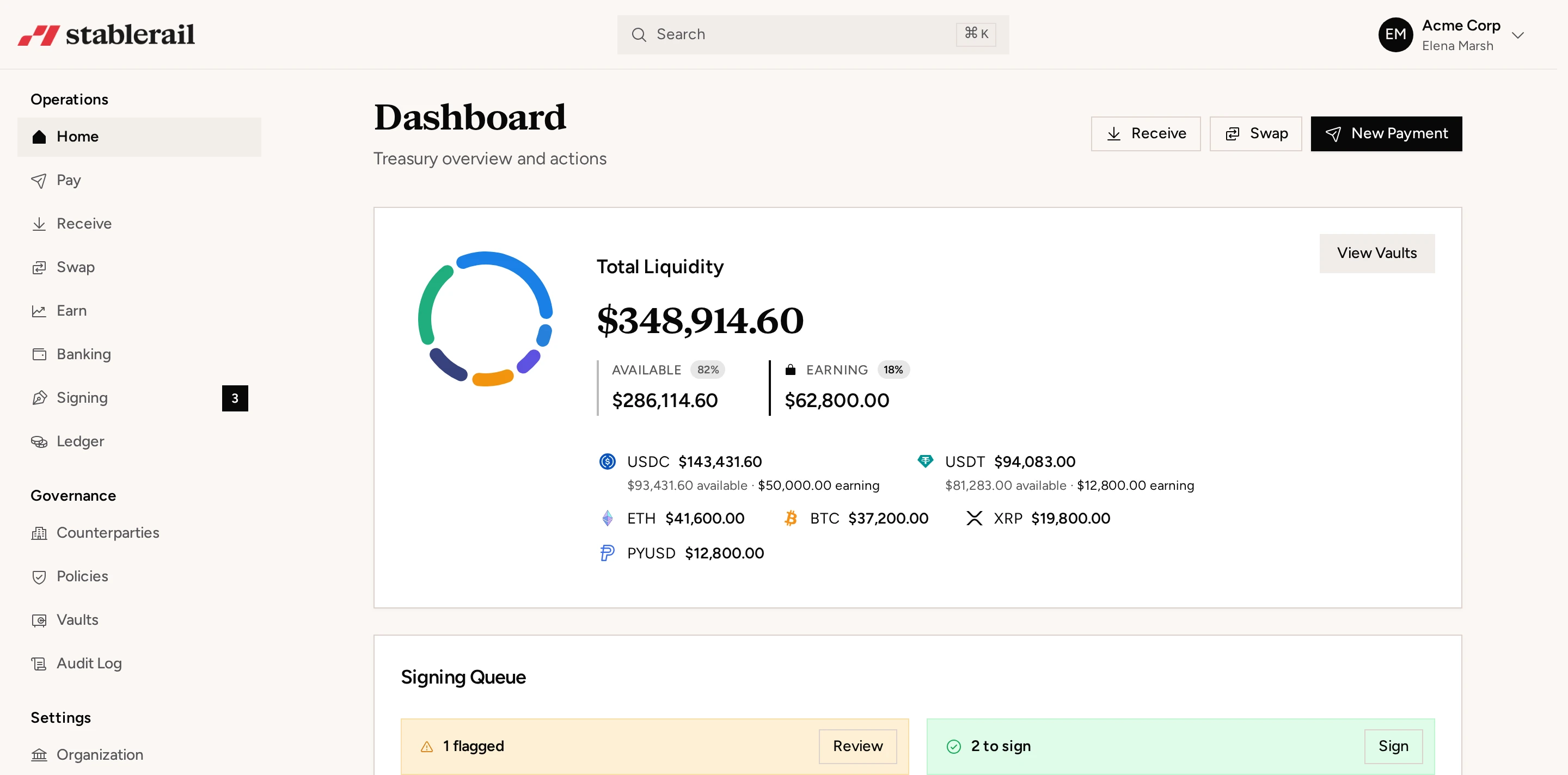
For example, Stablerail combines a business account for USDC and USDT with approvals and signing quorum, sanctions and address screening before send, corporate cards, global payouts, fiat off-ramp and exportable audit evidence. Whether monitoring is embedded in a treasury workflow or integrated from a specialist provider, finance should verify that no unreviewed path can bypass the intended control.
How to choose the right platform
The best platform is not necessarily the one with the most labels or the most detailed demonstration. It is the one that produces understandable alerts on your actual stablecoin rails and preserves enough evidence to defend each decision.
Before approval, finance, compliance, security and legal teams should agree on mandatory controls and assign an owner to each one. Treat unsupported networks, incomplete audit histories, weak role separation and non-portable case data as control gaps rather than implementation details. The final decision should be supported by test results, contractual commitments and a documented plan for integrations, access reviews, retention and vendor exit.
Frequently asked questions
What should a stablecoin risk monitoring platform include?
It should include wallet screening, transaction monitoring, ongoing re-screening, structured alert investigation and exportable evidence. It should also provide complete audit logs, role-based access and coverage for the exact USDC or USDT contracts and networks the business uses.
How do you test audit logs in a crypto monitoring platform?
Change a rule or threshold and confirm the log captures the previous value, new value, user and timestamp. Also test role changes, case updates, evidence uploads, approvals and exports, then verify whether administrators can alter or delete any record.
What evidence should be retained for a stablecoin transaction alert?
Retain the wallet address, transaction hash, token contract, network, risk labels, exposure path, applicable rule, threshold and screening timestamp. The record should also include analyst notes, attachments, disposition changes and approval history.
How should companies compare Chainalysis, TRM Labs and Elliptic?
Run the same representative transactions through each platform and compare network coverage, alert explanations, analyst workflow, audit logs, RBAC and export quality. Verify every requirement contractually because capabilities may depend on the selected module or package.
Is wallet screening enough for USDC and USDT payments?
No. Pre-transaction wallet screening is important, but companies may also need post-transaction monitoring and ongoing re-screening when sanctions lists or wallet attribution change. Screening should be connected to approvals, exception handling and evidence retention.
What is the difference between stablecoin monitoring and treasury controls?
Monitoring identifies and documents blockchain risk, while treasury controls govern who can initiate, approve and sign a payment. A strong operating model connects the two so a flagged transaction cannot bypass required review or approval.
Finance writers covering stablecoin treasury, payments, compliance, and risk controls.
More about the Stablerail team- Stablecoin treasury managementApprovals, limits, yield and reporting on one balance.
- Stablecoin payoutsBatch contractor and vendor payments with screening.
- USDT vs USDCWhich stablecoin your company should settle in.
- Stablecoin finance glossaryMPC, off-ramp, travel rule and the rest, in plain English.
- Product updatesEverything we ship, month by month.