
How to Maintain Oversight of Autonomous Finance Workflows
A practical control framework for autonomous finance workflows covering permissions, approval thresholds, destination controls, monitoring, kill switches and audit logs.
Maintain oversight of autonomous finance workflows by defining a narrow operating envelope, separating creation from approval and signing, and routing anything uncertain to human review. Set transaction and aggregate limits, restrict assets, networks and destinations, monitor transactions through settlement, and preserve complete audit evidence. Finance leaders should also control policy changes, test independent kill switches and expand automation only after measured performance reviews.
%22%20x1%3D%220%22%20y1%3D%220%22%20x2%3D%221%22%20y2%3D%221%22%3E%0A%20%20%20%20%20%20%20%20%3Cstop%20offset%3D%220%25%22%20stop-color%3D%22%232A0608%22%20%2F%3E%0A%20%20%20%20%20%20%20%20%3Cstop%20offset%3D%2250%25%22%20stop-color%3D%22%23420D12%22%20%2F%3E%0A%20%20%20%20%20%20%20%20%3Cstop%20offset%3D%22100%25%22%20stop-color%3D%22%23621619%22%20%2F%3E%0A%20%20%20%20%20%20%3C%2FlinearGradient%3E%0A%20%20%20%20%20%20%3CradialGradient%20id%3D%22glow%22%20cx%3D%22454%22%20cy%3D%22122%22%20r%3D%22520%22%20gradientUnits%3D%22userSpaceOnUse%22%3E%0A%20%20%20%20%20%20%20%20%3Cstop%20offset%3D%220%25%22%20stop-color%3D%22%23FF9577%22%20stop-opacity%3D%220.45%22%20%2F%3E%0A%20%20%20%20%20%20%20%20%3Cstop%20offset%3D%2255%25%22%20stop-color%3D%22%23FF9577%22%20stop-opacity%3D%220.08%22%20%2F%3E%0A%20%20%20%20%20%20%20%20%3Cstop%20offset%3D%22100%25%22%20stop-color%3D%22%23FF9577%22%20stop-opacity%3D%220%22%20%2F%3E%0A%20%20%20%20%20%20%3C%2FradialGradient%3E%0A%20%20%20%20%20%20%3ClinearGradient%20id%3D%22glass%22%20x1%3D%220%22%20y1%3D%220%22%20x2%3D%221%22%20y2%3D%221%22%3E%0A%20%20%20%20%20%20%20%20%3Cstop%20offset%3D%220%25%22%20stop-color%3D%22%23F8D6D2%22%20stop-opacity%3D%220.26%22%20%2F%3E%0A%20%20%20%20%20%20%20%20%3Cstop%20offset%3D%22100%25%22%20stop-color%3D%22%23FFFFFF%22%20stop-opacity%3D%220.08%22%20%2F%3E%0A%20%20%20%20%20%20%3C%2FlinearGradient%3E%0A%20%20%20%20%20%20%3ClinearGradient%20id%3D%22accent%22%20x1%3D%220%22%20y1%3D%220%22%20x2%3D%221%22%20y2%3D%221%22%3E%0A%20%20%20%20%20%20%20%20%3Cstop%20offset%3D%220%25%22%20stop-color%3D%22%23FF9577%22%20%2F%3E%0A%20%20%20%20%20%20%20%20%3Cstop%20offset%3D%22100%25%22%20stop-color%3D%22%23D03B2D%22%20%2F%3E%0A%20%20%20%20%20%20%3C%2FlinearGradient%3E%0A%20%20%20%20%20%20%3Cfilter%20id%3D%22soft%22%3E%3CfeGaussianBlur%20stdDeviation%3D%2210%22%20%2F%3E%3C%2Ffilter%3E%0A%20%20%20%20%3C%2Fdefs%3E%0A%20%20%20%20%3Crect%20width%3D%221600%22%20height%3D%22900%22%20fill%3D%22url(%23bg)%22%20%2F%3E%0A%20%20%20%20%3Crect%20width%3D%221600%22%20height%3D%22900%22%20fill%3D%22url(%23glow)%22%20%2F%3E%0A%20%20%20%20%0A%20%20%3Crect%20x%3D%22480%22%20y%3D%22200%22%20width%3D%22640%22%20height%3D%22500%22%20rx%3D%2232%22%20fill%3D%22url(%23glass)%22%20stroke%3D%22%23F4CDC5%22%20stroke-opacity%3D%220.6%22%20stroke-width%3D%223%22%2F%3E%0A%20%20%3Ccircle%20cx%3D%22800%22%20cy%3D%22450%22%20r%3D%22180%22%20fill%3D%22none%22%20stroke%3D%22%23F4CDC5%22%20stroke-opacity%3D%220.6%22%20stroke-width%3D%226%22%2F%3E%0A%20%20%3Ccircle%20cx%3D%22800%22%20cy%3D%22450%22%20r%3D%22130%22%20fill%3D%22url(%23glass)%22%20stroke%3D%22%23F4CDC5%22%20stroke-opacity%3D%220.5%22%2F%3E%0A%20%20%3Ccircle%20cx%3D%22800%22%20cy%3D%22450%22%20r%3D%2236%22%20fill%3D%22url(%23accent)%22%2F%3E%0A%20%20%3Crect%20x%3D%22966.5737087954692%22%20y%3D%22444.20738290522195%22%20width%3D%2216%22%20height%3D%2236%22%20rx%3D%223%22%20fill%3D%22%23F4CDC5%22%20opacity%3D%220.7%22%20transform%3D%22rotate(4%20974.5737087954692%20462.20738290522195)%22%2F%3E%3Crect%20x%3D%22906.8103300733387%22%20y%3D%22564.0741765389851%22%20width%3D%2216%22%20height%3D%2236%22%20rx%3D%223%22%20fill%3D%22%23F4CDC5%22%20opacity%3D%220.7%22%20transform%3D%22rotate(49%20914.8103300733387%20582.0741765389851)%22%2F%3E%3Crect%20x%3D%22779.792617094778%22%20y%3D%22606.5737087954692%22%20width%3D%2216%22%20height%3D%2236%22%20rx%3D%223%22%20fill%3D%22%23F4CDC5%22%20opacity%3D%220.7%22%20transform%3D%22rotate(94%20787.792617094778%20624.5737087954692)%22%2F%3E%3Crect%20x%3D%22659.9258234610149%22%20y%3D%22546.8103300733387%22%20width%3D%2216%22%20height%3D%2236%22%20rx%3D%223%22%20fill%3D%22%23F4CDC5%22%20opacity%3D%220.7%22%20transform%3D%22rotate(139%20667.9258234610149%20564.8103300733387)%22%2F%3E%3Crect%20x%3D%22617.4262912045308%22%20y%3D%22419.79261709477817%22%20width%3D%2216%22%20height%3D%2236%22%20rx%3D%223%22%20fill%3D%22%23F4CDC5%22%20opacity%3D%220.7%22%20transform%3D%22rotate(184%20625.4262912045308%20437.79261709477817)%22%2F%3E%3Crect%20x%3D%22677.1896699266612%22%20y%3D%22299.92582346101494%22%20width%3D%2216%22%20height%3D%2236%22%20rx%3D%223%22%20fill%3D%22%23F4CDC5%22%20opacity%3D%220.7%22%20transform%3D%22rotate(229%20685.1896699266612%20317.92582346101494)%22%2F%3E%3Crect%20x%3D%22804.207382905222%22%20y%3D%22257.42629120453074%22%20width%3D%2216%22%20height%3D%2236%22%20rx%3D%223%22%20fill%3D%22%23F4CDC5%22%20opacity%3D%220.7%22%20transform%3D%22rotate(274%20812.207382905222%20275.42629120453074)%22%2F%3E%3Crect%20x%3D%22924.0741765389851%22%20y%3D%22317.1896699266612%22%20width%3D%2216%22%20height%3D%2236%22%20rx%3D%223%22%20fill%3D%22%23F4CDC5%22%20opacity%3D%220.7%22%20transform%3D%22rotate(319%20932.0741765389851%20335.1896699266612)%22%2F%3E%0A%0A%20%20%20%20%3Crect%20x%3D%2226%22%20y%3D%2226%22%20width%3D%221548%22%20height%3D%22848%22%20rx%3D%2218%22%20fill%3D%22none%22%20stroke%3D%22%23F2D0C8%22%20stroke-opacity%3D%220.12%22%2F%3E%0A%20%20%3C%2Fsvg%3E)
Autonomous finance workflows should operate inside explicit boundaries rather than receive general authority over company funds. Finance remains accountable for deciding which accounts, assets, networks, beneficiaries, amounts and payment rails a workflow may use. The workflow can automate routine execution, but exceptions, policy changes and high-risk actions should remain under human control.
The objective is not to approve every transaction manually. It is to make routine activity predictable, prevent the workflow from expanding its own authority and give operators enough evidence to reconstruct every decision from request through settlement.
Start with a written operating envelope
An operating envelope defines the conditions under which a workflow may act without intervention. It should be precise enough that an operator, auditor or system can determine why a proposed transaction was processed, escalated or blocked.
| Control | Decision to document | Illustrative rule |
|---|---|---|
| Accounts and assets | Which balances may the workflow use? | Use USDC from the contractor payout balance only |
| Network | On which blockchain may the asset move? | USDC on Base; other networks require review |
| Destinations | Who may receive funds? | Verified contractor wallets on an allowlist |
| Transaction limit | How much may one payment move? | Process automatically up to an approved threshold |
| Aggregate limit | How much may move over a period? | Stop when the daily workflow limit is reached |
| Approval trigger | When must a person intervene? | Require controller approval for new or changed payment data |
| Stop condition | What suspends autonomous activity? | Pause after repeated failures or a screening alert |
The examples are not recommended defaults. Limits should reflect the company’s liquidity, transaction pattern, staffing model and risk tolerance. Payroll, vendor payouts and treasury conversions usually require different envelopes.
Define stablecoin permissions by both asset and network. Authority to transfer USDC on Ethereum should not automatically permit USDC transfers on Base, Arbitrum, Polygon, Optimism or Solana. The same principle applies to USDT across networks such as Ethereum and Tron. Each asset-and-network combination has distinct addressing, fee, confirmation and operational considerations.
Use scoped permissions and separation of duties
Give each workflow only the access required for its assigned task. A contractor payment process may need to read approved invoices, create payment drafts and monitor status. It should not necessarily be able to add beneficiaries, change limits, convert unrestricted treasury balances or approve its own transactions.
Separate permissions for:
- Viewing balances and transaction status
- Creating drafts or payment instructions
- Submitting transactions for approval
- Approving, signing or broadcasting transactions
- Adding or changing beneficiaries
- Converting fiat and stablecoins
- Changing policies, limits, credentials or workflow logic
The workflow must not be able to grant itself broader authority. Administrative changes should require controlled human access, documented approval and an audit record showing the old value, new value, approver and effective time.
Cryptographic signing controls can provide another separation layer. Multi-party computation can distribute signing operations among authorised participants, while a signing quorum can require multiple parties before execution. These controls do not replace business approval: a technically valid signature does not prove that the invoice, beneficiary or amount was appropriate.
Combine transaction, batch and period limits
A per-transaction cap alone is inadequate because a workflow could divide a large amount into many smaller payments. Apply controls at several levels: each payment, the total batch, cumulative activity over a defined period and the available balance reserved for the workflow.
A practical decision model has three outcomes:
- Process: The beneficiary, amount, asset, network, supporting record and timing all match policy.
- Review: The payment is plausible but exceeds a threshold, contains changed data or falls outside an expected pattern.
- Block: The destination, asset or network is prohibited, screening produces a blocking result, or a hard limit has been reached.
For batch payments, validate every item and the total before signing. A batch can contain individually valid payments while still creating an unexpected liquidity event. Confirm the funding balance, network, estimated network fee, recipient addresses and duplicate-payment checks at the final approval stage.
Apply equivalent controls to fiat. The workflow should not select a faster or more expensive rail unless policy permits it. Approval data should identify the destination, currency, route, quoted conversion amount, disclosed fee and expected recipient amount where those fields apply.
Keep destination changes outside the autonomous path
Adding a beneficiary is materially different from paying an established beneficiary. Separate destination administration from payment approval so one compromised process cannot both redirect and release funds.
A controlled setup process should verify bank details or wallet ownership, screen relevant names and addresses, record who requested the change and require a second authorised person to approve it. Sanctions and address screening should occur before a stablecoin payment is sent, not only when the destination is first added. A previously accepted address can produce new risk information later.
A cooling-off period can provide time to detect fraudulent change requests, although it does not replace verification. Urgent overrides should require a documented reason, additional approval and enhanced review rather than silently bypassing the control.
Send ambiguity to an exception queue
Automation should escalate uncertainty instead of guessing. A central exception queue lets finance operators prioritise items without searching across payment tools, messages and spreadsheets.
Common exceptions include:
- An invoice amount that does not match the payment request
- A new or recently changed beneficiary
- An address that fails screening or cannot be classified
- A duplicate invoice number or repeated payment reference
- Insufficient funds or an unexpected fee requirement
- A conversion quote outside the approved tolerance
- A transaction pending longer than the defined expectation
Each exception should display the triggering rule, source data, supporting documents, prior actions and available reviewer decisions. Preserve the original record when an operator corrects or resubmits an item. Otherwise, the audit trail may show only the final version and conceal why intervention was required.
Monitor the transaction through settlement
Oversight continues after a transaction is created or signed. Track lifecycle states such as created, approved, signed, broadcast, confirmed, settled, failed and returned. Define which state permits the accounting system to mark an obligation as paid. Creating an instruction or receiving a transaction identifier is not the same as settlement.
Reconcile completed activity against bank statements, stablecoin wallet or vault records, invoices, payment files and the general ledger. The reconciliation process should identify missing entries, duplicates, fee differences, returned fiat payments and stablecoin transactions that remain unconfirmed under the company’s chosen criteria.
Alerts should correspond to actions an operator can take. Useful conditions include unusual volume, repeated failures, balance shortfalls, activity outside expected hours, a sudden increase in destination changes or transactions approaching an aggregate limit. Assign each alert an owner, severity and response procedure to prevent a high-volume alert feed from becoming background noise.
Design independent kill switches
A kill switch should stop autonomous activity without deleting evidence or preventing authorised staff from handling urgent transactions manually. Protect the stop mechanism from the workflow it controls and document who can activate and release it.
Use more than one level where the system supports it:
- Pause a single workflow, such as contractor payouts
- Disable one beneficiary, asset or network
- Stop conversions while leaving approved payments available
- Prevent signing or broadcasting from a specific account
- Suspend all automated transaction creation
Test kill switches with a low-risk simulation. Verify that pending items are handled predictably, notifications reach the right people, records remain accessible and restarting does not duplicate previously submitted payments.
Retain evidence that explains each decision
An audit log should show both what happened and why. For each transaction or control change, retain the timestamp, unique identifier, initiating user or system, source account, asset, network, destination, amount, fee, payment reference and final status.
Also retain policy checks and their results, screening evidence, approvals and rejections, signing events, manual overrides, related invoices or payroll files, and changes to permissions, limits and allowlists. Exportable evidence should connect the original request to approval, execution, settlement and accounting treatment.
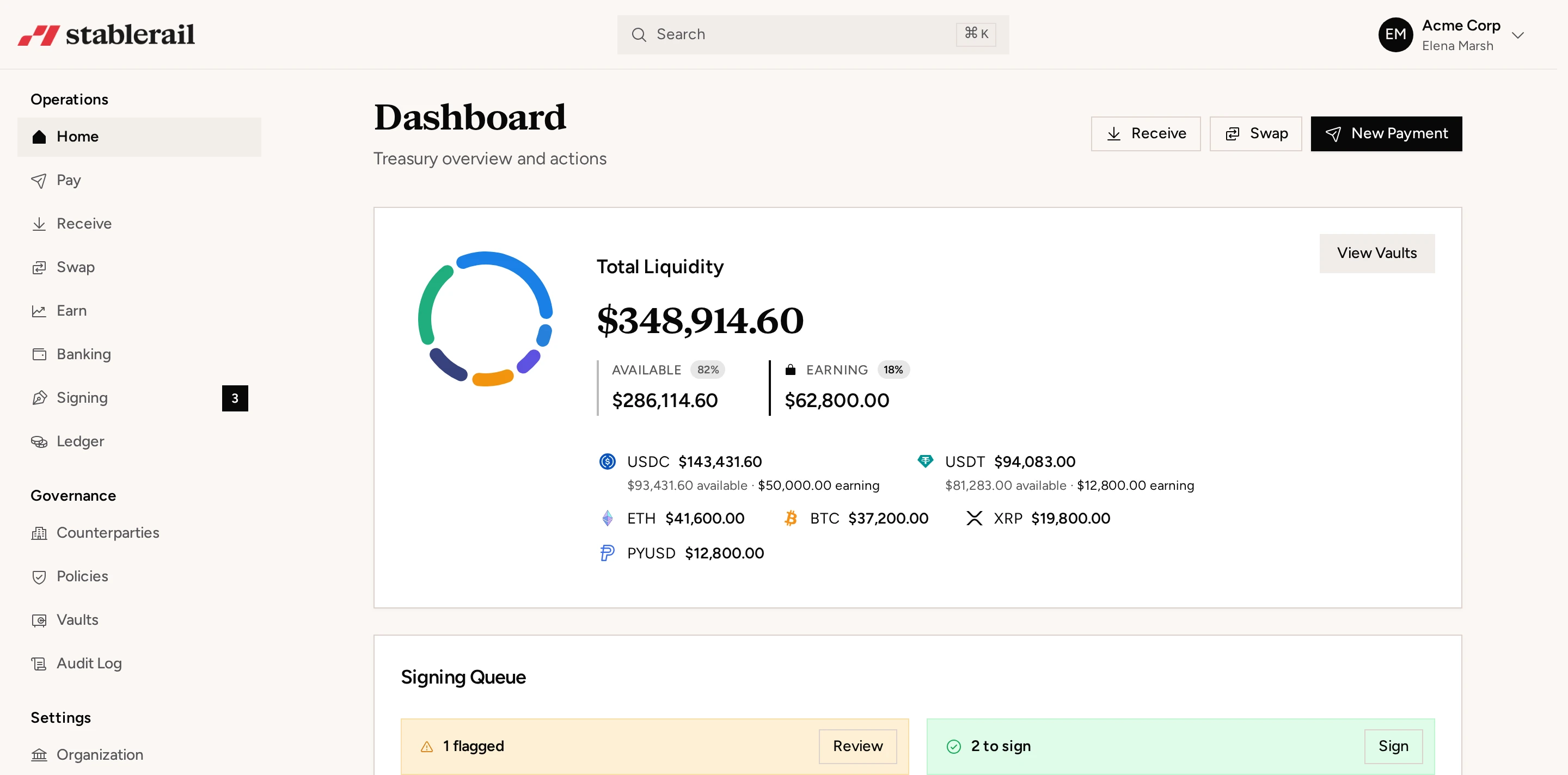
Stablerail, for example, combines a business account for USDC and USDT treasury with approvals and signing quorum, sanctions and address screening before send, global payouts, fiat off-ramp, corporate cards and exportable audit evidence. Whatever system a company uses, finance should confirm that records can be exported in a durable format and reconciled independently.
Roll out autonomy in measured stages
Do not begin with unrestricted transaction execution. Expand authority only after observing how the workflow performs under narrower permissions.
- Observe: Run read-only monitoring and compare proposed actions with operator decisions.
- Draft: Let the workflow prepare payments while people review every item.
- Constrain: Permit low-risk transactions for established beneficiaries within narrow limits.
- Measure: Review exception rates, failures, reconciliation breaks, overrides and time to resolution.
- Expand: Increase scope only through an approved policy change with rollback criteria.
Before each expansion, confirm that permissions remain least-privileged, aggregate limits cannot be bypassed, destination changes are separately controlled, alerts have owners, kill switches work and evidence exports are complete. Reassess the operating envelope after material changes to banking partners, blockchain networks, workflow logic, transaction volume or treasury policy.
Autonomy is safest when routine execution is broad enough to create operational value but bounded enough that unusual activity stops or reaches a person. The finance team should always be able to explain what the workflow was allowed to do, why a transaction proceeded and how the company could have stopped it.
Frequently asked questions
How do you control an autonomous finance workflow?
Define an operating envelope covering accounts, assets, networks, destinations, transaction limits, aggregate limits and approval triggers. Keep policy changes and beneficiary administration under separate human control, and route anything outside the envelope to an exception queue.
What approval limits should an autonomous payment workflow have?
Use limits for each transaction, each batch and cumulative activity over a defined period. Set the actual thresholds from the company’s liquidity, payment profile and risk tolerance rather than adopting a generic amount.
What should trigger human review of an automated payment?
Human review should be triggered by new or changed beneficiaries, threshold breaches, data mismatches, duplicate indicators, screening results, unusual timing or volume, and conversion quotes outside tolerance. The reviewer should see the triggering rule and supporting evidence before deciding.
What should an autonomous finance audit log contain?
The log should connect the original request to policy checks, approvals, signing, execution, settlement and accounting. It should also record permission changes, overrides, screening evidence, supporting documents, failures and returns.
Does MPC signing replace payment approvals?
No. MPC and signing quorums can distribute signing authority and prevent a single credential from executing a transaction, but they do not establish whether the payment is commercially valid. Invoice validation, beneficiary controls and business approval remain separate requirements.
Finance writers covering stablecoin treasury, payments, compliance, and risk controls.
More about the Stablerail team- Stablecoin treasury managementApprovals, limits, yield and reporting on one balance.
- Stablecoin payoutsBatch contractor and vendor payments with screening.
- USDT vs USDCWhich stablecoin your company should settle in.
- Stablecoin finance glossaryMPC, off-ramp, travel rule and the rest, in plain English.
- Product updatesEverything we ship, month by month.