
Sanctions Risk Aggregation: How It Works
How pre-sign sanctions screening combines lists, taint analysis, and policy-as-code to PASS/FLAG/BLOCK stablecoin payments with audit trails.

Sanctions risk aggregation ensures payments comply with global regulations by analyzing risks before transactions are executed. It consolidates data from sanctions lists, blockchain analysis, and counterparty behavior into a single decision - PASS, FLAG, or BLOCK - before funds move. This preemptive approach is vital for stablecoins, where transactions are irreversible.
Key takeaways:
Why it matters: Violating sanctions can lead to severe penalties, with OFAC fines exceeding $1 billion (2023–2024).
How it works: Systems check sanctions lists, analyze wallet activity, and enforce policies to stop risky payments.
Automation: Pre-signature checks and tamper-proof audit trails replace manual reviews, ensuring compliance and transparency.
With stablecoin adoption growing rapidly, automated compliance systems are no longer optional - they are critical for preventing costly violations.
Data Sources Used for Sanctions Screening
Government and International Sanctions Lists
Sanctions screening systems primarily rely on official government and international lists. These include the U.S. Treasury's Office of Foreign Assets Control (OFAC) Specially Designated Nationals (SDN) List, the United Nations Security Council Sanctions Lists, and the EU Consolidated List. These lists identify individuals, entities, and addresses banned from engaging in financial transactions.
To ensure accuracy, these lists are updated frequently, often through real-time API access, which helps reduce delays that could lead to regulatory violations. Screening systems also need to consider the 50 Percent Rule, which blocks entities not explicitly named but owned 50% or more - either individually or collectively - by sanctioned individuals or entities. This requires an in-depth analysis of ownership structures, going beyond surface-level data like names or wallet addresses to identify the entities controlling them. While these official lists form the foundation, additional layers of commercial data help refine the screening process.
Commercial Data Providers
In addition to government sources, commercial data providers play a critical role in enriching and contextualizing sanctions screening. Providers like LSEG World-Check, Dow Jones, Moody’s, Chainalysis, and TRM Labs offer additional metadata such as aliases, phonetic variations, transliterations, dates of birth, physical addresses, and wallet addresses. This extra information helps uncover risks that might not be evident from official lists alone.
Commercial data providers also supply insights into Politically Exposed Persons (PEPs) and adverse media reports, which can highlight potential risks even before formal sanctions are imposed. For blockchain transactions, these providers use advanced wallet clustering techniques to link multiple wallet addresses to a single entity, revealing hidden connections that government lists may not capture.
OFAC Basics: Sanctions List Search
How the Sanctions Risk Aggregation Workflow Operates
Sanctions Risk Aggregation Workflow: From Payment Intent to Transaction Verdict
From Payment Intent to Risk Dossier
The process begins when a user creates a payment intent - essentially a record of who you want to pay, how much, and why. This intent can be logged through various formats like PDF, CSV, or API. Once logged, the system kicks off automated screening.
Before any money changes hands, the system conducts pre-signing compliance checks. These include cross-referencing global sanctions lists, performing taint analysis on the recipient's wallet address, and identifying behavioral anomalies, such as odd transaction times or amounts that stray from typical patterns. All findings are compiled into a Risk Dossier, which provides both a risk score and a straightforward explanation of the results. This automated process replaces manual methods like spreadsheets and chat approvals while creating a clear audit trail. The insights from the Risk Dossier then determine the transaction’s outcome, explained in the next section.
How PASS/FLAG/BLOCK Verdicts Work
Each transaction is assigned one of three outcomes based on the Risk Dossier:
PASS: No risks detected. This means the recipient isn’t on any sanctions lists, the transaction complies with policy limits, and the counterparty is recognized. The payment proceeds directly to signing.
FLAG: Indicates potential concerns, such as a new payee, a high-value transfer, or an unusual timing (e.g., weekends). These require human review before moving forward.
BLOCK: Represents serious risks, such as a match with an SDN list, a sanctioned location, or indications of terrorist financing. These transactions are automatically stopped.
Verdict
Action Taken
Triggers
PASS
Transaction proceeds
No sanctions matches; within policy limits; known counterparty
FLAG
Human review required
New payee; high-value transfer; off-hours activity; minor taint detected
BLOCK
Automatic halt/freeze
SDN list match; sanctioned region; severe terrorist financing concerns
Regulators demand transparency, requiring firms to explain why a match was flagged or why an alert wasn’t triggered. This makes thorough documentation critical. For FLAG or BLOCK cases, human intervention is essential, as described below.
When Human Approvers Step In
Once a transaction is flagged, it’s escalated for human review to ensure compliance before any funds are moved. Approvers analyze the Risk Dossier and decide whether to approve or reject the payment. To execute the transfer, the system requires an MPC-based signature, ensuring no single person or system can act alone.
After approval, the system generates a Proof-of-Control receipt, which logs the payment intent, risk verdict, approver details, and timestamp, creating a tamper-proof audit trail. For example, in 2024–25, the UK's OFSI reported 394 suspected sanctions breaches. This workflow replaces informal, undocumented approvals with formal records, ensuring compliance is demonstrable at every step.
Processing and Normalizing Risk Signals
Data Normalization Methods
Sanctions data from sources like OFAC, the EU, and the UN comes in various formats, such as XML, CSV, and JSON. Each source structures its data differently, with distinct naming conventions and field definitions. To make this data usable, it’s parsed and reorganized into a single, consistent internal schema. This unified structure allows seamless querying across all lists, no matter how the original data was formatted.
One of the biggest hurdles is dealing with inconsistencies. For example, a sanctioned individual’s name might be spelled differently across various lists. To handle these variations, systems use fuzzy matching techniques like Levenshtein distance, which identifies close matches while minimizing false positives.
Advanced systems take this a step further by automating the entire data ingestion process. They pull updated data via APIs as soon as new sanctions are announced. As AML Analytics highlights:
It is not the system alone that determines effectiveness, but how well institutions configure, maintain, and evidence the way it is used.
This normalized data forms the backbone for more detailed processes, such as counterparty scoring and taint analysis.
Counterparty Scoring and Taint Analysis
Once the data is normalized, the system evaluates the risk associated with each payment recipient. This involves list matching and taint analysis, which tracks fund flows across wallets and protocols to uncover hidden risks that might not surface during direct screenings.
The system combines multiple signals - such as fuzzy match confidence, geographic factors, unusual behaviors like transfers at odd hours, and taint levels - into a single, standardized risk score. This score feeds into a Risk Dossier, which delivers a clear verdict: PASS, FLAG, or BLOCK. Each decision includes a plain-English explanation of how it was reached.
The stakes for compliance are enormous. Between 2023 and 2024, OFAC enforcement actions surpassed $1 billion, while the UK's OFSI investigated 394 suspected sanctions breaches in 2024–25. Regulators increasingly demand "explainability", requiring firms to clearly show how matches are generated and to justify their tuning decisions.
Policy-as-Code Governance and Decision Logic
Setting Up Machine-Enforceable Policies
Policy-as-code governance takes the insights from pre-sign checks and uses them to enforce transaction approvals automatically. By aggregating and scoring sanctions risk signals, businesses can link these insights to specific rules that dictate the next steps. This approach transforms informal approval methods - like Slack messages, emails, or verbal agreements - into automated, programmatic rules that execute before any payment is finalized.
Finance teams can define specific conditions to trigger actions. For instance, rules like:
"Payments to new addresses exceeding $5,000 require CFO approval and verification."
"Weekend transfers above $10,000 need additional approval."
"Only USDC transactions on Base/Ethereum are allowed."
These rules become enforceable policies that automatically apply to every transaction. Each workflow ensures that risk checks are performed in real time before a signature is made, with every decision logged in tamper-proof records. This prevents any circumvention of established protocols.
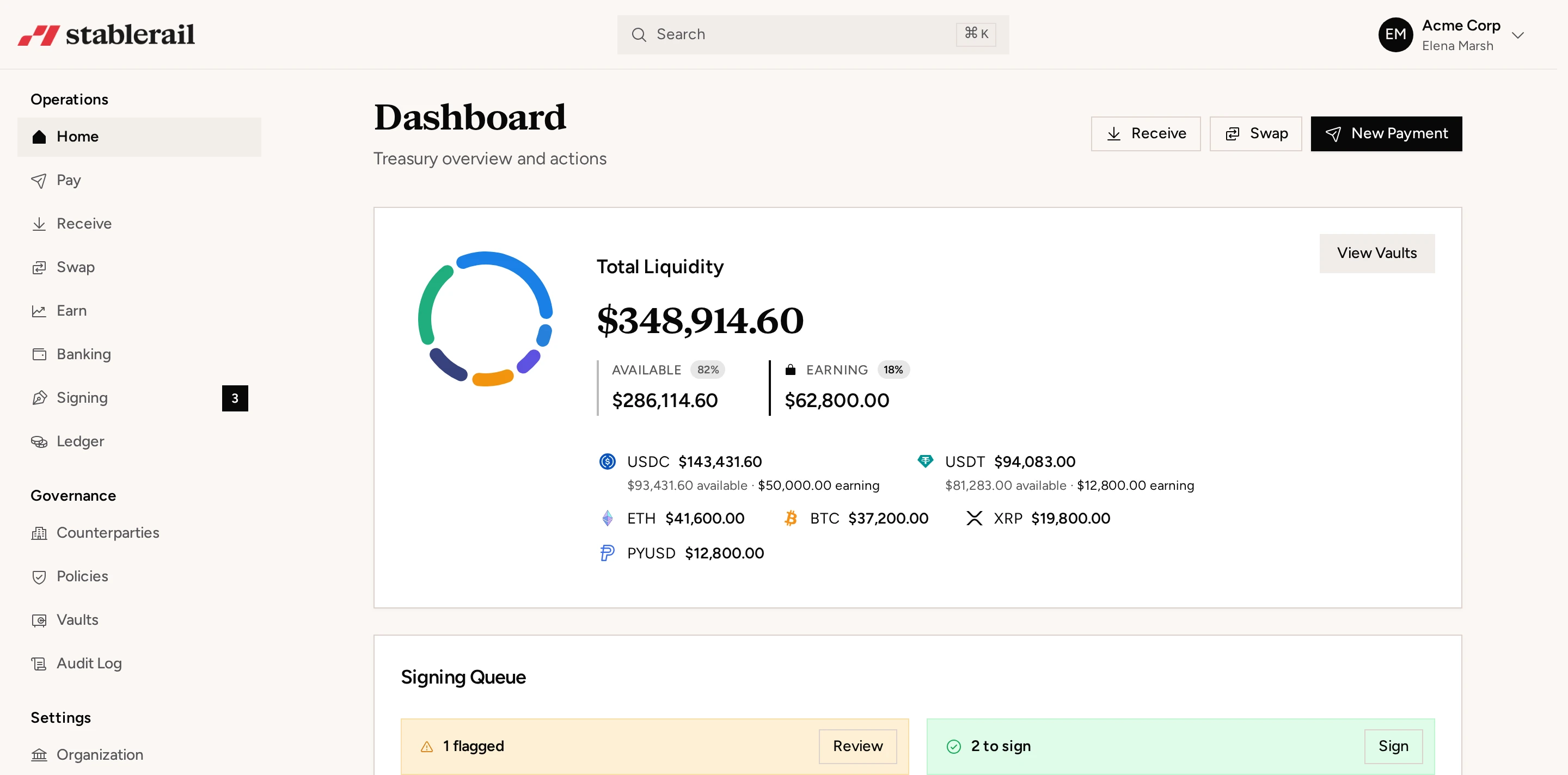
Tools like Stablerail bring this concept to life through a Policy Console, where teams can configure roles, approval chains, and transaction limits. When a payment intent is created, specialized agents evaluate it against these policies, alongside sanctions screening, taint analysis, and anomaly detection. The output is a Risk Dossier, which delivers a clear verdict - PASS, FLAG, or BLOCK - along with plain-English explanations that reference specific policy rules and timestamps.
This entire process feeds into an immutable audit trail, ensuring that every step is recorded and tamper-proof, as discussed in the next section.
Building Audit Trails for Compliance
Regulators demand more than just blocking sanctioned addresses - they want clarity on how decisions are made. Recent enforcement actions highlight the stakes: U.S. OFAC penalties in 2023–2024 exceeded $1 billion, while the UK's OFSI reported 394 suspected breach cases by 2024–25. A recurring issue? Poor documentation of compliance processes.
Policy-as-code addresses this by creating detailed, defensible audit trails. Every action in the transaction lifecycle - intent creation, sanctions checks, policy evaluations, and final approvals - is logged with timestamps, data sources, and references to the applied rules. If a transaction is flagged, the system records which rule triggered the alert and why. Decisions made by approvers - whether to approve, reject, or override a rule with justification - are logged immutably. Even the signing event is captured with cryptographic proof.
This comprehensive audit trail connects back to the initial risk evaluation and policy enforcement, ensuring every decision is documented from start to finish.
For auditors, this means having a complete chain of evidence. They can see which policy rule applied, the sanctions lists checked (along with their update timestamps), the calculated risk score, and the rationale behind the approver's decision. With automated API-based list ingestion, updates to sanctions lists - like new OFAC designations - are immediately reflected in the policy engine, leaving no gaps in enforcement.
Explainability is also becoming a key focus. Regulators now expect firms to clearly demonstrate how alerts are generated and justify any tuning decisions. Policy-as-code simplifies this process by automatically generating a detailed alert lineage, turning what was once a labor-intensive documentation task into a seamless system output. This ensures transparency and compliance without adding extra work for finance teams.
Conclusion
Managing sanctions risk is now a critical requirement for companies dealing with stablecoin payments. Unlike traditional bank transfers, blockchain transactions are irreversible, meaning sanctions checks must be completed before signing a transaction.
The stakes are high: U.S. OFAC enforcement actions in 2023–2024 surpassed $1 billion, while the UK's OFSI reported 394 suspected breach cases in 2024–2025. Regulators now expect firms to have robust, explainable controls capable of halting a transaction before any violation occurs. Relying on manual processes like spreadsheets, Slack approvals, or hardware wallets simply can’t meet the level of precision and scalability required.
This is where automated, pre-sign compliance systems become indispensable. Stablerail provides a solution by integrating sanctions lists, taint analysis, and policy rules into a unified pre-sign workflow. Finance teams can define enforceable policies, and specialized agents generate a Risk Dossier with clear outcomes - PASS, FLAG, or BLOCK - linked to specific policy clauses and timestamps. This approach preserves the speed of blockchain settlements while upholding the governance standards expected in traditional finance. Plus, every decision is securely logged in an audit trail that’s tamper-proof, offering transparency for auditors and regulators.
With the stablecoin market reaching $300 billion as of September 2025 and corporate adoption growing by 25% that year, automated sanctions risk management is no longer optional - it’s a necessity. The future of compliance lies in automating tasks like sanctions list ingestion via APIs, tracing ownership under the OFAC 50 Percent Rule, and ensuring pre-signature checks for every transaction. Treasury operations must evolve to meet these demands.
FAQs
What’s the difference between PASS, FLAG, and BLOCK?
PASS indicates that the verification or approval process was successful. FLAG points to a potential issue or alert that requires further review. BLOCK means the transaction or entity is prohibited or must be stopped due to non-compliance or risk-related concerns.
How does the system handle indirect ownership under OFAC’s 50% Rule?
The system follows the OFAC's 50% Rule by combining ownership stakes. This means any entity that is 50% or more owned - whether directly or indirectly - by blocked individuals is considered a blocked entity, even if it doesn’t appear on the Specially Designated Nationals (SDN) list.
How are false positives reduced when names and wallet data don’t match exactly?
Minimizing false positives in sanctions screening requires smart verification techniques that can handle variations and ambiguities in data. Tools like fuzzy matching, heuristics, and contextual analysis are used to spot matches even when there are discrepancies in names or wallet identifiers. On top of that, keeping a close eye on evasion methods - like mixers or cross-chain swaps - ensures a strong, policy-focused strategy. By evaluating multiple data points, these methods help strike the right balance between reducing false positives and maintaining compliance and security.
Related Blog Posts
Former CEO of Simple, a self-custodial wallet with $2B+ in transaction volume across 75+ countries.
More about the Stablerail team- Stablecoin treasury managementApprovals, limits, yield and reporting on one balance.
- Stablecoin payoutsBatch contractor and vendor payments with screening.
- USDT vs USDCWhich stablecoin your company should settle in.
- Stablecoin finance glossaryMPC, off-ramp, travel rule and the rest, in plain English.
- Product updatesEverything we ship, month by month.