
How to Onboard Your Business for Stablecoin Payments
A practical stablecoin onboarding guide covering provider selection, KYB, wallet controls, USDC and USDT networks, funding, test payments and reconciliation.
To onboard a business for stablecoin payments, define the payment flow, verify provider and jurisdiction eligibility, complete KYB, configure wallet access and approval controls, and select the exact USDC or USDT network. Then fund the treasury, validate counterparty instructions, screen the destination address, make a test transfer and reconcile the first live payment before expanding the program.
%22%20x1%3D%220%22%20y1%3D%220%22%20x2%3D%221%22%20y2%3D%221%22%3E%0A%20%20%20%20%20%20%20%20%3Cstop%20offset%3D%220%25%22%20stop-color%3D%22%232E0709%22%20%2F%3E%0A%20%20%20%20%20%20%20%20%3Cstop%20offset%3D%2250%25%22%20stop-color%3D%22%234A0F14%22%20%2F%3E%0A%20%20%20%20%20%20%20%20%3Cstop%20offset%3D%22100%25%22%20stop-color%3D%22%236B181C%22%20%2F%3E%0A%20%20%20%20%20%20%3C%2FlinearGradient%3E%0A%20%20%20%20%20%20%3CradialGradient%20id%3D%22glow%22%20cx%3D%22701%22%20cy%3D%2287%22%20r%3D%22520%22%20gradientUnits%3D%22userSpaceOnUse%22%3E%0A%20%20%20%20%20%20%20%20%3Cstop%20offset%3D%220%25%22%20stop-color%3D%22%23FFB199%22%20stop-opacity%3D%220.45%22%20%2F%3E%0A%20%20%20%20%20%20%20%20%3Cstop%20offset%3D%2255%25%22%20stop-color%3D%22%23FFB199%22%20stop-opacity%3D%220.08%22%20%2F%3E%0A%20%20%20%20%20%20%20%20%3Cstop%20offset%3D%22100%25%22%20stop-color%3D%22%23FFB199%22%20stop-opacity%3D%220%22%20%2F%3E%0A%20%20%20%20%20%20%3C%2FradialGradient%3E%0A%20%20%20%20%20%20%3ClinearGradient%20id%3D%22glass%22%20x1%3D%220%22%20y1%3D%220%22%20x2%3D%221%22%20y2%3D%221%22%3E%0A%20%20%20%20%20%20%20%20%3Cstop%20offset%3D%220%25%22%20stop-color%3D%22%23F8D6D2%22%20stop-opacity%3D%220.26%22%20%2F%3E%0A%20%20%20%20%20%20%20%20%3Cstop%20offset%3D%22100%25%22%20stop-color%3D%22%23FFFFFF%22%20stop-opacity%3D%220.08%22%20%2F%3E%0A%20%20%20%20%20%20%3C%2FlinearGradient%3E%0A%20%20%20%20%20%20%3ClinearGradient%20id%3D%22accent%22%20x1%3D%220%22%20y1%3D%220%22%20x2%3D%221%22%20y2%3D%221%22%3E%0A%20%20%20%20%20%20%20%20%3Cstop%20offset%3D%220%25%22%20stop-color%3D%22%23FFB199%22%20%2F%3E%0A%20%20%20%20%20%20%20%20%3Cstop%20offset%3D%22100%25%22%20stop-color%3D%22%23E85D3A%22%20%2F%3E%0A%20%20%20%20%20%20%3C%2FlinearGradient%3E%0A%20%20%20%20%20%20%3Cfilter%20id%3D%22soft%22%3E%3CfeGaussianBlur%20stdDeviation%3D%2210%22%20%2F%3E%3C%2Ffilter%3E%0A%20%20%20%20%3C%2Fdefs%3E%0A%20%20%20%20%3Crect%20width%3D%221600%22%20height%3D%22900%22%20fill%3D%22url(%23bg)%22%20%2F%3E%0A%20%20%20%20%3Crect%20width%3D%221600%22%20height%3D%22900%22%20fill%3D%22url(%23glow)%22%20%2F%3E%0A%20%20%20%20%3Crect%20x%3D%22340%22%20y%3D%22220%22%20width%3D%22118%22%20height%3D%22108%22%20rx%3D%2210%22%20fill%3D%22url(%23accent)%22%20fill-opacity%3D%220.9%22%20stroke%3D%22%23F4CDC5%22%20stroke-opacity%3D%220.4%22%2F%3E%3Crect%20x%3D%22480%22%20y%3D%22220%22%20width%3D%22118%22%20height%3D%22108%22%20rx%3D%2210%22%20fill%3D%22url(%23glass)%22%20fill-opacity%3D%221%22%20stroke%3D%22%23F4CDC5%22%20stroke-opacity%3D%220.4%22%2F%3E%3Crect%20x%3D%22620%22%20y%3D%22220%22%20width%3D%22118%22%20height%3D%22108%22%20rx%3D%2210%22%20fill%3D%22url(%23glass)%22%20fill-opacity%3D%221%22%20stroke%3D%22%23F4CDC5%22%20stroke-opacity%3D%220.4%22%2F%3E%3Crect%20x%3D%22760%22%20y%3D%22220%22%20width%3D%22118%22%20height%3D%22108%22%20rx%3D%2210%22%20fill%3D%22url(%23accent)%22%20fill-opacity%3D%220.9%22%20stroke%3D%22%23F4CDC5%22%20stroke-opacity%3D%220.4%22%2F%3E%3Crect%20x%3D%22900%22%20y%3D%22220%22%20width%3D%22118%22%20height%3D%22108%22%20rx%3D%2210%22%20fill%3D%22url(%23accent)%22%20fill-opacity%3D%220.9%22%20stroke%3D%22%23F4CDC5%22%20stroke-opacity%3D%220.4%22%2F%3E%3Crect%20x%3D%221040%22%20y%3D%22220%22%20width%3D%22118%22%20height%3D%22108%22%20rx%3D%2210%22%20fill%3D%22url(%23accent)%22%20fill-opacity%3D%220.9%22%20stroke%3D%22%23F4CDC5%22%20stroke-opacity%3D%220.4%22%2F%3E%3Crect%20x%3D%221180%22%20y%3D%22220%22%20width%3D%22118%22%20height%3D%22108%22%20rx%3D%2210%22%20fill%3D%22url(%23glass)%22%20fill-opacity%3D%221%22%20stroke%3D%22%23F4CDC5%22%20stroke-opacity%3D%220.4%22%2F%3E%3Crect%20x%3D%22340%22%20y%3D%22350%22%20width%3D%22118%22%20height%3D%22108%22%20rx%3D%2210%22%20fill%3D%22url(%23accent)%22%20fill-opacity%3D%220.9%22%20stroke%3D%22%23F4CDC5%22%20stroke-opacity%3D%220.4%22%2F%3E%3Crect%20x%3D%22480%22%20y%3D%22350%22%20width%3D%22118%22%20height%3D%22108%22%20rx%3D%2210%22%20fill%3D%22url(%23glass)%22%20fill-opacity%3D%221%22%20stroke%3D%22%23F4CDC5%22%20stroke-opacity%3D%220.4%22%2F%3E%3Crect%20x%3D%22620%22%20y%3D%22350%22%20width%3D%22118%22%20height%3D%22108%22%20rx%3D%2210%22%20fill%3D%22url(%23glass)%22%20fill-opacity%3D%221%22%20stroke%3D%22%23F4CDC5%22%20stroke-opacity%3D%220.4%22%2F%3E%3Crect%20x%3D%22760%22%20y%3D%22350%22%20width%3D%22118%22%20height%3D%22108%22%20rx%3D%2210%22%20fill%3D%22url(%23glass)%22%20fill-opacity%3D%221%22%20stroke%3D%22%23F4CDC5%22%20stroke-opacity%3D%220.4%22%2F%3E%3Crect%20x%3D%22900%22%20y%3D%22350%22%20width%3D%22118%22%20height%3D%22108%22%20rx%3D%2210%22%20fill%3D%22url(%23glass)%22%20fill-opacity%3D%221%22%20stroke%3D%22%23F4CDC5%22%20stroke-opacity%3D%220.4%22%2F%3E%3Crect%20x%3D%221040%22%20y%3D%22350%22%20width%3D%22118%22%20height%3D%22108%22%20rx%3D%2210%22%20fill%3D%22url(%23accent)%22%20fill-opacity%3D%220.9%22%20stroke%3D%22%23F4CDC5%22%20stroke-opacity%3D%220.4%22%2F%3E%3Crect%20x%3D%221180%22%20y%3D%22350%22%20width%3D%22118%22%20height%3D%22108%22%20rx%3D%2210%22%20fill%3D%22url(%23glass)%22%20fill-opacity%3D%221%22%20stroke%3D%22%23F4CDC5%22%20stroke-opacity%3D%220.4%22%2F%3E%3Crect%20x%3D%22340%22%20y%3D%22480%22%20width%3D%22118%22%20height%3D%22108%22%20rx%3D%2210%22%20fill%3D%22url(%23accent)%22%20fill-opacity%3D%220.9%22%20stroke%3D%22%23F4CDC5%22%20stroke-opacity%3D%220.4%22%2F%3E%3Crect%20x%3D%22480%22%20y%3D%22480%22%20width%3D%22118%22%20height%3D%22108%22%20rx%3D%2210%22%20fill%3D%22url(%23accent)%22%20fill-opacity%3D%220.9%22%20stroke%3D%22%23F4CDC5%22%20stroke-opacity%3D%220.4%22%2F%3E%3Crect%20x%3D%22620%22%20y%3D%22480%22%20width%3D%22118%22%20height%3D%22108%22%20rx%3D%2210%22%20fill%3D%22url(%23accent)%22%20fill-opacity%3D%220.9%22%20stroke%3D%22%23F4CDC5%22%20stroke-opacity%3D%220.4%22%2F%3E%3Crect%20x%3D%22760%22%20y%3D%22480%22%20width%3D%22118%22%20height%3D%22108%22%20rx%3D%2210%22%20fill%3D%22url(%23glass)%22%20fill-opacity%3D%221%22%20stroke%3D%22%23F4CDC5%22%20stroke-opacity%3D%220.4%22%2F%3E%3Crect%20x%3D%22900%22%20y%3D%22480%22%20width%3D%22118%22%20height%3D%22108%22%20rx%3D%2210%22%20fill%3D%22url(%23accent)%22%20fill-opacity%3D%220.9%22%20stroke%3D%22%23F4CDC5%22%20stroke-opacity%3D%220.4%22%2F%3E%3Crect%20x%3D%221040%22%20y%3D%22480%22%20width%3D%22118%22%20height%3D%22108%22%20rx%3D%2210%22%20fill%3D%22url(%23accent)%22%20fill-opacity%3D%220.9%22%20stroke%3D%22%23F4CDC5%22%20stroke-opacity%3D%220.4%22%2F%3E%3Crect%20x%3D%221180%22%20y%3D%22480%22%20width%3D%22118%22%20height%3D%22108%22%20rx%3D%2210%22%20fill%3D%22url(%23accent)%22%20fill-opacity%3D%220.9%22%20stroke%3D%22%23F4CDC5%22%20stroke-opacity%3D%220.4%22%2F%3E%3Crect%20x%3D%22340%22%20y%3D%22610%22%20width%3D%22118%22%20height%3D%22108%22%20rx%3D%2210%22%20fill%3D%22url(%23accent)%22%20fill-opacity%3D%220.9%22%20stroke%3D%22%23F4CDC5%22%20stroke-opacity%3D%220.4%22%2F%3E%3Crect%20x%3D%22480%22%20y%3D%22610%22%20width%3D%22118%22%20height%3D%22108%22%20rx%3D%2210%22%20fill%3D%22url(%23glass)%22%20fill-opacity%3D%221%22%20stroke%3D%22%23F4CDC5%22%20stroke-opacity%3D%220.4%22%2F%3E%3Crect%20x%3D%22620%22%20y%3D%22610%22%20width%3D%22118%22%20height%3D%22108%22%20rx%3D%2210%22%20fill%3D%22url(%23glass)%22%20fill-opacity%3D%221%22%20stroke%3D%22%23F4CDC5%22%20stroke-opacity%3D%220.4%22%2F%3E%3Crect%20x%3D%22760%22%20y%3D%22610%22%20width%3D%22118%22%20height%3D%22108%22%20rx%3D%2210%22%20fill%3D%22url(%23accent)%22%20fill-opacity%3D%220.9%22%20stroke%3D%22%23F4CDC5%22%20stroke-opacity%3D%220.4%22%2F%3E%3Crect%20x%3D%22900%22%20y%3D%22610%22%20width%3D%22118%22%20height%3D%22108%22%20rx%3D%2210%22%20fill%3D%22url(%23glass)%22%20fill-opacity%3D%221%22%20stroke%3D%22%23F4CDC5%22%20stroke-opacity%3D%220.4%22%2F%3E%3Crect%20x%3D%221040%22%20y%3D%22610%22%20width%3D%22118%22%20height%3D%22108%22%20rx%3D%2210%22%20fill%3D%22url(%23accent)%22%20fill-opacity%3D%220.9%22%20stroke%3D%22%23F4CDC5%22%20stroke-opacity%3D%220.4%22%2F%3E%3Crect%20x%3D%221180%22%20y%3D%22610%22%20width%3D%22118%22%20height%3D%22108%22%20rx%3D%2210%22%20fill%3D%22url(%23glass)%22%20fill-opacity%3D%221%22%20stroke%3D%22%23F4CDC5%22%20stroke-opacity%3D%220.4%22%2F%3E%0A%20%20%20%20%3Crect%20x%3D%2226%22%20y%3D%2226%22%20width%3D%221548%22%20height%3D%22848%22%20rx%3D%2218%22%20fill%3D%22none%22%20stroke%3D%22%23F2D0C8%22%20stroke-opacity%3D%220.12%22%2F%3E%0A%20%20%3C%2Fsvg%3E)
Stablecoin onboarding is an operational control project, not simply an account-opening exercise. A finance team must connect legal-entity verification, fiat funding, wallet security, payment approvals, blockchain execution and accounting evidence. The objective is a repeatable process in which the company can explain where funds came from, who approved each transfer, where it went and how the transaction reached the general ledger.
1. Define the payment flow before choosing a provider
Document the intended flow from funding source to final recipient. This prevents the business from selecting an account that supports USDC or USDT but not the required fiat currency, blockchain, destination country or operating model.
- Direction: Will the company pay vendors, contractors or employees, collect customer payments, or do both?
- Assets: Do counterparties require USDC, USDT or both?
- Networks: Which blockchains can each recipient or sending platform accept?
- Fiat requirements: Which currencies and bank-transfer rails are needed for funding or conversion?
- Activity: Estimate monthly value, transaction count, largest payment and expected treasury balance.
- Ownership: Identify who creates, approves, releases and reconciles transactions.
Separate company treasury activity from any proposed movement of customer or client money. A platform designed for a company’s own funds should not be assumed to support a client-funds model.
2. Compare providers across the complete payment path
Evaluate the entire route: company bank account, fiat deposit, conversion, wallet storage, blockchain transfer and recipient credit. A competitive conversion quote can be outweighed by bank charges, withdrawal fees, network costs or an unfavorable exchange spread.
| Area | What finance should verify | Evidence to request |
|---|---|---|
| Eligibility | Supported entity types, jurisdictions, industries and intended uses | Written eligibility confirmation and onboarding requirements |
| Assets and networks | Exact USDC and USDT versions available for deposit, conversion and withdrawal | Current asset-network matrix |
| Fiat funding | Supported currencies, account details, sender-name rules and bank rails | Funding instructions and applicable cut-off information |
| Total cost | Conversion spread, provider charge, bank fee and blockchain fee | Quote or fee schedule for the intended corridor |
| Wallet control | Who can sign, how many approvals are required and how access is recovered | Role, quorum and recovery documentation |
| Operations | Payment exports, audit history, batch handling and reconciliation fields | Sample export and transaction record |
| Limits | Per-transfer and aggregate limits, plus the review process for changes | Limits visible in the account or confirmed in writing |
Obtain corridor-specific information rather than assuming all combinations have the same cost or processing path. The relevant corridor includes the fiat currency, stablecoin, blockchain, funding rail and destination.
3. Prepare a consistent KYB file
Know Your Business, or KYB, allows a provider to verify the legal entity, ownership, controllers and intended activity. Requirements depend on jurisdiction, entity structure, industry and risk review, but a finance team may be asked for:
- A certificate of incorporation, registry extract and constitutional documents.
- Registered and operating addresses and a tax identification number.
- An ownership chart and details of ultimate beneficial owners.
- Identity or address evidence for owners, directors and account administrators.
- A description of products, customers, operating countries and expected payment activity.
- Bank statements or other evidence supporting source of funds.
- Industry-specific licences or policies where applicable.
Check that legal names, registration numbers, addresses and ownership percentages agree across every document. Explain complex holding structures before submission and identify the natural persons who ultimately own or control the company. KYB submission does not guarantee approval; the provider must still confirm jurisdiction, industry and use-case eligibility.
4. Configure access, approvals and recovery
Invite each user separately and prohibit shared credentials. Assign the minimum access necessary for the person’s responsibilities, then record the approved role design.
| Role | Primary responsibility | Control objective |
|---|---|---|
| Administrator | Manage users and account settings | Administration does not automatically permit unilateral payments |
| Payment creator | Enter instructions and attach supporting records | Preparation remains separate from approval |
| Approver | Check recipient, purpose, amount, asset and network | Payments require independent review |
| Reconciler | Export activity and match it to the ledger | Bookkeeping is independently checked against transaction records |
Set the signing quorum before placing material funds in the wallet. The control can require more than one authorized signer, with additional internal review for larger or unusual payments. Document how the business replaces a device, removes a departing employee, restores access and responds when an approver is unavailable.
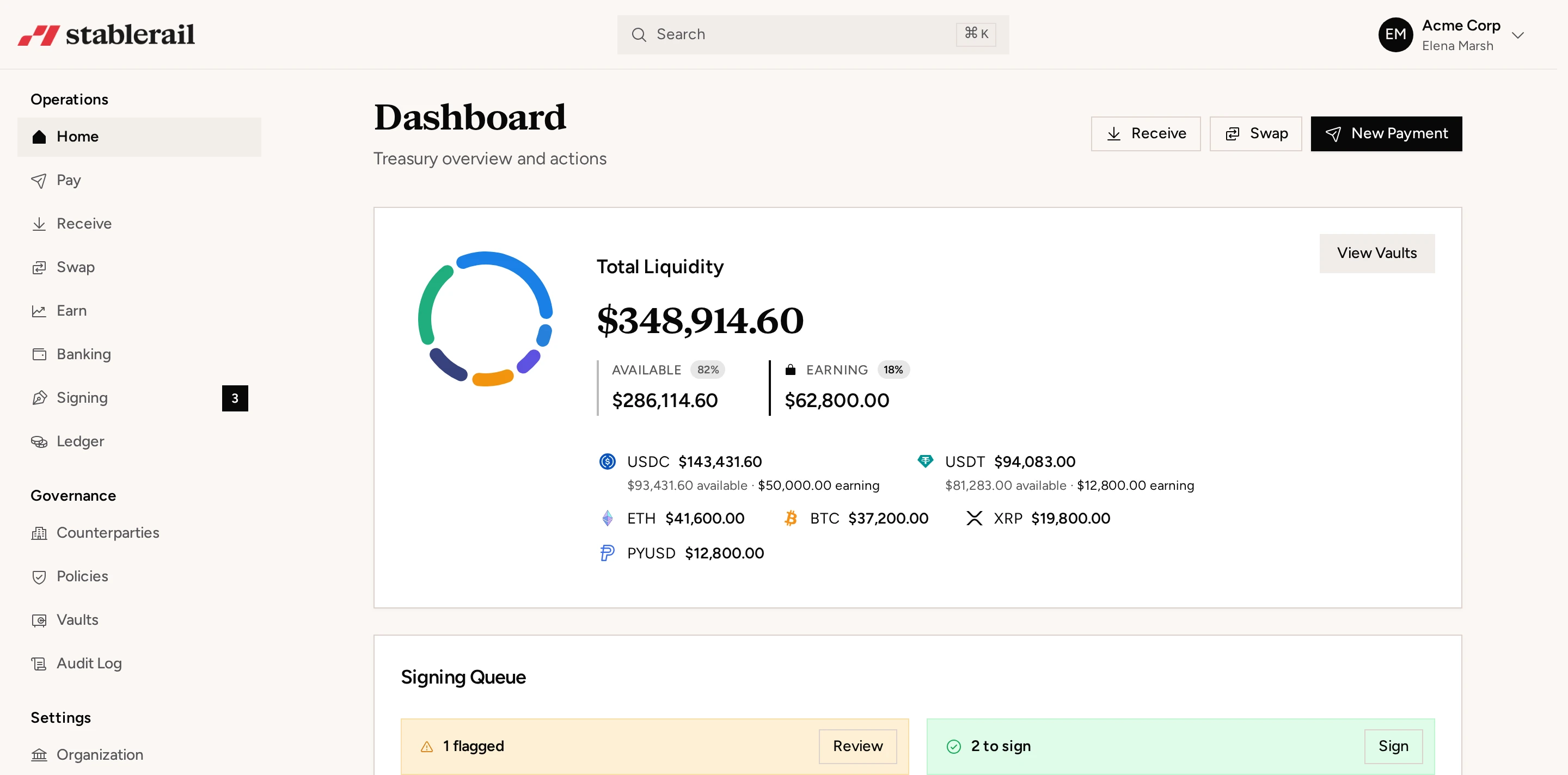
Stablerail supports approvals and signing quorum for corporate USDC and USDT treasury activity, alongside sanctions and address screening before a transfer is sent. Whatever platform is selected, test its access-removal and recovery procedures rather than relying only on written instructions.
5. Treat the token and network as one instruction
“Send USDC” or “send USDT” is incomplete. The payment instruction must identify both the stablecoin and the blockchain. A wallet address can look syntactically valid while belonging to a different network than the one the recipient expects.
- Confirm the exact token and whether the recipient supports that token version.
- Confirm the blockchain by its full name, not an abbreviation copied from an email.
- Check whether the destination requires a memo, tag or other routing field.
- Avoid bridged or wrapped variants unless both sides explicitly support them.
- Confirm how many network confirmations the receiving platform requires before crediting the balance.
Do not infer network compatibility from the address format. Some networks use visually similar addresses but maintain separate ledgers, and sending over the wrong network may require a difficult recovery process or result in permanent loss.
6. Fund the treasury and record the conversion
A company can generally fund its stablecoin treasury by depositing supported stablecoins from an existing wallet or by sending fiat and converting it through an on-ramp. For fiat funding, verify the beneficiary name, account details, reference, accepted sender policy and transaction limits before initiating the bank transfer. Funds will commonly need to originate from an account held in the onboarded company’s name.
The appropriate bank rail depends on currency and urgency. Examples include ACH or Fedwire for US dollars, SEPA or SEPA Instant for euros, and Faster Payments, BACS or CHAPS for pounds sterling. SWIFT may be used for cross-border transfers. Availability and timing depend on the banks involved, cut-off times, weekends, intermediary reviews and provider support.
Before conversion, capture the fiat amount, stablecoin amount, quoted rate, spread or conversion charge, bank fees and transaction timestamp. These details are needed to explain the resulting stablecoin cost and reconcile the treasury position.
7. Validate the counterparty and destination
Collect wallet instructions through a standard form or controlled vendor record rather than an unstructured message. Record the counterparty’s legal name, invoice or payment purpose, wallet address, token, network and confirmation that the receiving platform accepts that exact combination.
Screen the destination address before sending. Where the platform supports an approved-address list, use it with a controlled change process. If a counterparty changes wallet or bank details, verify the change through a second communication channel using previously trusted contact information.
8. Run a production-like test payment
A useful test follows the same workflow as the planned live payment. It should use the same token, network, destination, approval path and receiving platform, while staying within the company’s test-payment policy and any provider minimum.
- Create the payment and attach the invoice or documented business purpose.
- Recheck the address, token and network against the approved instructions.
- Complete every required review and signature.
- Record the transaction hash and execution timestamp.
- Ask the recipient to confirm the credited token, network and amount.
- Compare the requested, sent and received amounts and identify each fee.
A confirmed blockchain transaction proves that funds reached an address. It does not prove that a custodian or exchange credited the recipient’s internal account.
Do not release the full amount until the recipient confirms credit in the expected account. If the test fails, stop and identify whether the cause was an incorrect network, unsupported token, missing routing field, provider review or recipient-side crediting rule.
9. Reconcile the first live payment
Retain the internal payment ID, invoice, business purpose, creator, approvers, destination address, token, network, transaction hash, timestamps, stablecoin amount, network fee and conversion details. Match the blockchain transaction and platform record to the invoice and general-ledger entry.
The wallet balance, provider activity record and accounting balance should reach the same closing position after known timing items and fees are considered. Define how conversion differences and network fees will be classified, and preserve exportable evidence with the accounting period. Stablerail provides fiat conversion, global payouts and exportable audit evidence, as well as corporate cards where those functions form part of the company’s treasury workflow.
10. Move to production in controlled stages
Start with a limited group of known counterparties before introducing high-value transfers or batch payouts. Review exceptions after each stage and update the procedure when the team encounters a new network, destination type or reconciliation treatment.
Finance go-live checklist
- Document the approved assets, networks, fiat rails and transaction purposes.
- Complete KYB and confirm account limits before scheduling payments.
- Configure individual access, signing quorum and employee offboarding.
- Approve counterparty instructions and screen the destination address.
- Complete and reconcile a production-like test transfer.
- Confirm that exports contain the fields required by accounting and audit.
- Define escalation paths for failed, delayed or incorrectly routed transfers.
Once these controls work consistently, the business can expand volume without weakening authorization or evidence. Monitor approval delays, rejected instructions, network fees, address changes and reconciliation exceptions as part of normal treasury operations.
Frequently asked questions
What documents are required for stablecoin business onboarding?
Requirements vary by provider and jurisdiction, but businesses are commonly asked for incorporation records, constitutional documents, ownership details, director and administrator identification, addresses and tax information. Providers may also request bank statements, source-of-funds evidence and a description of expected payment activity.
How long does stablecoin KYB take for a business?
There is no universal timeline because review depends on the jurisdiction, ownership structure, industry and completeness of the submission. Consistent legal names, addresses and ownership percentages can reduce avoidable follow-up questions, while complex structures or missing evidence can extend the review.
Should a business use USDC or USDT for payments?
Choose according to the asset and network that the provider and recipient both support, along with the company’s treasury and risk requirements. The decision should also consider conversion availability, destination-country needs, liquidity on the selected platform and the evidence required for accounting.
Why should a company make a test stablecoin payment first?
A test verifies the complete route, including the wallet address, token, blockchain, approvals and recipient-side crediting process. A transaction can be confirmed on-chain without appearing in the recipient’s internal account, so obtain confirmation before sending the full amount.
What records should be kept for a business stablecoin payment?
Keep the invoice or payment purpose, creator and approvers, destination address, token, network, amount, transaction hash, timestamps and all fees. If fiat was converted, retain the fiat amount, exchange or conversion details and supporting platform export so the wallet, provider record and general ledger can be reconciled.
Finance writers covering stablecoin treasury, payments, compliance, and risk controls.
More about the Stablerail team- Stablecoin treasury managementApprovals, limits, yield and reporting on one balance.
- Stablecoin payoutsBatch contractor and vendor payments with screening.
- USDT vs USDCWhich stablecoin your company should settle in.
- Stablecoin finance glossaryMPC, off-ramp, travel rule and the rest, in plain English.
- Product updatesEverything we ship, month by month.