
How to Compare BVNK Alternatives for Stablecoin Infrastructure
A practical framework for comparing BVNK alternatives across fiat rails, accounts, custody, conversion, payouts, controls, pricing, eligibility and integration effort.

Companies evaluating BVNK alternatives should first decide what they are trying to build or operate. Some providers supply APIs for embedding stablecoin payments into a customer-facing product. Others give finance teams a platform for holding, converting and paying out the company’s own funds.
These categories overlap, but they are not interchangeable. An API-first provider may be suitable for a fintech processing thousands of customer transactions, while a corporate treasury platform may be a better fit for a finance team managing USDC, USDT, fiat balances, payroll and vendor payments.
The comparison should start with transaction mechanics: supported currencies and networks, payment cut-off times, account ownership, conversion spreads, payout fees and integration requirements. Controls and compliance matter, but only after confirming that the provider can support the required money flows.
Start by separating two types of stablecoin infrastructure
API and embedded-payment infrastructure
This category is designed for companies adding stablecoin functionality to their own product. Typical requirements include programmatic wallet creation, customer deposits, automated conversion, transaction webhooks and payouts initiated through an API.
It is usually the relevant category when customer funds move through the system or when stablecoin payments must appear inside an existing app. Buyers should expect a technical integration, compliance scoping and ongoing engineering work.
Corporate treasury platforms
A corporate treasury platform is designed for a company managing its own money. The finance team may need to receive customer payments, hold USDC or USDT, convert funds to EUR or USD, pay vendors, fund cards and produce transaction evidence.
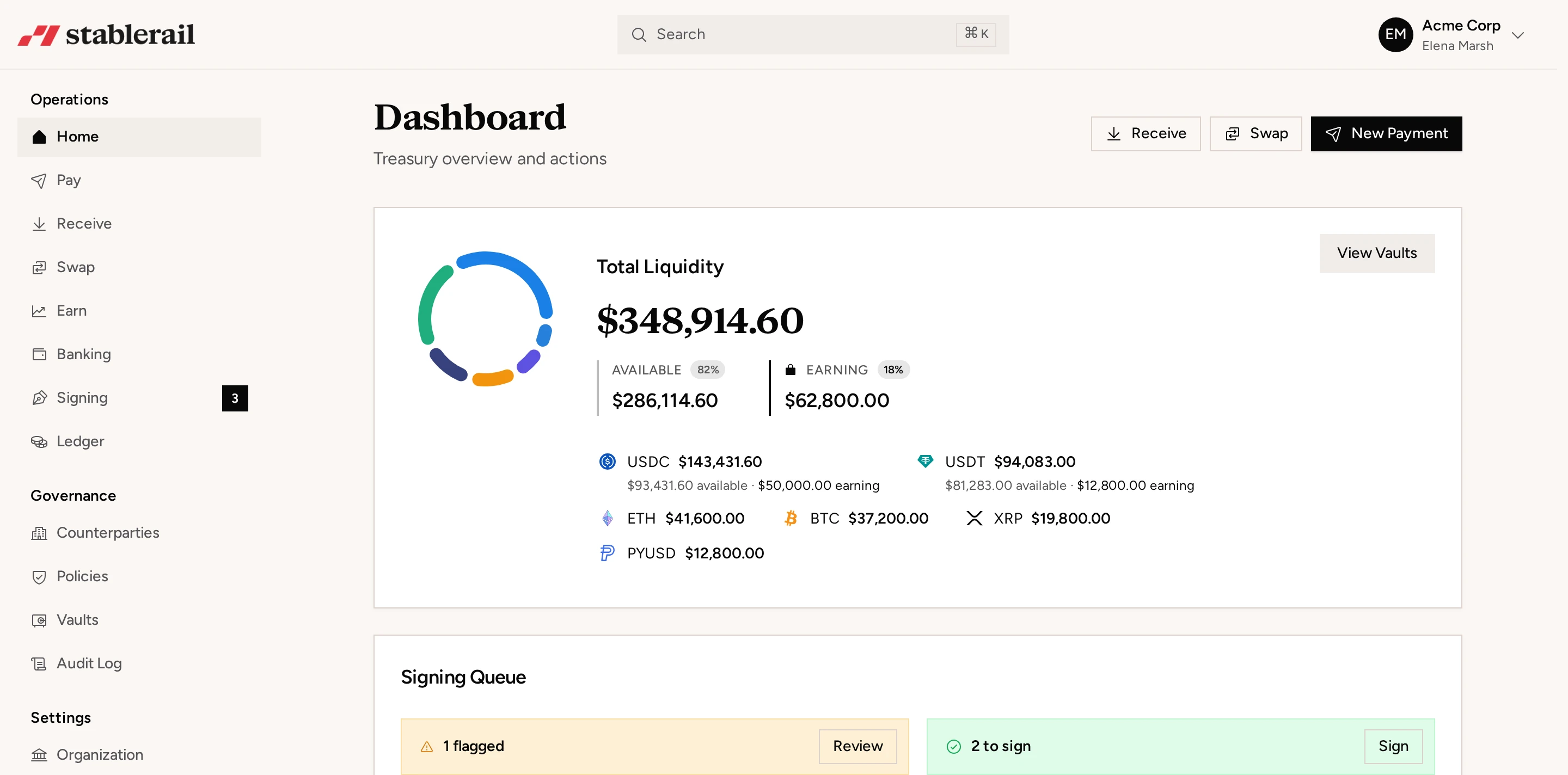
Stablerail falls into this category. It combines self-custodial MPC vaults, fiat accounts and payment rails, stablecoin conversion, multi-network payouts, corporate cards and treasury controls. MPC, or multi-party computation, splits signing authority so that no single person or device holds the complete private key.
Teams primarily looking for operational treasury tooling can review the USDC business account. Companies building stablecoin features for third parties should compare API depth separately rather than assuming a treasury platform is an embedded-finance stack.
Use a requirements table before comparing providers
| Area | Questions to ask | Evidence to request |
|---|---|---|
| Fiat accounts | Are accounts named or virtual? Which currencies and local rails are available? | Account terms, supported countries and sample payment instructions |
| Custody | Who controls the assets and signing keys? Is quorum approval supported? | Custody structure, recovery process and signing workflow |
| Conversion | Which fiat and stablecoin pairs are supported? How are fees and spreads shown? | Corridor pricing, quote examples and settlement terms |
| Payouts | Which bank rails, blockchains and tokens are available? | Network list, payout limits, cut-off times and failure handling |
| Controls | Can finance set approval thresholds, allowlists and role permissions? | Workflow demonstration and sample audit export |
| Eligibility | Are the company’s jurisdiction, industry and transaction types accepted? | KYB checklist and written eligibility confirmation |
| Pricing | What are the account, conversion, network, payout and integration costs? | Complete fee schedule with corridor-specific examples |
Compare fiat rails by corridor, not by headline coverage
A provider may advertise broad geographic reach while relying on SWIFT for corridors where another provider offers faster local settlement. Build a corridor map covering where money originates, the destination currency, expected volume and required delivery time.
For European payments, check SEPA and SEPA Instant separately. Standard SEPA commonly settles on a business-day basis, while SEPA Instant can arrive within seconds when both banks participate and the transfer passes screening. For US dollars, distinguish ACH from Fedwire: ACH is generally cheaper but slower, while Fedwire is used for time-sensitive bank transfers during operating hours.
For sterling, ask about Faster Payments, CHAPS and BACS. Faster Payments is typically used for rapid domestic transfers, CHAPS for high-value same-day payments and BACS for scheduled bulk payments. SWIFT remains relevant for cross-border transfers but can involve intermediary banks, deductions and less predictable arrival times.
Stablerail supports EUR rails including SEPA and SEPA Instant, USD rails including ACH and Fedwire, GBP rails including Faster Payments, CHAPS and BACS, and SWIFT cross-border payments. Availability remains subject to onboarding, account configuration, destination and banking hours.
Examine account ownership and custody separately
“Business account” can describe several legal and operational arrangements. Ask whether the company receives named account details, a virtual IBAN, or a reference-based collection account. Confirm who legally holds fiat funds and how reconciliation works when multiple customers pay into the same account.
For stablecoins, determine whether the model is custodial or self-custodial. In a custodial arrangement, the provider controls wallet keys and processes withdrawals. In a self-custodial setup, the customer retains control, often through an MPC signing policy.
Self-custody does not remove operational risk. Finance teams still need quorum rules, recovery procedures and controls over destination addresses. Stablerail supports self-custodial MPC vaults with quorum signing, approval limits, wallet allowlists and an audit log.
Measure conversion using the all-in delivered amount
Stablecoin conversion costs may include a platform fee, spread, banking charge, blockchain gas fee and third-party withdrawal fee. Comparing only the advertised percentage can produce the wrong result.
Request a quote for representative transactions, such as converting €100,000 to USDC on Base or redeeming 100,000 USDT into USD by Fedwire. Record the amount delivered, quote validity period, expected settlement time and every deducted fee. Repeat the test across high-volume corridors.
Stablerail provides on- and off-ramps between fiat and stablecoins with corridor pricing. Buyers should compare that published pricing against executable quotes from other providers, particularly where rates vary by size, currency or settlement route.
Check token and network support at both ends
Support for USDC or USDT does not mean every blockchain is available. A provider might accept a token on Ethereum but not on Tron or Solana. Sending a supported token over an unsupported network can lead to delays or loss, so network validation must be part of the payment workflow.
Stablerail supports payouts across Ethereum, Base, Arbitrum, Polygon, Tron, BNB Chain, Optimism and Solana, subject to token and destination availability. Its stablecoin payout tools cover batch vendor and contractor payments as well as individual transfers.
When comparing stablecoin payments, ask how the provider handles batch files, beneficiary validation, gas fees, failed transactions, transaction hashes and reconciliation exports. If payroll is in scope, confirm whether employee-level records and approval steps fit the finance team’s process.
Estimate the real integration effort
An API-based deployment involves more than connecting endpoints. Engineering may need to build authentication, wallet mapping, webhook handling, retry logic, reconciliation, user permissions and compliance workflows. The company must also monitor API changes and operational failures.
A treasury interface may require less engineering if finance users can create beneficiaries, upload batches and export records directly. However, it may not provide the flexibility required for customer-facing products. Compare providers using the implementation model you will actually deploy, not the longest feature list.
- No-code operations: assess dashboards, batch uploads, approval flows and accounting exports.
- API integration: assess documentation, test environments, idempotency, webhooks and rate limits.
- Hybrid model: confirm whether API-created payments can still be reviewed and approved in the interface.
Confirm controls, evidence and eligibility before contracting
For treasury use, useful controls include role-based access, approval thresholds, quorum signing, beneficiary allowlists, sanctions screening and wallet screening. Ask whether screened addresses are checked only when added or again when a payment is made.
Evidence should be usable by finance and auditors. Request sample transaction exports, approval histories, wallet addresses, bank references, fee records and screening results. Stablerail maintains an audit log and supports evidence packs for treasury activity.
Eligibility can be a gating issue. Providers may restrict jurisdictions, industries, ownership structures, expected volumes or source-of-funds profiles. Complete KYB early and provide incorporation documents, ownership details, director identification, business activity, expected corridors and supporting financial information. General onboarding guidance is available through the Stablerail help centre.
Build a weighted comparison, then run live tests
Score each provider based on the company’s actual priorities. A typical treasury buyer might weight fiat rails and accounts at 25%, conversion and pricing at 20%, custody and controls at 20%, payouts and network coverage at 20%, and integration, support and reporting at 15%. An embedded-finance buyer would likely assign more weight to API quality and scalability.
Before selecting among BVNK alternatives, run test transactions through the most important corridors. Test fiat funding, stablecoin conversion, an on-chain payout, a bank withdrawal and a failed or rejected beneficiary. Record timing, delivered amount, approval steps and reconciliation data.
The best stablecoin infrastructure is not necessarily the provider with the broadest headline coverage. It is the one whose account structure, fiat rails, custody model, pricing and operating workflow match how the company actually receives, holds and moves money.
Finance writers covering stablecoin treasury, payments, compliance, and risk controls.
More about the Stablerail team- Stablecoin treasury managementApprovals, limits, yield and reporting on one balance.
- Stablecoin payoutsBatch contractor and vendor payments with screening.
- USDT vs USDCWhich stablecoin your company should settle in.
- Stablecoin finance glossaryMPC, off-ramp, travel rule and the rest, in plain English.
- Product updatesEverything we ship, month by month.